In this article
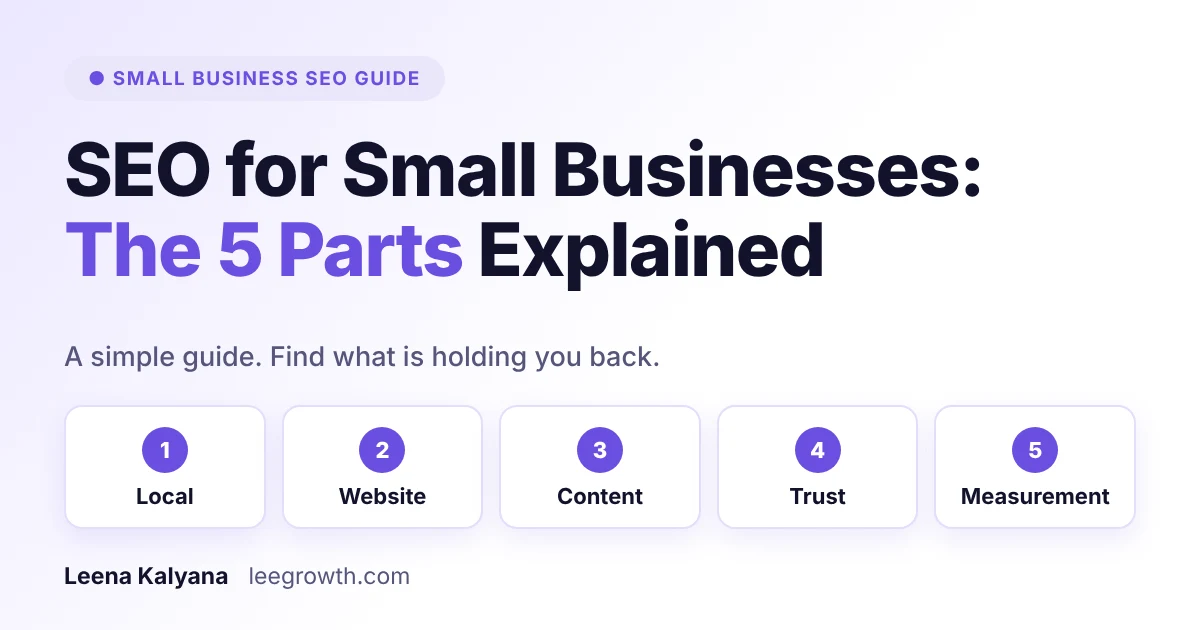
SEO for small businesses is the work of helping Google, Google Maps and AI tools find your business, understand it and trust it enough to show it when someone searches for what you sell. It has five parts: local, website, content, trust and measurement. You do not need all five on day one. You need to know which one is holding you back.
I am Leena Kalyana, an SEO and digital marketing consultant in Delhi NCR. I work directly with small business owners, so this guide is written for you, not for other SEO people. It works as a map. Each part below links to a deeper guide, so you can read only what you need.
How the five parts fit together
Think of SEO as five questions a search engine asks about your business.
- Local: Are you close to the person searching, and is your profile complete?
- Website: Can I read your pages without errors?
- Content: Does a page exist that answers what this person typed?
- Trust: Is your business real, and does everything about it match?
- Measurement: Are you checking what works, so you can do more of it?
If an early answer is no, the later ones matter less. A beautiful page cannot rank if Google cannot index it. A great profile cannot win if your phone number is different on three sites. So the order matters, and it is the same order I use with clients.
1. Local: help nearby customers find you
If you serve customers in one area, your Google Business Profile often matters as much as your website. It decides whether you appear on Google Maps and in “near me” results.
The work here is simple to describe. Claim your profile, fill every section, choose the right categories, and collect honest reviews. Then keep your name, address, phone number and hours the same everywhere.
Go deeper: Google Business Profile setup in India, how Google decides who shows up for near me searches, and Google Maps competitor analysis. For the day-by-day plan, use the 30-day local SEO action plan.
2. Website: make your pages easy to read
Google can only show a page it can find, load and understand. If your site is slow on a phone, blocked by a setting, or full of broken pages, good writing will not rescue it.
Most small sites need only a few checks. Does each important page load quickly? Is it indexed? Does each page have one clear address? Are your title and headings clear? I keep this list short on purpose, because a long list of tiny fixes is a good way to avoid the one big problem.
Go deeper: why your website is not ranking on Google and the technical SEO audit checklist. Planning a redesign? Read the website redesign SEO checklist first.
3. Content: build a page for every real search
Every page should answer one question that a real customer asks. That is all a keyword is. The skill is in finding the words your customer uses, not the words you use.
Many customers in India search in Hinglish, by area, or with a spelling you would never choose. If your pages only use your own wording, you miss them. Give each service its own page, answer the question in the first two lines, then add detail.
Go deeper: SEO keyword examples and Hinglish keyword research. When you are ready to publish more, how to build topical authority on a small website shows how to plan pages so they support each other.
4. Trust: prove your business is real
Search engines and AI tools do not only read your pages. They also check whether your business looks real. That means your name, your description, your reviews, your profiles and the places that mention you.
This part has grown more important because AI tools now recommend businesses in their answers. When your details are clear and consistent, those tools describe you correctly. When they conflict, those tools guess.
Go deeper: entity SEO for small businesses, how to make AI tools describe your business correctly and how to optimize your website for AI search.
5. Measurement: see what is working
You cannot improve what you do not check. Google Search Console is the free place to start. It shows which searches bring people to your site, which pages get clicks, and which pages Google has trouble with.
Look at it once a month. Write down what changed. After a few months, that record tells you what to repeat.
Go deeper: Google Search Console for small businesses and how to measure organic search visibility beyond rankings.
Which part should you fix first?
Match what you see to the closest line below. This is the quickest way I know to find the right starting point.
| What you notice | The likely part | Start here |
|---|---|---|
| Customers nearby cannot find you on Google Maps | Local | Near me SEO |
| Your Google profile was suspended | Local | Google Business Profile suspended |
| Your website is live but gets almost no visits | Website | Why your website is not ranking |
| A competitor ranks above you for your main service | Content and trust | Why your competitor ranks above you |
| You publish posts but nothing brings enquiries | Content | Keyword examples |
| AI tools name a competitor, not you | Trust | Why ChatGPT cites your competitor, not you |
| You do not know if anything is working | Measurement | Measure organic search visibility |
SEO for your type of business
The five parts stay the same, but the searches, questions and mistakes change by trade. If you want guidance written for your kind of business, start with the closest one.
- SEO for clinics and doctors in Delhi
- SEO for lawyers
- SEO for coaches in India
- SEO for consultants
- SEO for plumbers
- SEO for restaurants and cafes in Delhi
- SEO for gyms and fitness studios
- SEO for insurance brokers
- SEO for ecommerce product pages
Frequently asked questions
How do I do SEO for a small business?
Work through the five parts in order. Complete your Google Business Profile, make sure Google can read your website, build one page for each real search, keep your business details consistent, and check Search Console every month.
Is SEO paid or free?
You do not pay Google for organic rankings. SEO still costs time, or money if you hire someone. Ads are different, because you pay for each click. For what hiring costs, see SEO packages in Delhi for small businesses.
Does SEO work for small businesses?
It can, especially when customers search before they buy. It works slowly, and no one can promise a ranking, so it is not the right tool if you need customers this week.
Which part of SEO should a small business start with?
Start with the first part that is broken. For most local businesses that is the Google Business Profile. For most online businesses, it is whether Google can find and read the website.
How long does SEO take?
It depends on your competition, your site and your work. I explain the stages in how long SEO takes.
Want a second pair of eyes?
If you are not sure which part is holding you back, I can look. I offer a free SEO audit. I check your website and your Google Business Profile, and I tell you what to fix first.
If you would rather have help doing the work, see my SEO services or my local SEO services in Delhi. I work directly with every client, and I never promise rankings.

Leena Kalyana is an SEO and digital marketing consultant in Delhi NCR and the founder of LeeGrowth. She helps clinics, coaching institutes, consultants and small businesses get found on Google, Google Maps and AI search. She works directly with every client and does not guarantee rankings.