In this article
Quick answer: Entity SEO for small businesses means making your business easy for search engines and AI tools to identify as one real, distinct thing: the same name, address, services and facts everywhere, confirmed by sources you do not control. AI tools tend to name businesses they can identify clearly and check against other sources. Nobody outside the AI companies knows the exact rules, but the signals below are the ones most worth fixing first.
Key takeaways
- An “entity” is a clearly identified thing, such as a business, a person or a place. Search engines and AI tools work with entities, not only keywords.
- AI tools are more likely to mention a business when its facts agree across many places.
- Your own website is the starting point. Third-party sites, such as Google Business Profile, directories, LinkedIn and review sites, confirm it.
- Schema markup, a clear About page and consistent business details are cheap, practical fixes.
- Entity SEO sits on top of normal SEO. It does not replace it.
- No one can guarantee an AI mention. Treat everything here as a set of signals that likely help.
What is an entity in SEO?
An entity is a uniquely identifiable thing. Your business is an entity. So are you, your city, and your services.
Think about two searches. “Dentist” is a keyword. “Sharma Dental Clinic in Saket” is an entity: one specific clinic, in one specific place, with a phone number, reviews, doctors and opening hours.
Older SEO asked, “Which keyword should this page target?” Entity SEO asks a different question: “Who or what is this page about, and do other trusted places agree?”
For a small business, the aim is simple. When someone asks an AI tool “best dentist in Saket”, the tool should be able to find your clinic, understand what it is, and check that it is real.
Why do AI tools care whether your business is a “real” brand?
AI tools build answers from many sources. When a tool recommends a business, it takes a risk: if the business does not exist, has moved or has changed its services, the answer is wrong and the user loses trust.
So tools lean towards businesses they can identify with confidence. A business is easier to identify when:
- Its name, address and phone number are the same across the web.
- Several independent sources describe it in the same way.
- It has a website that clearly states who runs it and what it does.
- Real customers have left reviews or mentions.
I cannot see inside ChatGPT, Gemini, Claude or Perplexity, and none of them publishes a checklist for how they judge a business. What I can say is that these signals are what search engines have used for years to understand businesses, and they are the sensible things to get right.
How do AI tools check that a business is real?
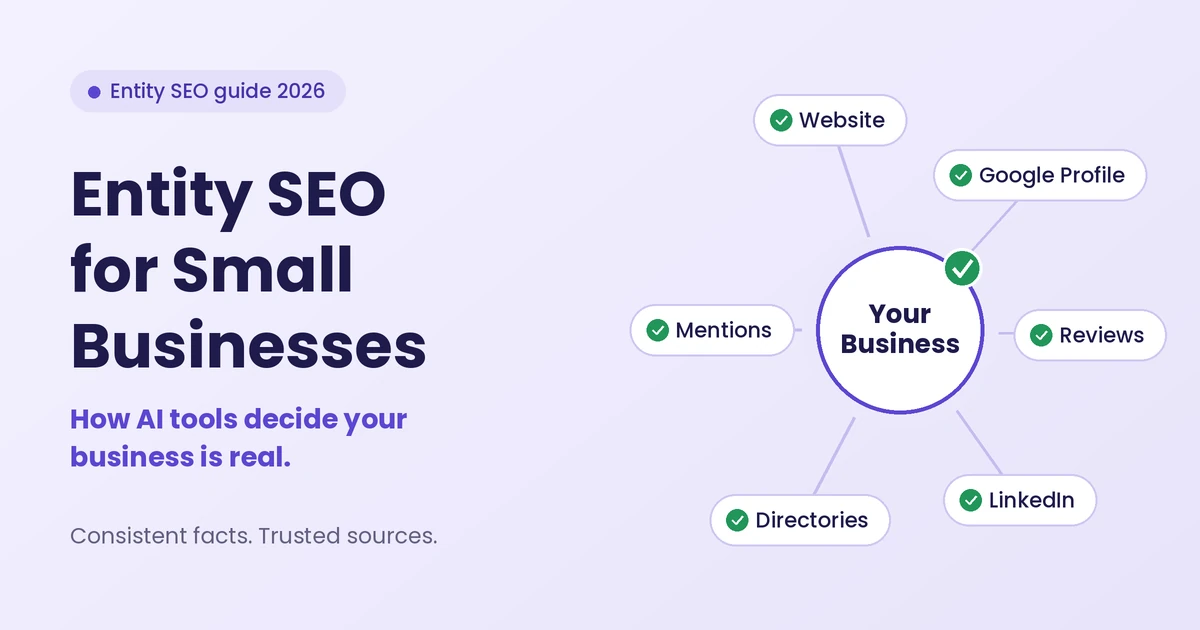
Here is the practical picture. When an AI tool or search engine meets your business name, it tends to look for agreement across a few kinds of places.
| Where | What it shows | What to check |
|---|---|---|
| Your website | Your own description of yourself | Clear About page, contact page, services |
| Google Business Profile | Location, category, hours, reviews | Same name and phone as your site |
| Directories and listings | Independent confirmation | Same details, no old addresses |
| Social profiles (LinkedIn, Facebook, Instagram) | Active, real presence | Same name, link back to your site |
| Reviews | Real customers | Genuine, recent, answered |
| News, mentions, Q&A sites | Others talk about you | Honest mentions, not paid spam |
If these places disagree, a tool has to guess. If they agree, the tool can be more confident.
What makes an entity “trusted”, not just “known”?
Being known and being trusted are different.
- Known means a tool can identify you.
- Trusted means other credible sources back you up and your claims hold up when checked.
A business with a website and nothing else is known only to itself. A business with a website, a complete Google Business Profile, a hundred genuine reviews, a LinkedIn page, and mentions in local articles is easier to trust.
This is why entity SEO is closer to brand building than to technical tricks. You cannot fake your way to it quickly, and buying “entity backlinks” or fake mentions is more likely to cause harm than good.
The 8 signals to fix first (in order)
1. Make your business details identical everywhere
Use one exact version of your business name, address and phone number (often called NAP). Write it down in a document. Then check every place it appears.
Common problems I see with Delhi NCR businesses:
- “Pvt Ltd” in one place, missing in another
- An old address on a directory
- A mobile number on the website but a landline on Google
- Different spellings of the business name
Fix the small differences. They sound minor, but they are the easiest way to make a business look like two separate entities.
2. Write a clear About page
Your About page is the best place to state facts about your business in plain language. Include:
- Your full business name and what you do, in the first two sentences
- Who runs it (real names, real photos)
- Where you are based and which areas you serve
- When you started
- Licences, memberships or qualifications, if you have them
- Links to your official profiles
Write it for a customer first. A clear page for a customer is also clear for a machine.
3. Add Organization or LocalBusiness schema
Schema markup is a small block of code that tells search engines plain facts about your business. Use it to state your name, address, phone, logo and official profiles.
A simple example for a local business, with placeholders you should replace:
<script type="application/ld+json">
{
  "@context": "https://schema.org",
  "@type": "LocalBusiness",
  "name": "Your Business Name",
  "url": "https://www.yourbusiness.com/",
  "logo": "https://www.yourbusiness.com/logo.png",
  "telephone": "+91-XXXXXXXXXX",
  "address": {
    "@type": "PostalAddress",
    "streetAddress": "Your street address",
    "addressLocality": "New Delhi",
    "addressRegion": "Delhi",
    "postalCode": "110000",
    "addressCountry": "IN"
  },
  "sameAs": [
    "https://www.linkedin.com/company/yourbusiness/",
    "https://www.facebook.com/yourbusiness",
    "https://www.instagram.com/yourbusiness/"
  ]
}
</script>
The sameAs list matters because it points to your official profiles, which helps tools connect them to one entity. Only list profiles you actually run and keep updated. If you use WordPress, an SEO plugin such as Rank Math can add this for you. Test the result with Google’s Rich Results Test.
4. Complete your Google Business Profile
For a local business, Google Business Profile is one of the strongest identity signals. Fill in every field: name, categories, hours, services, description, photos and website link. Make sure it matches your site exactly. See my Local SEO services if you want help.
5. Build real third-party confirmation
Independent sources are what turn “known” into “trusted.” Good, honest places to start:
- Genuine Google reviews (ask happy customers and reply to every review)
- Relevant industry directories and associations
- A complete LinkedIn company page
- Local news, guest posts or interviews, where you add real value
- Honest answers on Quora and Reddit, not promotion (read my guide on whether Reddit, Quora and LinkedIn mentions help AI visibility)
Avoid paid mention packages and fake profiles. They are weak signals at best.
6. Show real people behind the content
Add author names, short bios and photos to your blog posts and service pages. Link each author to a real LinkedIn profile. This shows that real people stand behind your business and helps connect the person to the brand.
7. Keep your site crawlable
If AI search bots cannot read your site, they cannot learn about you. Check your robots.txt file and make sure you are not blocking the search bots you want to reach you. My guide on which AI bots to block or allow explains this in simple steps.
8. Fix wrong facts at their source
If an AI tool describes your business wrongly, the cause is usually an old listing, a vague sentence on your site or another company’s page. Fix the source, not the answer. I explain this in How to Make AI Tools Describe Your Business Correctly.
What about Wikipedia, Wikidata and the Knowledge Graph?
You may read that every business needs a Wikipedia page or a Wikidata entry. For most small businesses, this is not realistic and not necessary. These sites have notability rules, and a page created only to promote a business is usually removed.
Focus first on the signals in your control: your website, your Google Business Profile, reviews and honest profiles. If your business or founder is genuinely notable, with independent news coverage, a Wikidata entry may become possible later. Do not pay for one.
How to test whether AI tools recognise your business
You can run a quick check yourself in about 20 minutes.
- Open ChatGPT, Gemini, Perplexity and Google AI Mode in separate tabs.
- Ask the same four questions in each:
- “What is [your business name]?”
- “Who runs [your business name]?”
- “What services does [your business name] offer in [city]?”
- “Best [your service] in [your area]?”
- Note whether your business is named, whether the details are correct, and which sources are shown.
- Save screenshots and the date.
- Repeat after you make fixes.
My 20-prompt AI visibility test gives you a fuller list of questions to use.
Before and after: what to record
Use a simple table so you can see what changed.
| Question asked | Tool | Named? | Details correct? | Sources shown | Date |
|---|---|---|---|---|---|
| What is [business]? | ChatGPT | ||||
| What is [business]? | Gemini | ||||
| What is [business]? | Perplexity | ||||
| Who runs [business]? | Google AI Mode |
A 30-day plan for a small business
Week 1: Audit. Write down your correct business details. List every place your business appears. Mark every mismatch.
Week 2: Fix. Correct directories, social profiles and your Google Business Profile. Rewrite your About page.
Week 3: Mark up. Add LocalBusiness schema with sameAs links. Add author bios to your top pages.
Week 4: Confirm and test. Ask three happy customers for honest reviews. Run your AI test again and record the results.
Then repeat the check every one to two months. Entity trust builds slowly, and it can fade if your details go out of date.
Common mistakes to avoid
- Changing your business name or address without updating everywhere. Old listings keep spreading the old details.
- Buying “entity backlinks” or fake mentions. These are weak at best and can hurt your reputation.
- Marking up reviews or details that are not on the page. Schema should match what visitors can see.
- Ignoring your own About page. It is the easiest page to improve.
- Expecting instant results. AI tools update at different speeds, and no one can promise a mention.
Frequently asked questions
What is entity SEO in simple words?
Entity SEO means making your business a clearly identified, well-connected thing that search engines and AI tools can recognise and check. It is about who you are, not only which keywords you use.
Is entity SEO different from normal SEO?
It builds on normal SEO. You still need useful content, a fast site and good links. Entity SEO adds a focus on consistent facts, clear identity and third-party confirmation.
Do I need schema markup for AI tools to find me?
Schema is not a magic switch, and no one can prove how much each AI tool uses it. It is still a low-cost way to state your business facts clearly, and search engines have used it for years.
Does my business need a Wikipedia page?
No. Most small businesses do not qualify, and a page written for promotion is likely to be deleted. Build your site, Google Business Profile and reviews first.
How long does it take for AI tools to recognise my business?
It varies, and no one can promise a timeline. Search engines may pick up changes in days or weeks, while AI answers can take longer to change. Retest every month or two.
Can I pay someone to make AI tools trust my brand?
Be careful. Anyone who guarantees AI mentions is guessing. Legitimate help covers fixing your facts, schema, profiles and content, and it does not rely on fake links or bought mentions.
Why does ChatGPT or Gemini say wrong things about my business?
Usually the cause is an old directory listing, a vague sentence on your own site, or another company’s page. Fix the source and give tools time to catch up.
Final thoughts
AI tools do not trust businesses because of one trick. They tend to name businesses they can identify, check and describe the same way across many places.
Start with the basics: one set of facts, a clear About page, a complete Google Business Profile, simple schema, and honest third-party confirmation. Then test, record what changes, and repeat.
If you want help, send me your website and I will tell you what to fix first. You can request a free SEO and AI visibility check, or read about my AI search work.

Leena Kalyana is an SEO and digital marketing consultant in Delhi NCR and the founder of LeeGrowth. She helps clinics, coaching institutes, consultants and small businesses get found on Google, Google Maps and AI search. She works directly with every client and does not guarantee rankings.