


If you’ve published dozens of posts and your rankings still won’t move, the problem usually isn’t effort. It’s structure. Search engines no longer reward a page just for mentioning a keyword. They reward websites that prove, page after page, that they understand a subject completely. That’s topical authority, and learning how to build topical authority for a small website is a different job than doing it as an agency with a ten-person content team.
Most guides on this topic are written for businesses with budgets for premium tools and a writer publishing daily. This roadmap isn’t that. It’s built for one person, or a small team, working with limited hours, a limited budget, and a day job alongside it. Every step below is scaled to that reality: realistic timelines, free-tool alternatives, and a topic map you can build in a spreadsheet this afternoon.
What Is Topical Authority in SEO?
Topical authority in SEO is the level of trust search engines place in a website as a complete, reliable source on a specific subject. Instead of ranking for one keyword, a site with strong topical authority ranks for dozens of related searches, because it covers a topic from every angle a reader actually needs.
This shift is tied to how modern search works. Google’s systems no longer just match strings of text; they map content to entities and concepts using a knowledge graph, and they evaluate semantic SEO signals like context, related terms, and topic depth. This is often called entity SEO: it’s how Google recognizes your website as a credible source connected to a specific subject, almost the way it would recognize a human expert.
Topical Authority vs. Domain Authority
These two terms get mixed up constantly, but they measure different things. Domain authority is a general, site-wide score based mostly on backlinks and age. Topical authority is narrower and more useful for a small website: it measures how completely you cover one specific subject, regardless of how big or old your site is.
| Topical Authority | Domain Authority |
| Measures depth of expertise on one subject | Measures overall site-wide strength |
| Built through content clusters and internal linking | Built mostly through backlinks and domain age |
| A brand-new site can build this quickly | Usually takes years to build |
| Rewards focus over size | Rewards scale and link volume |
This is the good news for a small site: you don’t need years of backlinks or a high domain score to rank well within your niche. You need to cover your specific subject more completely than anyone else bothering to.
Topical Authority vs. Backlinks: Do You Still Need Them?
You can absolutely build topical authority without backlinks being your starting point. Depth, structure, and internal linking carry real weight on their own, and Google’s own guidance emphasizes helpful, complete content over link volume. Backlinks still matter, but for a small website they work better as a result of good content than as a prerequisite for it. Publish something genuinely useful and specific, and links tend to follow on their own over time.
Why Topical Authority Matters for Small Websites
Building real topical authority pays off in ways that go beyond a single ranking:
- You rank for dozens of related searches instead of chasing one keyword at a time
- Your rankings become more resistant to algorithm updates that target thin, scattered content
- You reduce your dependence on expensive, highly competitive backlink campaigns
- You become more visible in AI Overviews and AI chat tools, which favor clearly structured, complete coverage
Can a small website really compete with much bigger competitors? Yes. A small website that covers one subject completely will consistently outrank a large site that covers many subjects shallowly. Focus beats size here, which is exactly why topical authority for small businesses and solo bloggers is worth the effort.
How Long Does It Take to Build Topical Authority?
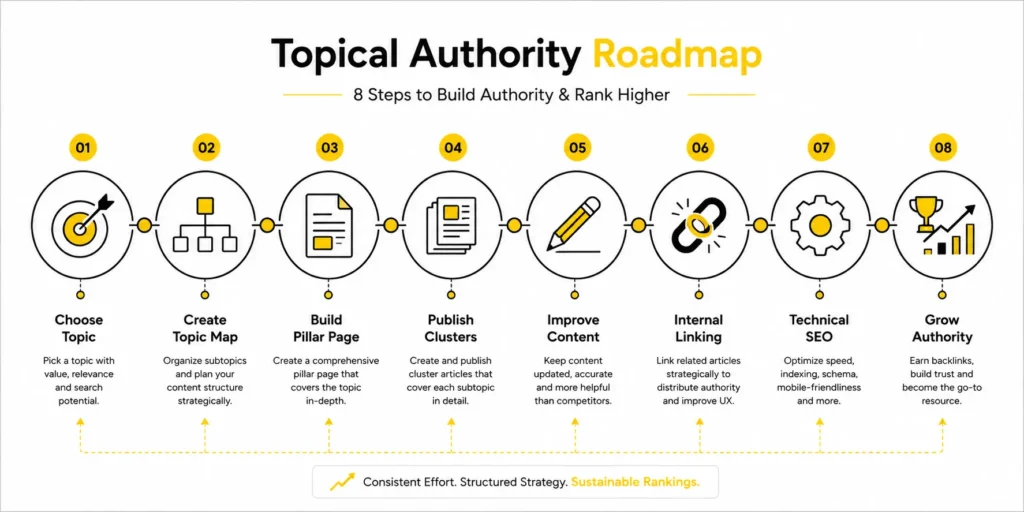
You’ll find wildly different answers to this online: some sources say eight weeks, others say two years. Both can be true, because it depends on four things: how consistently you publish, how competitive your niche is, how much existing trust your domain already has, and how narrow your chosen topic is.
A realistic expectation for a small, focused site publishing consistently: early movement in long-tail rankings within two to four months, and meaningful topical authority within six to twelve months. Tighter niches with less competition move faster. Broad, competitive topics take longer no matter how good the content is.
Step 1: Choose a Topic You Can Actually Own
Before anything else, pick a subject narrow enough that you can realistically cover it in full, not just broad enough to sound impressive. This is the single most common mistake small sites make: choosing a topic sized for an agency team of five, then trying to cover it with one writer publishing twice a month. Getting this first choice right is the real foundation of building topical authority for a small website.
The Small-Site Scoping Test
Ask these questions before committing to a topic:
- Could you list 20-40 realistic subtopics and questions within this subject? If you’re struggling past 10, it may be too narrow to build real depth around.
- Could you list more than 200? If so, it’s probably too broad for one person to cover in a year.
- Do you have genuine, first-hand knowledge or direct access to it? Depth is much easier to fake-detect than volume.
- Is there a commercial or personal reason this topic matters to your site, beyond search volume?
A good starting scope for a solo operator or small team is one to two core topics, not the five or more that agency-focused guides often recommend.
Step 2: Build Your Topical Map
A topical map is different from a keyword list. A keyword list is just a pile of phrases. A topical map organizes those phrases by intent and shows how they connect to each other, so you can see what’s covered and what’s still missing.
Here’s a simple version you can copy into a spreadsheet today:
| Keyword / Question | Search Intent | Pillar or Cluster | Status |
| Core topic overview | Informational | Pillar | Planned |
| Related subtopic #1 | Informational | Cluster | Planned |
| Comparison-style query | Commercial | Cluster | Planned |
| “How to” long-tail query | Informational | Cluster | Published |
Free Tools for Topical Research
You don’t need an expensive tool subscription to build a solid topical map. These free resources cover most of what a small site needs:
- Google Search Console — shows which queries you already get impressions for, including near-miss rankings on page two
- Google’s autosuggest and “People Also Ask” boxes — free, instant subtopic and question discovery
- AnswerThePublic and Ubersuggest free tiers — a handful of free searches per day, enough for topic mapping in small batches
- Reddit and niche forums — real questions people are asking that haven’t made it into keyword tools yet
- Your own inbox, comments, or client conversations — often the best source of subtopics nobody else is covering
Step 3: Structure Content Into Pillars and Clusters
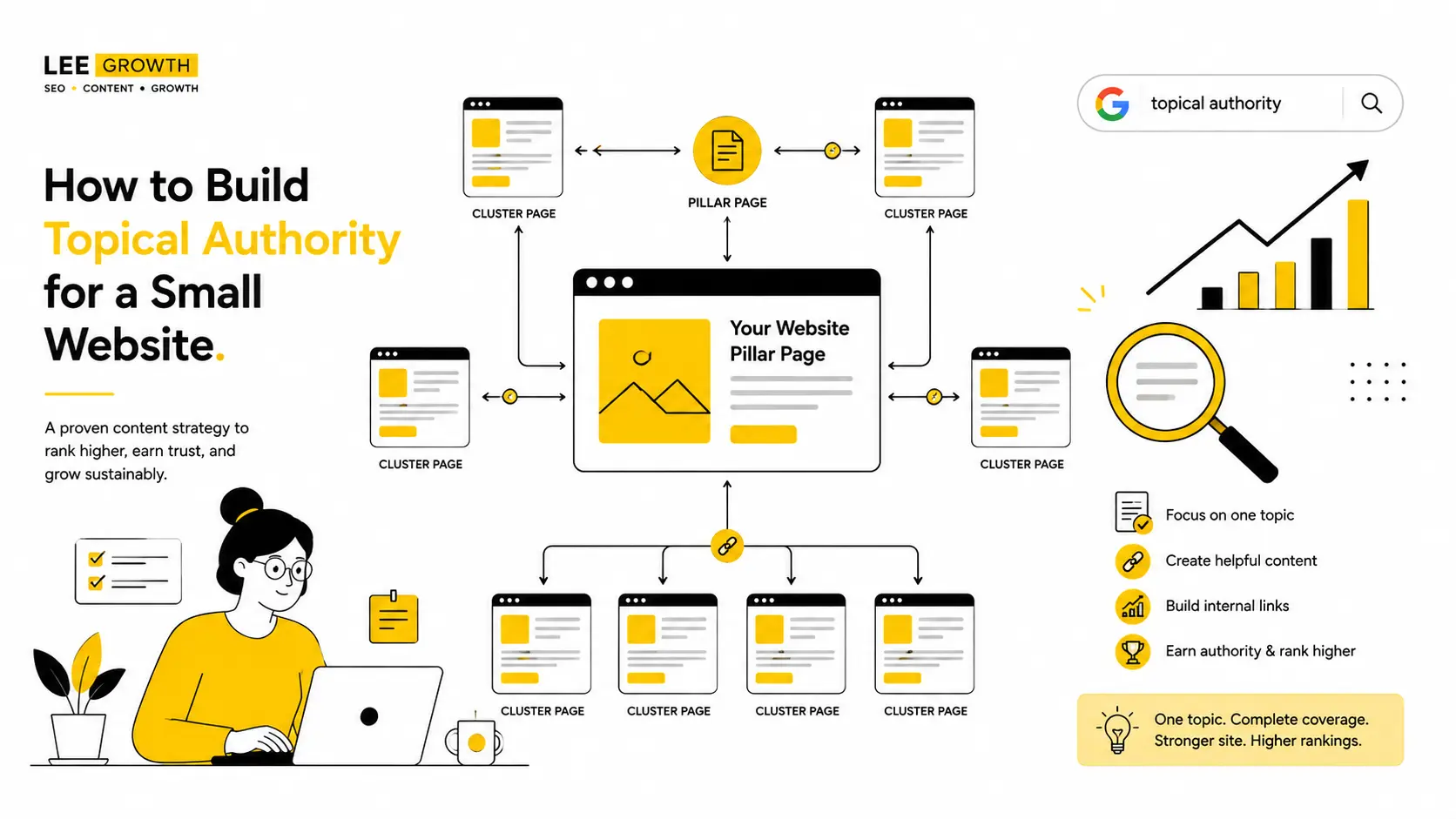
A pillar page is a broad, complete overview of your core topic. Cluster articles are the supporting pieces that go deep on one subtopic each and link back to the pillar. Together, they form a hub-and-spoke structure that shows search engines you’ve covered the subject from every angle, not just the obvious one. [IMAGE: insert a pillar-and-cluster diagram here. Alt text: “how to build topical authority for a small website — pillar and cluster roadmap diagram”]
For example, if your pillar page is a complete guide to a service you offer, cluster articles might cover pricing questions, common misconceptions, comparisons with alternatives, and step-by-step how-tos related to that service.
How Many Articles Do You Need for Topical Authority?
Agency-scale guides often recommend ten to twenty supporting articles per topic cluster. That’s unrealistic for most small sites starting out. A more realistic starting target is one pillar page plus six to twelve cluster articles per core topic, built out over four to six months rather than all at once. Quality and completeness within that smaller scope will outperform a rushed, larger set every time.
Step 4: Audit and Consolidate What You Already Have
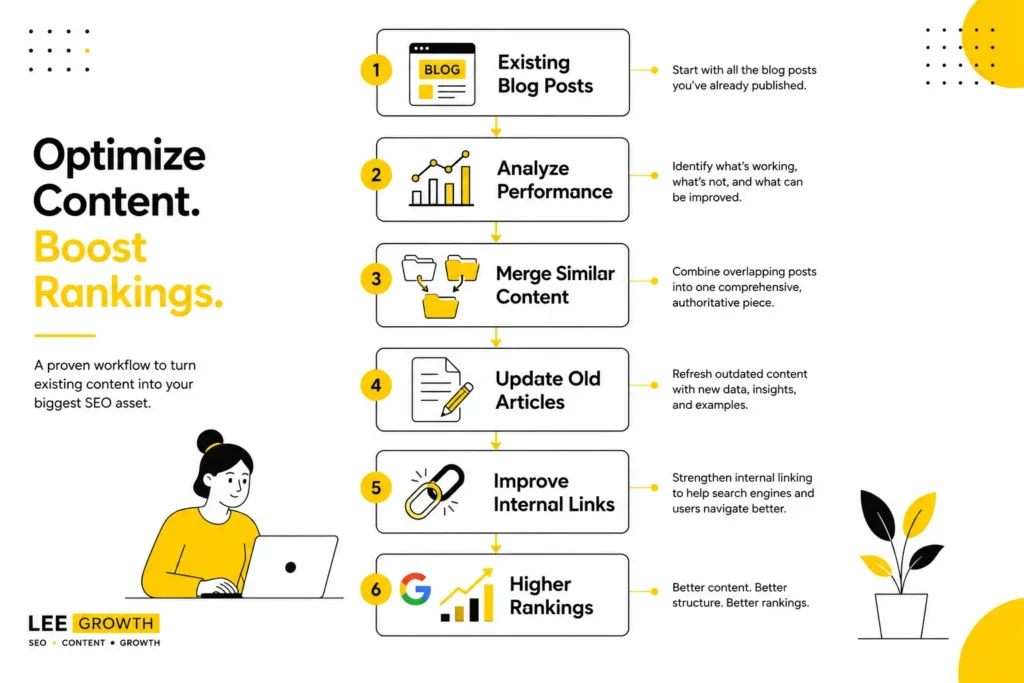
Before writing anything new, look at what’s already on your site. Most small websites have a handful of thin, outdated, or overlapping posts sitting quietly in the background. These dilute topical authority instead of building it, which is why an audit belongs at the start of any plan for topical authority for a small website.
A simple audit process:
- Pull your existing pages into a spreadsheet alongside their current traffic and rankings from Search Console
- Flag pages that overlap heavily with each other — these are candidates for merging
- Flag pages ranking on page two (positions 11-20) — these are your fastest wins with a light update
- Flag genuinely thin or outdated pages for a rewrite, merge, or removal
Doing this first often reveals that you don’t need as much brand-new content as you thought. Sometimes strengthening five existing pages moves the needle faster than publishing five new ones.
Step 5: Write Content That Demonstrates Real Depth
Depth means answering the follow-up questions before the reader has to search for them elsewhere. A useful test: could this article stand in for a knowledgeable person answering the question face to face? If a reader still needs to search again for an obvious next question, the piece isn’t deep enough yet.
Depth also means covering edge cases, common misconceptions, and the practical exceptions that textbook explanations skip. This is where a small site with genuine hands-on experience can actually out-write a much bigger, more generic competitor. This kind of depth is what separates a page that ranks briefly from real topical authority for a small website that holds its rankings over time.
E-E-A-T When You Don’t Have 12 Years of Bylines Yet
Most guides suggest an author bio listing over a decade of experience. That’s not realistic advice for someone just starting out, and inflating it would undermine the trust you’re trying to build. Instead:
- Write an honest bio describing your actual background and what you specifically have direct experience with
- Show your own work — real screenshots, real examples, real numbers where you have them, rather than borrowed statistics
- Cite genuinely credible outside sources when you’re covering something outside your direct experience
- Keep an About page current and specific, since Google and readers both check it for context
- Never claim expertise or results you don’t actually have — accuracy earns more long-term trust than an impressive-sounding bio
Step 6: Internal Linking That Connects Your Clusters
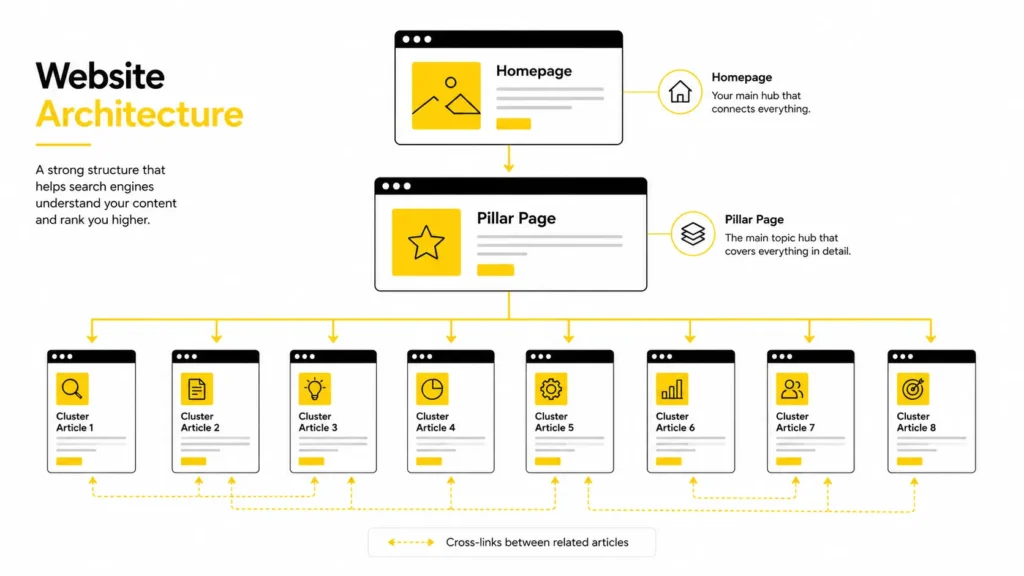
Internal linking is what turns a pile of articles into a system search engines can read as one coherent subject. The core pattern is simple: cluster articles link up to the pillar page, the pillar links back down to relevant clusters, and related cluster articles link sideways to each other where it genuinely helps the reader. [INTERNAL LINK: link this sentence to your own pillar page or a related post on your site before publishing — Rank Math requires at least one internal link.]
Use descriptive anchor text instead of “click here” or “read more.” A link that says what’s on the other side of the click helps both readers and search engines understand how your pages relate to each other.
Step 7: Strengthen Technical Foundations
Content does most of the work, but a messy site structure can quietly undercut it. Getting these basics right is part of the technical groundwork behind topical authority for a small website. A few foundational checks worth doing early:
- Keep URLs short, readable, and consistent — a clear path like /topic/subtopic beats a jumble of random parameters
- Organize categories so related articles sit together instead of scattered across unrelated sections
- Add basic schema markup (Article and FAQPage schema are the most useful starting points) to help search engines and AI tools parse your content
- Submit your sitemap through Google Search Console so new cluster pages get discovered and indexed quickly
- Fix or redirect any duplicate or near-duplicate pages you found during your content audit
Step 8: Set a Realistic Publishing Cadence
Consistency matters more than volume, but consistency has to match your actual capacity. If you have around four hours a week for content, that’s roughly two well-researched articles a month, not the daily publishing schedule some guides assume. A sustainable cadence like this is what actually builds topical authority for a small website over months, not weeks.
A realistic six-month starter roadmap for a solo operator or small team:
| Month | Focus |
| Month 1 | Audit existing content, choose your core topic, build your topical map |
| Month 2 | Publish your pillar page, begin internal linking structure |
| Months 3-4 | Publish 4-6 cluster articles, refresh 2-3 existing pages found in your audit |
| Months 5-6 | Publish remaining cluster articles, review Search Console for early movement, plan your next core topic |
Does AI-Generated Content Help Build Topical Authority?
AI tools can genuinely speed up research, outlining, and first drafts, and there’s nothing wrong with using them that way. Where it breaks down is when raw AI output gets published as-is: it rarely contains the first-hand experience, specific examples, or real numbers that E-E-A-T signals are built on.
The practical approach: use AI as a research and drafting assistant, then rewrite in your own voice, add your own examples, verify every fact, and remove anything you can’t personally stand behind. Content built this way can absolutely help you build topical authority for a small website faster. Content that’s simply generated and published unedited usually can’t.
Topical Authority for Different Small Website Types
The core process stays the same, but where you focus shifts depending on what kind of site you’re running:
| Website Type | Where to Focus |
| Bloggers / personal sites | Pick one narrow personal-expertise topic rather than writing broadly about your whole niche |
| Local businesses | Combine topical clusters with location-specific pages and local search intent |
| Service businesses | Build clusters around the questions prospects ask before booking, tied back to service pages |
| SaaS websites | Focus clusters on the specific problems your product solves, not generic industry topics |
| Ecommerce sites | Build buying-guide and comparison clusters around product categories, not just product pages |
| Affiliate / niche sites | Go deeper than review roundups — cover the decision-making questions competitors skip |
Common Mistakes That Slow Down Topical Authority
These are the mistakes that most often stall topical authority for a small website before it has a chance to build.
| Mistake | Why It Hurts You |
| Spreading across too many topics at once | Dilutes depth and signals a generalist site instead of a specialist one |
| Chasing domain authority instead of topical depth | Backlink volume without topic coverage rarely moves rankings for a small site |
| Skipping the content audit | You end up competing against your own old, thin pages |
| Weak or missing internal linking | Search engines can’t see how your content connects into one subject |
| Inconsistent publishing | Search engines see no clear signal of ongoing commitment to the topic |
| Publishing unedited AI content | Misses the first-hand detail that demonstrates real expertise |
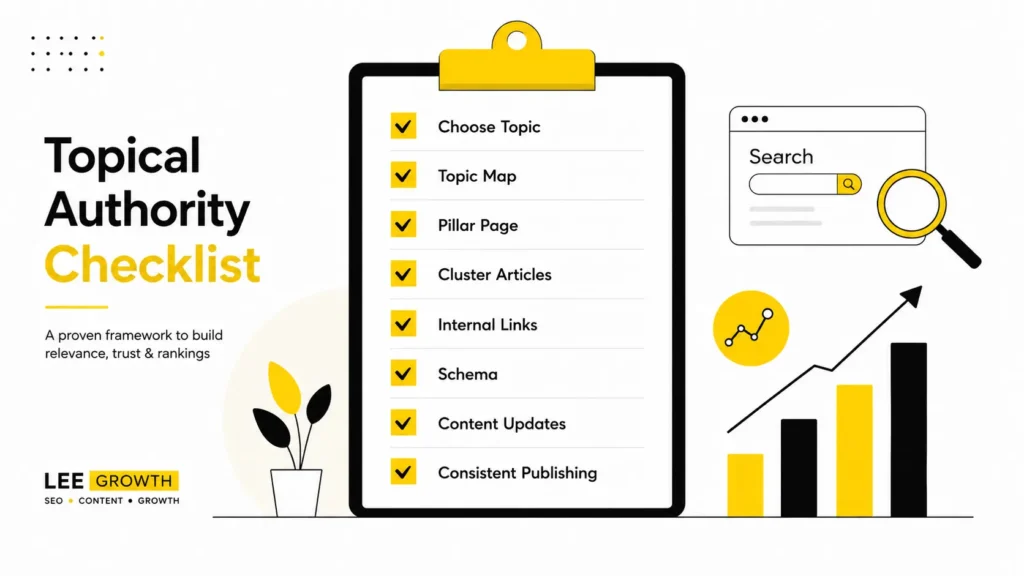
Topical Authority Checklist
- Chosen one to two core topics sized for your real publishing capacity
- Built a topical map covering search intent, not just keywords
- Audited and consolidated existing thin or overlapping content
- Published a complete pillar page for each core topic
- Built out 6-12 cluster articles per pillar
- Linked pillar and cluster pages together with descriptive anchor text
- Added basic schema markup and submitted your sitemap
- Set a publishing cadence you can actually sustain
- Written an honest, specific author bio
- Scheduled a quarterly content refresh
Frequently Asked Questions
What is topical authority in SEO?
Topical authority in SEO is the trust search engines place in a website as a complete, credible source on a specific subject, built through comprehensive, well-linked content rather than a single optimized page.
How long does it take to build topical authority?
Most small, focused sites see early movement within two to four months and meaningful topical authority within six to twelve months, depending on publishing consistency, competition, and topic breadth.
How many blog posts do you need for topical authority?
A realistic starting point for a small website is one pillar page plus six to twelve cluster articles per core topic, rather than the twenty-plus pages agency guides often suggest.
Can a small website compete with big websites?
Yes. A small website that covers one subject completely typically outranks a much larger site that covers many subjects only shallowly, because topical authority rewards focus over size.
Do backlinks matter for topical authority?
Backlinks still help, but they work better as a result of strong, complete content than as a starting requirement. A small site can build real topical authority without backlinks being the first priority.
How do you create a topical map?
List your core topic’s subtopics and questions, group them by search intent, and assign each to either a pillar page or a supporting cluster article in a simple spreadsheet.
What’s the difference between topical authority and domain authority?
Topical authority measures how completely a site covers one specific subject. Domain authority measures a site’s overall strength, based mostly on backlinks and age, regardless of topic.
Does AI-generated content help build topical authority?
AI can speed up research and drafting, but unedited AI output rarely contains the first-hand experience and specific detail that demonstrate real expertise. Used as an assistant, then rewritten and verified, it can help. Published as-is, it usually doesn’t.
Final Thoughts on How to Build Topical Authority for a Small Website
Building topical authority for a small website isn’t about outspending bigger competitors. It’s about choosing a subject you can genuinely own, mapping it out before you write, and covering it more completely than anyone else bothering to. Start with one topic, follow the roadmap above, and give it the months it actually needs to compound.

I’m Leena Kalyana, a Delhi-based freelance digital marketer and graphic designer. I work across SEO, content marketing, social media, and digital design. I’m interested in helping businesses build a stronger online presence through practical SEO strategies, useful content, and creative digital marketing.