


A Modern Guide to Getting Clients from Google and AI Search
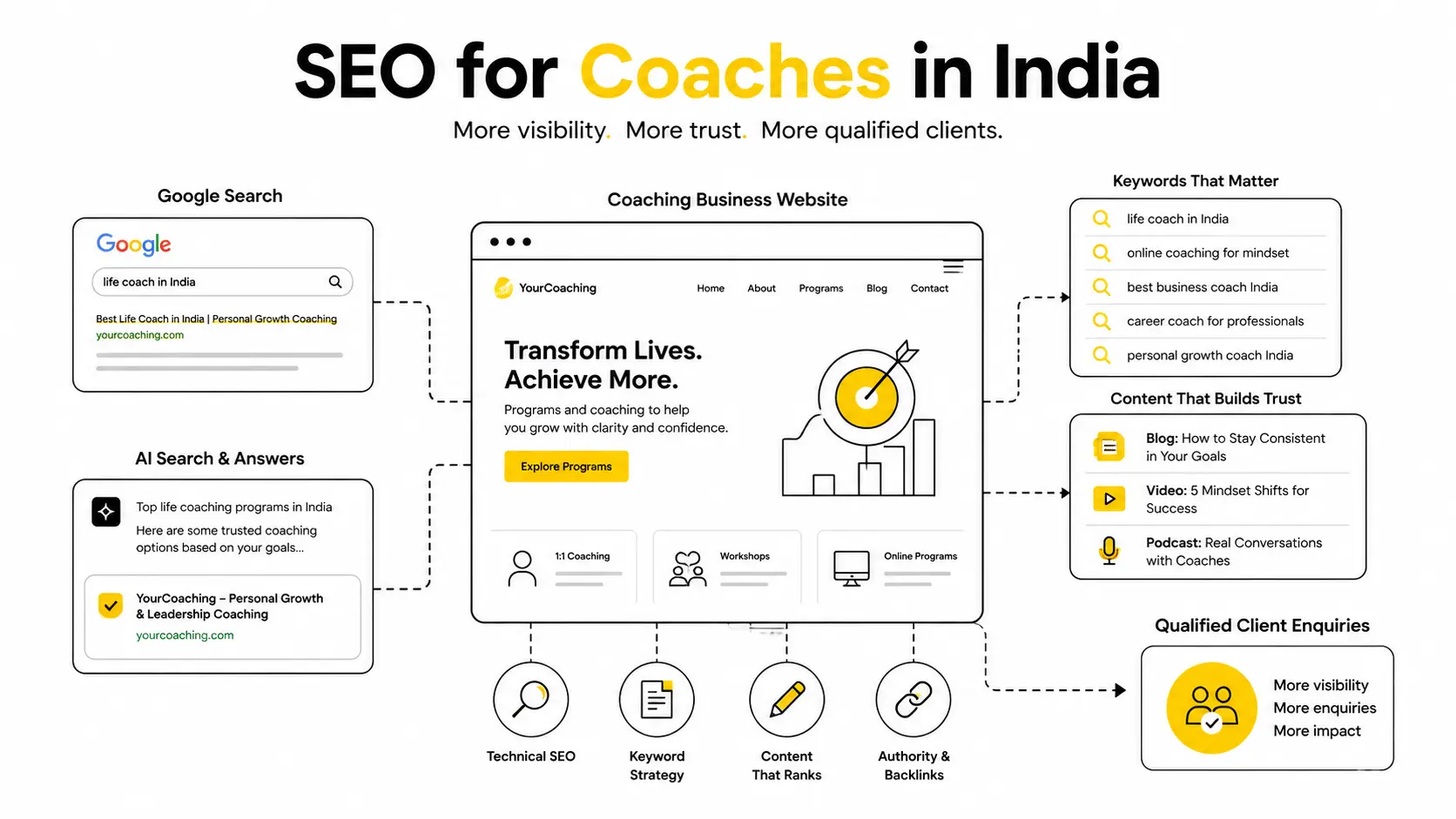
SEO for coaches means making your website easy to find when people search for the problem you solve, whether that search happens on Google or through an AI tool like ChatGPT. Done well, it brings in clients who are already looking for help, without you having to run ads or chase people on social media.
SEO for coaches in India works best when your website targets the exact problems, services and locations your potential clients are searching for.
This guide walks through how to actually make that happen for a coaching or consulting business based in India.
Table of Contents
Is SEO Right for Your Coaching Business Right Now?
SEO works best once your offer is already selling. It is not a fix for a business still finding its footing.
You are ready for SEO if:
- You already get a few clients a month through referrals or social media
- You know exactly who you help and how
- You have a working website, even a basic one
- You can commit to at least 3 to 6 months before expecting real results
- You can spend either time or money on content every month, consistently
Hold off on SEO if:
- You have not sold your coaching offer to a real client yet
- You are still testing what your coaching actually helps with
- You need clients this month, not in a few months
- You cannot publish content regularly, even with help
If you are in the second group, focus on getting a few paying clients first through direct outreach or referrals. Once your offer is proven, SEO becomes a much stronger investment.
How SEO for Coaches in India Works
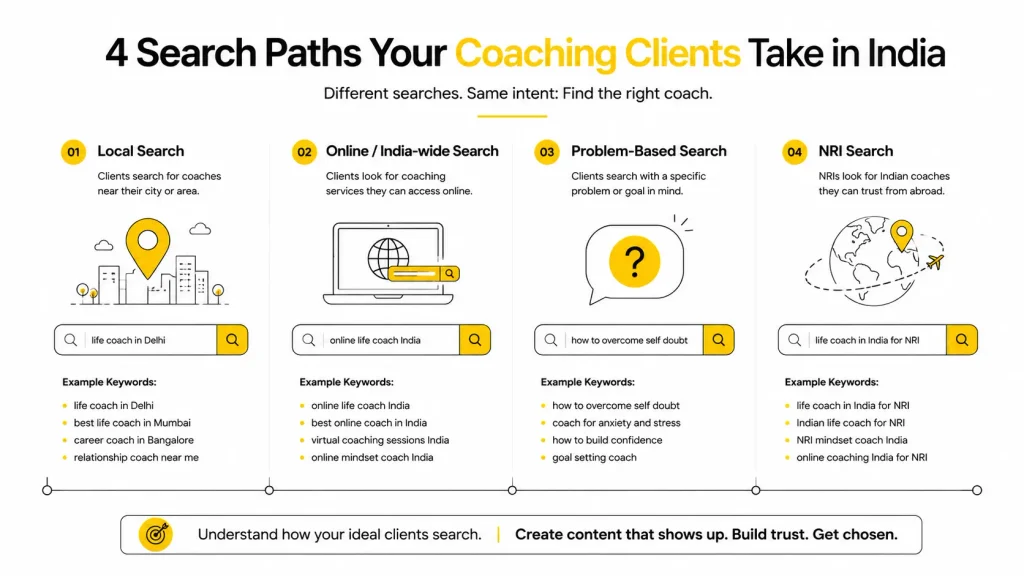
Indian search behavior is not one pattern. It is a mix of a few different types, and knowing which ones apply to you will shape your entire content plan.
Local searches
People wanting in-person sessions search things like “life coach near me” or “career coach in Delhi.” These searches usually convert fast because the person wants someone close by.
National and online searches
People open to online coaching search more broadly, like “online life coach India” or “business coach for startups India.” Here you compete with coaches from every city, not just your own.
Problem-based searches
Many people do not search for “coach” at all. They search for their problem, such as “why do I feel stuck in my career” or “how to build confidence at work.” Content written for these searches can introduce coaching as the solution before the person even knows to look for it.
Hinglish and Hindi searches
A large share of Indian searches mix Hindi and English or use Hindi words written in English letters, like “coach kaise bane” or “confidence kaise badhaye.” These searches carry real volume that English-only content misses.
NRI and diaspora searches
Clients living abroad often search with India-specific context, such as “career coach for Indians abroad” or “coach who understands Indian family expectations.” If this is part of your audience, plan for it separately.
Decide which of these groups you are actually writing for before you plan your keywords. Your language, examples, and even word choice should match how that specific person searches.
Choose Your Market Before Choosing Keywords
Decide where your clients are coming from before you start picking topics to write about.
- City-level: You serve one city and want local, in-person clients
- India-wide: You coach online and welcome clients from any Indian city
- International: You want clients outside India too
- NRI-focused: You specifically want Indian-origin clients living abroad
Also pick one main coaching niche to focus on first. Trying to rank for several niches at once, such as career, relationship, health, and business coaching all together, spreads your content too thin and makes it harder for Google to understand what you are actually known for. Build strong authority in one niche before expanding into others.
If you run a coaching institute rather than a solo practice, the search patterns shift again. Our guide on local SEO for coaching institutions covers that side in more depth.
How Your Website Platform Affects SEO
The platform your website runs on directly affects how well it can rank, so it is worth understanding the strengths and limits of each.
WordPress
Gives the most control. You can add proper schema, manage your URLs, and use plugins for on-page SEO. It takes more setup work but remains the strongest long-term option. See our breakdown of WordPress website development if you are deciding on a platform.
Wix
Has improved a lot, but still has limits. Watch page load speed if you add many apps, and check that your blog URLs stay clean and readable. If you are already on Wix and thinking about moving, our Wix to WordPress SEO migration checklist walks through the process without losing your rankings.
Kajabi
Built for selling courses and coaching programs, not for content SEO. Blog and page URLs are less flexible. It works well for your programs, but a dedicated WordPress blog will usually outperform it for organic content.
Systeme.io
Strong for funnels and email sequences, weaker for long-term content SEO. Many coaches keep it for sales pages while running a separate WordPress blog for content.
If you are starting fresh and SEO matters to you, WordPress is the safer long-term choice. If you already use Kajabi or Systeme.io for your programs, keep them and add a simple WordPress blog alongside for content.
Build Service Pages That Actually Rank and Convert
Give each important service its own dedicated page rather than listing everything on one general “Services” page. A focused page ranks better and converts better.
Structure each service page like this:
- The problem your client is facing, described in their own words
- Your approach, explained simply
- The outcome they can expect
- Who this is for, and who it is not for
- Your proof: results, testimonials, case studies
- Your credentials, where relevant
- FAQs specific to that service
- Pricing information, even just a starting range
- A clear next step, like booking a call
This structure does two things at once. It gives search engines enough specific, well-organized content to rank the page, and it gives your visitor enough confidence to actually book a call. If writing and structuring these pages yourself feels like too much on top of running your coaching practice, this is exactly the kind of work covered under content writing and SEO blog services.
Turn Your Coaching Sessions Into Content
Your best content ideas are already sitting in your client conversations. You do not need to invent topics from scratch.
Follow this simple path: client question leads to a session insight, which becomes a content idea, which turns into an article, then an FAQ, then a social post, all linked back to your main service pages.
Look for ideas in:
- Questions clients ask in the first session
- Messages people send before booking
- Objections you hear on discovery calls, like “I don’t have time” or “will this actually work”
- Misconceptions you correct again and again
- Patterns you notice across multiple clients, without naming anyone
- Real transformations, written up as anonymised case studies
If three clients asked you the same question this month, that question is your next article title.
Build E-E-A-T as a Coach
E-E-A-T stands for Experience, Expertise, Authority, and Trust. Search engines look closely at this for anything that affects a person’s life, health, money, or major decisions, and coaching sits in that category. Google’s own guidelines on E-E-A-T explain what their raters are actually looking for.
To build it properly:
- Write a detailed author bio, not just a one-line intro
- List your certifications clearly, such as those recognised by the International Coaching Federation (ICF, ACC, PCC), or whatever applies to your training
- Share specifics: years coaching, number of clients, real results
- Add testimonials and case studies that include actual outcomes, not just kind words
- Build a proper About page with your story and training
- Use structured data (author schema) so search engines can connect your content to a real, credentialed person
- Be specific and honest about what you are actually qualified to help with
Be accurate about your training and experience. Overstating it can backfire, and search engines and readers are both getting better at telling the difference between genuine expertise and vague claims.
How to Appear in Google AI Overviews and AI Search Results
To show up in AI Overviews or be referenced by tools like ChatGPT, your content needs to answer questions clearly and directly, the same way you would explain something to a client in person. Google’s own documentation on AI features confirms there are no separate technical requirements beyond the usual SEO fundamentals: a page just needs to be indexed and eligible to appear in regular search results.
What helps:
- Answer the actual question in the first two or three sentences, before any introduction
- Explain ideas in plain, simple language
- Use headings that describe exactly what each section covers
- Include real evidence: numbers, examples, specific client situations
- Share first-hand experience, not just general theory
- Cover the natural follow-up questions a reader would have next
- Keep your content fully readable by search engines, avoiding text hidden behind pop-ups or heavy scripts
There is no separate trick for AI visibility beyond this. The content that gets cited by AI systems is simply the content that answers the question better and more clearly than anything else available. Generic, filler-heavy writing does the opposite: it gets skipped by both readers and AI systems. Google’s guide to optimising for generative AI features is worth reading directly if you want the full detail.
Writing Habits That Help Both Readers and AI Systems
- Answer the main question in the first two or three sentences
- Use short, clear headings for each sub-topic
- Break complex ideas into simple steps
- Add real examples from your own coaching work
- Use specific numbers where you can, instead of vague claims
- Answer the natural follow-up questions a reader would ask next
- Keep the structure clean and easy to scan
- Cut filler sentences that add length without adding information
Match Your Call to Action to What the Reader Is Thinking
Not every visitor is ready to book a call. Matching your CTA to where they are in their thinking makes your content convert better.
| Reader stage | What they are thinking | Best CTA |
| Problem aware | “I have this problem, not sure what to do” | Learn how coaching can help |
| Solution aware | “I think I need coaching” | Explore this coaching program |
| Provider aware | “Should I choose this coach?” | View results and credentials |
| Ready to buy | “How do I get started?” | Book a consultation |
A blog post aimed at a problem-aware reader should first help them understand coaching as an option, then guide them toward learning more, and only later toward booking a call.
Should Coaches Show Their Pricing?
Whether to show pricing depends on how your coaching offer is structured.
Showing pricing works well when:
- Your offer is standardised, the same program for everyone
- You want to filter out people who cannot afford you before they book a call
- Your audience values transparency
Hiding pricing works well when:
- Every engagement is custom-priced based on the client’s situation
- You sell high-ticket coaching where price is discussed after understanding the client’s needs
- You use a qualification call as part of your sales process
A middle path that works for many coaches: show a starting price or range, and explain that the final price depends on the program chosen. This gives visitors enough to self-qualify without turning your service page into a full price list.
A Practical SEO Roadmap for an Indian Coach
Month 1: Foundation
Fix your website basics, set up your Google Business Profile if you serve a local area, do your keyword research, and plan your content pillars. If you serve a specific city, this is also where local SEO services make the biggest early difference.
Months 2 to 3: Core assets
Publish your main service pages properly. Start publishing 2 to 4 articles a month based on real client questions.
Months 3 to 6: Build authority
Keep publishing consistently. Start outreach for backlinks and podcast features. Add testimonials and case studies as they come in.
Month 6 onward: Scale what works
Look at which pages and topics are actually bringing in leads, and do more of that. Update older posts that rank well but are not converting.
Most coaches see early movement by month 3 to 4, and steady lead flow by month 6 to 9. Not sure where your site currently stands before you start? A website SEO audit is a useful first step.
How to Measure SEO for a Coaching Business
Traffic numbers alone will not tell you if your SEO is working. Track what actually connects to revenue:
- Qualified leads from organic search, not just visitors
- Consultation or discovery call bookings from your website
- Organic conversion rate, visitors to bookings
- Revenue tied back to an organic lead
- Branded search volume, how many people search your name over time
- Local visibility, if you serve a specific city
- Rankings for your most important service and problem-based keywords
- Visibility in AI Overviews, where you can check it
A page with 2,000 visitors and zero bookings is doing less for your business than a page with 200 visitors and 5 bookings.
Common SEO Mistakes to Avoid
- Trying to rank across all of India before validating your offer in one city or niche
- Targeting several coaching niches on one website at once
- Publishing generic, filler content with no real experience behind it
- Overstating credentials or expertise
- Creating dozens of thin city pages just to “cover more locations”
- Ignoring the technical limits of your website platform
- Having no proof, testimonials, or credentials on your site
- Writing content with no clear next step for the reader
- Giving up after 6 weeks, before results have had time to build
Frequently Asked Questions
Is SEO worth it for coaches in India?
Yes, once you already have a working offer and can commit to at least 3 to 6 months of consistent effort. It is not a quick fix for a business still finding its footing.
How long does SEO take for a coaching business?
Most coaches see early signs of progress around month 3 to 4, with steady lead flow building by month 6 to 9.
How much should a coach spend on SEO?
This depends on whether you do it yourself or hire help, and how competitive your niche and city are. Treat it as a 6 to 12 month investment rather than a one-time cost.
Can a life coach rank on Google?
Yes. Life coaching is competitive, so being specific about who you help and what problem you solve makes ranking realistic, even against larger, established sites.
How do I appear in Google AI Overviews?
Write content that directly and clearly answers real questions, backed by genuine experience and examples. There is no separate trick beyond writing genuinely useful, well-structured content.
Can ChatGPT recommend my coaching business?
It can reference publicly available content that is clearly written and well structured, though there is no guaranteed way to control this the way you can with traditional SEO.
Should I show my coaching prices online?
It depends on your offer. Standardised programs benefit from transparency. Highly custom, high-ticket coaching often works better with a starting range plus a qualification call.
Is WordPress better than Wix for coaching SEO?
WordPress gives more control over technical SEO and is generally the stronger long-term choice. Wix has improved but still has some limitations for advanced SEO needs.
In Short
Search visibility leads to credibility. Credibility leads to discovery. Discovery brings qualified traffic. Qualified traffic turns into consultations, and consultations turn into clients.
Each link in that chain depends on the one before it. Rank without credibility, and no one books a call. Get traffic with no clear next step, and visitors leave without converting. Build all the pieces together, and SEO becomes one of the most stable, low-cost ways to bring in coaching clients month after month.
If you would like help putting this into practice, get in touch to talk through a strategy built around your coaching business.

I’m Leena Kalyana, a Delhi-based freelance digital marketer and graphic designer. I work across SEO, content marketing, social media, and digital design. I’m interested in helping businesses build a stronger online presence through practical SEO strategies, useful content, and creative digital marketing.