In this article
By Leena Kalyana | Last updated: November 2026
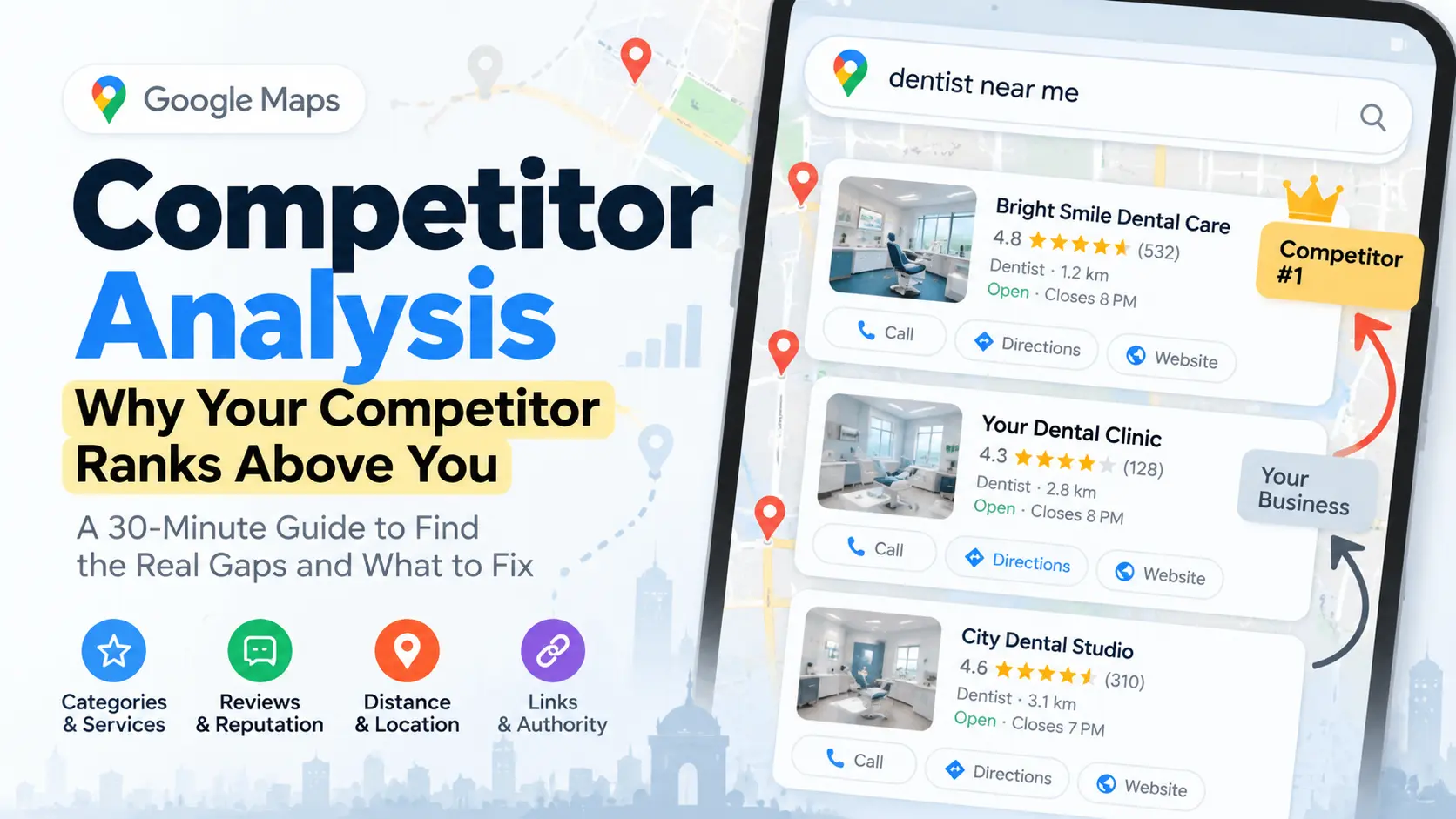
Short answer: A competitor usually shows above you on Google Maps because they do better on one or more of the three things Google looks at: how well they match the search, how close they are, and how well known they are. To find out which one it is, run a Google Maps competitor analysis: put your Google Business Profile next to theirs, compare the same things in the same order, fix what you can control, and accept what you can’t.
You search for your own service on Google Maps and a competitor is sitting above you. Maybe their shop is smaller. Maybe they started later. So you wonder what they are doing that you are not.
The better question is: what is different between my business and the businesses Google shows above me?
A Google Maps competitor analysis answers that. You compare your profile with theirs, point by point, and see where the real gap is. Some gaps you can close in a week. Some you can’t close at all, and it helps to know that early so you don’t waste months on them.
This guide is updated for 2026. When Google has said something officially, I say so. When something is my experience or common practice, I say that too. If you’d rather have it done for you, see my local SEO services in Delhi.
Why your competitor ranks above you on Google Maps
Google says local results are based mainly on three things: relevance, distance and prominence.
- Relevance: how well your profile matches what the person searched for.
- Distance: how far you are from the person, or from the place they searched.
- Prominence: how well known your business is. Google says this comes from information all over the web, like links, articles and directories. It also says your review count and star rating count.
Google is not asking “who is the best business?” It is asking “who is the best fit for this search, from this spot?” Google also says there is no way to pay for a better local ranking.
Before you compare anything: fix the search and the place
You don’t have one Google Maps ranking. Your position changes with where the person is, what they typed, how well you match, and who else is nearby. So test the same search from different places. For “dentist near me”, try:
- Your home
- Your shop or office
- A different Delhi area
- An incognito window
- Google Maps directly, and Google Search (the three map results at the top)
Write down who shows up each time. A business that is first near its own street can be fourth two kilometres away. That tells you something useful: your problem may be where people search from, not your profile.
Start with the exact search. The same two businesses can show in a different order for different searches, and sometimes a completely different set shows up. “SEO consultant”, “SEO consultant near me”, “local SEO consultant Delhi” and “Google Maps SEO consultant” can each bring up different competitors. Write down the exact search you want to win and do one analysis per search. If you mix searches together, your results won’t make sense.
The Google Maps Visibility Grid
Once you have tried a few places, turn the results into a simple grid. I use this to see where a competitor wins, not just whether they win.
- Pick one search, for example “emergency dentist”.
- Pick 6 to 9 spots across the area your customers come from. In Delhi that could be Karol Bagh, Connaught Place, Rajendra Place, Patel Nagar, Lajpat Nagar and Saket.
- Search the same words from each spot and note who is in the top 3.
- Mark each spot: Top 3, Top 10, or Not seen.
- Do it for yourself and your strongest competitor, then put them side by side.
| Area | You | Competitor A |
|---|---|---|
| Karol Bagh | Top 10 | Top 3 |
| Connaught Place | Not seen | Top 10 |
| Rajendra Place | Top 10 | Top 3 |
| Patel Nagar | Top 3 | Top 3 |
| Lajpat Nagar | Not seen | Top 10 |
| Saket | Not seen | Not seen |
Sample only, with made-up results.
Look for the pattern. Competitor A may be strong in the north-west and weak in the south. That shows you where it is realistic to compete. You don’t need to win the whole city. You need to be strong where your customers are.
Check where your customers really come from. Look at your last 20 to 30 customers or enquiries and note where they came from. If most are within 5 km of you, those areas matter most. Winning there is worth more than ranking in an area you will never serve. Give extra weight to the areas that bring you money.
Which problem do you actually have?
Before you change anything, work out what kind of gap you are looking at.
Two gaps you can’t edit away:
- Distance. Sometimes a competitor ranks higher simply because they are closer to the person searching. Google lists distance as one of its three main points, but it also says a farther business can still rank higher if it looks more likely to have what the person wants. So distance matters a lot, but it is not everything.
- Time. A competitor that has been in the area for eight years may have collected reviews, mentions, links and name recognition all that time. Ask: is this competitor really doing a better job, or have they just had more years to build trust? If it is mostly years, the answer is steady catching up, not a panic rewrite of your profile.
Three kinds of gap. Don’t treat all of them as an SEO problem.
| Kind | What it means | Example |
|---|---|---|
| Ranking gap | They are simply higher. This is only what you see. | 5 places above you |
| Fixable gap | A weak spot you can repair | Your main category doesn’t match the search well |
| Market gap | An advantage you can’t copy | They are 1 km closer, or 10 years older |
Fix the second kind and plan around the third.
Six problems to check for. Most businesses have two or three, not all six:
- Match problem: your profile doesn’t match the words people search.
- Distance problem: they are simply closer.
- Fame problem: they are better known, online or offline.
- Profile problem: your Business Profile is incomplete or set up wrongly.
- Website problem: your website doesn’t back up your service or area.
- Trust problem: they get more mentions and links from other places.
Now sort every gap you find into one of three groups: fixable (profile details, categories, services, website pages, asking for reviews and replying to them, listings), partly in your control and slow (more reviews, local mentions, links, being better known), and not in your control (where your competitor is, where the person searches from, how long your competitor has been around). This keeps you honest. Nobody can promise “do these 10 things and you’ll beat everyone”, because distance and history are out of your hands.
You also have more than one kind of competitor. The businesses you lose customers to are not always the ones Google shows above you.
| Kind | Who they are | Where you meet them |
|---|---|---|
| Customer competitor | Takes the customers you want | Anywhere |
| Maps competitor | Shows in the map results for your search | Google Maps |
| Google Search competitor | Shows in the normal website results | Google Search |
| AI competitor | Gets named when people ask an AI tool | ChatGPT and similar tools |
This guide is about your Maps competitors, so start there. If you also want to know why AI tools name someone else, read why ChatGPT cites your competitor instead of you.
Step by step: map your rivals and compare three
Step 1: Map your rivals. Don’t only open their profiles. Search your main keyword from where your customers search, write down the top 3 to 10 businesses, and mark where each one is on Google Maps. Then ask one question: is this competitor really stronger, or just closer? If the top results are all near the person and you are far away, the answer may be “closer”. If a competitor ranks above you even though you are closer, look harder at the gaps below.
Step 2: Compare three competitors, not one. Don’t build your plan around the #1 business alone. Look at three businesses that rank above you, and look for what they have in common. If Competitor A has 500 reviews, B has 120 and C has 80, review count alone is probably not what puts them above you. But if all three have the same main category, a page for the service and the same details everywhere online, you have found something much more useful.
| What to check | You | Competitor A | B | C | Do the winners share it? |
|---|---|---|---|---|---|
| Main category matches the search | No | Yes | Yes | Yes | Yes |
| 100+ reviews | Yes | Yes | No | Yes | No |
| Own page for the location | No | Yes | Yes | Yes | Yes |
| Rating of 4.8 or more | Yes | Yes | Yes | Yes | Yes, but you have it too |
Sample only.
The rule: don’t copy something only one competitor has. Work first on what the winners share and you are missing. In the sample, that is the main category and the location page.
Step 3: Write each finding as a guess to test. Don’t write “this is why they rank.” Things that go together are not always a cause. If a competitor has more reviews, more years, a better website and more links, you can’t say “reviews are the reason.” Use four lines for each finding:
- Guess: the competitor has stronger local trust.
- Evidence: they have 23 local mentions and you have 4 (sample only).
- How sure am I: medium, because two of the three competitors have it.
- Action: find local mentions I can realistically get.
Mark how sure you are like this: high if it shows up across 4 or 5 competitors, medium across 2 or 3, low if only one has it.
What if there is no clear gap? That happens. They may be closer, have been around for years, be known offline, or have few nearby rivals. Sometimes the answer is not another fix. It is a different search to go after, or a bit more patience.
What to compare in a Google Maps competitor analysis
Categories
Google confirms categories are part of your profile. Compare your main and extra categories with your competitor’s. For example (sample only): you list “Dental clinic”, while the competitor lists “Dentist” plus extra categories for “Orthodontist” and “Cosmetic dentist”. Ask whether you are both describing the same service, which category fits the search better, and whether the right extra categories are used.
Never add a category for a service you don’t offer. Google’s rules for representing your business ask you to be honest and accurate, and profiles that break them can be changed or removed.
Does your profile match the search?
Someone searches “emergency plumber Delhi”. The competitor’s profile says “24/7 emergency plumbing”, “emergency repairs” and “same-day service”. Yours says “plumbing services”, “bathroom fitting” and “kitchen plumbing”. They may not be better. They may just be a closer match to what the person wants.
Follow this chain for yourself and the competitor: what they typed, then category, services, website, reviews, area. At each step ask whether you are really the best match for the search you want to win. This is more useful than “add keywords to your profile.”
To measure it, score each business 0 to 5 on one exact search:
| What to score | You | Competitor A | B | C |
|---|---|---|---|---|
| Main category fits the search | ||||
| Services listed | ||||
| Website page for this search | ||||
| Area you mention | ||||
| What customers say in reviews | ||||
| Profile details filled in | ||||
| Total (out of 30) |
The Search Match Score is my own tool at LeeGrowth. It is not a Google score. It helps you see which row is pulling you down.
Reviews: count, speed and topics
Google confirms that review count and rating affect local ranking. But “they have 500 reviews and I have 100” is only where you start. Compare total reviews and rating, how many came in over the last 30 and 90 days, which services, areas and problems customers mention, and whether the owner replies.
Look at speed, not just the total. A big total shows how long a business has been collecting reviews. The last 90 days show whether customers are talking about them now.
| Business | Total reviews | Last 90 days | Recent pace |
|---|---|---|---|
| You | 200 | 4 | Slow |
| Competitor A | 800 | 70 | Fast |
| Competitor B | 500 | 12 | Medium |
Sample only. If Competitor A adds about 23 reviews a month and you add 1 or 2, that is a gap in your review habit, and it is one you can fix. Google has not said review speed is a ranking factor, so use it to compare, not as a promise.
Also read 20 to 30 reviews for each business and note the topics. A competitor’s customers may keep mentioning emergency visits, same-day appointments and South Delhi, while yours only say “good service.” That is a gap in detail. Google has not said that words in reviews help ranking, but it shows you what customers say about a competitor, and what you can honestly invite your own customers to talk about.
Never buy reviews or write fake ones, and don’t ask only your happiest customers. Google’s policies say all content on a Business Profile, including reviews, must be genuine, and Google’s tips say owners shouldn’t offer incentives. A review link or QR code is the honest way to make leaving one easy.
Photos
Compare how many photos there are and how recent, whether they show outside, inside and team, your work or before-and-after results, and whether they show the real place. Google has not said more photos means a higher rank. A photo gap mostly shows how actively a competitor looks after their profile, and customers do use photos to decide.
Does your website back up your profile?
Open the competitor’s website and look for a page for their location (or a page for each service and area), the same name, address and phone number as on their profile, an embedded map, local customer testimonials, page titles that mention the service and area, and local business structured data. Then check your own site the same way. If your profile says one thing and your website says another, fix that first.
If your site is missing service or area pages, my SEO content writing and WordPress website development services can help. You can also ask for a free website SEO audit if you want a second pair of eyes.
Links and mentions from other websites
“Get more links” is not a plan. Instead, find where your competitors get their local trust from: local news sites, business groups and trade associations, local directories, events and sponsorships, community groups, and supplier or partner pages. Then ask which of these you could realistically get too. A page on a local association site or an event sponsor page may be easy. A national newspaper feature is not.
Google says links and mentions from across the web help how well known you look, but it doesn’t say how much. A backlink tool makes this check much faster, and my comparison of Semrush, Ahrefs and Ubersuggest shows which suits a small budget.
Is your business information the same everywhere?
Compare name, address and phone number, your website and About page, services and categories, listings on other sites, and social media pages. Small mismatches, like “Pvt Ltd” on one site and not another, or an old phone number on an old directory, make it harder to tell which listing is the real one. Google doesn’t publish a score for this, but clear, matching details help. For Delhi businesses, check JustDial, Sulekha and IndiaMART as well as the big global directories.
Your gap score and what to fix first
Score each row for one competitor: +1 if you are ahead, 0 if equal, -1 if behind.
| # | What to compare | Can you change it? |
|---|---|---|
| 1 | Main category | Yes |
| 2 | Extra categories | Yes |
| 3 | Services listed | Yes |
| 4 | Profile details (hours, phone, description) | Yes |
| 5 | Number of reviews | Slowly |
| 6 | Star rating | Slowly |
| 7 | How recent and how often reviews come in | Yes |
| 8 | What the reviews say | Partly |
| 9 | Replies to reviews | Yes |
| 10 | Photos (number, quality, how recent) | Yes |
| 11 | Website page for the service | Yes |
| 12 | Pages for each area | Yes |
| 13 | Listings on other sites | Yes |
| 14 | Same name, address and phone everywhere | Yes |
| 15 | Links from local websites | Slowly |
| 16 | Local name and mentions | Slowly |
| 17 | Distance from the person searching | No |
| 18 | How well known the business is | Mostly no |
| 19 | Match with the exact search words | Yes |
Overall visibility is the result of the above, so score it last. For a full analysis, repeat this against three competitors. A sample with made-up numbers:
| Area | You | Competitor A | Competitor B | Gap |
|---|---|---|---|---|
| Reviews in last 90 days | 6 | 38 | 9 | Big |
| Links from other sites | 12 | 31 | 24 | Big |
| Listings on other sites | 18 | 35 | 29 | Big |
| Photos | 42 | 120 | 74 | Medium |
| Distance | 2.4 km | 0.8 km | 1.7 km | Can’t change |
Don’t try to beat the competitor on everything. Pick the 3 to 5 biggest gaps you can actually do something about. In this sample, reviews, links and listings are big gaps you can work on. Distance is a gap too, but you can’t change it, so let it shape your expectations, not your to-do list.
Which gap first? Score each possible fix from 1 to 5 on impact (how much could it help), control (how much is really in your hands) and effort (how much time or money it takes). Then:
Priority = (Impact × Control) ÷ Effort
| Fix | Impact | Control | Effort | Priority |
|---|---|---|---|---|
| Correct a wrong category | 5 | 5 | 1 | 25 (High) |
| Improve the services list | 3 | 5 | 2 | 7.5 (High) |
| Get more recent reviews | 4 | 4 | 3 | 5.3 (High) |
| Get one local link | 4 | 3 | 4 | 3 (Medium) |
| Move your business | 5 | 1 | 5 | 1 (Low) |
Sample scores. The formula matters less than the habit: pick the quick wins you control before chasing things you can’t change. If you want a ready plan for the first month, see my 30 day local SEO plan for small businesses.
Stuck on what to fix first? I can look at your filled-in tables with you. See how I work as a freelance SEO in Delhi or get in touch.
Beat the gap, don’t copy the competitor
Look for their weak side too. Check for poor reviews or reviews the owner never replies to, an old website, services they don’t list, thin or missing content, few local mentions, and only a small area covered. You don’t need to be better at everything. You need to be clearly stronger in one area that matters to your customers.
Don’t try to match their numbers. If they have 800 reviews and you have 120, don’t chase 800. Make your services match the search more closely, earn local mentions, invite detailed reviews, and go after a service they have ignored.
Find the search they are missing. Say a rival owns “dentist near me”. Instead of spending a year chasing that, look at related searches where fewer businesses compete: emergency dentist, root canal dentist, children’s dentist, braces dentist, weekend dentist. Then build real strength there: list the service on your profile, add a page on your website, and invite honest reviews from customers who used that service (only if you really offer it). It is often faster, and those customers are often more ready to buy.
Pick searches by value, not volume.
| Search | What the person wants | How many compete | Value to you | Where you show now |
|---|---|---|---|---|
| dentist Delhi | Just looking | Many | Medium | 12th |
| dentist near me | Ready to visit | Many | High | 8th |
| root canal dentist | One specific treatment | Some | Very high | 4th |
| emergency dentist | Needs help today | Some | Very high | 2nd |
Sample only. “Root canal dentist” may be worth more than “dentist Delhi”, even though fewer people type it.
Change one thing at a time. Treat each fix like a small test. Say your guess is that a competitor beats you because your main category fits the search less well. Fix the category (if the new one is true for your business), then track your visibility and enquiries for 4 to 6 weeks from the same places, and compare before and after. If you change five things at once, you will never know which one worked.
Rankings are not the goal. Customers are.
A competitor may be first for “best dentist Delhi” while your business earns more from “root canal dentist near me”. Your map position is only a means. Alongside rank, track calls, direction requests, website visits, booking clicks, enquiries and actual new customers. The Performance report inside your Business Profile shows calls, direction requests and more. Here is how to track calls and direction requests from Google Maps.
What not to copy from competitors. A competitor ranking above you doesn’t mean everything they do is the reason. Don’t copy categories that don’t fit, business names or descriptions stuffed with keywords, fake or bought reviews, spammy directory listings, many near-identical pages for different areas, copied content, review habits that only ask happy customers, or misleading details like a fake address. Some of these can get a profile suspended.
The 30-minute Google Maps competitor analysis
- Pick one search, the exact words a customer types.
- Note the top 3 competitors, searching from the right place.
- Compare each one on: main category, extra categories, reviews and how often new ones come in, services and profile details, website and area pages, listings on other sites, links, photos, distance and local mentions.
- Look for what two or three of them share, not just one, and mark how sure you are (high, medium or low).
- Pick your 5 biggest gaps and sort them: fixable, partly in your control, or not in your control.
- Choose the top 3 fixes using Impact × Control ÷ Effort.
- Check again in 4 to 6 weeks, from the same place, with the same search. Repeat the whole analysis every one to three months, or sooner if your rank drops after a change.
How long does it take to work? Google gives no official timeline, and anyone who quotes you a fixed number is guessing. From my own work, small profile changes like categories and services can show an effect within a few weeks. Reviews, listings and links usually take a few months of steady work. Treat that as experience, not a promise. A sensible order: fix the obvious (categories, services, profile details, photos), line up your website, build a review habit, earn local trust, then re-run the grid and count customers.
Key takeaways
- Google says local ranking is based mainly on how well you match the search, how close you are, and how well known you are. You can’t pay for a better rank.
- You don’t have one Google Maps ranking. It changes with where the person is, what they type and who is nearby. Test it with the Visibility Grid.
- Work out which problem you have (match, distance, fame, profile, website or trust) and separate the ranking gap, the fixable gap and the market gap.
- A competitor may be closer or older, not better. Compare three competitors for one exact search and look for what the winners share.
- Review speed, words in reviews and photo counts are worth studying, but Google has not confirmed them as ranking factors.
- Change one thing at a time, and if you can’t beat a competitor on their main search, find a related search they are missing.
- Count calls, enquiries and customers, not just rank.
Frequently asked questions
What is a Google Maps competitor analysis?
It is a side-by-side check of your Google Business Profile against your competitors’ profiles, plus their websites and local mentions. The goal is to find what is different between you and the businesses ranking above you, and decide which gaps you can fix.
Why do competitors rank higher on Google Maps?
Usually because they do better on one or more of Google’s three main points: how well they match the search, how close they are, and how well known they are. They may have a better category, more and newer reviews, a stronger website, or they may simply be closer to the person searching.
Why is my competitor above me even though I have better reviews?
Reviews are only part of how well known you look. Their category, services, distance, website and mentions from other places can outweigh a better star rating. Compare all of these side by side instead of looking at stars alone.
Is distance more important than SEO on Google Maps?
Distance is one of Google’s three main points, so it can matter a lot. But Google also says a business farther away can rank higher if it looks more likely to have what the person wants. Good SEO can help you win searches where you are not the closest.
Why does my ranking change from place to place?
Local results depend on where the person is searching from. The same search from home, from your shop and from another area can show different businesses in a different order. Test from several places, or build a visibility grid, before judging your rank.
How many Google reviews do I need to beat a competitor?
There is no magic number. Google says review count and rating affect local ranking, but the right target depends on your area and type of business. Look at the top three competitors and aim to match their pace and quality over time.
Do review speed, review wording and photos affect ranking?
Google has not confirmed any of them as ranking factors. They are still worth comparing. Recent reviews show how active a business is, detailed reviews show what it does, and photos help customers choose. Use them to understand the gap, not as promises.
Should I copy my competitor’s categories?
Only if they are true for your business. Use the category that best describes your main service, and add extra categories only for services you really offer. Wrong categories can hurt trust and cause problems with your profile.
Can I pay to rank higher on Google Maps?
No. Google says there is no way to request or pay for a better local ranking. Paid ads are separate and are labelled as ads.
What if I can’t beat the competitor on my main search?
Look at related searches where fewer businesses compete, such as one specific service, problem or area. Build real strength there first. It is often faster, and those customers are usually closer to buying.
Your Google Maps competitor analysis template
Copy this into a document or spreadsheet and fill it in.
GOOGLE MAPS COMPETITOR ANALYSIS SHEET

Business:
Exact search:
Where I searched from:
Date checked:

COMPETITORS
A:
B:
C:

WHAT I FOUND
Match with the search:
Distance:
Reviews (total, last 90 days):
Categories:
Services:
Website:
Links and local mentions:
Listings on other sites:
Where I show on the map (grid):

MY GUESSES (how sure: high, medium, low)
1.
2.
3.

THEIR WEAK SIDE
1.
2.

BIGGEST GAPS I CAN FIX
1.
2.
3.

MY NEXT ACTIONS
1.
2.
3.

RECHECK DATE:
Conclusion: start small
Your competitor probably didn’t beat you with one secret trick. It is usually a mix: a closer shop, a better matching category, newer reviews, a clearer website, more local mentions, or simply more years in the area. The way forward is to stop guessing and compare.
Start small. Pick one search, three competitors and 30 minutes. Fill in the gap score, mark what is fixable, and fix the top three things first. Run your visibility grid again in a month, from the same places. Over a few months, steady changes add up, and you will know which battles are worth fighting, which are only about distance, and where an easier chance is waiting.
If your tables are filled in but you still can’t tell what to fix first, get in touch and I’ll look at them with you, or request a free website SEO audit. You can also read more about local SEO for small business, near me SEO and how many service areas to add to your Business Profile.

Leena Kalyana is an SEO and digital marketing consultant in Delhi NCR and the founder of LeeGrowth. She helps clinics, coaching institutes, consultants and small businesses get found on Google, Google Maps and AI search. She works directly with every client and does not guarantee rankings.