


By Leena Kalyana, freelance SEO and GEO consultant at Lee Growth, Delhi NCR. Last reviewed 2 October 2026.
Picture a tax consultant in Noida. Her website says “GST registration and compliance services.” Her WhatsApp is full of messages like “GST number kaise milega?” and “filing ka kitna charge lagega?” Her customers speak Hindi and Hinglish, but her pages use only formal English. She has never seen those phrases in a keyword tool, so she has never written for them.
That gap is a keyword research blind spot. This guide shows you how to:
- find the words your customers really type,
- separate language from intent,
- decide what deserves a page, an FAQ or nothing,
- use what you learn without keyword stuffing or thin pages,
- measure whether it worked.
Quick answer: what to do in 30 minutes
Hinglish keyword research means finding the mixed Hindi-English phrases, scripts and spellings your customers actually type into Google, instead of assuming they use your formal English wording.
- Read your customer messages. Copy 20 recent WhatsApp, call or review phrases into a sheet. This is your best data source.
- Run the regex pack in Search Console (see “Method 4” below). Hinglish queries that already earn impressions are your cheapest evidence.
- Read the intent word, not the language. Kitna signals price, kaise signals how-to, kaun sa signals comparison, nahi ho raha signals a problem. That small word decides what page you need.
- Run the SERP overlap test. If “SEO agency Delhi” and “Delhi mein SEO agency” return mostly the same URLs, they are one target. Add an FAQ or heading to your existing page instead of a new page.
- Score your page with the Language Gap Score (below) to see which service page to fix first.
What is Hinglish keyword research?
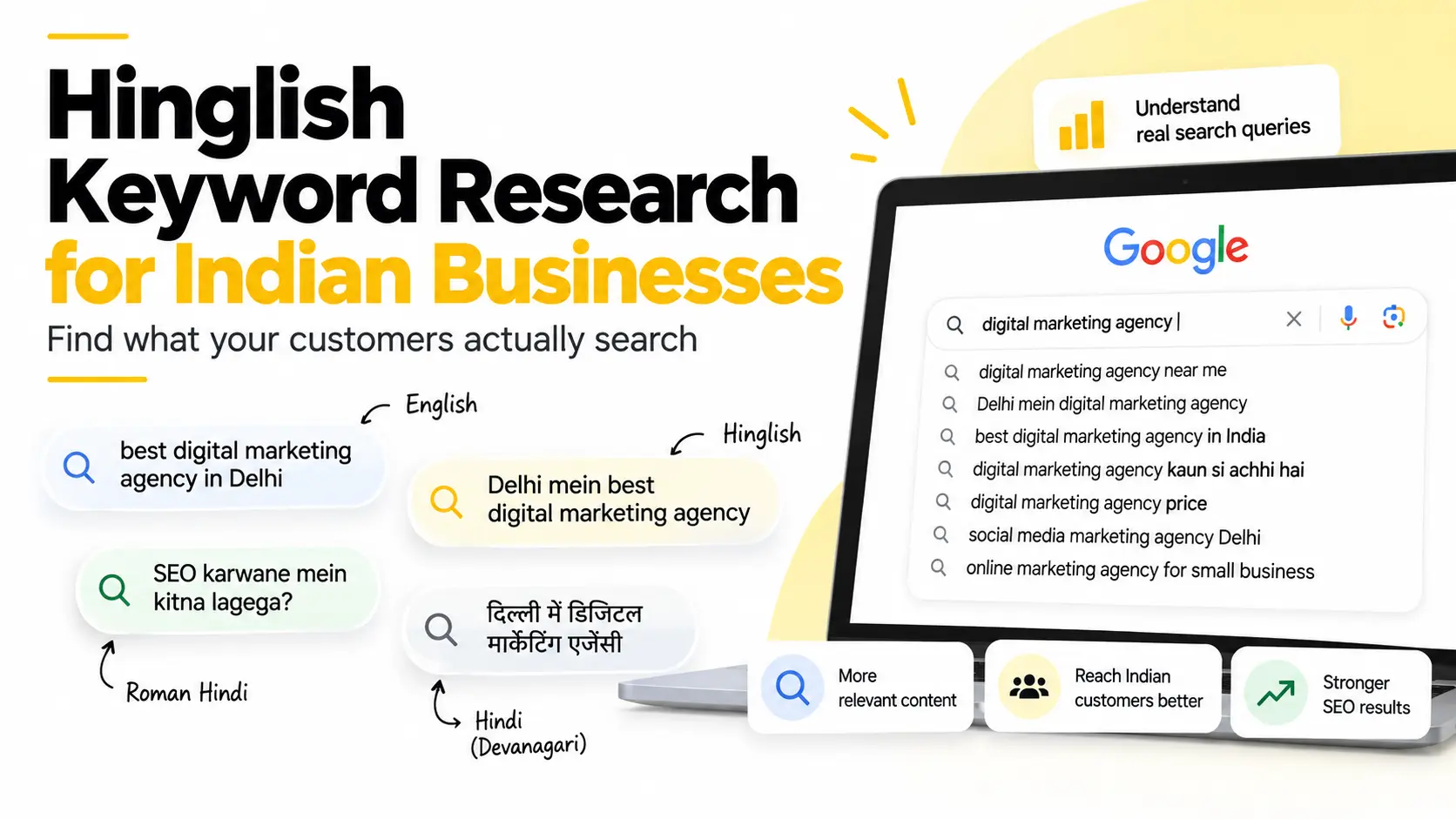
Hinglish is the everyday mix of Hindi and English used across much of urban and semi-urban India. In search it appears in several forms:
| Form | Example |
|---|---|
| English | best digital marketing agency in Delhi |
| Hindi (Devanagari) | दिल्ली में डिजिटल मार्केटिंग एजेंसी |
| Roman Hindi (Hindi in English letters) | website Google pe show nahi ho rahi |
| Hinglish (English terms in Hindi grammar) | Delhi mein best digital marketing agency |
| Mixed local + English | SEO agency Karol Bagh; SEO service kitne ki hai |
The lines blur, and people do not think in these categories. Use them as working vocabulary, not a linguistic standard.
Hinglish search behaviour is not the same as Hinglish content. Search behaviour is how people type. Content is how you write. You can learn that customers search in Hinglish and still publish a clean English page that answers their question, with a few of their phrases worked in naturally. Nobody is asking you to write entire pages in Hinglish.
An example query is not data. Hinglish keyword research is the process of replacing guesses with evidence.
Why Indian customers do not search the way businesses write
Businesses write in the language of their category: formal, English, brochure-like. Customers write in the language of their problem: casual, mixed, specific, often with a price question attached.
| Business wording | Customer wording (example queries) |
|---|---|
| Search engine optimization services | SEO karwane mein kitna lagega? |
| Website development services | website banwane ka kitna charge hai? |
| Digital marketing agency | Delhi mein digital marketing agency kaun si achhi hai? |
| GST registration services | GST number kaise milega? |
The customer version carries intent (price, comparison, how-to) that the business version hides. It also carries grammar that a keyword tool may not group with your English term.
Context from research. The IAMAI and Kantar Internet in India report estimated 886 million active internet users in 2024, and the 2025 edition reports 958 million. Coverage of the 2024 edition reported that 98% of users accessed content in Indic languages and that 57% of urban users preferred regional-language content. These figures describe content consumption across India, not search queries, so they do not tell you what your customers type. Treat them as context: multilingual behaviour is the norm.
What Google has said. A 2020 announcement of Google’s MuRIL language model said it was built to handle transliteration, spelling variation and mixed languages, including Hindi written in Roman script. That suggests Google works on these query styles. It does not say such pages rank better.
What I saw in the SERPs. Results for Hinglish and Hindi keyword research were mostly keyword-tool landing pages, blogger tutorials (some written in Hinglish themselves) and agency explainers. Almost all targeted bloggers and publishers. I found little that explains the process for local service businesses such as a dentist, a CA or a salon, which is the gap this guide fills. One agency post claims Hindi keywords are easier to rank because most sites publish in English. That is a plausible hypothesis, but the piece does not back it with data, so test it before relying on it.
How to read a Hinglish query: the particle decoder
Most Hinglish business queries follow one pattern. The English noun stays fixed (“SEO”, “GST”, “agency”, “interior”) and small Hindi words around it carry the intent. Once you see this, you stop treating each phrase as a separate keyword and start reading the small word as the signal. This is my practitioner interpretation. Confirm each against the live SERP before acting.
| Hindi word in the query | Rough meaning | Intent it usually signals | Example query | What usually answers it |
|---|---|---|---|---|
| kaise | how | How-to, process | GST number kaise milega | Step-by-step guide with documents and timeline |
| kitna / kitne / kitni | how much | Price | SEO service kitne ki hai | Pricing section with what is included |
| kharcha / charge / rate / fees | cost | Price | website banwane ka kitna charge hai | Cost breakdown, ranges, factors |
| kaun sa / kaun si | which | Comparison, shortlisting | Delhi mein kaun si agency achhi hai | Comparison criteria, proof, reviews |
| chahiye / lena hai / karwana hai | need / want done | Ready to hire or buy | Noida mein CA chahiye | Service page with a clear way to enquire |
| mein / ke paas | in / near | Location | Dwarka mein dentist | Address, map, location signals, reviews |
| nahi ho raha / nahi chal raha | not working | Problem, troubleshooting | website Google pe show nahi ho rahi | Diagnostic explainer that ends in a service option |
| kya hai / kya hota hai | what is | Definition | SEO kya hai | Short definition page or glossary entry |
| kitne din / kitna time | how long | Timeline | GST registration kitne din mein hota hai | Honest timeline with the factors that change it |
| sasta / achha / best | cheap / good / best | Quality or price filter | sasta website developer | Honest positioning, not a discount promise |
| ya / vs | or / versus | Comparison | LLP ya private limited kaun sa better | Side-by-side comparison with a recommendation by situation |
| zaroori hai kya | is it necessary | Doubt, eligibility | GST lena zaroori hai kya | Rules, thresholds and exceptions with a checked date |
Why this matters for research. Spelling varies wildly (me / mein / main, kitna / kitne / kitni, nahi / nahin / nhi, karwana / karvana). Do not build a page per spelling. Group queries by the noun plus the intent word and treat spellings as one cluster. If your keyword sheet has 40 rows that collapse into six noun-plus-intent clusters, you have six decisions to make, not forty.
Spelling clusters to treat as one keyword
| Cluster | Common variants |
|---|---|
| price | kitna, kitne, kitni, kitne ka, kitne ki, kitna lagega, kitna padega |
| not / no | nahi, nahin, nhi, nai |
| how | kaise, kaisey, kese, kaisay |
| in | mein, me, main, mai |
| get done | karwana, karvana, karana, karwane, karvane |
| cost | kharcha, kharch, kharche |
| need | chahiye, chahie |
| happening | ho raha, ho rha, ho rahi, ho rhi |
| how long | kitne din, kitna time, kitna samay |
Hinglish queries in the age of AI answers
Search in 2026 is not only ten blue links. Google’s documentation on AI features says AI Overviews and AI Mode may use “query fan-out”, meaning they issue several related searches across subtopics to build one response. It also states that there are no additional requirements to appear in these features beyond normal SEO best practices, and that traffic from them is counted in Search Console’s overall search traffic.
Google does not publish how it handles Hinglish inside these features, so treat the rest of this section as my interpretation, not documented behaviour.
- A Hinglish question can contain several questions. “Noida mein GST registration karwana hai, kitna kharcha aayega aur kitna time lagega?” asks about place, price and time at once. A page that answers each in its own clearly headed section is easier to match to any one of them than a page that mentions all three in one paragraph.
- Clear, specific answers beat clever keyword placement. Customer-language headings work because they state a real question and answer it directly, not because they contain a Hinglish term.
- Keep your Business Profile and page facts consistent on timings, services and address. A mismatch weakens both.
- Measure instead of assuming. Compare impressions for your Hinglish-led pages against your English-led pages over several weeks.
A simple GEO test you can run yourself. Once a month, ask an AI assistant or Google’s AI features 10 questions about your service the way a customer would, in Hinglish (“Noida mein GST registration ka kharcha kitna hota hai?”). Record whether your business or page is mentioned, which sources are cited, and whether the answer matches your real pricing and process. Treat it as a rough observation, since answers vary between runs. Wrong answers are a prompt to publish clearer, dated facts on your own pages.
No schema trick or “AI-friendly” rewrite is required by Google’s guidance. Spend that effort on better answers.
Hindi vs Hinglish vs English keywords: which should you target?
| Search style | Example query | Likely intent | Where it fits | Check before targeting |
|---|---|---|---|---|
| English | SEO services in Delhi | Commercial: hiring a provider | Service pages, titles, H1s | Competition from larger agencies; are results local or national? |
| Hindi (Devanagari) | दिल्ली में एसईओ सेवा | Often informational or local | Dedicated Hindi page, if your audience reads Hindi script | Do real results exist in Devanagari? Does it appear in Search Console? |
| Roman Hindi | website Google pe rank nahi kar rahi | Problem-solving, early stage | FAQs, blog posts, a “common problems” section | Spelling variants and whether the SERP is useful |
| Hinglish | Delhi mein SEO agency | Commercial and local | Natural copy in service pages, FAQs, GBP description | Does it trigger the same results as the English version? |
| Mixed local + English | SEO agency Karol Bagh | Hyper-local commercial | Location page, if you truly serve that area | Do you have a real presence or customers there? |
None of these is universally better. The right one depends on your audience, city, industry, device and the buyer’s stage.
How to find Hinglish keywords for your business
Start free and local. Tools come last, because customer language is the evidence tools struggle to capture.
Method 1: Google autocomplete
Type a seed term, then add connectors: mein, kaise, kitna, kaun sa, kyun, ka rate, ke liye. Add your city. Note whether suggestions are English, Hinglish or Devanagari. Use a private window and repeat on mobile, since suggestions vary by device and location.
Method 2: Related searches
Scroll to the related searches at the bottom of the results page. Look for language switches (English term, Hinglish follow-up), new problem phrases, and price or comparison modifiers.
Method 3: People Also Ask
Expanding a question often reveals more. Questions show intent, so group them by intent, not just by word.
Method 4: Search Console regex filters (the most valuable free method)
If your site is verified, the Performance report shows the actual queries that produced impressions and clicks. This is first-party data and beats any estimate. Even a handful of impressions for a Hinglish phrase is real evidence that people search that way.
Go to Performance → + New → Query → Custom (regex) → Matches regex. Search Console uses RE2 syntax. Test on a short date range first. The patterns below are guarded with (^|\s) and (\s|$) so short words do not match inside longer English words.
Connector words (starter list, extend it with your customers’ words):
(mein|kaise|kitna|kitne|kitni|kaun|kaunsa|kharcha|chahiye|karwane|karwana|banwane|banwana|nahi|nhi|zaroori)
Price:
(kitna|kitne|kitni|kharcha|kharch|charge|charges|rate|fees|price)
How-to:
(kaise|kaisey|kese|kaisay)
Comparison:
(kaun|kaunsa|konsa|konsi)
Ready to buy:
(chahiye|chahie|lena hai|karwana hai|karvana hai|karana hai|banwana hai)
Problem:
(nahi|nahin|nhi)(\s|$).*(ho raha|ho rahi|ho rha|chal raha|chal rahi|aa raha|show)
Timeline:
(kitne din|kitna time|kitna samay|kab tak)
Definition:
(kya hai|kya hota hai|kya hoti hai|matlab)
Devanagari queries:
(क्या|कैसे|कितना|कितने|कौन|चाहिए|में|के|लिए|नहीं|होता|होती|मतलब)Watch for false positives. Words like “rate”, “price”, “fees”, “me”, “main” and “ho” also appear in plain English queries. Do not run location connectors such as “me” or “main” on their own. Combine them with a city name, or review matches by hand.
What to do with the export. Ask three questions:
- Which pages receive these queries? A Hinglish price query landing on a page with no price section tells you exactly what to add.
- Where do they rank compared with the English version of the same intent? A Hinglish query sitting around positions 8 to 20 on a page that already answers it is often better handled by adding a heading or FAQ than by building a new page. That is a practitioner heuristic, not a Google rule.
- What is missing? Google omits some very rare queries from the report for privacy, so a short list does not prove small demand. Cross-check with your customer messages.
Export to a sheet with these columns: query, clicks, impressions, average position, landing page, intent word, decision.
Method 5: Google Business Profile Performance
For verified profiles, the Business Profile Performance report lists the search terms people used to find your business, updated monthly. Compare them with how you describe your services. Gaps between your category wording and the customer’s wording are good leads. Google says some metrics may not be available for every profile.
Method 6: Customer conversations (the most valuable source)
Keyword databases cannot see inside your WhatsApp. You can. Collect language from:
- WhatsApp enquiries and voice notes
- Phone calls and call notes
- Sales conversations and quotation requests
- Customer reviews (Google, Justdial, Instagram comments)
- Instagram and Facebook DMs
- The questions your team repeats every week
Paste 30 to 50 real messages into a sheet and code them:
| Column | What to write | Why it helps |
|---|---|---|
| Raw message | Exactly as received, spelling mistakes included | Shows real variants |
| Service | Which service it was about | Maps phrase to page |
| Intent word | kaise, kitna, kaun sa, chahiye, nahi ho raha | Reveals intent |
| English words kept | “GST”, “SEO”, “website”, “interior” | Shows which terms need no translation |
| Script | Roman, Devanagari, English | Informs the script decision |
| Place mentioned | City, sector, landmark | Feeds local pages and GBP |
| Worry | “kitna lagega”, “koi hidden charge”, “result guarantee” | Becomes FAQ and proof content |
Illustrative rows (invented for this guide):
| Raw message | Service | Intent word | English kept | Place | Worry |
|---|---|---|---|---|---|
| “GST registration ka kitna charge hai sir” | GST | kitna charge | GST, registration | none | Price |
| “naya GST lena hai Noida mein, documents kya lagenge” | GST | lena hai, kya | GST, documents | Noida | Paperwork |
| “filing time pe nahi hui to penalty?” | GST filing | nahi hui | filing, penalty | none | Risk |
A phrase or worry that appears from several different customers is a stronger content signal than one clever phrase from one person (a rule of thumb, not a Google threshold). The Worry column is where most unique content ideas come from, because a keyword tool will not give you the doubt behind the question.
Privacy note: remove names and phone numbers before pasting messages into any shared sheet or AI tool.
Common customer worries by business type (illustrative starting points, replace with your own messages):
| Business | Typical worry, in customer language | What the page should answer |
|---|---|---|
| CA / tax | “koi hidden charge to nahi?” | Government fee vs professional fee, listed separately |
| CA / tax | “time pe nahi hua to penalty kaun bharega?” | Who is responsible, stated clearly |
| Dentist / clinic | “dard hoga kya?” | Honest explanation of the procedure |
| Dentist / clinic | “kitne sitting lagenge?” | Typical range and why it varies |
| Salon / bridal | “trial ke paise adjust honge?” | Trial policy |
| Interior designer | “budget se zyada to nahi jayega?” | Cost range and what counts as extra |
| Coaching institute | “result guarantee hai?” | Honest claims, no fake guarantee |
| Digital marketing | “kitne din mein result aayega?” | Realistic timeline by stage |
Method 7: Voice and mobile behaviour
Many Hinglish queries are typed on phones, often by voice, which produces conversational full sentences (“mere paas ke best dentist kaun hai”). Test your seed terms by voice on your own phone and note what Google transcribes. Voice transcription may land in Devanagari or Roman script depending on settings, which is one more reason to check Search Console instead of assuming.
Method 8: Keyword tools (validate, do not invent)
- Google Keyword Planner (free with a Google Ads account) lets you set language and location. Try English, Hindi and Hinglish phrasings separately.
- Google Trends helps you compare two spellings or phrasings when volume is high enough to show a trend.
- Paid tools vary in how well they cover mixed-language queries.
Treat volume as an estimate. Tool databases are often thin for mixed-language and Roman Hindi queries, so “no data” does not mean “no demand”, and a number does not mean a precise count. When the tool is silent, rely on Search Console, GBP data and customer conversations.
Do not forget YouTube. For how-to and problem queries, check YouTube autocomplete too. Hinglish is very common in Indian YouTube titles, and what ranks there shows how people phrase problems. Treat it as phrasing evidence, not Google Search data.
The 5-Layer Indian Keyword Method
A single seed keyword hides several decisions. This framework separates them so each layer is researched on purpose.
- Language: What language and script does this customer naturally use for this topic?
- Intent: What do they want: information, comparison, price, service, location, or a fix?
- Location: Where do they want it: city, neighbourhood, or “near me”?
- Problem: What situation triggered the search?
- Commercial modifier: What signals readiness to buy: price, cost, services, agency, consultant, best, affordable?
Layer 1: Language. Decide between English, Roman Hindi, Hinglish, Devanagari or a mix based on evidence. Segments differ: a Gurgaon B2B buyer may search in English while a Lajpat Nagar household may type in Hinglish.
Layer 2: Intent. The same words can mean different things. “SEO kya hai” is informational. “SEO service kitne ki hai” is price-seeking. Match the page type to the intent.
Layer 3: Location. Cities (Delhi, Noida, Gurgaon) and neighbourhoods (Karol Bagh, Dwarka, Lajpat Nagar) carry different weight. Use only areas where you genuinely operate or have customers.
Layer 4: Problem. “Website rank nahi kar rahi” and “Google pe business show nahi ho raha” describe a symptom, not a service name, so they suit explainer content and FAQs.
Layer 5: Commercial modifier. Words like price, cost, near me, best and affordable suggest closer-to-purchase intent and often belong on service or location pages.
How one seed keyword changes through the layers (example queries):
| Step | Example query | Layer added | What the intent becomes |
|---|---|---|---|
| 1 | SEO | None | Broad and ambiguous: learning, tools, jobs or hiring |
| 2 | SEO services | Intent (service) | Someone is exploring a provider |
| 3 | SEO services Delhi | Location | Local provider search |
| 4 | Delhi mein SEO service chahiye | Language + need | Ready to hire, in Hinglish |
| 5 | affordable SEO service Delhi | Commercial modifier | Price-sensitive, comparing options |
| 6 | website Google pe show nahi ho rahi | Problem (Roman Hindi) | Has a symptom, may not know the solution name |
Worked example: a CA firm in Noida (hypothetical).
- Seed: GST registration.
- Customer language (from WhatsApp): “GST number kaise milega”, “GST registration ka kharcha”, “naya GST lena hai”.
- Intent: how-to (kaise), price (kharcha), ready to act (lena hai).
- Location: Noida; Sector 62 and Sector 18 only if the firm actually serves clients there.
- Problem: “naya business shuru kiya, GST zaroori hai kya”.
- Commercial modifier: consultant, cost, fees.
- Validate: autocomplete, SERP check, Search Console, then map.
- Result of mapping: one core service page (“GST Registration Services in Noida”) with a price section and an FAQ using the customer phrases; one explainer post (“GST number kaise milega: process, documents, time”); and a short Noida contact section. Not five separate pages.
Roman Hindi vs Devanagari: which script should you target?
There is no honest universal answer, and I found no reliable public data on which script has more searches for local services. In practice:
- Roman Hindi is very common in informal digital communication, so it often appears in WhatsApp-style, problem-led queries.
- Devanagari may suit audiences who read and search in Hindi script. Google Input Tools lets people type phonetically into Devanagari, so script choice may be about convenience, not preference.
- English may still dominate commercial terms in many industries (“SEO”, “GST”, “interior”).
Decide with evidence:
- Search Console: which script and style earns impressions for your pages?
- Autocomplete: what does Google suggest in each script?
- Customer language: what do people write to you?
- SERP inspection: are top results in Devanagari, Roman Hindi or English, and what type of page ranks?
- Keyword tools: is there any volume signal for the variants?
- Google Trends: compare variants when volume is enough to show a trend.
If you publish Hindi pages, Google’s guidance on multilingual sites recommends giving each language version its own URL, rather than switching language through cookies or browser settings, and using hreflang to connect alternate versions.
How to find local keywords in India
Local intent in India often arrives in compact, mixed forms. Four patterns that look similar behave differently:
| Pattern | Example query | What it probably signals |
|---|---|---|
| City modifier | SEO agency Delhi | Searcher is comparing providers across the city |
| Hinglish city phrase | Delhi mein SEO agency | Same intent, different language; check whether the SERP is identical |
| Near me | SEO agency near me | Proximity matters; map results and GBP matter most |
| Neighbourhood | SEO agency Karol Bagh | Highly local; may favour businesses with a real address there |
These are my interpretations. Verify with the SERP: if two variants return the same results, they are one target, not two.
To build a local keyword list:
- Combine service and location (“AC repair Gurgaon”) and problem and location (“AC thanda nahi kar raha Gurgaon”).
- Check which neighbourhoods appear in your GBP search terms, your reviews and your customer addresses.
- Use “near me” mainly to inform your Business Profile, categories, reviews and on-site address details, not as a phrase to repeat on a page.
- Avoid listing dozens of areas you do not serve. Google’s spam policy on keyword stuffing explicitly includes blocks of text that list cities and regions a page is trying to rank for.
Local trust signals worth building: a consistent name, address and phone number across your site and profile; reviews that mention the service and area in the customer’s own words (never script or buy them); real photos; accurate hours.
The SERP overlap test: is it one keyword or two?
Before creating a page for a language variant, check whether Google treats it as a different search.
- Search both variants (for example “SEO agency Delhi” and “Delhi mein SEO agency”) in a private window on the same device and location.
- Note the top ten URLs for each.
- Compare.
How to read the result (a working heuristic, not Google guidance):
- Mostly the same URLs: it is effectively one target. Use the variant inside the page you already have.
- Some overlap, different page types: the intent may differ. Look at what the extra results are (explainers, directories, videos).
- Largely different results: a separate page may be justified, but only if you can answer that intent better than what already ranks.
Page, FAQ or skip? A decision table
| Query (example) | What the SERP shows | Decision | Why |
|---|---|---|---|
| “GST number kaise milega” | Mostly explainers, few service pages | New blog post | Intent is how-to; a service page will struggle. End the post with a service CTA |
| “GST registration ka kitna charge” | Heavy overlap with “GST registration fees” | Price section on the existing service page | Same intent; a new page would be a duplicate |
| “Delhi mein CA kaun sa achha hai” | Directories and map results | Skip a page; work on GBP and reviews | Won by proof and profile, not a page |
| “Noida sector 18 mein GST consultant” | You have no office or clients there | Skip | No real presence makes a thin location page |
| “GST late filing penalty kitni” | Official sources plus explainers | FAQ or short explainer | Only if you can keep it accurate and dated |
Quick rule. Create a dedicated page when the intent is distinct, the ranking page type differs from what you have, you can add information competitors do not, and there is evidence of demand. Add a section, FAQ or heading when the SERP matches an existing page, the phrase is a question inside a broader topic, or demand evidence is thin. Skip it when you cannot serve the customer or place it implies.
Ten-point validation checklist before you commit a page:
- Does Google return relevant results for the query, or is it confused by it?
- What types of pages rank: service pages, blog posts, directories, maps, videos?
- What is the intent? If top results are explainers, a hard-sell service page will struggle.
- Are there meaningful variations, or do spelling variants return the same results?
- Does your business actually serve this audience and this place?
- Can you give a genuinely useful answer, with real examples, pricing ranges or process?
- Is it worth a dedicated page, or is it a one-off variation?
- Would it work better inside an existing page as an FAQ, subheading or example?
- Is there evidence of demand: Search Console impressions, GBP terms, customer messages, tool data?
- Would targeting it create duplicate or thin content next to a page you already have?
If you cannot answer yes to numbers 6 and 7, fold the phrase into an existing page.
How to use Hinglish keywords without keyword stuffing
Google’s SEO Starter Guide notes that users with different knowledge levels use different words, and that excessively repeating the same words, even in variations, is tiring for users and against Google’s spam policies. Google also does not use the keywords meta tag. The practical lesson: use language variety where it helps the reader.
Where natural variations can appear:
- Title and H1: one clear primary phrase, usually in the language of the page.
- H2s and H3s: a customer-language question works well (“Website banwane ka kitna charge lagta hai?”).
- Body copy: explain terms in the customer’s own words once.
- FAQs: the best home for Roman Hindi and Hinglish questions.
- Image alt text: only when it genuinely describes the image.
A note on FAQ markup: Google has sharply limited FAQ rich results, so write FAQs for readers, not for a search snippet. Check Google’s current structured-data documentation before adding any markup.
Avoid:
- Repeating Hinglish phrases unnaturally
- One page for every tiny spelling variation
- Hidden text or keyword lists in footers
- Awkward transliterations nobody types
- Generating hundreds of near-identical location or language pages (Google’s spam policies cover scaled content abuse)
- Mechanically translating every English keyword into Hindi
Keyword targeting vs understanding search language. Targeting means choosing a phrase for a page. Understanding means learning how people talk so the whole page answers them better. Most small businesses gain more from the second.
Ready-to-use templates
Brackets mark facts only you can supply. Do not invent them, and do not copy this wording across many pages.
Before and after: one section of a service page
Before (generic):
GST Registration Services. We provide comprehensive GST registration and compliance solutions for businesses.
After (answers the actual question):
GST registration in Noida for new businesses. If you are asking “GST number kaise milega”, the short answer is: you apply on the GST portal with [list the documents you really ask for], and approval usually takes [your typical timeline, stated honestly]. We handle the application and tell you what is still pending. Our fee is [your fee or range] and covers [what is included].
Common questions
GST registration ka kitna kharcha hota hai? [Explain government fee versus your professional fee, if applicable.]
Kya small business ko GST lena zaroori hai? [Explain the threshold and exceptions that apply, with the date you checked them.]
What makes the second version stronger is not the Hinglish. The page answers the question in the first two sentences, states real process and price information, and uses the customer’s wording only where it labels a real question. That kind of first-hand detail is the hardest thing for a competitor, or a generic AI-written article, to copy. Google’s guidance emphasises helpful, people-first content with first-hand expertise, but no page can be guaranteed to rank, so judge success by Search Console impressions, enquiries and calls, not by whether a phrase appears.
Service page skeleton
- H1 with service and city, in the page’s main language.
- A two-sentence direct answer: what you do, for whom, how to start.
- Price section: ranges, what is included, what changes the price.
- Process: numbered steps with realistic timelines.
- Documents or information you need from the customer.
- Proof: real cases, reviews, credentials (with permission).
- FAQ using customer phrasing (5 to 8 questions from your Worry column).
- Clear contact options: call, WhatsApp, form, address and hours.
- A “last updated” date for anything rule-based or price-based.
FAQ writing rules
- Use the customer’s wording as the question and answer in 2 to 4 sentences.
- Answer first, qualify second.
- Never promise results or guarantees you cannot keep.
- Date any rule, fee or deadline.
Blog post skeleton for a how-to Hinglish query
- Title in the customer’s language: “GST number kaise milega: process, documents aur time”.
- Short answer at the top.
- Who needs it and who does not.
- Steps, with documents and timelines.
- Mistakes that cause delays.
- Cost breakdown.
- When to get professional help (soft call to action).
- Updated date and sources.
Title tag examples (illustrative)
- English-led with a Hinglish hook: “GST Registration in Noida: Fees, Documents and Time”
- Hinglish question for a guide: “GST Number Kaise Milega? Step-by-Step Guide (2026)”
- Price-led: “Website Banwane ka Kharcha: Realistic Price Ranges in India”
Keep titles readable and honest, and test which style earns clicks in Search Console.
Google Business Profile
Write your description in clear language that matches how customers describe the service. Keep categories, services, hours and address consistent with your website. Reply to reviews in the language the reviewer used.
Industry playbooks (illustrative)
| Business | Page to build first | FAQ topics from customer language | Proof to show |
|---|---|---|---|
| CA / tax | Service page with fee structure | Hidden charges, penalty responsibility, documents, timeline | Registration count, credentials, sample checklist |
| Dentist / clinic | Treatment page per major procedure | Pain, number of sittings, cost range, aftercare | Doctor credentials, clinic photos, patient-approved reviews |
| Interior designer | Cost-guide page by flat size | Budget overruns, timeline, what counts as extra | Real project photos with budgets and timelines |
| Salon / bridal | Package page with pricing | Trial policy, advance, travel charges, skin concerns | Real work photos, reviews |
| Coaching institute | Course page per exam | Fees, batch timing, results claims, demo class | Honest results with context |
| Home services | Service plus city page | Visit charge, same-day availability, warranty | Technician profiles, warranty terms |
| Digital marketing | Service page plus problem explainers | Timeline to results, pricing, reporting | Case studies with real metrics |
| E-commerce | Category pages and buying guides | Size, quality, returns, COD | Product reviews, return policy |
Fill these in from your own messages. If you cannot back a claim with real evidence, leave it out.
Example keywords for Indian small businesses
Illustrative examples only. These were written to show patterns, are not verified search queries, and carry no volume claims. Validate each against Search Console, GBP and a keyword tool.
| Business | English | Hinglish | Roman Hindi | Local variation | Likely intent |
|---|---|---|---|---|---|
| SEO agency | SEO services Delhi | Delhi mein SEO service | SEO service kitne ki hai | SEO agency Karol Bagh | Commercial, price |
| Dentist | root canal cost Delhi | Delhi mein root canal ka kharcha | daant mein dard ho raha hai kya karein | dentist Dwarka | Problem or local service |
| Interior designer | 2BHK interior cost Noida | Noida mein 2BHK ka interior | ghar ka interior karwana hai | interior designer Sector 62 Noida | Price, planning |
| CA / tax | GST registration consultant | GST registration kaise karein CA | GST number kaise milega | CA near me for GST | How-to, then hire |
| Salon | bridal makeup artist Gurgaon | Gurgaon mein bridal makeup price | dulhan makeup ka rate | bridal makeup near me | Price, local booking |
| Coaching institute | SSC coaching in Delhi | Delhi mein SSC coaching fees | SSC ki taiyari kaise karein | SSC coaching Mukherjee Nagar | Comparison, fees |
| Restaurant | family restaurant Lajpat Nagar | Lajpat Nagar mein achha restaurant | paas mein achha khana kahan milega | restaurant near me open now | Immediate local |
| Real estate | 2BHK flat for sale Noida | Noida mein 2BHK flat | flat kharidna hai Noida mein | 2BHK flat Sector 137 | Property search |
| Home services | AC repair Gurgaon | Gurgaon mein AC repair | AC thanda nahi kar raha | AC repair near me | Urgent problem |
| E-commerce | cotton kurti for women online | cotton kurti sasti online | kurti kahan se kharidein | kurti wholesale Jaipur | Product browsing |
Should your website be in Hindi, English or Hinglish?
No single answer fits. Use this as a decision frame, then confirm with data.
- Use mostly English when: your customers are B2B, corporate or in technical categories; Search Console shows mostly English queries; or your industry terms are English and unchanged (“SaaS”, “GST”, “API”).
- Add Hindi content when: customers write to you in Devanagari or ask for Hindi explanations; your SERP shows Hindi pages ranking or your audience is Hindi-first; and you can maintain the pages with quality, not machine output.
- Use Hinglish examples when: customers describe problems casually; you want FAQs and explainers to match how they ask; or you are adding “how customers ask” language inside English pages.
- Consider multilingual pages when: you have meaningful demand in more than one language; you can give each version its own URL and keep them updated; and both versions provide real, distinct value.
A safe default for many local businesses: keep the page in clear English (or Hindi, if that is your audience) and weave in Hinglish phrasing through FAQs, headings and examples.
Quality warning for Hindi pages: machine translation often produces stiff, unnatural Hindi. Have a native speaker review anything you publish, and keep the English and Hindi versions factually identical.
A 30-minute Hinglish keyword research workflow
- 0 to 5 minutes, customer language: skim 20 recent WhatsApp, call or review messages. Copy phrases about problems, price and location into a sheet.
- 5 to 10 minutes, autocomplete: test your seed term with “mein”, “kaise”, “kitna”, “kaun sa” and your city, on mobile too.
- 10 to 15 minutes, SERP and related searches: for your top three phrases, note the page types ranking, the language of results, People Also Ask and related searches.
- 15 to 20 minutes, Search Console and GBP: run the regex pack and check GBP search terms. List phrases you already get impressions for.
- 20 to 25 minutes, validation: run the ten-point checklist. Use a tool for rough demand and treat the result as an estimate.
- 25 to 30 minutes, mapping: assign each phrase to an existing page (add an FAQ or heading), a new page (clear intent and value) or skip.
Worksheet checklist
- 20+ real customer phrases collected
- Autocomplete variants logged in English, Hinglish and Hindi
- SERP page type recorded for top phrases
- Search Console and GBP queries reviewed
- Each phrase tagged by intent and layer
- Each phrase mapped to a page or discarded
- Duplicates and near-duplicates merged
Measuring results and a 90-day plan
What to track
- Search Console: impressions, clicks and position for your Hinglish regex filters (compare equal date ranges).
- Page level: which queries land on each updated page.
- Business: calls, WhatsApp clicks, form fills, and whether enquirers use your phrases.
- GBP: search terms, calls, direction requests.
- GEO test: the monthly AI-answer check described earlier.
Changes can take weeks to show. Avoid judging on a few days of data.
90-day plan
| Weeks | Focus | Output |
|---|---|---|
| 1 | Collect | 30 to 50 coded customer messages; Search Console regex export |
| 2 | Decode and cluster | Clusters by noun and intent; spelling variants merged |
| 3 | Validate | SERP overlap tests; decisions: add, new page or skip |
| 4 to 6 | Fix your top page | Rewrite one service page using the template; add an FAQ |
| 7 to 8 | Fill gaps | One how-to post for the highest-demand “kaise” query |
| 9 to 10 | Local and profile | Align GBP description, services and review strategy |
| 11 to 12 | Measure | Re-score the Language Gap Score; compare impressions and enquiries; choose the next page |
Tracking sheet columns: Phrase | Cluster | Intent | Source (Search Console, GBP, WhatsApp, autocomplete) | SERP page type | Decision | Target page | Date changed | Impressions before | Impressions after | Enquiries
Troubleshooting
“Search Console shows no Hinglish queries.”
Check the date range (use the full 16 months), that your property covers the right URL prefix or domain, and that your regex is valid. If there are truly none, your pages may not match Hinglish queries at all, so lean on customer messages and autocomplete.
“Hinglish phrases show up but with 1 or 2 impressions.”
That is still a signal. Cluster them and look at which pages they appear on.
“The keyword tool shows zero volume.”
Expected for many mixed-language queries. Validate through the SERP, GBP and customer messages instead.
“Hinglish and English variants return the same results.”
Treat them as one target and add the phrase to the existing page.
“I rank for Hinglish queries but nobody enquires.”
Check for intent mismatch: a price query landing on a page with no price, or a how-to query landing on a hard-sell page.
“My competitor has a Hinglish page and ranks.”
Check why: page type, depth, reviews, links or local presence. Language alone rarely explains it.
Common Hinglish keyword research mistakes
- Assuming everyone searches in English and never testing a Hinglish variant.
- Assuming everyone searches in Hindi and building Devanagari pages with no evidence.
- Confusing language with intent. A Hinglish query can be informational or commercial; the language does not tell you which.
- Targeting every variation with its own page.
- Creating thin locality pages that only swap the area name.
- Translating keywords literally instead of checking how people actually phrase them.
- Ignoring customer language sitting in your WhatsApp.
- Trusting keyword-tool volume blindly, especially for mixed-language queries.
- Creating pages without checking the SERP for intent and page type.
- Publishing prices, fees or rules without a checked date.
Your Language Gap Score: a 20-minute audit
Most guides tell you to “use Hinglish keywords”. This audit tells you whether you have a problem to fix. It is a Lee Growth working method, not an industry benchmark, so use it to compare your own pages over time rather than against other businesses.
Step 1: Collect. Gather 30 real customer phrases from WhatsApp, calls, reviews and Search Console queries for one service.
Step 2: Check each phrase against your page. Does the live page for this service answer this exact question, in words the customer would recognise? Mark each phrase Covered, Partly or Missing.
Step 3: Score.
Language Gap Score = (Missing + 0.5 × Partly) / Total phrases
Example: 30 phrases, 8 Missing, 10 Partly gives (8 + 5) / 30 = 0.43.
Step 4: Read it.
| Score | What it suggests (my working reading) | What to do |
|---|---|---|
| Under 0.25 | Your page already speaks your customer’s language | Monitor; refresh quarterly |
| 0.25 to 0.5 | Gaps exist, mostly in questions and price wording | Add FAQs and one or two headings |
| Over 0.5 | Your page describes your service, not your customer’s problem | Restructure the page around customer questions before building new pages |
Step 5: Track. Re-score after changes and compare with Search Console impressions and enquiry quality over the following weeks. The score will not tell you rankings. It tells you how far your wording sits from your customers’ wording.
If you run this across several services, the service with the highest gap is usually the best first page to improve.
FAQ
What is Hinglish keyword research?
It is finding the mixed Hindi-English words and phrases customers actually search, and using them to shape your content. It looks at language, intent, location and problem together, rather than only translating English terms.
Are Hinglish keywords useful for SEO?
They can be, where real people search that way for your service. Google’s documentation does not say Hinglish keywords improve rankings. The value is relevance and matching demand, which you should confirm with Search Console or other data.
Does Google understand Hinglish and Roman Hindi queries?
Google has publicly described work on language models that handle transliteration, spelling variation and mixed languages, including Romanised Hindi. That suggests it can interpret many such queries, but it does not guarantee that any specific page will rank.
Should I use Hindi or English keywords for my local business website?
It depends on your audience. Check Search Console, autocomplete, customer messages and the SERP. Many businesses end up using English for commercial terms and Hindi or Hinglish for questions and explanations.
How do I find Hinglish keywords for free?
Use Google autocomplete with Hindi connectors, related searches, People Also Ask, Search Console regex filters, Business Profile search terms, YouTube autocomplete and your own WhatsApp messages. Use a keyword tool afterwards to validate.
How do I find Hinglish queries in Google Search Console?
Open the Performance report, add a Query filter, choose Custom (regex) and use the connector or intent patterns in this guide. Test on a short date range first, and review matches for words that also appear in English.
Do I need Devanagari pages for local SEO in India?
Only if your evidence shows a Devanagari audience. Check Search Console and the SERP first. If you do publish Hindi pages, give each language version its own URL.
Can I target Hindi and Hinglish on the same page?
Sometimes, if the language blend is natural and the intent is the same. Google recommends one language per URL for separate language versions, so use separate pages when you are truly serving separate languages.
How many Hinglish phrases should one page include?
There is no number. Include a phrase when it labels a real question you answer. If removing it would not change the page’s usefulness, it was probably stuffing.
How long until I see results?
It varies by site, competition and crawl frequency. Compare several weeks of data before and after, and judge by enquiries as well as impressions.
Can AI tools do Hinglish keyword research for me?
They can help cluster and tidy phrases, but they cannot know your customers’ real wording or demand. Feed them your own messages and Search Console data, and verify every suggestion against the SERP.
Is Hinglish only for B2C businesses?
No, but B2B buyers often search in English for formal terms. Check your own data.
Where to go next
Keyword research is the start. The next step is turning findings into pages that answer real questions and tracking whether the phrases you chose earn impressions and enquiries.
Want your own Language Gap Score? Send me the links to three of your service pages and I will tell you which one sits furthest from your customers’ language and what to change first. No form, no gate. [Add your WhatsApp or contact link here]
Sources and further reading
- Google Search Central, SEO Starter Guide (keywords, keyword stuffing, meta keywords): developers.google.com/search/docs/fundamentals/seo-starter-guide
- Google Search Central, Spam policies for Google web search (keyword stuffing, scaled content abuse): developers.google.com/search/docs/essentials/spam-policies
- Google Search Central, Managing multi-regional and multilingual sites: developers.google.com/search/docs/specialty/international/managing-multi-regional-sites
- Google Search Central, documentation on AI features and your website: developers.google.com/search/docs/appearance/ai-features
- Google Business Profile Help, Understand your Business Profile performance and insights: support.google.com/business/answer/9918094
- Google Input Tools, Transliteration: google.com/inputtools/services/features/transliteration.html
- IAMAI and Kantar, Internet in India Report 2024 and 2025
- TechCrunch, Google expands languages push in India (MuRIL announcement), 2020

I’m Leena Kalyana, a Delhi-based freelance digital marketer and graphic designer. I work across SEO, content marketing, social media, and digital design. I’m interested in helping businesses build a stronger online presence through practical SEO strategies, useful content, and creative digital marketing.