


Written by Leena Kalyana, SEO and digital marketing consultant at Lee Growth. Last updated: October 2026.
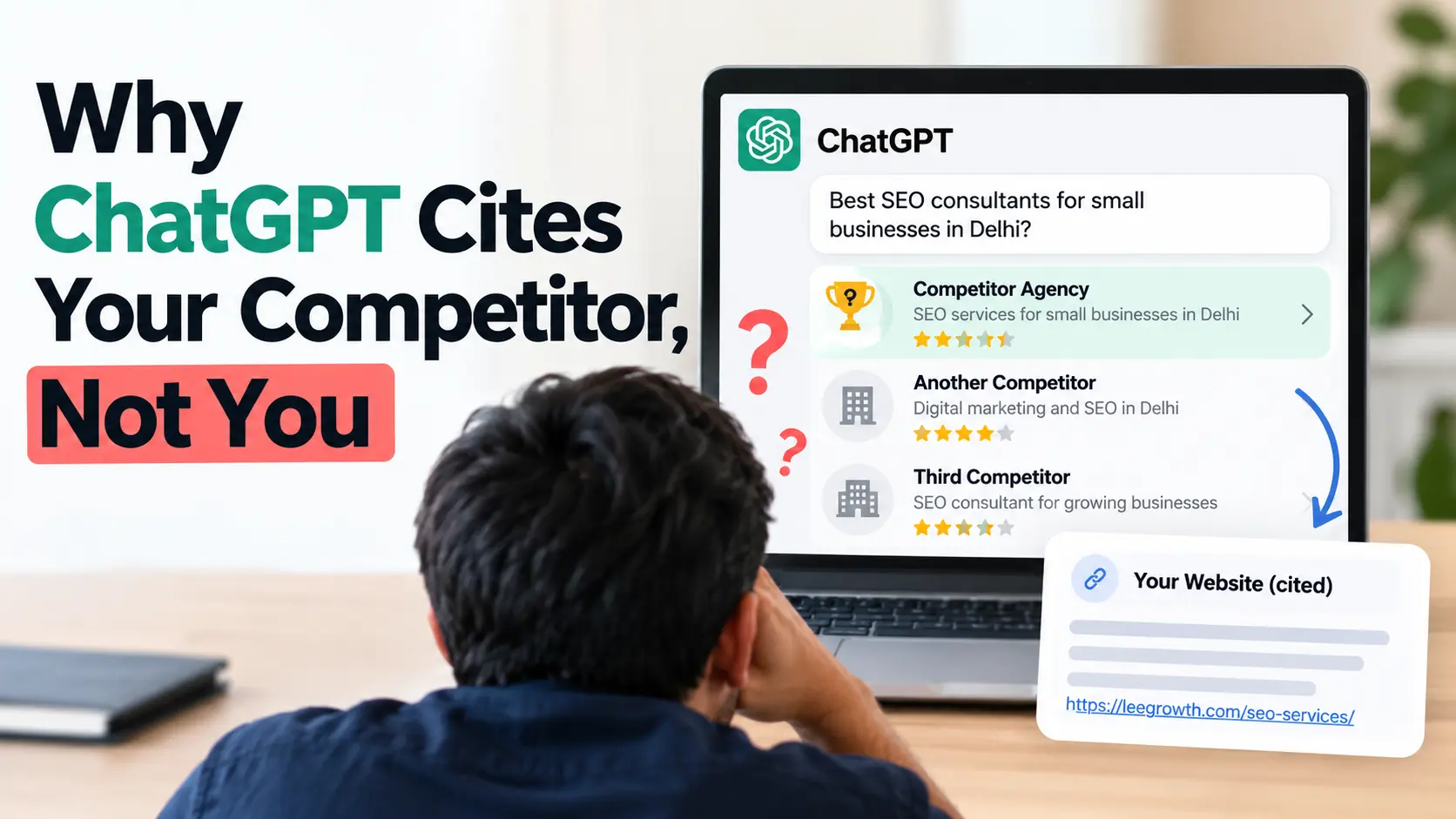
You ask ChatGPT for a business like yours. It names three companies, and you are not one of them. You try another question. Your competitor shows up again.
Then you check the sources, and it gets stranger. ChatGPT links to a page from your own website, but still recommends someone else. Those ChatGPT citations look like good news until you notice they did not turn into a recommendation.
Ranking well on Google does not automatically mean ChatGPT will recommend you. An AI answer can pull from several sources, and it answers a conversational question differently from a normal search results page.
This guide shows you how to find the gap, what to fix first, and how to test whether your changes helped. You do not need a technical background.
Why does ChatGPT recommend my competitor?
Usually, it means your competitor has clearer or more relevant information available for that specific question. It does not automatically mean they have a better website or better SEO.
That is a working explanation, not something OpenAI has confirmed. The information could be:
- Clearer service pages
- Content that answers the exact question the customer asked
- Mentions on other websites
- Business details that match everywhere online
- Pages that say clearly who the business serves and where
Here is what OpenAI has said publicly. ChatGPT can search the web and link to its sources, as OpenAI explains on its ChatGPT Search page. It uses third party search providers as well as content from partners. OpenAI’s help article adds that search results and citations can be incomplete, outdated or incorrect, and that ChatGPT ranks results using multiple factors without guaranteeing placement.
OpenAI does not publish those factors, so there is no “ChatGPT ranking score” you can work on. Treat any single answer as a snapshot. The practical goal is simpler: make your business easy to find, easy to understand and easy to verify.
Why does ChatGPT cite my website but recommend another company?
A page can be useful as a source without making your business the obvious choice for the question asked. One possibility is that your page supplied useful information, while the available evidence did not connect your business as strongly to the recommendation being requested. This is something to test, not a confirmed explanation of how ChatGPT works inside.
Retrieval vs citation vs recommendation
Three different things can happen in an AI answer, and people often mix them up.
- Retrieval means finding information.
- Citation means using that information as a source and showing it.
- Recommendation means naming a business as an option.
| Stage | What it means | Example |
|---|---|---|
| Retrieval | AI finds relevant information | Your SEO page is found |
| Citation | AI uses your page as a source | Your URL is shown as a link |
| Recommendation | AI names your company as an option | “Consider Lee Growth” |
Retrieval does not guarantee citation. Citation does not guarantee recommendation. So ChatGPT citations only tell you your page was used as a source. They do not tell you your business was recommended.
How does AI search interpret a customer question?
Take this search: “SEO services for small businesses in Delhi.”
The important context is not only “SEO.” The question contains several connected ideas:
- Service: SEO
- Provider: a consultant or company
- Customer: a small business
- Location: Delhi
- Goal: hiring someone, or getting a recommendation
A strong page makes these links clear in plain sentences. It says who offers the service, what the service is, who it is for and where.
Google documents a process called query fan-out for its AI Overviews and AI Mode, where one complex question is split into several related searches. You can read about it in Google’s AI features documentation. That shows how one question can become many. It does not prove that ChatGPT works the same way. OpenAI does say ChatGPT search can rewrite your question into one or more targeted searches before it looks for results.
Why can a weaker looking competitor still be recommended?
Many owners assume the better website should win. It often does not, because visibility seems to depend on the specific question, not just overall website quality.
Compare two websites:
- Website A says: “We are a full service digital company helping businesses reach their online goals.”
- Website B says: “Local SEO for restaurants, clinics and small shops in Delhi. We set up Google Business Profiles, local landing pages and city specific content.”
Website A may be bigger, prettier and older. But Website B is much easier to match with “local SEO for a small clinic in Delhi.” Your competitor may not be better overall. They may simply be easier to understand for the exact thing the customer asked.
The Competitor Citation Gap
Once you know who keeps appearing, compare them with you, signal by signal. This is my own audit framework. It is not an official OpenAI metric and not a known ChatGPT ranking factor. The numbers below are examples only.
| Signal | Your Brand | Competitor | Gap |
|---|---|---|---|
| Relevant service pages | 2 | 6 | High |
| Customer specific content | Low | Strong | High |
| Third party mentions | 1 | 7 | High |
| Comparison content | 0 | 4 | High |
| Brand attribution | Moderate | Strong | Medium |
| Entity consistency | Moderate | Strong | Medium |
| Recommendation content | Low | Strong | High |
The goal is not to copy your competitor. It is to find which relevant signals they have that you do not. Then you can decide which gap is worth closing first.
The 7 Layer AI Search Visibility Diagnostic
When a competitor keeps appearing, check these seven layers. Each one has a question to ask and a simple fix.
- Search intent. Does your content answer the kind of question people ask, such as explaining, comparing or choosing? Fix: add pages that help people choose and hire.
- Retrieval. Can search systems find and open the page? Fix: check indexing, robots.txt and internal links.
- Semantic relevance. Does the page connect your service, customer, problem and place? Fix: replace vague copy with specific sentences.
- Brand attribution. If one section is read alone, can it be tied to your business? Fix: name your business naturally in key sections.
- External evidence. Do other websites back up what your site says? Fix: earn honest mentions on relevant sites.
- Entity consistency. Do your name, services, location and description match everywhere? Fix: correct profiles that conflict.
- Recommendation coverage. Do you cover “best,” “alternatives,” “compare” and “how to choose” questions? Fix: publish useful decision content.
You do not need to fix all seven at once. Start with the layer where you are weakest.
How to improve brand visibility in AI search engines
If you want a short action list, start here. These steps can make your business easier to understand, find or verify. None of them guarantees a recommendation. For a longer checklist, see my guide on how to optimize your website for AI search.
- Make your category clear. Say plainly what you are. “Lee Growth is a freelance digital marketing service in Delhi offering SEO and content for small businesses” works better than “we help ambitious companies grow.”
- Build a separate page for each main service. One page for SEO services, one for local SEO, one for audits. Each should explain what it is, who it is for, what is included, how it works and what to do next.
- Match customer wording. Use the words customers actually use.
- Answer buying questions. Cover pricing, how to choose, alternatives and comparisons.
- Strengthen brand attribution. Name your business where it helps a section make sense on its own.
- Earn mentions on other relevant websites. Directories, industry articles, interviews and partner pages.
- Keep your business details the same everywhere. Name, location, services and description.
- Fix technical barriers. Important pages should be indexed, linked and readable as text.
- Create comparison and decision content. For example, “SEO freelancer vs agency for a small business.”
- Monitor what AI tools say about you. Test the same questions regularly and record the results.
Semantic relevance and the question behind the question
Concepts matter more than repeating keywords
Semantic relevance sounds technical, but the idea is simple. A page should connect related ideas, not repeat one phrase.
On an SEO service page, technical SEO, on page SEO, local SEO and keyword research are all parts of the same service. Local SEO connects to Google Business Profile. “Small businesses” says who it is for, and “Delhi” says where. A page that explains these links in normal sentences gives a search system more to work with than a page that says “SEO services” thirty times.
Google’s guide to optimizing for generative AI says unique, useful content will likely matter more over time than other tactics, and that you do not need to rewrite content just for AI systems. If you need help turning this into pages, that is what SEO content writing is for.
Make service pages specific
- Weak: “We offer innovative digital marketing solutions designed to help businesses grow.”
- Better: “Lee Growth provides SEO services for small businesses, including technical SEO audits, on page optimization, keyword research and content optimization.”
The second version tells the reader and search systems four things: who the business is, what it offers, who it serves and which services are included.
Write for the question behind the question
When someone asks, “Why doesn’t ChatGPT recommend my business?”, they are really asking several things:
- How does AI find businesses?
- Why does my competitor appear?
- Why isn’t my website cited?
- Why is my website cited but another company recommended?
- Which sources influence the answer?
- How can I improve my visibility?
- How do I measure progress?
A good page answers the connected questions too. That is how you cover a topic fully without stuffing keywords.
Use your customers’ language
Your customer searches “SEO audit for my website.” Your internal term might be “organic visibility assessment.” Lead with the words the customer uses. You can mention your own term after that, where it helps.
Good places to find that language:
- Google Search Console queries
- Questions customers ask you directly
- Reviews
- Sales calls and support messages
- Competitor FAQ pages
- Google autocomplete
- Reddit and industry forums
Do not overdo it. A few real phrases in the right places are enough.
Brand attribution
AI systems can use smaller passages or pieces of information from a page when building an answer. So an important section should still make sense if it is read on its own. It should make reasonably clear:
- Who the business is
- What it offers
- Who it serves
Example:
- Weak: “Our SEO services help businesses improve organic visibility.”
- Stronger: “Lee Growth’s SEO services help small businesses improve organic visibility through technical fixes, on page work and content.”
A simple test: if this paragraph appeared without the rest of my website, would someone know whose it is? If not, name your business naturally in the sentence where it matters. Do not repeat your name in every line. Once per important section is enough.
This is not about chopping your content into tiny pieces. Google says that is not required. It is about writing sections that stay clear on their own. For more on this, read how to write content that AI search engines can understand.
Third party evidence
Your website is one part of your information footprint. Other websites provide another type of evidence:
- Owned evidence: what you say on your own website
- External evidence: what others say about you, including directories, industry publications, interviews, reviews, partner pages and comparison pages
Relevant external sources can give context around a business that its own site cannot give about itself. To see where you stand, look at where your competitor is mentioned and ask:
- Which websites mention them?
- Which directories list them?
- Which comparison pages include them?
- How is their business described?
- Are those mentions recent?
- Are those sites relevant to your customers?
Then look for honest ways to appear in some of the same places. Do not manufacture evidence. Earn relevant mentions. Fake reviews, paid fake rankings or “top 10” lists that rank yourself first can damage trust.
Keep your business details the same everywhere
Here, an entity simply means your business as a clearly identified thing online. If you are “Lee Growth” on your website, “LeeGrowth Media” in a directory and “Lee Growth Agency” on a profile, it is harder for anyone, human or machine, to be sure these are the same business.
Check that these do not conflict across your important profiles:
- Business name
- Website address
- Location
- Services
- Short business description
- Email and phone
- LinkedIn and other profiles
- Google Business Profile, if you have one
Technical checks
New content will not help if your important pages cannot be reached. Check only what matters:
- Key pages are indexed and not set to “noindex” by mistake
- Your robots.txt file is not blocking them
- Important pages are linked from other pages on your site
- Pages load properly, with no broken links or server errors
- Your main content is real text, not hidden inside images or scripts
- Your sitemap is up to date
- OpenAI says website owners can allow OAI-SearchBot to crawl their sites so their content can be included in ChatGPT search results. Allowing the crawler does not guarantee that a page will be shown or cited.
- Google Search Console is checked regularly
These checks do not cause a recommendation. They only remove reasons for good pages to be missed. A website SEO audit covers all of them.
On schema markup: Google says no special schema is needed for its AI features. Structured data can help search engines interpret eligible information on a page, but it cannot force an AI system to recommend your business. Fix vague service pages before spending weeks on schema.
On llms.txt: Google says Google Search ignores these files, and it is fine to create one for other services. OpenAI’s help article on making a site eligible for ChatGPT search talks about OAI-SearchBot access, not llms.txt. So it should not come before clear pages and good information.
Google rankings vs AI search visibility
Google says its AI features are rooted in its core Search ranking and quality systems, so SEO still matters. These two overlap, but they are not the same.
- Results vs answers: Google shows a list of links. AI tools often give one written answer with a few sources.
- Keywords and meaning: Keywords still matter in SEO, but modern search also looks at meaning, context and intent. AI search makes these relationships especially noticeable.
- Pages and brands: SEO is often measured at the page and query level, while AI search can make brand level visibility more noticeable.
- What you measure: Rankings and clicks still matter. With AI answers, mentions, citations and referrals matter too.
Track both. Google Search Console also has a Generative AI performance report, but it covers Google’s own AI features, not ChatGPT.
What if your competitor has fewer backlinks?
Backlinks still matter for SEO. But backlink quantity alone does not explain why a business is recommended for a specific question. Other things can matter too:
- Pages that match the question more closely
- Clearer service pages
- Relevant third party mentions
- Better use of customer wording
- Business details that match everywhere
- More comparison content
- Better coverage of buying questions
OpenAI has not published how much weight backlinks carry in ChatGPT search. So do not assume links will fix this, and do not assume they do not matter. Look at the full picture.
AI Citation Gap Score
This is a practical framework created for this guide. It is not an official OpenAI or ChatGPT score. Use it to find your weakest areas. Score each area from 0 to 5.
| Area | Score |
|---|---|
| Crawlability | /5 |
| Service clarity | /5 |
| Search intent alignment | /5 |
| Semantic relevance | /5 |
| Brand attribution | /5 |
| Entity consistency | /5 |
| Third party coverage | /5 |
| Recommendation and comparison coverage | /5 |
| Customer terminology | /5 |
| Content depth | /5 |
| Total | /50 |
- 40 to 50: Strong foundation
- 30 to 39: Moderate gaps
- 20 to 29: Significant gaps
- 0 to 19: Fix the fundamentals first
A high score does not mean ChatGPT will recommend you. The score only shows where you are weak. “We scored 1 out of 5 on third party coverage and 2 out of 5 on brand attribution” tells you exactly where to start.
Competitor Citation Gap Audit
Here is the full process, from start to finish.
- Build 20 to 30 real customer questions. Use questions customers actually ask, not keyword lists.
- Sort them by type: informational, commercial, recommendation, local and transactional.
- Test them consistently. Use the same wording each time, and repeat them on different days since answers change.
- Record what happens: whether you were mentioned, recommended and cited, which URL was cited, which competitor appeared, and which sources were shown.
- Study the competitor who keeps appearing. Look at their service pages, wording, external mentions and how recently things were updated.
- Name the gap in plain words. For example: “They have a page for SEO for SaaS companies, and we only have a general SEO page.”
- Fix the highest value gap first.
- Retest. Run the same questions again after your changes.
AI search visibility metrics
These are practical tracking metrics, not official OpenAI metrics. Keep them in a simple sheet.
- Mention rate: brand mentions ÷ total relevant prompts × 100
- Recommendation rate: brand recommendations ÷ relevant prompts × 100
- Citation rate: cited responses ÷ relevant prompts × 100
- Competitor visibility: track how often each competitor appears across your test questions
Example: you test 20 questions and your brand is mentioned in 5. Your mention rate is 5 ÷ 20 × 100 = 25%.
Also track cited URLs, source domains, prompt category and date. And check accuracy: is what ChatGPT says about your business correct?
How can I check my brand visibility in ChatGPT?
Ask ChatGPT the questions your customers would ask, without your brand name, and write down what it says. Then repeat the same questions on a schedule.
Do not test only your own name. “What is Lee Growth?” tells you very little. The real opportunity is in questions where the customer has not heard of you yet, such as:
- Best SEO consultants for small businesses
- Affordable local SEO services
- Who can audit my website for SEO
- What to look for when hiring an SEO freelancer
For local questions, include your city. OpenAI says ChatGPT can use approximate location from your IP address for local results, so keep your testing setup the same each time. Record the cited URL too, since your ChatGPT citations show which of your pages are being used as sources.
| Date | Prompt | Mentioned | Recommended | Cited | Competitor | Cited URL | Other sources | Accurate? |
|---|---|---|---|---|---|---|---|---|
| Example | Best SEO agency for startups | ✓ | ✗ | ✓ | Agency X | /seo | Directory A | Yes |
| Example | Affordable local SEO | ✗ | ✗ | ✗ | Agency Y | None | Review site B | Not applicable |
| Example | SEO audit for small business | ✓ | ✓ | ✓ | Agency Z | /audit | Blog C | Partly |
AI answers can change from one day to the next. A single test is not a ranking, so never report one screenshot as a result. The same method works on other tools such as Perplexity and Google’s AI Overviews and AI Mode, but results differ, so track each one separately.
Understanding ChatGPT source selection is less about finding a secret ranking factor and more about checking which sources repeatedly appear for the questions you care about.
Decision tree: find your visibility gap
Start at the top and follow the answers.
Is your brand mentioned?
- No. Check these:
- Retrieval and indexing
- Relevance of your pages
- Clarity about who you are
- External evidence
- Yes. Go to the next question.
Is your website cited?
- No. Check these:
- Whether your content matches the question
- Source quality
- Page clarity
- Yes. Go to the next question.
Are you recommended?
- No. Check these:
- Commercial intent coverage
- Brand attribution
- What makes you different
- Recommendation and comparison content
- Yes. Keep monitoring, and check that the details are accurate.
What not to do
- Do not stuff “ChatGPT” or your brand name into every paragraph. It reads badly and does not build trust.
- Do not publish dozens of thin articles. More pages do not mean more visibility.
- Do not create fake “best of” lists or reviews.
- Do not change everything at once. If you rewrite your site, publish 30 posts and chase 15 mentions in a month, you will not know what worked.
- Do not treat one good answer as a result. Answers vary, so one screenshot proves very little.
- Do not chase tricks. No file or markup is known to force a recommendation.
30 day action plan
Week 1: Diagnose. Write 20 to 30 questions, test them, and record which competitors and sources appear. Check that your key pages can be found.
Week 2: Fix. Improve your main service pages, add brand attribution to important sections, and fix any technical issues.
Week 3: Build evidence. Look for honest mentions on relevant websites. Add one or two comparison or buying guide pages.
Week 4: Measure. Retest the same questions, compare with your Week 1 results, and choose the next gap to work on.
What we know vs what we don’t know
What we know
- ChatGPT can search the web and show source links.
- OpenAI says it uses third party search providers and partner content.
- OpenAI says search results and citations can be incomplete, outdated or incorrect.
- OpenAI says it ranks results using multiple factors, and that placement is not guaranteed.
- Google says no special markup or extra files are needed for its AI features.
- Search systems work better when important pages are accessible, understandable and relevant to the question.
What we don’t know
- OpenAI’s full recommendation or ranking method
- A guaranteed set of “ChatGPT ranking factors”
- A fixed score that decides whether a business gets recommended
These tools change, so check current guidance from OpenAI and Google from time to time.
FAQs
1. Why does ChatGPT recommend my competitor?
Usually, it means your competitor has clearer or more relevant information for that question. It does not automatically mean they have a better website. Use the audit above to find which gap applies to you.
2. Why does ChatGPT cite my website but recommend another company?
A page can be useful as a source without making your business the obvious choice. Check whether the relevant section says who you are, what you offer and who it is for.
3. How does ChatGPT find businesses?
ChatGPT can search the web and link to the sources it uses. OpenAI says it uses third party search providers and partner content, so what it finds depends partly on what those sources can see. How it picks which businesses to name is not published.
4. Why does ChatGPT cite certain websites more than others?
OpenAI has not published a full list of reasons. It says ChatGPT ranks results using multiple factors meant to surface relevant, reliable information. Clear, relevant pages that crawlers can access are at least easier for any search system to use.
5. Can ChatGPT citations be wrong?
Yes. OpenAI says search results and citations can be incomplete, outdated or incorrect. Always open the cited source to check that it supports the answer, and check what ChatGPT says about your own business too.
6. How can I check my brand visibility in ChatGPT?
Use a fixed list of customer questions without your brand name, ask them regularly and record the results. Keep the questions and your testing setup the same so you can see real change.
7. Does Google ranking affect ChatGPT visibility?
Not automatically. Good rankings help people find you, but AI answers can use different sources and combine them differently. The two overlap, but they are not the same.
8. Does schema help AI visibility?
Schema does not force a recommendation. Google says no special schema is needed for its AI features. Structured data can help search engines read your pages, but it will not make up for vague content.
9. Should I use llms.txt?
It is not proven to help. Google Search ignores these files, and OpenAI’s search guidance talks about crawler access instead. Put clear pages and good information first.
10. How do I monitor competitors in AI search?
Add a competitor column to your tracking table. Note who appears, how often, and which sources are shown.
11. How long does AI visibility optimization take?
There is no fixed timeline. Google says crawling can take anywhere from several days to several months, depending on how often it decides a page needs refreshing. Building outside mentions usually takes longer than fixing pages. Retest monthly.
12. Can I guarantee that ChatGPT recommends my business?
No. Anyone who promises that is guessing. You can make your business easier to find, understand and verify, but you cannot control the answer.
Final takeaway
When ChatGPT recommends your competitor, the useful question is not “what trick are they using?” It is: what can someone find about my competitor that they cannot find about me?
The answer may be something ordinary: a clearer page, a mention on a trusted site, or business details that match everywhere. Find the biggest difference, fix it and test again. That turns AI visibility from guesswork into an SEO investigation.
Find out why competitors appear and you don’t
If you can see your competitor appearing repeatedly but cannot see why, I can help you turn that pattern into a practical SEO action plan.
I’m a digital marketing consultant based in Delhi, and I work directly with clients. I can review your website and the questions your customers ask, then show you where competitors are ahead and what to fix first. See how I work, or book a call below.
Book a Free Consultation with Lee Growth

I’m Leena Kalyana, a Delhi-based freelance digital marketer and graphic designer. I work across SEO, content marketing, social media, and digital design. I’m interested in helping businesses build a stronger online presence through practical SEO strategies, useful content, and creative digital marketing.