In this article
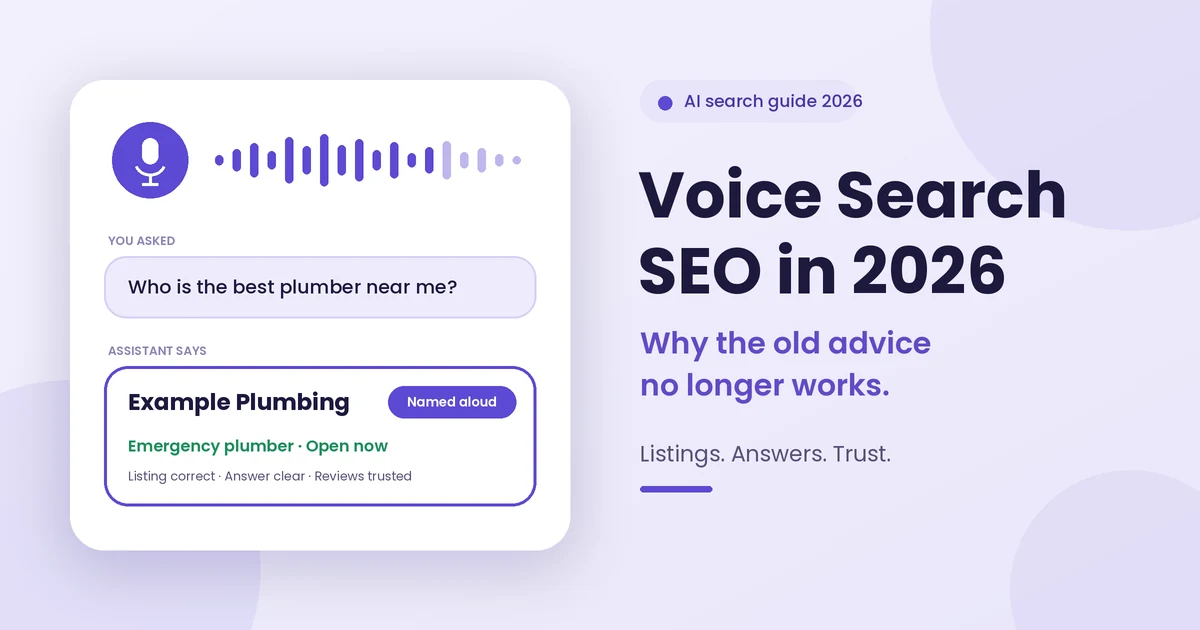
Voice search SEO in 2026 is no longer just about targeting conversational keywords or getting your website featured in Google’s snippets. People now use voice assistants, AI-powered search experiences and conversational tools to find businesses, compare services and get immediate answers.
When someone asks, “Which SEO agency can help a B2B company improve its organic visibility?”, the challenge is no longer simply ranking for a particular keyword. Your website needs to provide relevant information, demonstrate credibility and make it easy for search systems to understand what your business offers.
This is where traditional SEO, Answer Engine Optimization (AEO), Generative Engine Optimization (GEO) and local search intersect.
The old advice still has some value, but it does not explain how modern search experiences work.
This guide explains what has changed, which voice search optimization techniques still matter, and how businesses can improve their visibility across Google, Siri, Alexa and AI-powered assistants.
Last updated: November 9, 2026
Key Takeaways
- Voice search is increasingly connected to conversational and AI-powered search experiences.
- Conversational keywords alone are not a complete voice SEO strategy.
- Accurate business information helps search platforms understand local businesses.
- Clear answers, descriptive headings and useful content improve information accessibility.
- Google Business Profile, Apple Business and Bing Places help maintain business information across their respective platforms.
- Speakable structured data has a specific use case and is not a universal ranking shortcut.
- Traditional SEO fundamentals remain important for AI-powered search experiences.
- Businesses should measure qualified traffic, calls, leads and visibility rather than relying on assumed voice-search traffic figures.
What Is Voice Search SEO?
Voice search SEO is the process of optimizing website content and business information so that search engines and voice-enabled assistants can understand and retrieve relevant information when people speak their queries.
Traditional searches often contain short phrases such as:
- SEO agency Delhi
- Best CRM software
- WordPress development services
Voice searches can be expressed as complete questions:
- Which SEO agency in Delhi works with B2B companies?
- What is the best CRM software for a small business?
- How much does a WordPress website cost?
The underlying search intent may be similar, but the way people express their questions can differ.
Voice search optimization focuses on making information easy to discover, understand and access through spoken interactions.
It involves several interconnected areas:
- Technical SEO
- Content optimization
- Local SEO
- Structured data
- Business information management
- Search intent optimization
- Accessibility and mobile usability
Voice search SEO is not a separate technical discipline with its own guaranteed ranking formula. It builds on established SEO practices.
For a broader understanding of how search systems interpret businesses and their relationships, explore our guide to ChatGPT citations and how AI assistants discover website information.
How Has Voice Search Changed Between 2018 and 2026?
The biggest change is the evolution of search interfaces.
In earlier years, voice search was commonly associated with assistants responding to relatively simple commands and questions.
Examples included:
- What is the weather today?
- Where is the nearest restaurant?
- Who won the match?
- What time does the shop close?
Today, people can use conversational interfaces to ask longer questions, provide additional context and request follow-up information.
Google AI Mode, AI Overviews and conversational AI assistants have expanded how people explore information.
This does not mean every traditional voice query is now answered by a generative AI model. Conventional voice search, local search and AI-assisted search continue to coexist.
Traditional Voice Search vs Modern Search Experiences
| Earlier approach | Modern approach |
|---|---|
| Target exact spoken phrases | Understand the complete search intent |
| Focus on individual keywords | Cover related questions and subtopics |
| Chase featured snippets | Build useful, reliable and accessible content |
| Treat voice as a separate SEO channel | Connect voice optimization with broader SEO |
| Focus primarily on spoken answers | Consider text, maps, citations and conversational responses |
| Measure keyword rankings | Monitor visibility, qualified visits and conversions |
The practical lesson is simple: businesses should optimize for the information people need, not just the exact words they speak.
Voice Search vs AEO vs GEO: What Is the Difference?
These three concepts are related, but they serve different purposes.
1. Voice Search Optimization
Voice search optimization focuses on making information accessible through spoken queries.
For example:
A user asks, “Where can I find a WordPress developer near me?”
The search experience may return local business information, maps or website results.
2. Answer Engine Optimization (AEO)
Answer Engine Optimization focuses on making content useful for systems that provide direct answers.
For example:
A user asks, “What is technical SEO?”
A well-structured article should explain the concept clearly, without forcing the reader to search through several unrelated paragraphs.
3. Generative Engine Optimization (GEO)
Generative Engine Optimization focuses on improving the visibility and representation of a brand or source in generative AI experiences.
For example:
A user asks an AI assistant, “Which SEO agencies specialize in B2B SaaS companies?”
The assistant may generate a response using information from multiple sources.
Understanding how AI systems select and reference information is important here. Read our related guide on how ChatGPT citations work.
How They Work Together
| Area | Primary objective | Example |
|---|---|---|
| Voice SEO | Improve spoken-query accessibility | Finding a nearby service |
| AEO | Provide clear answers | Explaining technical SEO |
| GEO | Improve visibility in AI-generated responses | Being referenced in an AI recommendation |
| Traditional SEO | Improve organic search visibility | Ranking a service page |
These disciplines overlap, but optimizing for one does not guarantee visibility in the others.
Google’s official guidance confirms that its AI search experiences continue to rely on foundational SEO practices. There are no special AI-only markup requirements for appearing in AI Overviews or AI Mode.
Reference: Google Search Central – AI Features and Your Website.
Where Do Voice Assistants Get Business Information?
Different platforms maintain and retrieve information through different systems.
There is no universal database or single ranking formula shared by every voice assistant.
For local businesses, managing accurate information across important platforms is a sensible starting point.
Google Assistant and Google Search
Google Business Profile allows eligible businesses to manage their information across Google Search and Google Maps.
Important information includes:
- Business name
- Primary business category
- Address or service area
- Contact number
- Business hours
- Website
- Services
- Photos
- Customer reviews
Google also uses information from other sources. Maintaining an accurate Business Profile does not guarantee a particular voice-search recommendation.
Official resource: Google Business Profile.
Businesses that depend on location-based searches should also understand local SEO for small businesses.
Siri and Apple Maps
Apple Business allows businesses to manage their place cards across Apple’s ecosystem, including Apple Maps and Siri-related experiences.
Businesses should check:
- Correct business name
- Location details
- Contact information
- Opening hours
- Website
- Business photos
- Relevant location information
Official resource: Apple Business.
Bing and Microsoft Search
Bing Places for Business allows businesses to claim and manage their business listings.
It is particularly relevant for maintaining accurate information within Microsoft’s local search ecosystem.
Check:
- Business name
- Address
- Phone number
- Website
- Opening hours
- Business category
Official resource: Bing Places for Business.
ChatGPT and Other AI Assistants
AI assistants may use web retrieval, search indexes and other information sources, depending on the product and the specific experience.
There is no publicly documented universal source database that guarantees a business will be recommended.
Businesses should focus on:
- Crawlable website content
- Accurate and consistent company information
- Useful service pages
- Original information
- Credible third-party mentions
- Clear descriptions of their products and services
For more detail, explore how Perplexity chooses its sources and how AI-powered systems discover information across the web.
Which Old Voice Search SEO Techniques No Longer Work?
Some traditional recommendations are still useful, but relying on them alone is a mistake.
1. Targeting Long-Tail Keywords Without Understanding Intent
Earlier voice SEO advice often suggested targeting longer, conversational keywords.
For example:
“Best digital marketing agency in Delhi for small businesses.”
However, including a conversational phrase does not automatically make a page relevant.
A better approach is to understand what the searcher actually wants.
Consider these queries:
- What does an SEO agency do?
- How much does SEO cost?
- Which SEO agency works with SaaS companies?
- How do I improve my website’s organic traffic?
These questions represent different search intents.
A single page should not attempt to satisfy every possible intent.
Build content around the actual problem and provide the information necessary to solve it.
2. Treating Featured Snippets as the Entire Strategy
Featured snippets remain a search feature, but they are not the only way information reaches users.
Modern search experiences can combine information from multiple pages and sources.
Instead of writing content exclusively to win a featured snippet:
- Answer questions clearly.
- Use descriptive headings.
- Provide supporting evidence.
- Include useful examples.
- Explain important concepts.
- Link to relevant resources.
The objective should be to create the most useful answer for the intended audience.
3. Adding Speakable Schema Everywhere
Speakable is a structured data property documented by Google for identifying sections of a webpage suitable for text-to-speech playback.
However, its documented Google Assistant use case is specific to eligible topical news content.
It is not a general-purpose ranking factor for every business website.
Small businesses should not prioritize Speakable markup over accurate information, useful content and technical SEO.
Reference: Google Search Central – Speakable Structured Data.
4. Publishing Content Around Unverified Voice Search Statistics
Many articles publish large voice-search statistics without explaining their original sources, research methodology or publication dates.
This creates a problem for businesses making SEO decisions.
Before using a statistic, check:
- Who conducted the research?
- When was it published?
- Which country or market was studied?
- How many people participated?
- What exactly was measured?
- Does the statistic still represent current user behaviour?
For example, BrightLocal’s Voice Search for Local Business study was published in 2018. It can provide historical context, but it should not be presented as a measurement of current 2026 behaviour.
A reliable SEO strategy should use evidence rather than repeating statistics simply because other blogs publish them.
How to Optimize Your Website for Voice Search in 2026
The following nine steps provide a practical framework.
1. Fix Your Business Information
Start with the information search platforms use to understand your business.
If your business name, contact information or opening hours are inconsistent, customers may receive incorrect details.
Check the following:
- Google Business Profile
- Apple Business
- Bing Places
- Your official website
- Relevant industry directories
Make sure that your information reflects your real business.
For service-area businesses, specify only the areas you genuinely serve.
Do not create misleading location pages or use virtual offices as real customer-facing locations.
For a broader approach to local visibility, read our guide to local SEO for small businesses.
2. Use Real Customer Questions as Headings
Your content should reflect the questions customers actually ask.
Instead of writing a generic heading:
“SEO Services”
Consider using:
“How Can SEO Services Help a B2B SaaS Company?”
This makes the purpose of the section more explicit.
Use questions from:
- Google Search Console
- Customer emails
- Sales conversations
- Customer support requests
- Reviews
- People Also Ask results
- Keyword research tools
You can use tools covered in our guide to SEO tools for small businesses in India to support keyword discovery and performance analysis.
Do not force every heading into a question format. Use questions where they genuinely match the content.
3. Answer the Question Directly
Avoid making readers go through several paragraphs before reaching the answer.
For example:
Question: What is technical SEO?
Technical SEO is the process of improving a website’s technical foundation so search engines can crawl, understand and index its pages. It includes site architecture, indexing controls, canonical tags, structured data and website performance.
You can expand the explanation underneath.
A short opening answer can improve readability and make the information easier to extract. However, there is no guaranteed word count or paragraph length that secures a voice-search ranking.
4. Write in Clear, Natural Language
Content should sound natural when read aloud.
Consider this example.
Before:
Our organization provides a comprehensive range of innovative digital solutions designed to facilitate the development of business-oriented growth strategies through the implementation of advanced optimization methodologies.
After:
We help businesses improve their organic search visibility through technical SEO, keyword research and content optimization.
The second version communicates the same general idea with fewer unnecessary words.
Use:
- Short sentences.
- Active voice.
- Clear terminology.
- Descriptive headings.
- Specific examples.
- Explanations of technical terms.
Clarity is more important than artificially shortening every sentence.
5. Build an FAQ Around Real Search Intent
FAQs can help answer specific questions that do not require an entire article.
For an SEO agency, useful questions might include:
- How long does SEO take to show results?
- What is included in a technical SEO audit?
- How much does B2B SEO cost?
- Can SEO generate qualified leads?
- What is the difference between on-page and off-page SEO?
- Does a new website need an SEO strategy?
Answer each question accurately and provide additional context when necessary.
Avoid adding dozens of repetitive FAQs simply to increase keyword coverage.
Also remember that adding FAQ schema does not guarantee FAQ rich results in Google.
6. Build Trust Through Expertise and Original Information
Search visibility is not just about matching phrases.
Your website should demonstrate why its information deserves attention.
Useful trust-building elements include:
- Author information
- Relevant professional experience
- Original research
- Real examples
- Case studies
- References to authoritative sources
- Transparent business information
- Consistent brand identity
For example, an article about technical SEO should ideally include practical examples of indexing problems, crawl errors or canonicalization issues.
A generic explanation that repeats information available across hundreds of websites provides limited additional value.
7. Implement Relevant Structured Data
Structured data helps search engines understand specific information about a webpage.
For business websites, relevant schema types may include:
| Schema | Purpose |
|---|---|
| Organization | Describes the organization |
| LocalBusiness | Describes an eligible local business |
| Article | Describes an article |
| BreadcrumbList | Describes the page’s position in site navigation |
| Product | Describes eligible products |
Use JSON-LD where appropriate and ensure that structured data matches the information visible on the page.
Do not add schema simply because a particular markup type is associated with voice search.
Google does not require special schema markup for AI Overviews or AI Mode.
Official reference: Google Structured Data Documentation.
8. Improve Mobile Experience and Page Performance
Many voice interactions take place on mobile devices.
A website that is difficult to navigate or slow to load creates a poor experience.
Review Google’s Core Web Vitals:
| Metric | Recommended threshold |
|---|---|
| LCP | 2.5 seconds or less |
| INP | 200 milliseconds or less |
| CLS | 0.1 or less |
These are Google’s good-performance thresholds at the 75th percentile.
Additional improvements include:
- Compressing large images.
- Removing unnecessary scripts.
- Enabling caching.
- Using responsive layouts.
- Improving navigation.
- Maintaining HTTPS.
- Avoiding intrusive pop-ups.
You can test your website using Google PageSpeed Insights.
9. Build Related Content Around Your Main Topic
One article rarely establishes comprehensive topical coverage.
If your website discusses voice search SEO, build supporting content around related subjects.
For example:
Main topic: Voice Search SEO
Supporting articles:
- Voice Search vs Traditional Search: Key Differences
- How Local SEO Influences Voice Search Visibility
- How to Optimize Content for Conversational Search
- AEO vs GEO: Understanding AI Search Optimization
- How AI Assistants Discover Business Information
- How to Improve Your Website’s AI Search Visibility
- Google Business Profile Optimization Guide
- How to Structure Content for Direct Answers
Connect these articles through relevant internal links.
Each supporting article should address a distinct search intent rather than repeating the same information.
For further reading, explore our guides to ChatGPT citations, Perplexity’s source selection and local SEO.
What Does Voice-Ready Content Look Like?
Let’s compare two versions of a business answer.
Imagine a customer asking:
“Do you provide SEO services for SaaS companies?”
Version A: Generic content
We are a digital marketing organization committed to delivering innovative strategies that help businesses achieve their online marketing objectives. Our team works across several areas of digital marketing to support organizations of different sizes.
Version B: Clear, direct content
Yes. We provide SEO services for SaaS companies, including technical SEO audits, keyword research, content strategy and organic search optimization. Our approach focuses on improving search visibility and attracting relevant business audiences.
Version B is more specific.
It explains:
- Who the service is for.
- What the business provides.
- Which activities are included.
- What the service aims to achieve.
This does not guarantee that a voice assistant will select the answer. It does make the information clearer for customers and search systems.
Who Benefits Most From Voice Search Optimization?
Voice search optimization can be useful across different industries, but the priorities vary.
Local Service Businesses
Examples:
- Plumbers
- Electricians
- Dentists
- Restaurants
- Salons
- Home repair businesses
These businesses should prioritize accurate local information, service details, reviews and location relevance.
Related reading: Local SEO for Small Businesses.
B2B and Technology Companies
B2B companies can benefit from clear answers to research-oriented questions.
Examples:
- What does a managed IT service provider do?
- How much does custom software development cost?
- What is the difference between cloud hosting and dedicated hosting?
- How can SaaS companies improve organic lead generation?
Their priority should be technically accurate content that supports the buyer’s research process.
Professional Service Providers
Examples:
- Accounting firms
- Business consultants
- Legal service providers
- Financial advisory companies
These businesses should focus on expertise, accurate service information and credible supporting content.
Ecommerce Businesses
Online stores can optimize information about:
- Product specifications
- Shipping
- Returns
- Availability
- Product compatibility
- Warranty information
Accurate product information and appropriate Product structured data can help search systems understand product pages.
How to Test Whether Voice Assistants Mention Your Business
You cannot assume your website is visible simply because it ranks for a related keyword.
You need to test the actual search experiences.
Here is a practical audit that businesses can conduct.
Step 1: Create Ten Customer Questions
Prepare questions that reflect your products, services and locations.
Example for a digital marketing agency:
- Which SEO agencies work with B2B companies?
- Who provides technical SEO audits?
- How much does SEO cost for a SaaS company?
- Which agency offers international SEO?
- How can a business improve its Google rankings?
- What is the difference between SEO and AEO?
- Which SEO services help generate B2B leads?
- How do I find a reliable SEO consultant?
- What should I check before hiring an SEO agency?
- How can a business improve its visibility in AI search?
Step 2: Test Multiple Assistants
Use available voice or conversational search experiences.
Examples:
- Google Assistant and Google Search
- Siri
- Alexa
- ChatGPT Voice
- Gemini Live
Remember that the capabilities and retrieval methods differ between products.
Step 3: Record the Results
Use a tracking table.
| Question | Assistant | Business mentioned? | Competitor mentioned? | Source |
|---|---|---|---|---|
| Which SEO agencies work with B2B companies? | Yes/No | Competitor name | Source URL | |
| Who provides technical SEO audits? | ChatGPT | Yes/No | Competitor name | Source URL |
| Which agency offers international SEO? | Gemini | Yes/No | Competitor name | Source URL |
| How much does SEO cost? | Siri | Yes/No | Competitor name | Source URL |
Step 4: Identify Visibility Gaps
If competitors appear more frequently, investigate:
- Their service pages.
- Their topical coverage.
- Their business information.
- Their reviews.
- Their external mentions.
- Their content quality.
- Their industry relevance.
Do not assume that publishing more blogs will automatically solve the problem.
Step 5: Repeat the Test
Run the same questions periodically.
Keep the device, location, wording and testing conditions as consistent as possible.
AI-generated responses can vary by location, time, product version and context.
Treat your results as directional observations, not a standardized ranking report.
How to Measure Voice Search SEO Performance
One of the biggest measurement challenges is that traditional analytics platforms do not provide a universally reliable voice-search traffic segment.
Google Search Console reports search performance, but it does not provide a dedicated report separating spoken queries from typed queries.
Therefore, use a combination of metrics.
| Metric | What it tells you |
|---|---|
| Organic impressions | How often your pages appear in search |
| Organic clicks | How many visits come from search |
| Average position | Your approximate ranking performance |
| CTR | How frequently searchers click your result |
| Branded searches | Whether more people search for your business |
| AI mentions | Whether assistants reference your brand |
| Phone calls | Whether customers contact your business |
| Direction requests | Whether local customers show visit intent |
| Leads | Whether visibility generates business opportunities |
Tools Worth Using
Google Search Console
Use it to identify queries, impressions, clicks, CTR and average position.
Google Analytics 4
Use it to understand landing-page engagement and conversions.
Google Business Profile
Monitor available business interactions and customer activity.
Google PageSpeed Insights
Check mobile and desktop performance.
Bing Places
Maintain accurate business information within Bing’s local search ecosystem.
For additional keyword and website analysis, see our guide to SEO tools for small businesses in India.
No single tool provides a complete measurement of voice-search visibility.
Common Voice Search SEO Mistakes to Avoid
Even businesses investing in SEO can overlook important details.
Avoid these mistakes:
- Keyword stuffing: Repeating conversational phrases unnaturally does not make content more useful.
- Ignoring local listings: Incorrect business information can confuse customers.
- Publishing generic FAQs: Questions should reflect actual customer needs.
- Adding irrelevant schema: Structured data must describe the visible content accurately.
- Ignoring mobile performance: A poor mobile experience can frustrate visitors.
- Creating duplicate location pages: Pages should provide genuine local value.
- Using outdated statistics: Research should always be checked against its original source.
- Publishing content without expertise: Generic articles provide little differentiation.
- Measuring only rankings: Visibility should ultimately support meaningful business outcomes.
Frequently Asked Questions About Voice Search SEO
1. Is voice search SEO still relevant in 2026?
Yes. People continue to use voice-enabled devices and conversational search experiences. Businesses should make their content understandable, maintain accurate business information and provide useful answers to customer questions.
2. Do I need a separate voice search SEO strategy?
Not necessarily. Most businesses can integrate voice-search considerations into their existing SEO, local SEO and content strategies. Separate technical implementations are not required for every voice-enabled experience.
3. What are voice search keywords?
Voice search keywords are the words and questions people use when speaking to a search assistant. Examples include “Where can I find a dentist near me?” and “How much does website development cost?”
4. Does Speakable schema improve voice search rankings?
There is no documented universal ranking benefit. Google’s Speakable documentation describes a beta feature for identifying suitable sections of news articles and webpages for audio playback. It should not be treated as a general ranking shortcut.
5. How do I optimize my website for Siri?
Start by maintaining accurate information through Apple’s business platform. Improve your website content, use clear service descriptions, maintain correct location details and ensure that important pages are accessible to search engines.
6. Can AI assistants recommend my business?
AI assistants can reference or recommend businesses using information available through their respective search and information systems. However, there is no guaranteed method to secure a recommendation.
7. Does voice search depend on local SEO?
Local SEO is particularly important for location-based queries such as “restaurants near me” or “emergency electrician nearby.” However, voice search also includes informational, educational and product-related questions.
8. How can I track voice search traffic?
There is no universal voice-search traffic report in Google Search Console. Monitor organic search performance, business calls, direction requests, conversions and visibility tests across voice-enabled assistants.
9. Does website speed affect voice search optimization?
Website performance contributes to overall user experience and is part of technical SEO. A fast, mobile-friendly website is preferable to one that creates unnecessary delays. However, speed alone does not guarantee voice-search visibility.
10. What should I optimize first?
Start with your website’s technical foundation, accurate business information, important service pages and content that directly answers customer questions. Measure the results and improve based on actual search performance.
Final Thoughts: Voice Search Is Part of a Bigger Search Evolution
Voice search has changed, but the fundamentals of helping people find useful information have not disappeared.
Businesses no longer need to chase every new voice-search trick or create separate pages for every spoken query.
They need a website that communicates clearly, answers relevant questions, maintains accurate business information and demonstrates genuine expertise.
The same foundations support traditional search visibility and can make information more useful across conversational and AI-powered search experiences.
At LeeGrowth, we approach SEO as a broader organic growth strategy. That means improving technical foundations, understanding search intent, building topical authority and creating content that serves real business objectives.
Want to understand how your website performs in modern search?
Explore our SEO services or request a free website SEO audit to identify opportunities for improving your organic visibility.
References and Further Reading
- Google Search Central – AI Features and Your Website
- Google Search Central – Speakable Structured Data
- Google Search Central – Article Structured Data
- Google Search Central – Structured Data Introduction
- Google Business Profile – Business Information Management
- Apple Business
- Bing Places for Business
- Google PageSpeed Insights
This article discusses general SEO practices. Search interfaces, assistant capabilities and platform documentation may change over time. No specific voice-search ranking or AI recommendation is guaranteed.

Leena Kalyana is an SEO and digital marketing consultant in Delhi NCR and the founder of LeeGrowth. She helps clinics, coaching institutes, consultants and small businesses get found on Google, Google Maps and AI search. She works directly with every client and does not guarantee rankings.