In this article
Written by Leena Kalyana, SEO and digital marketing consultant in Delhi NCR, LeeGrowth. Last updated: November 2026.
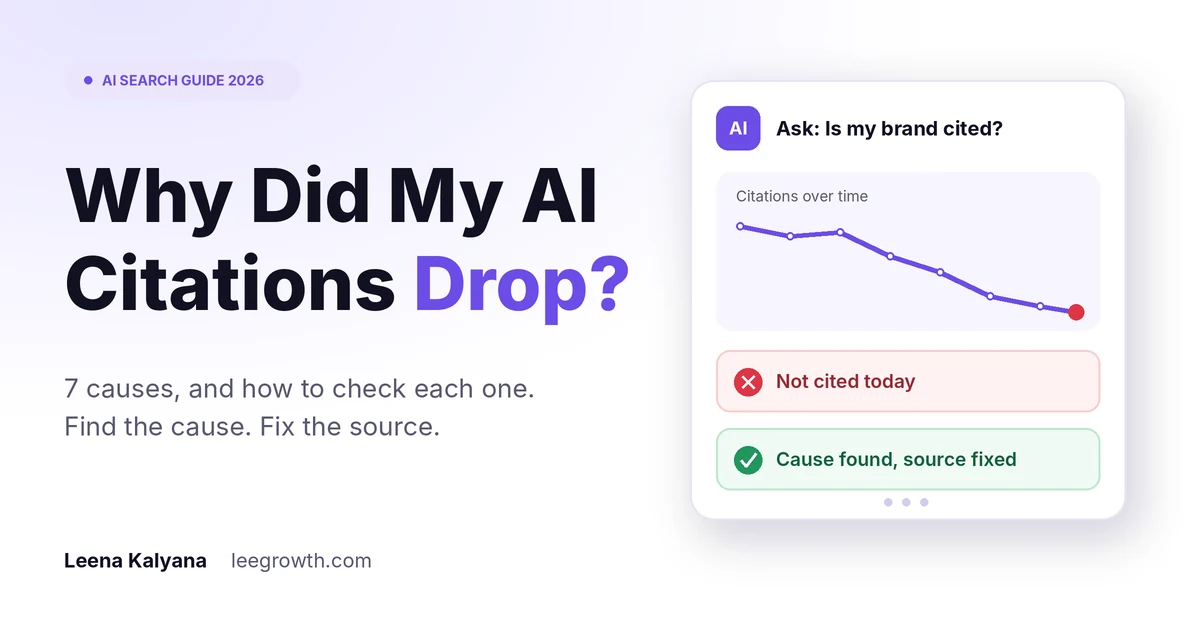
Many AI citation drops are normal source rotation, not a penalty. In published studies, 40% to 74% of cited domains changed within a week to a month, depending on the tool. Rule out drift, tracking changes, blocked bots, page edits, Google ranking losses and model updates before you rewrite anything.
An AI citation is a page that an AI tool lists as a numbered source in its answer. The seven checks below work whether you lost ChatGPT citations, lost Perplexity citations, or saw your AI visibility score fall. Figures in this guide were rechecked against the published sources in November 2026.
What are the key takeaways?
- Compare four to six weeks of the same test before you judge a drop.
- Check your tracking method before you check your content.
- Confirm that PerplexityBot and OAI-SearchBot can reach the page.
- Compare Search Console data for the same page before and after the drop.
- Record the date of any AI model update next to your results.
- Change one thing at a time and log the date.
About the examples: Cedar Row Bookkeeping is a made up Denver bookkeeper. All numbers for Cedar Row are invented to show how the checks work. They are not real test results.
What do the studies say, at a glance?
Studies agree that citations rotate, but they disagree on how fast. The size of the drift depends on the tool, the prompts and the way it is measured. Treat every figure as directional.
| Source | Date | Sample | Finding |
|---|---|---|---|
| SISTRIX | April 2026 | 82,619 prompts, 17 weeks, 6 countries | Cited domains changed by 56% per week in Google AI Mode and 74% per week in ChatGPT Search. For 53% of AI Overviews prompts, no source changed in 17 weeks. |
| Profound | July 2025 | About 80,000 prompts per tool, one month apart | 40.5% (Perplexity) to 59.3% (Google AI Overviews) of cited domains changed. Over six months, 70% to 90% changed. |
| BrightEdge | Weekly AI search report | Thousands of prompts across five tools | In one weekly report, 96.8% of cited domains showed no change week over week. |
| Ahrefs | August 2025 | 15,000 prompts | On average, 12% of links cited by ChatGPT, Gemini and Copilot ranked in Google’s top 10. Perplexity: 28.6%. |
| Search Engine Journal (Lily Ray) | February 2026 | 11 site sections, January 20 to February 16, 2026 | After an unconfirmed Google update, all 11 lost AI citations. ChatGPT fell 27.8% on average, Google AI Mode 23.8% and Perplexity 2.9%. |
| SISTRIX | June 2026 | 3.8 million German-language ChatGPT responses | Daily citation variation of 1% to 2% jumped to 47% around a May 2026 model change. SISTRIX says this is correlation, not proof. |
| Profound | Citation overlap analysis | ChatGPT and Perplexity compared | About 11% of cited domains appear in both tools. |
What are the key terms in this guide?
- AI citation: a page listed as a numbered source in an AI answer.
- Citation drift: the change in which sources an AI tool cites for the same question over time.
- ChatGPT: OpenAI’s chatbot, which cites web sources when search is on.
- Perplexity: an AI answer engine that cites numbered sources in every answer.
- Google AI Mode: Google’s conversational AI search view.
- PerplexityBot: the crawler that Perplexity uses to find and index web pages.
- OAI-SearchBot: the crawler that OpenAI uses to find pages for ChatGPT search.
- robots.txt: a text file that tells crawlers which pages to visit or skip.
- 200 status: the server code that means a page loads normally.
- noindex tag: a page instruction that tells search engines to skip the page.
- Search Console: Google’s free tool for clicks, impressions and positions.
- GA4: Google Analytics 4, Google’s free tool for website traffic.
- Source Map: a table that sorts every cited link by type, such as competitor, directory or forum.
Is a drop in AI citations real or normal drift?
A drop is normal drift when results move inside a range for four to six weeks. A drop is real when results fall every week and do not recover.
Citation drift happens because AI tools search live and rebuild the source set for each answer. Profound describes drift as a built in feature of how these probabilistic systems work, not a bug.
Drift is not the same on every tool. SISTRIX found that Google AI Mode answers often hold a small fixed core of domains while the rest rotate, and that ChatGPT Search showed almost no stable core. A page that was in a stable core and then vanished is a stronger warning sign than a page that sat in a rotating slot.
Drift and decline look different over time:
- Drift: results move up and down inside a range.
- Real decline: results keep falling and do not recover.
Example (invented): Cedar Row tests 12 questions every week and counts how many cite its site.
| Week | Questions citing Cedar Row (of 12) |
|---|---|
| 1 | 5 |
| 2 | 3 |
| 3 | 4 |
| 4 | 5 |
| 5 | 3 |
| 6 | 4 |
The result moves between 3 and 5, so Cedar Row sees drift. A run of 5, 4, 3, 2, 1, 1 would show a real decline.
How do you log your test so the data is reliable?
Use one fixed log with the same columns every week. A drop only means something when every row was recorded the same way. Copy this format:
| Date | Question | AI tool | Mode | Country | Brand mentioned? | Page cited | Others cited |
|---|---|---|---|---|---|---|---|
| 2026-11-02 | (your question) | ChatGPT | Search on | India | Yes or no | URL or none | List the domains |
Run the same 12 questions at the same time of day. Start from the 20 prompt AI visibility test if you have no question set yet, and follow the Perplexity visibility tracker method to score each run.
What are the 7 checks for a drop in AI citations?
Run the seven checks in this order: tracking method, bot access, page edits, Google rankings, page age, replacement sources, and AI tool, mode or model. The first three checks cost nothing and catch the most expensive mistakes.
Check 1: Did your tracking method change?
A changed tracking method creates fake drops. Four steps rule it out:
- Compare the prompt wording with last time. One changed word makes a new test.
- Confirm that the AI tool, mode, country and account match last time.
- Check whether your paid tracker changed its prompt set or model.
- Repeat the test at the same time of day.
GA4 has a second trap. Google added an AI Assistant channel to the Default Channel Group on May 13, 2026. It sorts visits by referrer, Google does not publish the full list of assistants it recognises, and sessions from before that date were not reclassified. Visits with no referrer still land in Direct, and visits from an assistant that is not on the list can stay in Referral. Open Traffic acquisition in your own GA4 and read the real values before you call it a traffic drop. The steps in how to check Perplexity referral traffic work for other AI tools too.
Check 2: Can the AI bots still reach your pages?
A blocked bot cannot retrieve your page, so the page cannot earn a citation. Five steps test access:
- Open robots.txt and confirm that PerplexityBot and OAI-SearchBot have no Disallow rule. Read this guide to robots.txt rules for AI bots.
- Remember that GPTBot, used for training, is a separate crawler. Blocking GPTBot does not block OAI-SearchBot, and allowing one does not allow the other.
- Review firewall, CDN and security plugin rules that block AI bots in bulk. The firewall trap explained in the robots.txt guide shows where to look.
- Search your server logs for PerplexityBot and Perplexity-User and note the last visit date. The same guide shows how to check what is really happening on your site.
- Confirm that the page returns a 200 status and carries no noindex tag.
Cloudflare began blocking known AI crawlers by default on new domains on July 1, 2025, and it has offered a one click block for existing sites since September 2024. A plugin or CDN update can also switch on similar rules without a warning.
Check 3: Did you edit the page?
A page edit causes a drop when it moves the direct answer lower or removes details. Compare your page history with the date of the drop. Look for these five edits:
- A direct answer removed or moved below the first two sentences
- A new URL, a redirect or a changed slug. If you moved the site, see how to protect AI search citations during a website migration.
- A deleted heading, price, table or FAQ
- Content hidden inside tabs or sliders
- A new title that no longer matches the question
If a table or comparison was removed, read how to structure a comparison page for LLMs before you rebuild it.
Check 4: Did your Google rankings fall?
A fall in Google rankings often pulls AI citations down, and Perplexity reacts least. Search Engine Journal analysed 11 site sections that lost organic traffic after an unconfirmed Google update in mid January 2026. All 11 also lost AI citations. ChatGPT citations fell 27.8% on average and Google AI Mode citations fell 23.8%. Perplexity held up best: only 4 of the 11 dropped, with an average change of 2.9%. Ahrefs reports that Perplexity runs its own search index, built by PerplexityBot, which fits that result. Eleven sections is a small sample, so read it as a pattern, not a rule.
Ranking does not decide everything. Ahrefs found that on average only 12% of links cited by ChatGPT, Gemini and Copilot ranked in Google’s top 10 for the same prompt, while earlier Ahrefs research found that 76% of Google AI Overview citations came from top 10 pages. Google rankings matter most for AI Overviews and AI Mode, and least for ChatGPT.
Open Search Console. Compare clicks and average position for the same page in the 28 days before and after the drop. The Search Console guide for small businesses shows how to find pages losing organic traffic. Fix a Google drop first.
Check 5: Has the page become old?
An old page can lose its slot to a newer page, but page age is a hypothesis to test, not a proven cause. No study reviewed for this guide shows that a refresh restores lost citations. Compare your page with the sources that now appear. If they carry newer facts, prices or screenshots, run a refresh as one controlled change:
- Add the current year and recent facts.
- Replace old prices, tools, screenshots and steps.
- Show a real last updated date.
- Change the date only when the content changes.
For the writing side of a refresh, use the 10 ways to write content AI search can understand.
Check 6: Which source replaced you?
Run your question, read the numbered sources, and sort each source by type. Use the Source Map method from the Perplexity visibility tracker guide. Each type needs a different fix:
- Competitor page: compare its first 100 words with yours and close real gaps only. Read why ChatGPT cites your competitor for the comparison method.
- Directory or review site: correct your listing so the facts match your own page.
- Forum thread: check whether Reddit, Quora and LinkedIn mentions shape AI answers in your niche.
- Wrong description of your business: follow the steps to make AI tools describe your business correctly.
A page can enter the set of pages an AI tool reads and still not make the final answer, so being absent from the citations does not always mean the tool never saw you.
Check 7: Did the AI tool, mode or model change?
Each AI tool selects sources by its own rules, and a model update can reshuffle citations overnight. Profound found that only about 11% of cited domains overlap between ChatGPT and Perplexity, so a drop in one tool says little about another.
Model updates matter too. SISTRIX measured 3.8 million German-language ChatGPT responses and saw daily citation variation of 1% to 2% jump to 47% around a model change on May 22 and 23, 2026. Reddit and German publishers gained, and several international aggregators lost. SISTRIX calls it a “ChatGPT Core Update” and states that the data shows correlation, not proof. SISTRIX sells a prompt tracking product, so read its framing with that in mind.
Record these five details next to every result:
- AI tool name
- Mode, such as standard search or deeper search
- Model name or version, if the tool shows it
- Country
- Date and time
For background on how one tool picks sources, read how Perplexity chooses its sources.
How do you diagnose the drop in one table?
Match what you see to the likely cause, then run the first check in the last column. One result is a clue, not proof.
| What you see | Likely cause | First check |
|---|---|---|
| Fewer citations for one week, then a recovery | Normal drift | Repeat the same test for four to six weeks |
| Drop right after you changed prompts or tools | Tracking change | Run the old prompt set again |
| No PerplexityBot visits in your logs | Blocked bot | robots.txt, firewall, CDN, security plugin |
| Drop right after an edit | Page change | Page history, URL, first two sentences |
| Google clicks fell at the same time | Ranking loss | Search Console, same page, before and after |
| A competitor with a newer page now appears | Freshness gap | Date, facts, prices, examples |
| Many sites in your niche moved on the same day | Model or mode change | Model name, mode, date |
| Cited in one AI tool, missing in another | Tool difference | Tool, mode, country, date |
| Falling for six weeks in a row | Real decline | Checks 2 to 6 again |
What should you do this week after an AI citation drop?
Freeze 12 questions, log every run, and finish Checks 1 to 3 today. Five steps cover the week:
- Freeze your test with the same 12 questions in the same tool and mode.
- Log every run: date, question, tool, mode, brand mentioned, page cited, and who else was cited.
- Finish Checks 1 to 3 today.
- Wait four to six weeks before you make big changes.
- Change one thing at a time, log the change and the date, then test again.
What should you avoid after an AI citation drop?
Avoid panic edits, because one bad week proves nothing. Five habits waste time and hide the real cause:
- A full site rewrite after one bad week.
- Extra keywords added to the page.
- Bought links and mass produced content.
- Decisions based on one run, one tool or one dashboard.
- Promises to clients that citations will stay.
What are the limits of this check?
Nobody outside the AI company can see why a source was chosen. Five more limits apply:
- Drift studies use different prompts, tools and dates, so their numbers differ, and BrightEdge reported far less churn than SISTRIX or Profound.
- A 12 question test is a sample, not the whole market.
- Paid trackers run their own prompts, so their numbers are estimates too.
- Several findings rest on small or vendor run studies, such as 11 site sections in one review.
- A log shows what happened and does not prove why.
What questions do people ask about AI citation drops?
Why did my AI citations drop suddenly?
Normal source rotation, a changed tracking method, a blocked bot, a page edit, a fall in Google rankings and an AI model update are the first causes to rule out. Run the seven checks in order before you change content. The first three checks are free and catch the most expensive mistakes.
How long do you wait before acting on a citation drop?
Wait four to six weeks of the same weekly test before you act. Results that stay inside a range point to drift. Results that keep falling every week and do not recover point to a real decline, and that is when you run Checks 2 to 6 again.
Do AI citations come back after a drop?
Sometimes. Citations can return when the source set rotates back to your page, and clear, reachable, current pages have a better chance. Nobody outside the AI company can promise a return, so keep testing the same questions and log each result.
Can a Google update reduce AI citations?
Yes. In a Search Engine Journal analysis of 11 site sections hit by an unconfirmed Google update in January 2026, all 11 lost AI citations. ChatGPT fell 27.8% on average, and Perplexity fell only 2.9%. Compare Search Console data for the same page before and after the drop.
Can an AI model update cause a citation drop?
Yes, it can. SISTRIX measured 3.8 million German-language ChatGPT responses and saw daily citation variation jump from 1% to 2% up to 47% around a model change in May 2026. SISTRIX says this shows correlation, not proof. Record the date of any model change in your log.
Why does Perplexity cite me but ChatGPT does not?
The two tools select sources by different rules. Profound found that only about 11% of cited domains overlap between ChatGPT and Perplexity. A page can be cited in one and missing in the other, so track each tool and mode on its own with the same questions each week.
Can a blocked bot cause an AI citation drop?
Yes. PerplexityBot or OAI-SearchBot cannot retrieve a page that robots.txt, a firewall or a CDN blocks, so the page cannot appear as a source. Check robots.txt first, then your firewall, CDN and security plugin, and confirm the page returns a 200 status.
Does a new date on a page restore citations?
No. A new date helps only when the content changes with it. Add current facts, prices, screenshots and examples first, then show the real last updated date. A date change without a content change gives readers and AI tools no new reason to prefer the page.
Is a drop in citations the same as a drop in traffic?
No. A citation is a listed source in an AI answer, and a click is a visit to your site. You can be cited and still get few visits. Check the Traffic acquisition report in GA4 for referral traffic on its own, and read the real channel values.
Where should you start today?
Pick 12 questions your customers ask and run them in the same AI tool and mode. Log who gets cited. Finish Checks 1 to 3 today and run the same test again in two weeks. In about one hour you will know whether your AI citation drop is drift, a blocked bot, a page edit or a real decline.
I track my own site the same way. Over July to October 2026, my AI visibility report for leegrowth.com shows 16 citations across 9 pages, up 128.6%. That is my own data from one tool, and it does not predict your result.
Which guides should you read next?
Read these in order if you want to go deeper after the seven checks.
- The 20 prompt AI visibility test: a fixed question set and score to rerun every month.
- Perplexity visibility tracker: a free spreadsheet method for mentions, citations and clicks.
- How Perplexity chooses its sources: why one tool cites you and another does not.
- robots.txt guide for AI bots: which bots to allow, and the firewall trap.
- Why ChatGPT cites your competitor: a gap audit for lost recommendations.
- Reddit, Quora and LinkedIn and AI visibility: what the 2026 data does and does not show.
- Make AI tools describe your business correctly: fix wrong facts at the source.
- Google Search Console for small businesses: 25 checks, including pages losing traffic.
Want help finding why your citations moved?
For help finding where your business appears in AI search and why it moved, explore LeeGrowth’s AI search optimization services, see the SEO services, or ask for a free website SEO audit.
Which sources back these numbers?
- SISTRIX: AI citation drift, how stable are sources in AI search results, April 2026
- Profound: AI search volatility and citation drift, July 2025
- Profound: citation overlap strategy, ChatGPT and Perplexity domain overlap
- BrightEdge: how much do AI search citations change week to week, weekly AI search insights
- Ahrefs: only 12% of AI cited URLs rank in Google’s top 10, August 2025
- Search Engine Journal (Lily Ray): are citations in AI search affected by Google organic visibility changes, February 2026
- Search Engine Journal (Matt G. Southern): GPT-5.5 update changes how ChatGPT cites sources, June 2, 2026, reporting SISTRIX data
- Google Analytics Help, What’s new: AI Assistant traffic measurement, May 13, 2026
- Cloudflare announcement on default blocking of AI crawlers for new domains, July 1, 2025

Leena Kalyana is an SEO and digital marketing consultant in Delhi NCR and the founder of LeeGrowth. She helps clinics, coaching institutes, consultants and small businesses get found on Google, Google Maps and AI search. She works directly with every client and does not guarantee rankings.