
In this article
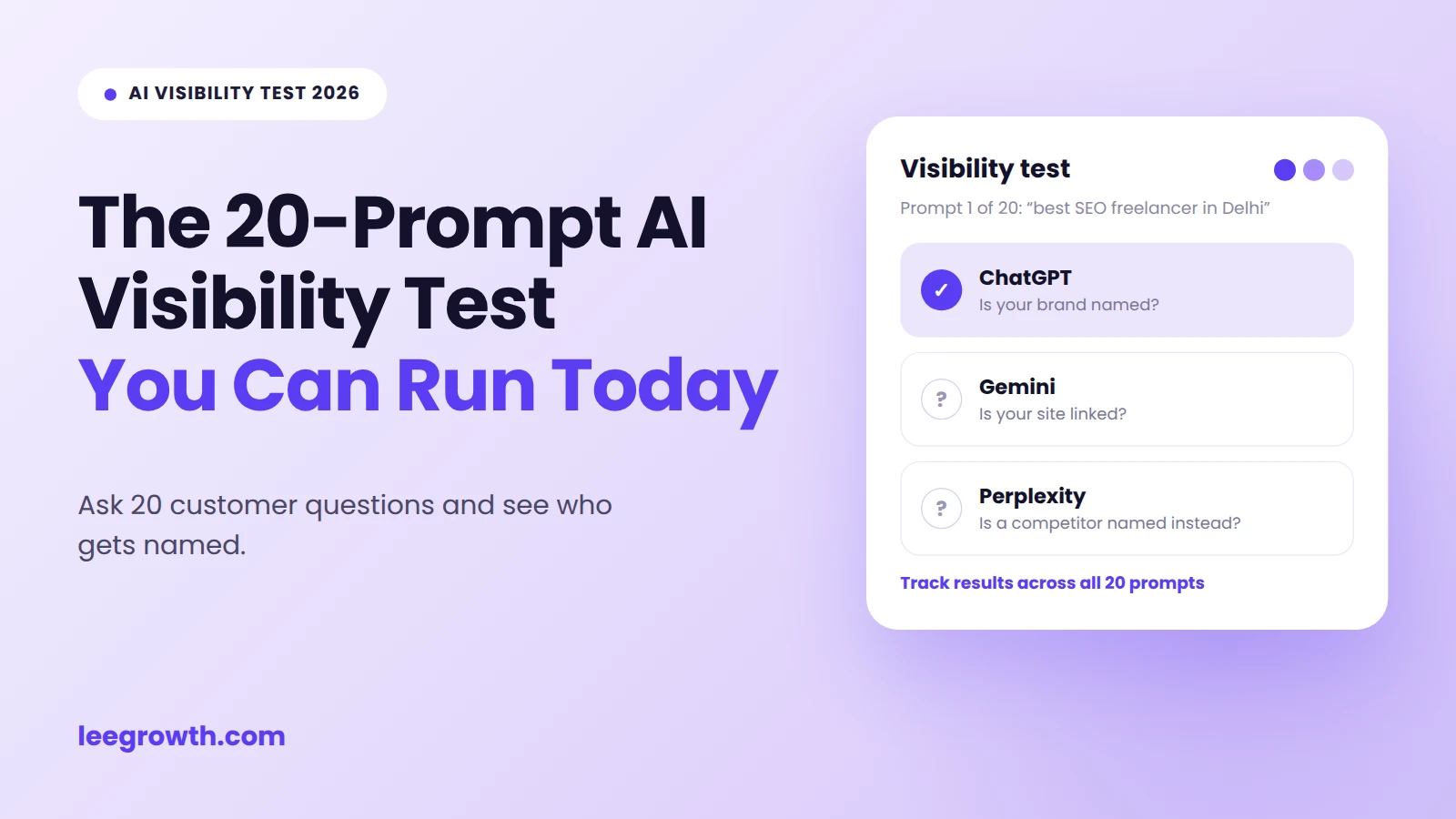
Quick answer: The AI visibility test is a fixed list of 20 questions your customers might ask ChatGPT, Gemini, Perplexity and Google’s AI Overviews. You run them, then count how often your business is named, described correctly and linked. It is free, and a first pass takes one sitting.
Key takeaways
- AI visibility means how often AI tools name, describe and recommend your business when people ask about your category.
- AI answers change on almost every run, so track mention rate, not rank.
- Test more than one tool. Google’s own AI features pull from different sources.
- Your first score is your baseline. Repeat monthly with the same prompts.
- Fix wrong facts and unclear pages first, then build outside proof and new content.
What is AI visibility?
AI visibility is the share of AI-generated answers that mention your business, describe it correctly and point people to it. It covers chat tools such as ChatGPT, Gemini and Perplexity, and Google’s AI Overviews and AI Mode inside search.
You may see related terms. Here is how I use them:
| Term | What it means in plain words |
|---|---|
| SEO | Helping your pages rank in search results |
| AEO (answer engine optimization) | Writing pages that give short, direct answers that search and AI tools can lift |
| GEO (generative engine optimization) | Making your business easy for AI tools to understand, trust and mention |
| AI visibility | The result you measure: how often you show up in AI answers |
These terms overlap. Google states that there are no extra requirements to appear in AI Overviews or AI Mode, and that normal SEO practice still applies. So treat AEO and GEO as extensions of good SEO, not replacements.
AI tools now answer buying questions with short lists of businesses and products. This test shows whether yours is on those lists.
Why one quick check is not enough
Before the prompts, you need three facts. They change how you should run and score this test.
1. AI answers change every time you ask. SparkToro and Gumshoe.ai asked ChatGPT, Claude and Google’s AI the same 12 brand-recommendation questions, about 3,000 times in total, using 600 volunteers. The chance of getting the same list of brands twice was less than 1 in 100. The chance of getting the same list in the same order was closer to 1 in 1,000 (Search Engine Land). This is one study, and its authors say it is still an open question how many runs you need for a reliable number. The clear lesson: do not trust a single answer.
2. How often you appear is more stable than where you rank. In the same study, the brands that led a category still showed up again and again, in some cases in 60% to 90% of answers, even when their position jumped around. The study also found that smaller markets, such as regional service providers, gave more stable answers than huge categories. So this test measures how often you are named, not whether you are number 1 or number 3.
3. Even inside Google, AI features use different sources. Ahrefs data, reported by Search Engine Journal, found that Google’s AI Mode and AI Overviews cite different sources 87% of the time for the same query. A good result in one place may tell you little about another, so test more than one tool.
There is also a clicks problem. A Pew Research Center study of 900 US adults and 68,879 Google searches found:
| Visits where people clicked a normal result | |
|---|---|
| Google page with an AI summary | 8% |
| Google page without an AI summary | 15% |
Only 1% of visits to pages with an AI summary included a click on a link inside the summary. Pew’s data is from March 2025 and covers US users only. It suggests that being named in the answer may matter more than being linked, because few people click the links inside it.
What you need
- Free accounts on ChatGPT, Gemini and Perplexity. Add Microsoft Copilot if your buyers use it. For Google AI Overviews, run the prompts as normal Google searches.
- A spreadsheet. Paste this header row into the first line:
Prompt | Group | Tool | Run # | Named (Y/N) | Described correctly (Y/N/Partly) | Your site linked (Y/N) | Competitors named | Other sites cited | Notes - Your details to fill in:
[Business]: your business name[Service]: what you sell, such as “family dentist” or “bookkeeper”[City]: your main market[Competitor]: one or two real competitors[Customer]: your ideal client, such as “small restaurants”
- A fresh chat for every prompt. Log out or use a private window if you can, so saved memory or chat history does not affect the answers.
The 20 prompts
The prompts follow the way a buyer moves from “who are you?” to “should I trust you?”. Each group matches a different search intent. Replace the brackets and paste each prompt as written.
Group 1: Do they know you? (prompts 1-4)
Intent: brand and navigational questions.
What is [Business]?What does [Business] in [City] do, and who is it best for?Is [Business] a good [Service] provider? What do customers say?Who runs [Business], and what is it known for?
Group 2: Do they recommend you? (prompts 5-9)
Intent: commercial discovery. These matter most for sales, because the buyer has never heard of you.
Best [Service] in [City]Who are the top 5 [Service] providers in [City]?I need a [Service] for [Customer]. Who should I consider?Recommend a trustworthy [Service] near [City] with good reviews.What are the best [Service] options for a small business on a budget?
Group 3: How do you compare? (prompts 10-13)
Intent: comparison and shortlisting.
[Business] vs [Competitor]: which is better for [Customer]?Alternatives to [Competitor] in [City]Compare the top [Service] providers in [City] by price, services and reviews.Why would someone choose [Business] over [Competitor]?
Group 4: Do they use your knowledge? (prompts 14-17)
Intent: informational questions, early in the buying journey.
How do I choose a [Service] provider? What should I look for?What mistakes do people make when hiring a [Service]?How much does [Service] cost in [City]?[A real problem your service solves]. What should I do?
Group 5: Trust and local (prompts 18-20)
Intent: final checks before contact.
Is [Business] legit? Any complaints or red flags?[Service] in [City] open now / available this weekWhich [Service] providers in [City] are best for [specific need, such as urgent, weekend or bilingual]?
How to run it
Pick the level that fits your time.
| Level | What you run | Answers to log |
|---|---|---|
| Quick | All 20 prompts, 1 tool, 1 run | 20 |
| Standard | All 20 prompts, 3 tools, 1 run | 60 |
| Full | Standard, plus prompts 5-8 and 10 run 2 more times in each tool (3 runs each) | 90 |
Because answers change each time, repeat runs give you a steadier mention rate. The number of repeats is a practical choice, not a proven one: the researchers above say the right number is still unknown. If you are short on time, start with Quick, then repeat the five money prompts (5-8 and 10).
How long it takes depends on how fast you copy and log answers, so Standard and Full need more time than Quick.
Log each answer straight away. Screenshot anything wrong, such as a wrong address or a competitor listed for your exact service.
How to score it
Skip complicated point systems. You need four numbers.
1. Mention rate Answers that name you ÷ total answers. This is your main number.
2. Brand gap Mention rate on Group 1 minus mention rate on Group 2. A big gap suggests AI knows you but does not recommend you to strangers.
3. Wrong facts Count every error: wrong hours, wrong city, a service you do not offer, an old price.
4. Source map When a competitor is named instead of you, write down every site the AI cites. After 20 prompts you will see the same few sites again and again. For reference, Pew found that Wikipedia, YouTube and Reddit were the most cited sources in Google’s AI summaries. Your own source map will show which sites matter in your market.
How the maths works
You run 20 prompts in 3 tools, which gives 60 answers.
- Group 1 has 4 prompts × 3 tools = 12 answers. Count how many name you, then divide by 12.
- Group 2 has 5 prompts × 3 tools = 15 answers. Count how many name you, then divide by 15.
- Subtract the second result from the first. That is your brand gap.
Example (made-up numbers, for illustration only):
| Group | Answers | Named you | Mention rate |
|---|---|---|---|
| Group 1: brand | 12 | 10 | 83% |
| Group 2: recommendation | 15 | 3 | 20% |
| Brand gap | 63 points |
In this example, AI tools know the business by name but rarely suggest it to new buyers. That points to a lack of outside proof, not a lack of awareness.
A big gap suggests AI recognizes your name but does not suggest you to new buyers. A small gap with both numbers low suggests AI knows little about you at all.
I could not find a trusted industry benchmark for these numbers. Your first score is your benchmark. The goal is a higher number next month.
What your results may mean
| What you see | Possible cause to check | Fix first |
|---|---|---|
| Low on Group 1 | Little clear information about you online | Make your About page, homepage and business profiles say the same clear things |
| High on Group 1, low on Group 2 | Little outside proof that you fit the category | Reviews, directories, mentions on sites AI already cites |
| Low on Group 3 | No clear position against competitors on your site | Add honest “who we are best for” and comparison pages |
| Low on Group 4 | Your content may not answer these questions directly | Write answer-first pages (see below) |
| Wrong facts anywhere | Old or conflicting information online | Fix the source page, not the AI answer |
| Named but never linked | Your pages may be hard to quote or cite | Clearer headings, short direct answers, indexable text |
What to fix first
Work in this order. It is my suggestion: fix basic errors before you build new content.
- Fix wrong facts. AI tools can repeat outdated information they find. Look for the old directory or page that holds the error and correct it.
- Make your core pages clear. Your homepage, About page and service pages should say who you help, what you do, where, and what happens next. Name your business, services, city and ideal customer the same way on every page. My SEO and AI search optimization service is built around this. Google’s guide to helpful, people-first content is a good check.
- Fix your local signals. Check your Google Business Profile, your review count and how recent they are, and that your name, address and phone number match everywhere. My local SEO services cover this.
- Keep structured data accurate. Google says you do not need special AI markup to appear in its AI features, but structured data can help search engines understand your pages when it matches the visible text. Where it fits, use Organization and LocalBusiness markup. Google’s structured data guide shows how.
- Let search bots in. If your robots.txt blocks them, AI tools may not be able to use your pages in answers. OpenAI lists GPTBot, OAI-SearchBot and ChatGPT-User as separate bots with different jobs, and Perplexity lists PerplexityBot and Perplexity-User. Read my guide on whether to block GPTBot, OAI-SearchBot, Google-Extended and PerplexityBot before you change anything.
- Earn mentions where AI looks. Use your source map. Reviews, trade directories and community sites all count. See my guide on whether Reddit, Quora and LinkedIn mentions help AI visibility.
- Write answer-first pages. Put the direct answer in the first two lines, then add detail, a real example and a next step. Build one page per Group 4 question. Need help? See my SEO content writing services.
What an answer-first page looks like
Use the same shape each time:
- A one- or two-sentence answer under the question heading.
- A short list or table with the key facts, such as price range, steps or criteria.
- A real example from your own work, so the page says something others do not.
- A clear next step, such as a call, quote or audit.
- Author name, date and sources, so readers and AI tools can see who wrote it and how current it is.
Repeat it every month
- Use the same 20 prompts and the same tools each time. Changing prompts breaks your trend line.
- Run the five money prompts (5-8 and 10) three times each month.
- Track four numbers: mention rate, brand gap, wrong facts, and the top five cited sources.
- Add two or three new prompts each quarter, based on questions real customers ask you. Keep the original 20.
- Watch your analytics for visits from AI tools. This shows whether mentions turn into visits. Google notes that traffic from its AI features is counted in the Web report in Search Console.
Mistakes to avoid
- Judging by one answer. One answer is not reliable. Use mention rate.
- Chasing position. The study above found positions are too unstable to track. Track how often you appear.
- Testing only your brand name. Group 1 is the easiest group, so it can make your results look better than they are. Group 2 shows how new buyers find you.
- Testing logged in with a long chat history. Saved memory or history may change the answers.
- Buying fake mentions. Focus on real reviews and real expertise instead.
FAQ
What is an AI visibility test? It is a repeatable set of questions you ask AI tools to measure how often they name, describe and link to your business. This one uses 20 prompts across five buyer intents.
How long does the test take? It depends on how fast you copy and log answers. The Quick level is 20 answers, Standard is 60, and Full is 90.
Do I need paid tools? No. A spreadsheet and free accounts are enough to start. Paid tools may save time later.
Why do I get a different answer each time? AI writes each answer fresh, so the brands, order and length change. That is why you repeat key prompts and track mention rate.
What is a good mention rate? I could not find a trusted benchmark, and it varies by market. Use your first score as the baseline and aim to raise it each month.
Can I pay to be named in AI answers? I am not aware of any way to pay for a place in organic AI answers. What you can control is clear pages, correct facts and real outside mentions. Google explains how its AI features in Search work.
How often should I test? Once a month. Add a check after a big website or reputation change.
Do I need special schema or an llms.txt file? Google says no special markup or AI-specific files are needed to appear in its AI features. Focus on crawlable, accurate, helpful pages first.
Next step
Not sure how to read your results? Send me your scores and your source map. You can ask for a free website SEO audit summary or get in touch. I help small businesses get found in search engines and AI answers.
Related reading
- Do Reddit, Quora and LinkedIn mentions help AI visibility?
- Should you block GPTBot, OAI-SearchBot, Google-Extended and PerplexityBot?
- SEO myths in India (2026): 15 things that are not true
- All Lee Growth guides
Sources
- Pew Research Center, Google users are less likely to click on links when an AI summary appears in the results (July 2025)
- Search Engine Land, AI recommendation lists repeat less than 1% of the time: Study (reports the SparkToro and Gumshoe.ai research)
- Search Engine Journal, AI recommendations change with nearly every query: SparkToro (includes the Ahrefs AI Mode and AI Overviews finding)
- Google Search Central, AI features and your website
- Google Search Central, Creating helpful, reliable, people-first content
- Google Search Central, Intro to structured data markup
- OpenAI, Overview of OpenAI crawlers
- Perplexity, Perplexity crawlers

I’m Leena Kalyana, a freelance SEO expert and digital marketing consultant in Delhi. I work across SEO, content marketing, social media, and digital design. I’m interested in helping businesses build a stronger online presence through practical SEO strategies, useful content, and creative digital marketing.