


By Leena Kalyana, Digital Marketing & SEO Consultant at LeeGrowth | Published and last updated: October 3, 2026
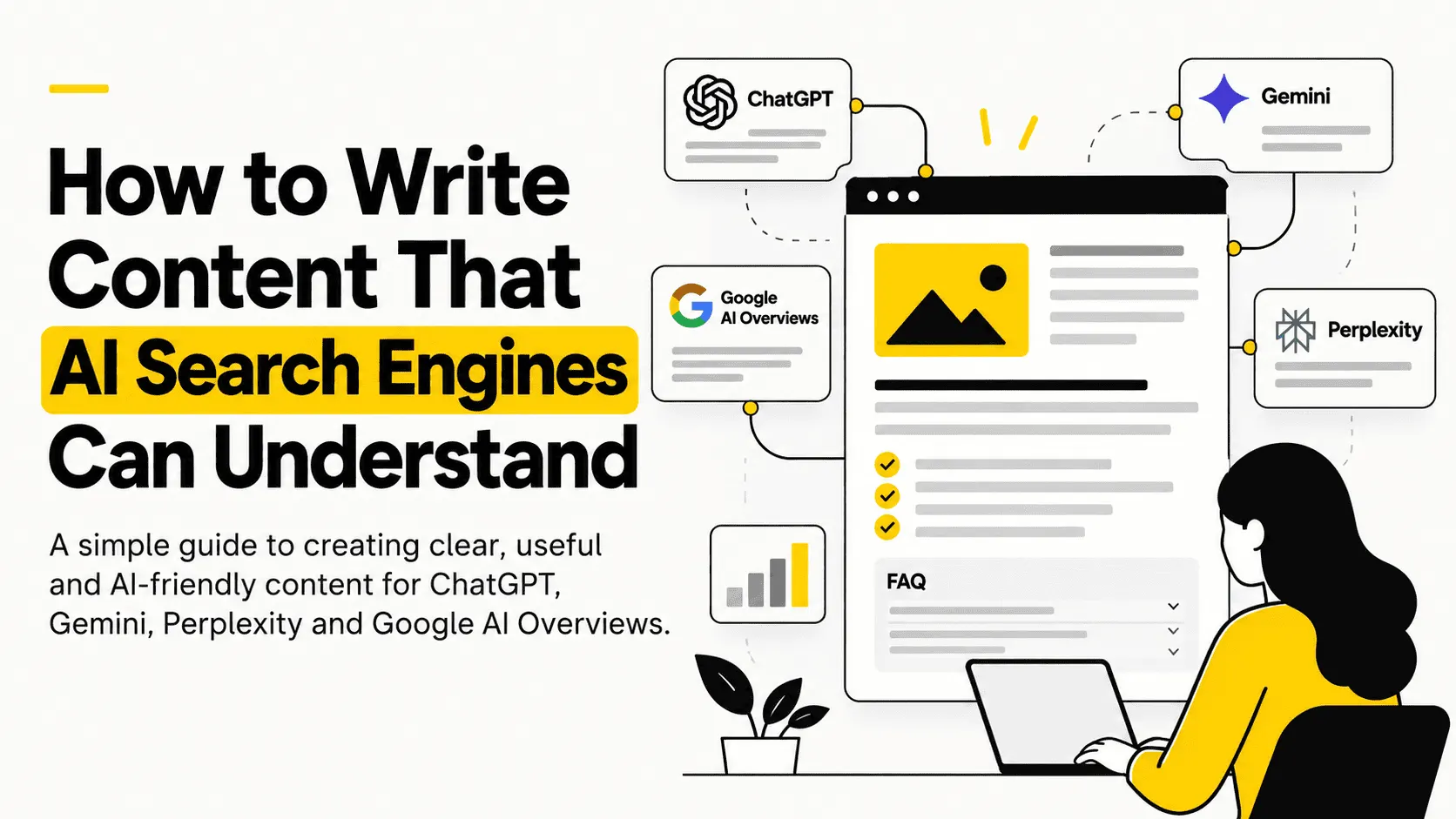
Your website may rank on Google, but that does not mean AI search tools will understand or mention your business. When someone asks ChatGPT, Gemini, Perplexity or Google an important question, these systems need clear, useful and accessible information to work with. AI search optimization is the work of providing it.
This guide shows you how AI search reads content, how to structure and write your pages, how to support claims with sources, how to check whether a page is ready, and what not to waste time on. One caution up front: no method guarantees an AI citation or a ranking, and platforms change their systems without publishing the details. So the goal is not to trick an AI tool. It is to make your website a clear, useful and trustworthy source.
Table of Contents
Quick Answer
How do you write content for AI search?
Write content that gives a clear answer, explains the topic completely, uses descriptive headings, supports important claims with reliable sources and can be reached by search crawlers. You do not need a special writing format or a trick. Content built for AI search should first be useful to people.
In simple terms: answer the question, explain it, support it, make it easy to find, keep it accurate.
Key takeaways
- Write for people first.
- Answer the main question early.
- Use clear headings.
- Explain technical terms simply.
- Support important claims with reliable sources.
- Make important pages crawlable and indexed.
- Use internal links to connect related topics.
- Add real experience and examples.
- Keep changing information updated.
- Do not expect guaranteed AI citations.
What Is AI Search Optimization?
AI search optimization means making your website easy for AI search tools to find, understand and use when answering people’s questions.
The more technical version: AI search optimization is the practice of improving website content and technical signals so AI-powered search systems can more easily discover, interpret, retrieve and reference relevant information. This is a working definition, not an official one from any platform.
Search is no longer only a list of ten links. Google says its AI features can use a “query fan-out” technique, which means running several related searches across subtopics to build one response. Pages that answer clearly have more to offer in that setup.
| Term | What it means | Examples |
|---|---|---|
| Traditional search | A ranked list of links for a query | A standard Google results page |
| AI-powered search | A generated summary with links inside a search engine | Google AI Overviews and AI Mode |
| AI answer engine | A conversational tool that answers and may show sources | ChatGPT search, Perplexity |
| Generative Engine Optimization (GEO) | A practitioner term for visibility in generated answers | Also called AI SEO |
| Answer Engine Optimization (AEO) | A practitioner term for being the clear answer to a question | Often used with GEO |
GEO and AEO are industry labels, not separate official disciplines. Google says that, from its perspective, optimizing for generative AI search is still SEO. I use “AI search optimization” here as an umbrella term for the same work.
AI search has not replaced traditional Google search. Google’s AI features sit inside Search, and AI Overviews often do not trigger.
How AI Search Understands Website Content
No platform publishes its full process, so this is a simplified model. Each idea below follows the same pattern: the term, what it means, and an example.
Crawling and indexing. Crawling is when a bot visits your page. Indexing is when the page is processed and stored so it can be found later. For example, if your robots.txt file blocks a bot, that bot cannot read the page at all. OpenAI documents OAI-SearchBot for ChatGPT search and GPTBot for training, as independent settings. Perplexity documents PerplexityBot for surfacing and linking sites. For Google, Googlebot controls Search, while Google-Extended is a separate token for Gemini training and grounding that does not affect Search inclusion. Google also says a page must be indexed and snippet-eligible to appear as a supporting link in AI Overviews or AI Mode.
Relevance and context. Systems match a question to pages that cover it. Google says its AI systems understand synonyms and meaning, so you do not need a page for every phrasing.
Entities. An entity is a specific person, business, place, product or concept that can be clearly identified. For example, “LeeGrowth, a digital marketing business in Delhi” is clearer than “our company”. The links between entities (a business, its city, its services) are called semantic relationships. Clear, consistent names make them visible.
Structured information. Headings, lists, tables and schema markup label what is on a page. Google says structured data is not required for its AI features, though it should match the visible text. Our guide to schema markup for AI search visibility covers what is worth adding.
Authority and citations. Platforms try to draw on reliable sources. Clear authorship, accurate facts and credible references all point that way, but the weighting is not public.
What this means for you
If an important page is blocked or not indexed, better writing alone will not fix it. Check these first:
- Is the page accessible without logging in?
- Is it indexed? (Search Console’s URL Inspection shows this.)
- Is your robots.txt blocking a crawler you want?
- Does the page have internal links pointing to it?
10 Ways to Write Content That AI Search Can Understand
Google says no special formatting is needed for its AI features. These are good writing habits that also make pages easier to process. Where a point is my own recommendation, not a documented rule, I say so.
1. Answer the main question directly
Put the answer in the first sentence or two under the heading. Under “What is a canonical tag?”, open with: “A canonical tag tells search engines which URL is the preferred version of a page.” Then add context. I keep opening answers to two to four sentences, which is my habit, not a platform rule.
2. Use clear headings and subheadings
One H1 states the topic, H2s mark main sections and H3s mark points inside them. Write headings that describe what follows, such as “How to check if a page is indexed”, not “Getting started”.
3. Put important information near the beginning
Lead with the conclusion or definition, then give detail. This is a practitioner habit for busy readers. Google does not say that position on the page decides what gets used.
4. Write specific, complete answers
Replace vague claims with details: who, what, where, how. Each key answer should work without the paragraph before it. The next section shows examples.
5. Cover the topic comprehensively
Answer the follow-up questions a reader would ask next, or link to the page that does. Depth means completeness, not length. Google says there is no ideal page length, and mass-producing pages for every query variation can breach its spam policies. To build a full cluster, start with how to build topical authority on a small website.
6. Use relevant entities and terminology
Name things precisely: “Google Search Console”, not “the tool”. Explain expert terms once. Keep your business name, author name, services and location consistent across pages. If your audience mixes Hindi and English when searching, cover both phrasings naturally, as explained in our Hinglish keyword research guide. Do not stuff variants, because Google says its systems already understand meaning.
7. Support claims with trustworthy sources
Link to primary sources such as official documentation and original research, and say what they state in your own words. For platform behavior that changes, note the date you checked. A habit that works well is a claim ledger: for each article, list every factual claim, its source URL and the date you opened it. Delete any claim with no source.
8. Use examples, lists and tables
Tables suit comparisons, numbered lists suit steps and examples suit abstract rules. Use them only where the content has that shape. Google says chunking for AI is not needed, so do it for readers.
9. Add useful FAQs
Add an FAQ when readers have recurring questions the article does not fully answer. Sales calls, support emails and Search Console queries are good sources. Skip FAQs that repeat the body or only hold keywords.
10. Keep information accurate and updated
Freshness matters most for things that change: platform features, prices, rules and tools. Review those pages on a schedule and show a “last updated” date only after a meaningful change.
Before vs After Examples
Describing your business
Weak
We provide customized digital marketing solutions that help businesses grow online.
Better
LeeGrowth provides SEO, AI search optimization and digital marketing services for small businesses in Delhi.
Why the second one works: it says what the business does, names the services, identifies the audience and location, and drops vague marketing language.
Writing about an entity
Instead of: We help businesses with online growth.
Write: LeeGrowth is a digital marketing business that provides SEO, AI search optimization and content marketing services for businesses in Delhi.
The second sentence carries four clear facts: the business (LeeGrowth), the location (Delhi), the services (SEO, AI search optimization, content marketing) and the category (digital marketing).
Naming a section
Weak: Getting started
Better: How to check if a page is indexed
A descriptive heading tells readers, and any system reading the page, what the section answers.
Answering a real question
Topic: “How long does SEO take to work?”
Weak
SEO is a powerful, ever-evolving journey that unlocks sustainable growth for brands. Results depend on many dynamic factors, and with the right strategy and a data-driven approach, your business can dominate its market over time. Every journey is unique, so get in touch to find out what is possible for you.
Better
How long does SEO take to work?
SEO usually takes several months to show steady results, and the timeline varies by site, competition and the work involved. No one can guarantee a specific ranking or date.
What affects the timeline: site age and authority, competition, technical health (crawling and indexing), content quality and intent match, and consistency of the work.
Realistic expectations. Small technical fixes, such as unblocking a page from crawling, can show effects within weeks once Google recrawls. New content on a competitive topic often takes longer. Track impressions and indexing in Search Console first, because they usually move before clicks.
Supporting information. Google notes that crawling can take anywhere from several days to several months, depending on how often its systems decide a page needs refreshing.
The better version answers first, names the factors, sets honest expectations and points to a source. It does not guarantee an AI citation or any ranking.
AI-Friendly Content Template
This is a practitioner template, not a platform requirement. It follows how people read: answer first, then reasons, then proof. Each section has one job, so a passage still makes sense when read alone.
H1: Main topic

Short answer:
Give the answer in 2 to 4 sentences.

Why it matters:
Explain the problem.

How it works:
Explain the topic simply.

Step 1:
Action + explanation + example.

Step 2:
Action + explanation + example.

Common mistakes:
List what to avoid.

Evidence:
Add reliable sources.

FAQ:
Answer real questions.

Conclusion:
Summarize the main point.
You can use this structure for blog posts, service pages, guides and FAQ content.
How to Make an Existing Article Better for AI Search
Most people do not need to write from scratch. Improve what you already have:
- Find the main question the page answers.
- Write a 2 to 4 sentence direct answer below the relevant heading.
- Replace vague headings with descriptive ones.
- Remove paragraphs that add nothing.
- Add the questions readers would ask next.
- Add sources to important claims.
- Add useful internal links.
- Check indexing and crawlability.
- Update outdated information.
- Read the page as if you were the customer.
Add something only you could write
Do not just repeat what is already online. Google’s guide separates “commodity” content, which restates common knowledge, from content with a unique point of view and real experience. Add your own observations, examples from your work, screenshots where appropriate, before and after comparisons, your process and the mistakes you have seen. If twenty sites publish the same generic explanation, the page with original evidence gives readers something a basic definition cannot.
How to Optimize Content for ChatGPT, Gemini, Perplexity and Google AI Overviews
These systems differ and change often. The table is not a description of how any one ranking or retrieval system works.
| Platform | What users ask | What content should provide | What you can control | Important consideration |
|---|---|---|---|---|
| ChatGPT | Explanations, comparisons, how-to questions | Self-contained answers, specific facts, named sources | Site access, crawler settings, content quality | OpenAI documents OAI-SearchBot (search) and GPTBot (training) as separate controls and recommends allowing OAI-SearchBot. User-initiated requests may not follow robots.txt. |
| Google AI Overviews | Queries where a summary adds value | Helpful, original pages that are indexed and snippet-eligible | SEO fundamentals, indexing, snippet settings | Google says no extra requirements or special markup. Overviews often do not trigger. |
| Google AI search experiences (AI Mode) | Longer, nuanced questions and follow-ups | Depth across related subtopics, clear structure | Same as above, plus topic coverage | May use different models than AI Overviews, so links can differ. |
| Gemini | General questions and research | Accurate, well-organized, crawlable content | Site access, content quality, Google-Extended | Google-Extended governs Gemini training and grounding. Google says it does not affect Search. |
| Perplexity | Research questions with cited answers | Factual, well-sourced pages | Site access, PerplexityBot settings, content quality | PerplexityBot (surfacing sites) and Perplexity-User (user actions) are separate agents. |
You control your website. You do not control which source an AI system selects.
Traditional SEO vs AI Search Optimization
| Area | Traditional SEO | AI search optimization |
|---|---|---|
| Keywords | Target the phrases people type | Cover the topic and related questions naturally |
| Search intent | Match the purpose behind a query | Match intent across longer questions and follow-ups |
| Content structure | Headings and readable sections | Same, plus direct answers that stand alone |
| Backlinks | Links from other sites signal importance | Genuine mentions support credibility. Google says inauthentic ones do not help. |
| Authority | Site and author credibility | Same, with clear authorship |
| Entities | Handled indirectly | Precise, consistent names and details |
| Citations | A position in a list of links | A link or mention in an answer. Never guaranteed. |
| Technical SEO | Crawlability, indexing, speed, mobile | Same, and pages must be indexed and snippet-eligible |
| User experience | Good page experience | Same, for visitors from AI results too |
Does SEO still matter for AI search?
Yes. Google says SEO best practices remain relevant for its generative AI features, because those features are rooted in its core Search ranking and quality systems. Google says they retrieve relevant pages from its Search index, then generate a response with links. So crawlability, indexing, relevance and quality still decide whether a page can be used. Other AI tools run their own systems, but they also need to reach and read your pages.
If you are unsure your fundamentals are in place, start with a free website SEO audit. If a page is not ranking at all, read why your website is not ranking on Google first. For ongoing help, see my SEO services.
What AI Search Optimization Cannot Guarantee
It cannot guarantee:
- a ChatGPT citation
- a Google AI Overview appearance
- a Perplexity mention
- a higher Google ranking
- more traffic
- more leads
The goal is not to trick an AI system into mentioning your website. The goal is to make your website a clear, useful and trustworthy source of information.
Common Mistakes and AI SEO Tactics to Avoid
| Tactic | What to do |
|---|---|
| Keyword stuffing | ❌ Don’t do it |
| Creating a page for every tiny keyword variation | ❌ Don’t do it |
| Adding fake FAQs | ❌ Don’t do it |
| Hiding keywords in text | ❌ Don’t do it |
| Publishing hundreds of low-quality AI pages | ❌ Don’t do it |
| Copying competitors | ❌ Don’t do it |
| Writing only for AI tools instead of for people | ❌ Don’t do it |
| Making claims you cannot support, or using fake statistics | ❌ Don’t do it |
| Ignoring technical SEO (a blocked or unindexed page cannot be used) | ❌ Don’t do it |
| Expecting guaranteed citations (no one can promise them) | ❌ Don’t do it |
| Adding structured data that does not match visible content | ❌ Don’t do it |
| Creating llms.txt files or splitting pages into tiny chunks for Google | ❌ Not needed. Google says it does not use them. |
| Improving crawlability | ✅ Do it |
| Writing clear answers | ✅ Do it |
| Adding reliable sources | ✅ Do it |
| Building useful internal links | ✅ Do it |
| Updating outdated information | ✅ Do it |
30-Minute AI Search Content Audit
Pick one page and work through it in six blocks of five minutes.
- Question. What exact question does this page answer?
- Answer. Can someone find the answer within the first few paragraphs?
- Structure. Are the headings clear?
- Evidence. Which claims need sources?
- SEO. Is the page crawlable, indexed and internally linked?
- User test. Can someone understand the page without knowing SEO?
Then score it:
| Check | Yes | No |
|---|---|---|
| Main question is clear | ☐ | ☐ |
| Answer appears early | ☐ | ☐ |
| Headings are descriptive | ☐ | ☐ |
| Claims have support | ☐ | ☐ |
| Internal links exist | ☐ | ☐ |
| Page is crawlable and indexed | ☐ | ☐ |
| Information is current | ☐ | ☐ |
| Author and business are identified | ☐ | ☐ |
| Page shows first-hand expertise where appropriate | ☐ | ☐ |
| Page is more useful than generic competitor content | ☐ | ☐ |
Fix the “no” answers first, starting with access and accuracy.
If You Own a Small Business, Start Here
Do not try to optimize your whole website at once. Start with these five pages:
- Homepage
- Main service page
- Most important location or service page
- Best-performing blog post
- One high-value FAQ or guide
For each page: make it clear, make it useful, make it accessible, support the claims and link it to related pages.
The simple AI search content formula
Clear answer + useful detail + trustworthy sources + strong structure + technical accessibility + real expertise = stronger AI-search-ready content.
This is a practical framework, not a ranking formula.
Frequently Asked Questions
What is AI search optimization?
Making your website easy for AI search tools to find, understand and use. It overlaps heavily with SEO.
How do I optimize my website for AI search?
Make important pages crawlable and indexed, answer questions directly, cite credible sources and keep facts accurate. Check that robots.txt does not block Googlebot, OAI-SearchBot or PerplexityBot.
How do I get my content cited by ChatGPT?
You cannot make ChatGPT cite you. You can allow OAI-SearchBot and publish specific, accurate, well-sourced content. Citation is the platform’s decision.
Does Google SEO help with AI search?
Yes, for Google’s AI features. Google says they are rooted in its core Search ranking and quality systems.
What is the difference between SEO and GEO?
SEO covers search visibility generally. GEO is a label for visibility in generated answers. They overlap, and Google says optimizing for its generative AI search is still SEO.
How do I optimize content for Google AI Overviews?
Google says no special optimization is required. Follow SEO fundamentals: indexed, snippet-eligible pages and helpful, original content.
Can AI-generated content rank in search?
It can, if it is helpful, original and reviewed. Google focuses on quality, not how content is produced.
Does word count matter for AI search?
Not directly. Google says there is no ideal page length. Cover the topic completely and stop.
How can I measure AI search visibility?
Google’s guide points to a generative AI performance report in Search Console. For other platforms, check server logs for crawlers such as OAI-SearchBot, track referral traffic and test key questions manually, as described in our guide to checking if ChatGPT cites your website. Google says no third-party tool can see its internal ranking systems.
Can I optimize old blog posts for AI search?
Yes. Use the ten steps in the section on improving an existing article. Start with posts that already get impressions in Search Console, which our guide to Google Search Console for small businesses explains.
Should every blog post be optimized for ChatGPT?
No. Focus on pages that matter to your business. You do not need ChatGPT-specific versions of your content.
Does adding more keywords help AI search?
No. Google says its systems understand synonyms and meaning, so extra keywords add little and can make the page worse to read.
Do backlinks still matter for AI search?
Google says its AI features are rooted in its core ranking systems, and genuine mentions across the web can show up in them. It also says chasing inauthentic mentions is not helpful. Earn real links and mentions. No platform publishes how much weight they carry.
Should I create separate content for ChatGPT and Google?
No. Google says you do not need to write in a special way for generative AI search. One useful, clear page serves both.
How often should I update AI-search content?
Update a page whenever its facts change. As a rule of thumb, I review fast-changing topics such as AI search every few months and evergreen explanations about once a year. That interval is my practice, not a platform rule.
AI Search Optimization Checklist
Page-level check
| Area | What to check |
|---|---|
| Search intent | Page matches what the searcher wants |
| Content structure | Logical headings, short paragraphs, lists and tables where they fit |
| Direct answers | Main answer appears early and stands alone |
| Entities | Names are precise and consistent |
| Sources | Facts link to primary sources you actually read |
| Internal linking | Related pages link with descriptive anchors |
| Technical SEO | Crawlable, indexed, snippet-eligible, mobile-friendly |
| Structured data | Valid and matching the visible text |
| Expertise | Named author, real experience, clear business details |
| Freshness | Time-sensitive facts reviewed and dated |
| Citations | How AI tools describe your brand, with dates recorded |
| User experience | Mobile-readable, main content easy to find |
Site-level actions
- [ ] Make important pages crawlable. Check robots.txt, CDN and firewall rules.
- [ ] Make sure important pages are indexed.
- [ ] Use descriptive page titles and clear headings.
- [ ] Answer user questions directly.
- [ ] Demonstrate expertise. Add author details and first-hand examples.
- [ ] Cite credible sources.
- [ ] Build relevant internal links between related pages.
- [ ] Strengthen topical coverage across the subject, not just one page.
- [ ] Keep important information updated.
- [ ] Use appropriate structured data. It must match visible text and is not required for Google’s AI features.
- [ ] Maintain consistent business and entity information across your site and Business Profile. See the Google Business Profile setup guide for India and our Near Me SEO guide.
- [ ] Earn relevant mentions and links from sources that have a real reason to mention you.
- [ ] Review how AI systems represent your brand. Follow our steps for checking if ChatGPT is citing your website and fix errors at the source.
OpenAI recommends allowing OAI-SearchBot in robots.txt if you want to appear in ChatGPT search, and says changes can take about 24 hours. AI answers also vary between sessions, so record the date and treat each check as a snapshot.
Conclusion: Start with One Page
AI search optimization comes down to clear writing, accessible pages and credible information. Do not try to optimize your whole site today. Choose your most important service page and ask one question:
Can a customer understand exactly what I do, who I help and why they should trust this page within 30 seconds?
If not, improve that page first. Confirm it is crawlable and indexed, put the answer first, add sources, name the author and update anything outdated. Then move to the next page.
If you want hands-on help, see my AI search engine optimization services, my SEO content writing services or get in touch.
Platform claims were checked against official Google, OpenAI and Perplexity documentation on October 3, 2026. Points described as practice are the author’s judgment, not platform rules. These systems change, so recheck the sources below.
Sources
- Google Search Central: AI features and your website
- Google Search Central: Optimizing your website for generative AI features on Google Search
- Google Search Central Blog: Top ways to ensure your content performs well in Google’s AI experiences on Search
- Google Search Central: List of Google’s common crawlers (Google-Extended)
- Google Search Central: Creating helpful, reliable, people-first content
- Google Search Central: Do you need an SEO?
- OpenAI: Overview of OpenAI crawlers
- Perplexity: Perplexity crawlers

I’m Leena Kalyana, a Delhi-based freelance digital marketer and graphic designer. I work across SEO, content marketing, social media, and digital design. I’m interested in helping businesses build a stronger online presence through practical SEO strategies, useful content, and creative digital marketing.