In this article
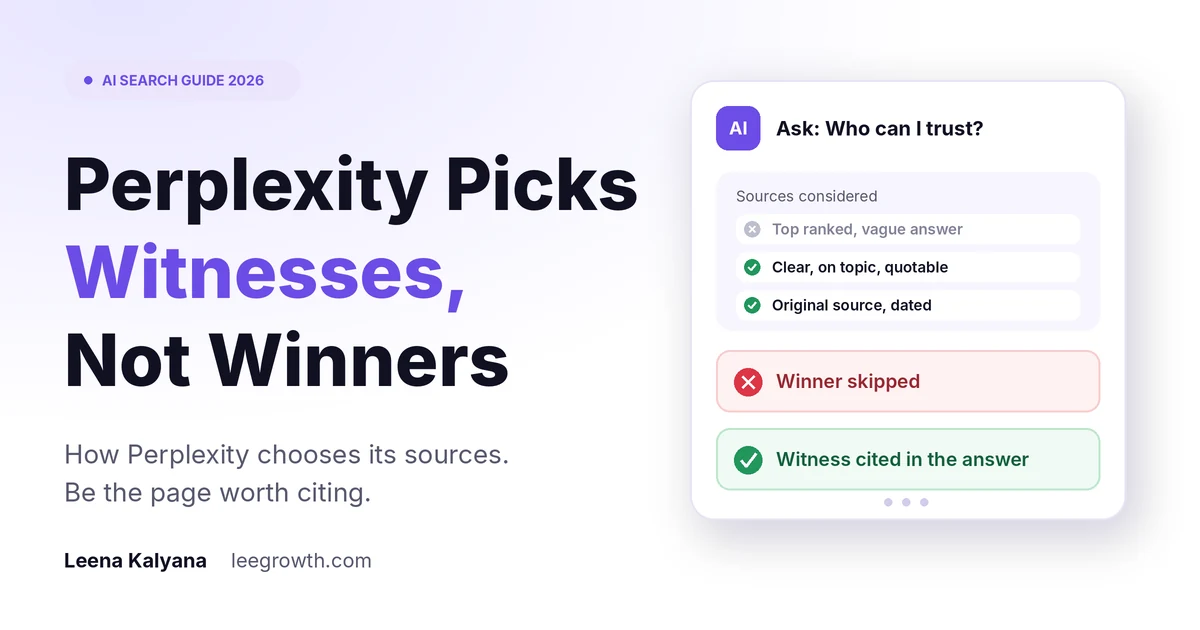
How does Perplexity choose its sources? It searches the web live, pulls back a set of pages, and cites the few that fit that one question best. It does not rank pages the way Google does. My view is that Perplexity picks witnesses, not winners. Perplexity has not published its formula, so this guide keeps three things apart: what is documented, what was tested, and what is only my opinion.
What is the short answer?
Perplexity searches the web live for every question, then cites the few pages that answer that question most directly. It does not rank pages like Google, and it has not published its formula.
Perplexity does not answer from memory alone. It searches the internet in real time, then writes the answer from the pages it found.
Researcher Suganthan Mohanadasan tested this and published the results in Search Engine Journal in July 2026. Perplexity searched the web on all seven questions he tried. That included a how to question that ChatGPT answered from memory, without searching. So every question is a fresh contest. A page cited yesterday can be skipped today.
“In the test I studied, Perplexity cited the page closest to the answer, not the biggest brand. So stop asking how to rank, and ask which questions only you can answer.”
Leena Kalyana, Digital Marketing & SEO Consultant, LeeGrowth
What has Perplexity documented, and what is guesswork?
Perplexity documents its two crawlers and describes running its own index. How it scores pages, how many it considers and which signals matter are not published, so every ranking factor list is a guess.
- Documented by Perplexity: PerplexityBot is the crawler used to surface and link websites in Perplexity’s search results. Perplexity-User fetches a page when a person’s question needs it, and it generally ignores robots.txt rules. Perplexity’s own engineering write-up also describes an index and crawling system that Perplexity runs itself.
- Tested by one researcher: how Perplexity routes a question, how many searches it runs, which pages it finds and which it cites. The test is small, so read it as direction, not proof.
- Guesswork: exact ranking weights, the number of candidate pages, and any percentage in a “Perplexity ranking factors” list. Nobody outside Perplexity has shown these.
Does Perplexity pick witnesses instead of winners?
In one test, Perplexity usually cited the source closest to the answer, not the biggest brand. This is my reading of one small test, not a rule Perplexity has stated.
A court does not ask who is the most famous person in the room. It asks who can speak to this one fact. Perplexity seems to behave the same way. It looks for the page that is closest to the answer.
Here is what won in the test:
- Comparison question (“Ahrefs vs Semrush”): Ahrefs’ own comparison page was the most cited source. The vendor is the witness for its own product. Backlinko’s well known comparison post was found but not cited.
- News question (“latest Google algorithm update”): Google’s own status page and documentation were cited. A news article only three days old was found but not cited. The source of the news is the witness.
- “Best X” question (“best AI SEO tools 2026”): fresh list posts for the current year and mid sized SEO blogs won. Big brand pages like Semrush were found but not cited. These list posts are not first hand sources. My reading is that they matched the format of the question: a list question got a list answer.
Perplexity’s engineering write-up also says it splits documents into small units and scores each unit against the query. A single passage can then be the witness, even when the site around it is not famous.
The question changes. Stop asking “how do I rank in Perplexity?” Ask “for which questions am I the right witness?”
How does Perplexity choose sources, step by step?
The test showed three steps: a router sorts the question, one search runs close to your exact words, and Perplexity cites two to nine of the 10 to 15 pages it finds.
1. A router reads the question. Before it searched, Perplexity ran each question through a classifier (a model that sorts each question into a type). The classifier gave a topic label and scored about sixteen features, such as maps, video, shopping and images. Only features above a fixed threshold switched on. A “near me” question switched on maps. A “how do I change a flat tyre” question moved to a teaching mode with a video tab.
2. It searches, usually with your exact words. For six of the seven questions, Perplexity ran one search that stayed close to the typed phrase. The local question ran four searches across two rounds. A retest a few weeks later showed a few close variants added.
3. It finds many pages and cites few. In one test on one account, Perplexity pulled back 10 to 15 pages per question and cited between two and nine. Getting found is like getting shortlisted. Getting cited is like getting hired.
Can Perplexity read your site?
Perplexity can find your site in search only if PerplexityBot is allowed. Check robots.txt and your firewall first, because a blocked site is unlikely to be cited.
Perplexity uses two agents:
- PerplexityBot surfaces and links websites in Perplexity’s search results. Blocking it asks Perplexity not to surface your site.
- Perplexity-User fetches a page when a person’s question needs it. A person asked for that fetch, so it generally ignores robots.txt rules. A Disallow rule may not stop it.
Many sites block AI crawlers by accident. Some firewall and bot protection tools (Cloudflare is one example) have settings that block AI bots, and nobody on the team may have chosen that. Use this quick check:
- Open
yourwebsite.com/robots.txt, the file that tells crawlers which pages they may visit. Look for a block like this.Disallow: /under PerplexityBot means you are blocking it.
User-agent: PerplexityBot
Disallow: /
- An open rule looks like this:
User-agent: PerplexityBot
Allow: /
- Check your firewall or hosting logs for PerplexityBot requests. A 403 error means a security setting is blocking the crawler even when robots.txt looks fine.
For crawler settings across ChatGPT, Gemini and Perplexity, see my guide to content AI search engines can understand.
What else did the test show?
The winners changed with the question type: list posts for “best X,” the vendor’s page for comparisons, official pages for news, YouTube for how to, and business listings for local searches.
The patterns here come from 8 captures on one Pro account in Dubai, taken in June 2026, with three spot checks in July. The sample is small. A different user in a different city may see different results. Treat everything as direction, not proof.
- “Best X” questions: Fresh list posts for the current year and mid sized SEO blogs won. Big brand pages were found but not cited.
- How to and product questions: YouTube was cited heavily. Reddit threads were found but not cited. The same researcher saw the opposite in ChatGPT.
- Local questions: Business listings from a maps index took the citations. In a retest with no location shared, list articles took over. Local businesses should start with my Google Business Profile setup guide.
- Deep Research mode (Perplexity’s slower mode that reads many pages and writes a long report): It read two pages in full. One page got 20 of the 30 citation markers.
A note on Reddit. In this test, Reddit threads were found but not cited. Other data points the other way. Profound’s 2025 analysis, as reported by Veritas, found Reddit made up 46.7% of Perplexity’s top 10 cited sources. The methods and years differ, so I treat Reddit as unsettled for Perplexity.
Why are most Perplexity ranking factor lists guesswork?
Outside sites give different numbers for candidate pages and citations, and Perplexity has confirmed none of them. Treat every number as an estimate, not a formula.
Search for the numbers and you will find a mess. Some sites say Perplexity collects 10 to 30 candidate pages. Another says about 60. Estimates of sources cited per answer run from 3 to 8, 5 to 15, and about 22. One site lists percentage weights, such as 30% for relevance. I found no sign that Perplexity has published any of these.
My view: three sites giving three different numbers is a sign that none of them is quoting Perplexity’s own rules. Veritas checked several articles that describe Perplexity’s pipeline in detail and found that none of the ones it checked cited Perplexity for those details. My guess is that the numbers come from testing a few queries, but I cannot confirm how each site got its numbers. Treat every number as an estimate.
The same warning applies to this guide. The test I lean on is one account and eight captures. Its most useful finding is not a number. It is a pattern: the closest source to the answer tends to get cited. The researcher also saw no ranking score in the data Perplexity sent to the browser. Anyone selling exact ranking factors is guessing.
What are trust notes, and do they matter?
Trust notes are short labels the researcher saw on some sources in July 2026. They say what a domain is credible for. They mostly sat on big official sites, and sources without a note were still cited.
Here is what he found:
- The notes mostly sat on big official domains, such as the RAC, AAA, Goodyear and Car and Driver.
- None of the 15 sources on the local question, which were small editorial sites, carried one.
- YouTube had no note and still took 14 of the 40 citations on the how to question.
- The field changed across three builds in about two months, so it may change again.
My bet, and it is only a bet: the notes describe what a domain owns, not how big it is. Being the clear source for a narrow topic may count for more over time, should Perplexity keep building this. So far, though, the notes lean toward big official sites. I explain how to build topical authority on a small website in a separate guide.
What should you do to get cited by Perplexity?
Find the questions where you are the right source, answer them in the first two sentences, keep the crawler allowed and your pages dated, and test your results with five real questions.
- List the questions where you are the witness. Write down 10 questions only you can answer first hand: your pricing, your process, your data. Example: a local accountant owns “how our fixed fee works”, not “what is tax”.
- Use the exact phrase people type. Put “how does Perplexity choose its sources” in the H1 and answer it in the first two sentences.
- Publish your own comparison page. Be honest on it. Example: “Us vs Brand X” with real differences and who each suits. Here is how to structure a comparison page so AI tools can use it.
- Make the video for how to topics. A three minute YouTube walkthrough gives Perplexity something to cite that most blogs cannot offer.
- Keep dated list posts current. Update the year and the entries in your “best tools” post.
- Let the crawler in. Run the three step check in the section above.
- Run your own test. Ask Perplexity five questions your readers ask and note which pages it cites. My steps for checking if ChatGPT cites your site work the same way.
A real example from my own site. Semrush’s AI visibility report shows 16 citations across 9 of my pages in October 2026. In September the same report showed 7 citations across 4 pages, so October is up 128.6% and 125%. Semrush does not break out Perplexity on its own, so this is not Perplexity data. It shows what AI citation growth can look like for a small site when you track it month by month.
What I would skip:
- Chasing percentage weights. Nobody outside Perplexity can prove them.
- Treating Reddit as a sure win or a waste of time. The data disagrees, so test it on your own topic.
- Thin pages that hope to be shortlisted. A shortlist is not a citation.
FAQ
Does Perplexity use Google results?
Perplexity’s own engineering write-up describes an index and crawling system that Perplexity runs itself. Some sites say it also uses Bing or partner data, but I found no confirmation from Perplexity for that.
How many sources does Perplexity cite per answer?
Perplexity has not published an official number. Outside estimates run from 3 to about 22. In the test above, answers cited between two and nine sources, depending on the question type.
Can I stop Perplexity from using my site?
You can block PerplexityBot in robots.txt, but that keeps you out of Perplexity’s search results. Perplexity-User generally ignores robots.txt because a person asked for the fetch, so a Disallow rule may not stop it.
Does ranking high on Google help me get cited?
Not proven. Good, clear content helps everywhere, but Perplexity runs its own crawl. In the test, big brand pages were often found and skipped, so size alone did not win.
Does Perplexity cite Reddit?
The answer depends on whose data you read. In the single test above, Reddit threads were found but not cited. Profound’s 2025 analysis, as reported by Veritas, put Reddit at 46.7% of Perplexity’s top 10 cited sources. Test your own topic before you decide.
Conclusion
Perplexity searches live every time, so no page is safe. What wins depends on the question, and the winner is usually the source closest to the answer: the vendor for its own product, the official page for news, the video for a how to, the listed business for a local search, and a fresh list post for a “best X” question. The exact formula is not public.
Your next step is simple. Ask Perplexity five questions your readers ask, and write down which pages it cites and why.
Want to know if ChatGPT, Perplexity and Google AI Overviews can find and mention your business? Ask me for a free website SEO audit and choose the AI visibility check.
The sources in this guide were checked on November 2, 2026. The test findings come from one published test on one account, and Perplexity can change how it works at any time. Points marked “my view” or “my bet” are my judgment, not Perplexity’s statements.
Sources
- How Perplexity Actually Picks Sources (I Read the Stream, Not the Answers), Suganthan Mohanadasan, Search Engine Journal
- Perplexity bots documentation, Perplexity
- How does Perplexity work?, Perplexity Help Center
- Architecting and evaluating an AI-first search API, Perplexity Research
- How Perplexity Chooses Its Sources: What Is Documented and What Is Not, Veritas
- Outside estimates mentioned above, which Perplexity has not confirmed:
- Perplexity Source Citation Strategy, Texta
- Perplexity SEO, GoGoChimp
- Understanding Perplexity’s Source System, Texta
- How to Rank in Perplexity AI, SEOprofy
- How Perplexity AI Decides Which Websites to Cite, The Plus Addons
- How to Get Cited by Perplexity AI, upGrowth
- Wie werde ich in Perplexity zitiert, Flize

Leena Kalyana is an SEO and digital marketing consultant in Delhi NCR and the founder of LeeGrowth. She helps clinics, coaching institutes, consultants and small businesses get found on Google, Google Maps and AI search. She works directly with every client and does not guarantee rankings.