In this article
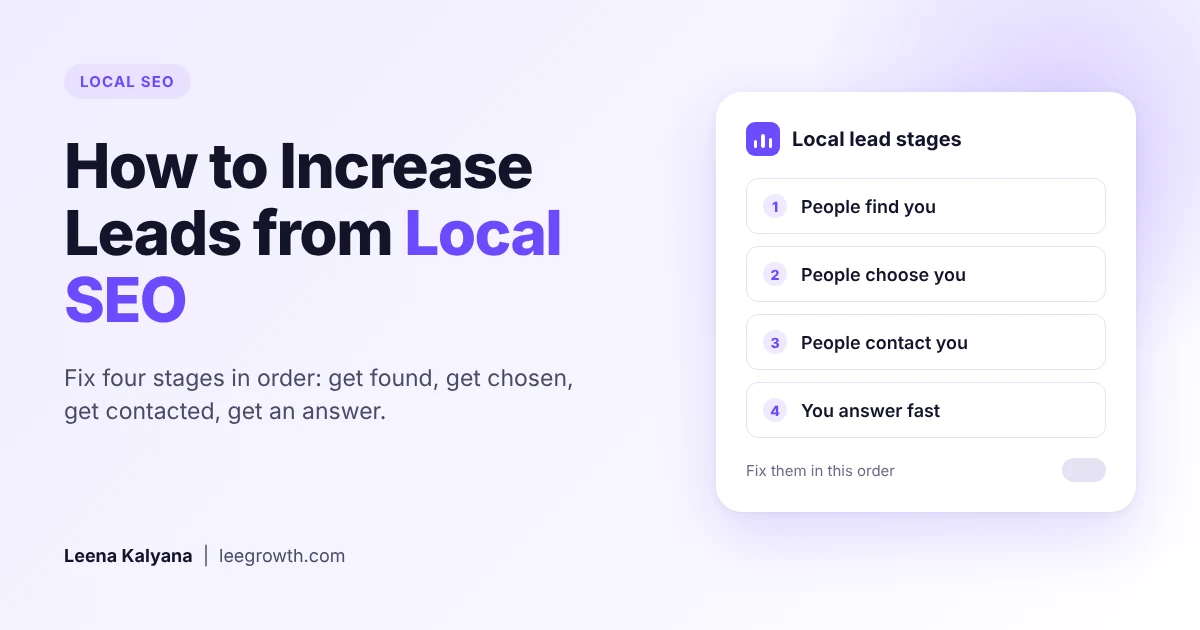
Increase leads from local SEO by fixing four stages in order: people find you, choose you, contact you, and get an answer from you. Measure your results first, then fix the weakest stage.
Local SEO leads arrive as calls, direction requests, website clicks and messages. Most small businesses lose leads at stage two, three or four, not at stage one. A higher ranking fixes only stage one.
Lead numbers depend on your area, your competitors and how you handle enquiries. This guide promises no figures. The guide shows where leads drop off and how to stop the loss in five steps.
Want a second opinion on your own profile and website? Get a free website SEO audit and I will point out the biggest drop-off.
Why does ranking alone not bring leads?
A ranking earns visibility, not enquiries. Reviews, photos, opening hours, page speed and contact options decide whether a searcher calls.
Take two clinics in the same area. Both appear in the top three on Google Maps. Clinic A has 8 reviews, 2 photos, wrong Sunday hours and a website that loads in 6 seconds on mobile. Clinic B has 140 reviews, clear photos, a tap-to-call button and a WhatsApp link. Clinic B receives more calls at the same ranking.
Local SEO therefore does two jobs: getting seen and getting chosen. Visibility without conversion wastes the investment. Local SEO for small businesses covers the full primer.
Step 1: How do you measure local SEO leads?
Track five numbers every month: profile calls, direction requests, website clicks, WhatsApp or form enquiries, and the source each enquiry reports. One hour sets up the baseline.
The five numbers:
- Calls from your Google Business Profile (GBP), the free listing that shows a business on Google Maps and Search
- Direction requests from your profile
- Website clicks from your profile
- WhatsApp clicks and form fills from your website
- Enquiry sources, collected by asking every new customer how they found you
Set up the tracking in five actions:
- Open the GBP performance report. The report shows calls, direction requests, website clicks and the searches that found you. The guide to tracking calls and direction requests from Google Maps walks through the setup.
- Tag the profile link. Add
?utm_source=google&utm_medium=organic&utm_campaign=gbpto the website link on your profile. UTM parameters are tags that tell Google Analytics where each visit came from. - Track taps on the phone number and WhatsApp button in Google Analytics 4. A developer or anyone who uses Google Tag Manager completes this in under an hour.
- Keep a monthly sheet. Add one column for “enquiries received” and one for “became customers”. Sales that take weeks need the source logged in a CRM or lead sheet, so each customer traces back to the first enquiry.
- Keep the real number primary. A call tracking number goes in as an additional number on the profile, so listings stay consistent.
Take the snapshot before any change. Without a baseline, month four proves nothing. Still deciding whether to invest? Read is SEO worth it for a small business first.
Step 2: How do you get found by searchers ready to buy?
Target narrow searches with buying intent, such as “root canal in Dwarka”, and give each main service its own page. Broad phrases like “local SEO” draw browsers, not buyers.
A local search shows three kinds of results. The map pack lists the top three businesses with a map. Regular results below it show websites and service pages. Extras include reviews and profile details. Your profile competes for the map pack, and your pages compete in the regular results. Both need work.
Apply these five actions:
- List services and areas in the words customers use, not industry words.
- Build one page per main service. A page for “root canal treatment in Dwarka” outranks one page that lists ten services.
- Group variants on one page. Terms such as dentist, dental clinic and “near me” searches belong on a single comprehensive page, not on duplicate pages.
- Add micro-locations for areas you actually serve. Neighbourhoods, colonies, markets, metro stations and pin codes match real searches, such as “near Dwarka Sector 12 metro”.
- Improve pages that already earn impressions. Google Search Console shows which searches those are.
Copy-paste area pages add nothing. Twenty near-identical pages for twenty localities look like spam. Write an area page only for a place you serve, with details that exist nowhere else. For the service-area setup, see how many service areas to add to your Google Business Profile.
What local content proves you work in the area?
Real job write-ups, local FAQs, area guides and pre-booking answers prove local presence. Generic posts that fit any city prove nothing.
- Describe real jobs. Name the neighbourhood, the problem, the work and the result, with the customer’s permission.
- Answer local FAQs. Cover local rules, typical timelines, parking, or how your service differs by building type.
- Write one honest area guide. List the areas you serve and the travel time to each.
- Answer pre-booking questions. Write down the five questions people ask before calling, such as cost, availability and what to expect on a first visit. Answer each plainly on your site. Plain answers also pre-qualify leads before they call.
A page that moves to a competitor’s site without changing a word is not local content.
Need help choosing searches? See keyword research services. Need page-level work? See on-page SEO.
Step 3: How do you get chosen over nearby competitors?
Win the choice with a complete Google Business Profile, specific reviews, identical business details everywhere and a few real local links. For most local businesses, the profile decides who gets the call, because many searchers never open the website.
How do you set up a Google Business Profile that sells?
Complete these seven items in order:
- Choose the primary category that matches your main service. The primary category strongly affects which searches show your profile. Add secondary categories only when they are true.
- List every service. Add a short plain description and, where possible, a price or range.
- Write the business description. State what you do, where and for whom in the first lines. Skip keyword stuffing.
- Update the hours. Wrong hours lose calls and reviews. Change the business hours on Google and set special hours for holidays such as Diwali.
- Upload real photos of the premises, team and work. A logo-only profile looks abandoned.
- Verify the contact options. Confirm the phone number is correct and answered. Point any booking link your category allows to your WhatsApp or booking page.
- Post updates. Offers and new services carry a small ranking signal and show the business is active.
Read more in Google Business Profile optimisation.
How do you collect reviews that win the choice?
Ask every happy customer right after the job, with one direct review link sent on WhatsApp. When two profiles look equal on the map, reviews break the tie.
- Send one link. One tap beats asking people to search for you first.
- Ask for specifics. Replace “please leave a review” with “what would you want someone in your situation to know?” Replies then name the service, the speed and the area. Specific reviews persuade readers more than “great service, five stars”.
- Reply to every review, good or bad, politely and briefly. Mention the service naturally and write a fresh reply each time.
- Follow Google’s review rules. Google Business Profile policies require genuine reviews, and Google can restrict a profile that buys or incentivises them. Ask all customers, not only happy ones.
Benchmark against the businesses above you with a Google Maps competitor analysis. The analysis shows what those businesses do better. To manage what searchers see when they look you up, see online reputation management.
Why must business details match everywhere?
Match the business name, address and phone number (NAP) on your website, Google profile, Apple Maps, Bing Places and every directory. Fix old listings first. A wrong number or old address sends customers to the wrong place.
How do you earn real local links?
Ask organisations that genuinely know you to link to you. Local associations and trade bodies you belong to, suppliers and partners who list you, community projects you sponsor, and local news or community sites that cover your area all qualify. A few real local mentions outweigh a long list of directories nobody visits. Off-page SEO services cover the wider link work.
Not sure how your profile compares with the businesses above you? Get a free check of your profile and website and I will tell you where you stand.
Step 4: How do you make it easy to contact you?
Make the phone number tap-to-call, add a WhatsApp button, and keep one short form on every service page. A visitor decides within seconds.
Check your main service page on your own phone with these actions:
- Load the page on mobile data. Compress large images, because slow pages lose visitors before the first word is read.
- Place the tap-to-call number where it shows without scrolling.
- Add a WhatsApp button that opens a chat with a ready message, such as “Hi, I want to know about [service]”. The link looks like
https://wa.me/91XXXXXXXXXX?text=Hi%2C%20I%20want%20to%20know%20about%20your%20service. Replace the X’s with your number. - Keep one short form. Name, phone and a short message suit most businesses.
- Show the price or a range. Buyers leave when no price appears.
- Show proof. Real reviews, photos of your work, years in business and the area you serve build trust.
- Show your location. Add an embedded map, the address and a note on landmarks or parking to the contact page.
- Give one clear next step per page, not five competing buttons.
Technical basics support these actions: fast loading, HTTPS, a mobile-friendly layout and LocalBusiness schema. LocalBusiness schema is structured data that gives Google your address, hours, services and reviews in a readable format. Most fixes are small. Technical SEO support covers the deeper ones. WordPress sites start with these WordPress SEO fixes for small businesses and the technical SEO audit checklist.
Step 5: How do you answer enquiries fast enough to win them?
Reply to every call and message within minutes during working hours, and set automatic replies for the rest. This is the step most owners skip, and the step where I see the most leads lost.
A person searching for a service contacts two or three businesses. The business that replies first, clearly and politely, often wins.
Build these habits:
- Assign an owner for calls and WhatsApp, and fix the hours they cover.
- Set up WhatsApp Business with a greeting message, an away message and quick replies for common questions. WhatsApp marketing services help with the setup.
- Return missed calls the same day. Missed calls from new numbers are often new leads.
- Cover after hours. Enquiries arrive in the evening and on Sundays. Show your hours clearly, use an away message that states when you will reply, and answer the backlog first thing next morning.
- Follow up once on every quote or enquiry that goes quiet. A short, polite message is enough.
- Bring customers back. A thank-you message and a reminder when they are due again cost little and keep the lead supply from restarting at zero.
- Keep a lead sheet with name, source, date and outcome. After two months the sheet shows which source brings paying customers, not only enquiries.
How do you get named in AI answers too?
Give AI tools clear, consistent, specific facts about your business. More people now ask ChatGPT, Gemini, Perplexity or Google’s AI answers for “best dentist near me” and act on the one or two businesses named. No AI company publishes its full selection method, so the habits below are best practice, not a guarantee.
- Collect specific reviews and write specific replies. Reviews that name the service, the speed and the area say more than a bare star rating.
- Answer real customer questions on your site: price ranges, availability and what to expect.
- Keep facts identical everywhere. Use the same name, address, phone number and services on your site, profile and listings.
- Earn real local mentions from associations, suppliers and community sites.
A lead sent by an AI answer arrives ready to act. A named business that misses the call or ignores the message loses that lead to the next name on the list. Step 5 protects this lead.
Read how to get cited by ChatGPT, why ChatGPT cites competitor content instead of yours and how voice search SEO differs from typed search.
Where do local SEO leads drop off?
Leads drop off at the stage with the lowest conversion rate. Compare each stage’s numbers to find that stage.
This illustration is not a promise or a benchmark. A service business records these numbers in one month:
- 2,000 people see the profile
- 120 take an action (call, directions, website click)
- 60 become real enquiries
- 15 become customers
Each ratio points to a fix:
- 120 actions from 2,000 views means the profile fails to convince. Improve photos, reviews, services and category.
- 60 enquiries from 120 actions means calls go unanswered or the website loads slowly. Check missed calls and page speed.
- 15 customers from 60 enquiries means replies, quotes or follow-up fall short. Review response time and follow-up messages.
Traffic is not always the problem. Sometimes the business loses the traffic it already has.
What mistakes waste local SEO leads?
Seven mistakes waste local SEO leads: chasing rankings, wrong details, weak reviews, single-page sites, copy-paste location pages, no mobile contact path and slow replies.
- Chasing rankings and ignoring enquiries. Report calls and leads, not only positions.
- Publishing wrong or missing details. An old phone number, wrong hours or a moved address costs real customers.
- Showing no reviews, or only old ones. A profile that looks inactive is a weak choice.
- Using one page for everything. Visitors want the page that matches the exact service they searched.
- Copying location pages. Near-identical pages for many areas add nothing and look like spam.
- Hiding the contact path on mobile. A number that is not tappable sends visitors back to the results.
- Answering slowly. The best ranking in the area cannot fix a phone nobody picks up.
Buying shortcuts adds an eighth risk: fake reviews, bought links and keyword-stuffed business names can get a profile or site penalised.
What does a 30-day plan to get more leads look like?
Spend a few focused hours each week for four weeks, in this order.
Week 1: Baseline and profile
- Record the five numbers.
- Tag the profile link.
- Fix hours, category, services and photos.
Week 2: Website lead path
- Add tap-to-call and a WhatsApp button to every service page.
- Test the site on a phone and fix the slowest page first.
Week 3: Reviews and response
- Send the review link to the last 20 happy customers.
- Reply to every existing review.
- Set up the WhatsApp Business greeting and quick replies.
Week 4: Review and decide
- Compare the numbers with week 1.
- Pick the weakest stage (found, chosen, contacted or answered) as next month’s focus.
Local results move over months, not days. Judge the change over 2 to 3 months before drawing conclusions. A weak number with no visible cause calls for a full SEO audit with an action plan, which lists every fix in priority order.
Should you do local SEO yourself or hire help?
Do it yourself when time allows, and hire help when time, technical problems or unclear priorities block progress. Every step above works without an agency.
A hired consultant reports calls, directions and enquiries, not only rankings. You keep ownership of your own Google accounts. These questions to ask before hiring an SEO consultant test any candidate. What SEO work actually includes explains what a quote must cover. See what local SEO services involve before you decide, or talk to me directly for a free first look.
Frequently asked questions about increasing leads from local SEO
How do I increase leads from local SEO?
Count calls, directions and enquiries first. Then complete the Google Business Profile, give each service its own page, add tap-to-call and WhatsApp buttons, collect specific reviews and answer every enquiry quickly. Fix the weakest stage before adding traffic.
How long does it take to get more leads from local SEO?
A small local business sees early movement in 2 to 3 months and clearer lead growth in 3 to 6 months. Crowded markets take longer. Competitors and the starting point set the timeline.
Why do I rank on Google Maps but get no calls?
Three causes explain most cases. The profile fails to convince (few reviews, poor photos, wrong hours), the contact path is hard (number not tappable, slow website), or calls go unanswered. Check these before paying for more SEO.
How do AI search tools affect local leads?
AI tools such as ChatGPT, Gemini and Perplexity name one or two businesses per answer. No company publishes its full selection method. Clear services, consistent business details, specific reviews and plain answers to common questions give these tools more to work with. The named business still has to answer fast.
Which matters more for leads, reviews or rankings?
Rankings get you seen, and reviews get you chosen. A high ranking with weak reviews brings fewer calls than a slightly lower ranking with strong reviews.
Is WhatsApp useful for local business leads in India?
Yes. Customers in India often prefer to message before they call. A visible WhatsApp button, a greeting message and fast replies turn visits into enquiries.
Can I track which leads come from local SEO?
Yes. Use the profile’s performance numbers, tag the profile link, track taps on the phone and WhatsApp buttons, and ask every new customer how they found you.
Is local SEO better than regular SEO?
Local SEO serves customers in a specific area, and regular SEO serves a wider audience. Local SEO works through the Google Business Profile, reviews, listings and area pages. Businesses with a location or a set service area gain most from local SEO, and many need both.
Is local SEO important for every business?
No. Local SEO matters most for businesses with a physical location or a defined service area. A business that sells nationwide online with no local customers benefits more from broader SEO.
Should I buy leads or rely on local SEO?
Rely on local SEO as the base and treat bought leads as a short-term supplement. Lead sellers often sell the same lead to several businesses, so you compete for one person, and quality varies. Local SEO builds assets you own: a profile, reviews and pages. Track which source brings paying customers.
Where are your local SEO leads dropping off?
I will check your Google Business Profile and website and name the stage that loses you the most enquiries. The check carries no obligation and no guaranteed-rankings talk.
Get your free website SEO audit or message me on WhatsApp.
Learn more: SEO services · About Leena

Leena Kalyana is an SEO and digital marketing consultant in Delhi NCR and the founder of LeeGrowth. She helps clinics, coaching institutes, consultants and small businesses get found on Google, Google Maps and AI search. She works directly with every client and does not guarantee rankings.