In this article
Last updated: November 2026 · Written by: Leena Kalyana, SEO consultant, Delhi NCR
The short answer
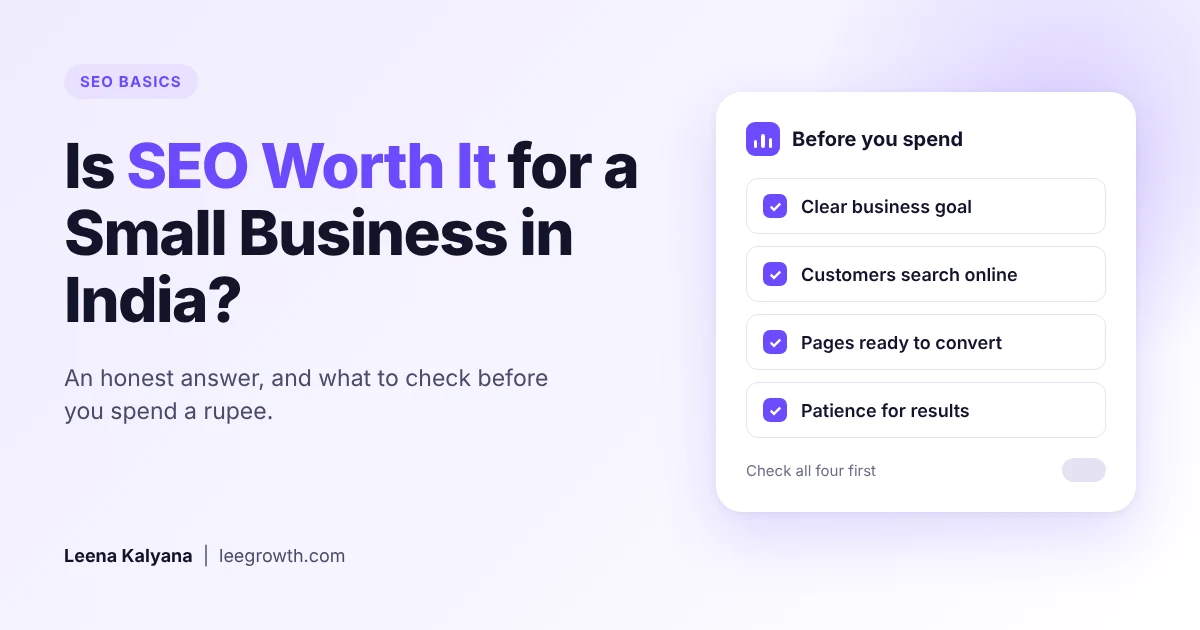
SEO is worth it for a small business when three things are true: people in your area search for what you sell, you can handle the extra enquiries, and you can wait a few months for results. If any of these is missing, SEO may be a poor fit right now, and I will say so honestly.
I am not going to promise you a number one ranking or a fixed number of leads. Nobody honest can. What SEO can do is put your business in front of people who are already looking for you, without paying for every click.
Not sure where you stand? Get a free website SEO audit and I will tell you plainly whether SEO makes sense for you right now.
Why SEO matters for a small business
Many people in India start a purchase on Google or Google Maps. A person who searches “dentist near me” or “CA for GST filing in Delhi” has already decided they need someone. They are not scrolling past an ad. They want an answer today.
That is the real importance of SEO for a small business: you show up at the moment of need, and you are not buying every visit. Because older pages can keep ranking, the work also builds on itself. What you set up in month three can still bring enquiries in year two. If you are new to the topic, what SEO work actually involves explains what you pay for.
The benefits of local SEO for small businesses
For a business that serves one city or a few areas, local SEO often gives the best return. The main advantages of local SEO are:
- You reach people close to buying. Searches with a place or “near me” usually come from people ready to call or visit.
- Calls, directions and WhatsApp messages, not just clicks. A Google Business Profile can send people straight to your phone or shop.
- Costs that do not rise with every visit. Ads stop the moment you stop paying. A page that ranks keeps working.
- Trust. Reviews, photos and a complete profile make a small business look established before the first call.
These are the benefits of local SEO services when the work is done properly. They are not automatic, and they depend on what your competitors are doing. If a competitor keeps showing above you on the map, this guide to Google Maps competitor analysis shows what to look at first.
When SEO is worth it
SEO usually pays off if:
- Your customers search before they buy. Clinics, coaching centres, interior designers, repair services, lawyers, CAs, schools, salons and B2B services all fit.
- Each customer is worth a reasonable amount. If one new customer brings you real profit, even a few extra a month can cover the cost.
- You can respond to leads quickly. Ranking brings enquiries only if someone answers the phone and WhatsApp.
- You can wait. A realistic first look at progress is 3 to 6 months, and it can take longer in a crowded market.
- Your website or Google profile can be fixed. Many small sites already have the basics wrong, which is where quick gains come from.
When SEO is not worth it (yet)
- You need customers this week. SEO is slow. Google Ads, referrals or WhatsApp outreach will be faster. Many businesses use both.
- Nobody searches for what you sell. Check this first. A new or unusual product may need awareness before search.
- Your margins are too thin for any marketing. Fix the offer before you pay to promote it. If you earn very little on each sale, a multi-month SEO payback rarely works.
- You cannot handle more enquiries. More leads help only if you can serve them.
- Someone promises guaranteed rankings. This is the biggest red flag. “Rank in days” tactics such as bought links can also get a site penalised and cost far more to repair later.
What SEO work actually includes
SEO is not one task. A proper plan covers four parts, and a proposal that skips most of them will underdeliver:
- Technical health. Pages Google cannot find or load, slow mobile speed, duplicate pages and broken redirects. This is often where the quickest gains are. See technical SEO.
- Page structure. One page for each service, clear titles and headings, and internal links between related pages. See on-page SEO.
- Content. Useful pages and guides that answer what your customers ask before they buy, built on proper keyword research. This is the slowest part and usually the biggest.
- Trust and local signals. A complete Google Business Profile, reviews, consistent listings and genuine mentions from other sites.
How long does SEO take?
There is no fixed answer. A typical pattern for a small local business looks like this:
- Month 1: fixes to the website and Google Business Profile. Little visible change.
- Months 2 to 3: early movement for low-competition searches, more profile views.
- Months 3 to 6: steadier rankings and the first leads that clearly come from search.
- Months 6 to 12: competitive searches often start moving, and growth builds if you keep adding useful pages and reviews.
Highly competitive terms such as plain “local SEO” or “SEO services” take much longer than specific searches for your service and area. Your timeline depends on your competitors and your starting point.
Why SEO gets cheaper over time
Ads bring leads from day one, and the cost per lead stays about the same for as long as you pay. SEO brings almost nothing in the first month, so its cost per lead looks high at first, then falls as your pages start to rank.
That is why the worst mistake is stopping at month 4 or 5. You have paid for the slow part and left before the cheaper part begins. As a rule, give it at least 6 months before you judge it, and only commit if you can afford to wait that long. For many small businesses the best answer is both: ads for leads now, SEO for lower-cost leads later.
A simple break-even check
Here is how to test it with your own numbers. Say SEO costs a certain amount each month, and one new customer is worth a certain amount to you in profit, not just sales. Divide the first by the second and round up. That is how many new customers a month you need from search just to break even. Anything beyond that is return.
As an illustration only, and not a quote: if SEO cost ₹15,000 a month and each new customer left you ₹5,000 in profit, you would need 3 new customers a month to break even. Four would leave you ahead. Zero in the first four months would mean ₹60,000 spent before the first clear result.
Also count that slow start. Ask yourself honestly whether you can carry those early months. If you can’t, start smaller, with only your Google Business Profile and one or two service pages, or use ads first.
How much does SEO cost in India?
Prices vary widely, so be careful with both very cheap and very expensive offers. The cost depends on your website, your competitors, how many locations you serve and how much content you need. Ad spend, a full redesign and paid tools usually cost extra.
Whoever you hire, ask these before paying:
- What exactly will you do each month?
- What will I see in my reports, and who owns the accounts?
- Can I contact past clients?
- What happens if I stop after three months?
If the answers are vague, walk away. If you want a written plan and price for your own business, start with the free audit. There is also a paid full SEO audit with an action plan if you want a complete step-by-step list. You can also compare SEO tools and their Indian prices if you plan to do some of the work yourself.
Also insist on these before any work starts:
- Your accounts stay yours. Google Analytics, Search Console, your domain and your Google Business Profile should be in your name, with the provider added as a user.
- A written list of what is broken, in order of priority. If they cannot produce one, they do not know your site yet.
- A starting snapshot of your traffic, rankings and enquiries, so you can tell later whether it worked.
- Reports that show enquiries, not only rankings and impressions.
Is it worth paying an SEO company?
Sometimes yes, sometimes no. It is usually worth paying when you lack the time or skills to do the work yourself, when your site has technical problems you can’t fix, or when you want faster progress than you can manage alone.
It is usually not worth paying when the provider guarantees rankings, won’t show you what they will do each month, won’t give you access to your own accounts, or reports only on rankings and not on enquiries. A good provider:
- explains the work in plain language and shows you a priority list
- uses honest methods and does not buy links or stuff keywords
- reports on calls, enquiries and leads, not just impressions
- is happy for you to speak to past clients
For more, here are 10 questions to ask before hiring an SEO consultant.
Freelancer or agency?
For a business with one location and a modest budget, a good freelancer can be a sensible choice: you deal directly with the person doing the work, and costs are usually lower. The risks are that everything depends on one person’s availability, and that one person may not cover technical work, content and reviews equally well.
An agency brings a team and usually more structure and reporting, but costs more, and a small account can end up handled by the most junior person.
I work as a solo consultant, so I am not neutral here. Judge for yourself, and read what working with a digital marketing freelancer in Delhi looks like. Either way, the same checks apply: a written priority list, a starting snapshot of your numbers, reports on enquiries and ownership of your own accounts. The size of the provider matters less than whether they are open about what they will do and what they cannot promise.
How to tell if SEO is bringing you leads
Rankings alone do not pay your bills. Track things that show real interest:
- phone calls from your Google Business Profile
- direction requests
- WhatsApp clicks and form fills
- enquiries that say “I found you on Google”
Ask every new customer how they found you, and write it down. After 3 to 4 months you will have a much clearer picture than any ranking report.
Set a review point at 6 months and agree what you will look at before you start: calls and direction requests from your profile, WhatsApp and form enquiries, and the number of enquiries that came from Google. Compare them with your starting snapshot. That gives you a fair basis to continue, change approach or stop.
What about AI search and fewer clicks?
Google now shows AI-generated summaries for some searches, and people also ask questions in AI chat tools. That can reduce clicks for general information searches. But for local, “I need someone now” searches, people still look at maps, reviews and business profiles, and then call or visit.
The basics still matter either way: a complete Google Business Profile, a clear page for each service, genuine reviews and accurate details across the web. Nobody can honestly guarantee that your business will appear in AI answers, so be cautious of anyone who promises it. If you want to go deeper, read how to get cited by ChatGPT and the guide to voice search SEO.
Before you decide
Do three quick checks:
- Search for your service and your area on Google. Who shows up?
- Work out what one new customer is worth to you.
- Decide who will answer new enquiries, and how quickly.
If these look good, and you can wait at least 6 months, SEO is likely worth a serious try.
What you can do yourself first
You can do a lot before paying anyone, and it makes you a better judge of whoever you hire later:
- Complete your Google Business Profile with all services, photos and your hours.
- Set up Google Search Console and check that your important pages are indexed.
- Make sure your website loads fast on mobile and shows your phone number. Compress large images. If your site runs on WordPress, these 15 WordPress SEO fixes are a good place to start, and the technical SEO audit checklist shows what to check.
- Give each service its own page instead of listing everything on one.
- Turn the ten questions customers ask you most often into ten short pages or FAQ answers.
- Publish your prices, or at least a range. Many buyers search for price and few local businesses answer.
Frequently asked questions
Is SEO worth it for a very small business? Often yes, especially local SEO, because you compete in a small area and not nationally. It depends on whether your customers search and how many you can serve.
Is SEO better than ads? Neither is better for everyone. Ads are faster and stop when you stop paying. SEO is slower and builds over time. Many businesses use both.
How long does SEO take to work? For a small local business, early movement often shows in 2 to 3 months and clearer leads in 3 to 6 months. Competitive searches can take 6 to 12 months or longer. It depends on your competitors and your starting point.
Is SEO still worth it with AI summaries and fewer clicks? For local businesses, usually yes. People who need a service nearby still rely on maps, reviews and business profiles. The basics stay the same, and nobody can guarantee visibility in AI answers.
Is it worth paying an SEO company? It can be, if you lack the time or skills and the provider is open about their work, gives you your own accounts and reports on enquiries. Avoid anyone who guarantees rankings.
What if SEO doesn’t work? Usually the cause is one of a few things: technical problems on the site, thin or missing service pages, the wrong keywords, an incomplete Google Business Profile, or too little time. Before you quit or switch provider, audit what has actually been done and compare your numbers with your starting snapshot. If a provider cannot show you what they changed, that is a reason to look elsewhere.
Can I do SEO myself? Yes, the basics are manageable. Start with the list above, and hire help when you lack the time or want faster progress.
How do I know if I am getting value? Track calls, directions, WhatsApp and form leads, not just rankings.
Not sure whether SEO fits your business?
I will check your website and Google Business Profile and tell you honestly whether SEO makes sense now, with no obligation and no guaranteed-rankings talk.
Get your free website SEO audit or message me on WhatsApp.
Learn more: What SEO work really involves · Local SEO services in Delhi · SEO services · About Leena

Leena Kalyana is an SEO and digital marketing consultant in Delhi NCR and the founder of LeeGrowth. She helps clinics, coaching institutes, consultants and small businesses get found on Google, Google Maps and AI search. She works directly with every client and does not guarantee rankings.