In this article
What is SEO work? It is the ongoing set of tasks that helps your website appear on Google when people search for what you sell. The goal is more enquiries, not just more visits. This guide is for business owners who are about to hire an SEO or already pay for one. It shows what the work includes, what a normal month looks like and what your money buys. You will get a clear picture to check against what your SEO sends you, with no promises of instant rankings.
What is SEO work? (short answer)
SEO work is the monthly effort of making your website easier for Google to find, understand and trust. It covers keyword research, page fixes, technical checks, content, local listings, link building and reporting.
In marketing terms, SEO (search engine optimization) is the part of digital marketing that earns free, unpaid traffic from search results. You do not pay Google for each click, but you do pay for the time and skill needed to earn the ranking. That is the core answer to “what is an SEO in marketing” and “what does SEO mean in marketing.”
What does SEO include? The 6 parts of the work
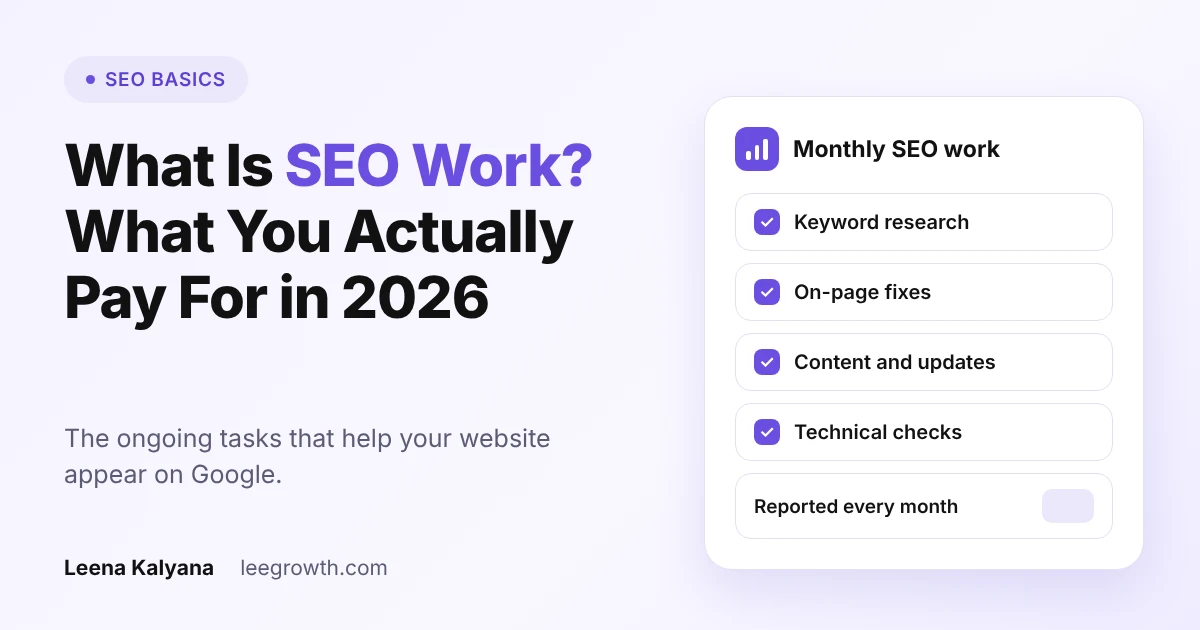
Most SEO work falls into six parts. This is a complete SEO breakdown. Agencies name the parts differently, but the components of search engine optimization are the same. Each part below shows what the SEO does and what proof you can ask for.
1. Keyword research
What the SEO does: Finds the words your customers type into Google, checks how often they are searched, and decides which ones your site should target first. A good SEO also checks the intent behind a search. Someone searching “what is SEO” wants to learn. Someone searching “SEO company near me” wants to hire.
Proof you should see: A keyword list in a sheet, with search volume, difficulty and the page each keyword is assigned to.
2. On page SEO
What the SEO does: Fixes what is on your pages: page titles, meta descriptions, headings, content, image names and internal links (links between your own pages). This is the part most people mean when they ask “what is SEO optimization.” It is about making each page clearly match the search it should rank for.
Proof you should see: A before and after list of the pages changed, with the new titles and headings.
3. Technical SEO
What the SEO does: Checks that Google can crawl (find) and index (store) your site without trouble. This covers page speed, mobile display, broken links, redirects, duplicate pages, sitemap and indexing errors.
Proof you should see: A list of errors found, which ones were fixed, and a screenshot from Google Search Console (a free Google tool that shows how your site performs in search) showing the issues going down. For a step by step list you can follow yourself, read my technical SEO checklist.
4. Content
What the SEO does: Plans, writes or edits pages and blog posts that answer real customer questions. This also includes updating old posts that have lost traffic.
Proof you should see: A content plan for the month, the published links, and later, the traffic and rankings those pages earn.
5. Local SEO and Google Business Profile
What the SEO does: For businesses that serve a city or area, this means setting up and improving your Google Business Profile (the free listing that shows your business on Google Search and Maps), keeping your name, address and phone number the same across the web, adding photos and posts, and helping you collect genuine reviews.
Proof you should see: Profile views, calls and direction requests from your Google Business Profile, and the list of listings updated. For help with this part, see local SEO services in Delhi.
6. Link building and reporting
What the SEO does: Earns links from other trusted websites to yours, because these act as a signal of trust. Then reports on what happened. Reporting is part of the work, not an extra.
Proof you should see: A list of new links with the site name and page, plus a monthly report covering rankings, traffic, enquiries and the next month’s plan.
What does an SEO do in a normal month?
In a normal month, an SEO reviews results, fixes problems, creates content and reports what happened. The work is mostly invisible, so here is what a SEO does across one month. The exact split depends on your site and package.
Week 1: Review and plan
- Check last month’s rankings, traffic and enquiries in Google Search Console and Google Analytics
- Look for pages that dropped, pages that grew and new errors
- Decide the month’s priorities
Week 2: Fix and improve
- Fix technical issues found in the audit
- Update titles, headings and content on pages that are close to page one
- Add internal links between related pages
Week 3: Create
- Publish new content or refresh old posts
- Update your Google Business Profile with posts, photos or new services
Week 4: Build and report
- Work on link building or outreach
- Prepare the monthly report in plain language
- Share what was done, what changed and what happens next month
A good SEO can tell you which of these things happened last month. If yours cannot, that is a problem. I cover it in the red flags section below.
What do you actually pay for in SEO work?
You pay for time and skill, not rankings. No one controls Google. What a good SEO controls is the quality and consistency of the work. Rankings are the result of that work over time.
What is usually included
- Keyword research and a plan
- On page and technical fixes
- A set amount of content or page updates
- Local SEO setup and upkeep
- A monthly report and a call or message to explain it
What is often extra
- Content writing, if the package only covers strategy
- Paid link placements or digital PR
- Paid SEO tools and subscriptions
- Website design or development changes
- Extra locations or languages
Always ask which of these your quote covers. Two quotes that look similar can include very different amounts of work.
What you should never be paying for
- A guaranteed ranking or “page one in 30 days”
- Instant results
- Bulk, low quality links
- Reports that only show keywords moving up, with no traffic or enquiry data
What does SEO cost in India in 2026?
There is no official rate card, and published guides do not fully agree. Pulling together three 2026 pricing guides from Indian agencies, these are rough monthly ranges. Treat them as a guide, not a quote:
- Small local business (one city): roughly ₹15,000 to ₹50,000 per month. Guides range from about ₹10,000 at the low end to ₹60,000.
- Growing or mid-market business: roughly ₹40,000 to ₹1.5 lakh per month
- Large, national or e-commerce campaigns: roughly ₹1 lakh to ₹4 lakh or more per month
- One-time SEO audit: roughly ₹10,000 to ₹80,000, depending on the size of your website
- Freelancers: a wide spread, from about ₹5,000 to ₹60,000 per month. One guide says ₹5,000 to ₹15,000, another says ₹10,000 to ₹60,000, and the difference is mostly experience and scope
In Delhi NCR, one agency guide puts a locally focused small business at about ₹15,000 to ₹30,000 per month, and NCR-wide or national visibility from about ₹40,000.
Why the gap? Price mostly follows how competitive your keywords are, the condition of your website, how many pages and keywords are targeted, how much content and link building is included, and who does the work (senior or junior).
Add GST to the quote. SEO services attract 18% GST in India, charged by providers who are registered for GST. A ₹30,000 quote becomes ₹35,400 a month with GST. Always ask whether the price you are given includes GST.
Be careful with very low quotes. The guides warn that quotes of a few thousand rupees a month usually mean automated directory submissions or low-quality links, which can even risk a Google penalty. Between roughly ₹10,000 and ₹30,000 the scope has to be narrow, such as local SEO for a single location, or a freelancer’s limited hours. The better question is always: “What exactly do I get each month?”
What the money usually buys. At the lower end, expect Google Business Profile work, basic on page fixes, about 2 to 4 blog posts a month, light link building and a monthly report. In the middle, expect full technical SEO, more content (one guide puts it at roughly 6 to 10 posts a month), active link building and a monthly strategy review. At the top end, expect a dedicated team, large amounts of content and digital PR. Ask which items are actually included when a quote lists work from a different level.
Is it worth the money? A simple payback check. Judge SEO by what it brings in, not only by the monthly fee. Here is an example with made up numbers, so replace them with your own:
- You pay ₹30,000 a month plus GST, so ₹35,400
- By month six, SEO brings 20 enquiries a month and you close 10% of them, so 2 new customers
- Your average sale is ₹25,000, so that is ₹50,000 a month
In this example you need about 1.4 sales a month to cover the cost. Expect the first few months to run at a loss, because foundation work comes before traffic. This is an illustration, not a promise of results.
Ask any provider whether the quote includes content writing, link building and tools, since these are the items most often charged on top.
My SEO services page explains what a scoped package covers. Freelance SEO services may be a better fit for smaller needs.
What has changed in SEO work in 2026?
The basics of SEO marketing have stayed the same, but a few things matter more than they did a few years ago.
AI Overviews and AI search. Google now shows AI generated summaries for many searches, and other AI tools also cite web pages in their answers. A clear, direct answer near the top of a page, like the short answer box above, is therefore more useful than ever. Google’s own guidance on AI features says there are no extra requirements to appear in AI Overviews or AI Mode, and the usual SEO fundamentals still apply. Doing them well makes your page eligible to be shown, but Google does not guarantee that any page is shown, so be careful with anyone selling guaranteed AI citations.
Experience and trust matter more. Google’s guidance asks for helpful, reliable, people-first content. In practice: real author names, real examples from your business, accurate facts, clear contact details and genuine reviews.
Reporting now includes AI search. Google counts visits from AI Overviews and AI Mode in the overall search traffic in Search Console. Other tools try to show whether ChatGPT and similar tools mention your brand. This kind of data is still early and not perfect, so treat it as extra information, not a replacement for enquiries and sales.
What are the red flags that SEO work is not real work?
Watch for these signs:
- They guarantee the first page. No honest SEO can promise this.
- There is no monthly report. If you cannot see what was done, you cannot judge the value.
- They only buy links. Links matter, but a plan made only of bought links is risky and often ignores the actual problems on your site.
- They cannot say what they did last month. Real SEO leaves a trail: pages changed, content published, errors fixed.
- They will not give you access. You should have access to your own Google Search Console, Analytics and Business Profile.
- The report only shows keyword rankings. A useful report also shows traffic, enquiries and what was done, not just positions.
- They only get paid if you rank. Pay per ranking sounds safe, but it rewards shortcuts that can hurt your site later.
- They want a long lock in. A contract of 6 to 12 months is usually reasonable. Be careful with two year terms and no way out.
Questions to ask before you sign
- What exactly will change on my website each month?
- How many articles, links and fixes are included, as real numbers?
- Who will do the work, and who is my contact?
- Do the price and the scope include content, links, tools and GST?
- Can I see a sample monthly report?
- What are the contract length and the exit terms?
For a longer list, read 10 questions to ask before hiring an SEO consultant. A good provider answers these clearly and in writing. Vague answers tell you what you need to know.
When is SEO not the right fit yet?
SEO suits most businesses where customers search online, but there are a few cases where it should wait:
- Your sales come only from referrals or formal tenders. If buyers never search for a supplier like you, there is little search demand to capture.
- You need customers this week. SEO is slow, so paid ads are a better short-term tool. SEO can start once the pressure eases.
- Your market is tiny. If you only sell to a handful of large buyers, direct contact will reach them better than rankings.
For everyone else, if people search for what you offer, you want to be found.
DIY, freelancer or agency: what fits you?
DIY
- Best if you have more time than budget and your site is small
- You will need to learn the basics and stay consistent. It costs little cash but takes real time every week
- Start with a free audit to find the biggest issues first
Freelancer
- Good for small businesses with a clear, limited scope
- Usually more direct communication and a lower overhead
- One person can only do so much fixing, writing and outreach in a month, and usually does it one task after another
- Ask what happens if they are unavailable or busy
Agency
- Better if you need content, technical work, links and reporting handled by a team
- Useful for larger sites or several locations
- A team can work on fixes, content and links at the same time
- Ask who will actually do the work, and whether you get a named contact
Whichever you choose, ask for the same things: a written scope, a monthly report and access to your own accounts.
FAQs
What is SEO work in simple words?
SEO work is the regular effort of improving your website so Google shows it to people searching for your products or services. It includes research, page fixes, technical checks, content, local listings, links and reporting.
What does SEO include?
SEO includes keyword research, on page SEO, technical SEO, content, local SEO and link building, along with monthly reporting. This is what SEO consists of in most professional packages. Some also add conversion improvements and AI search tracking.
What does an SEO do in marketing?
In marketing, an SEO is responsible for bringing in free, search based traffic. They find what customers search for, improve your site to match, build trust through content and links, and report on results. This is the main use of SEO for a business: steady enquiries without paying for each click.
How does SEO work step by step?
SEO works in six steps: research, audit, fix, publish, build trust and measure.
- Research the keywords your customers use
- Audit your site for technical and content problems
- Fix and improve pages
- Publish helpful content
- Build trust with links, reviews and a strong Business Profile
- Measure results and repeat
The six steps above are the full explanation of how SEO works in a nutshell.
Behind the scenes, a search engine also works in three stages. It crawls pages by following links, indexes them by storing them and working out what each page is about, and ranks them by choosing the pages that best answer a search. SEO work makes each of those stages easier for your pages.
What is advanced SEO?
Advanced SEO goes beyond the basics. It covers things like site architecture for large websites, structured data (schema), log file analysis, international SEO, crawl budget management and content strategy built around topics rather than single keywords. If your site is small, you usually need the basics done well before advanced work pays off.
How long does SEO take to show results?
Most small business sites see early movement in about 3 to 6 months, and meaningful results in about 6 to 12 months. Competitive keywords, new websites and sites with technical problems can take longer. This is a rough industry estimate, not a promise. Anyone who promises page one in a few weeks is a red flag.
Is SEO a one time job?
No, SEO is not a one time job. A one time setup can fix major problems, but search results, competitors and Google itself keep changing. SEO needs regular work to build results and to protect them. For more on this and other common beliefs, see SEO myths in India.
Conclusion
SEO work is steady, practical effort: research, fixes, content, links and honest reporting, not a trick or a guarantee. Once you know what to expect, it is much easier to judge whether you are getting value.
Not sure where your website stands? Get a free website SEO audit and see what needs fixing first.

Leena Kalyana is an SEO and digital marketing consultant in Delhi NCR and the founder of LeeGrowth. She helps clinics, coaching institutes, consultants and small businesses get found on Google, Google Maps and AI search. She works directly with every client and does not guarantee rankings.