In this article
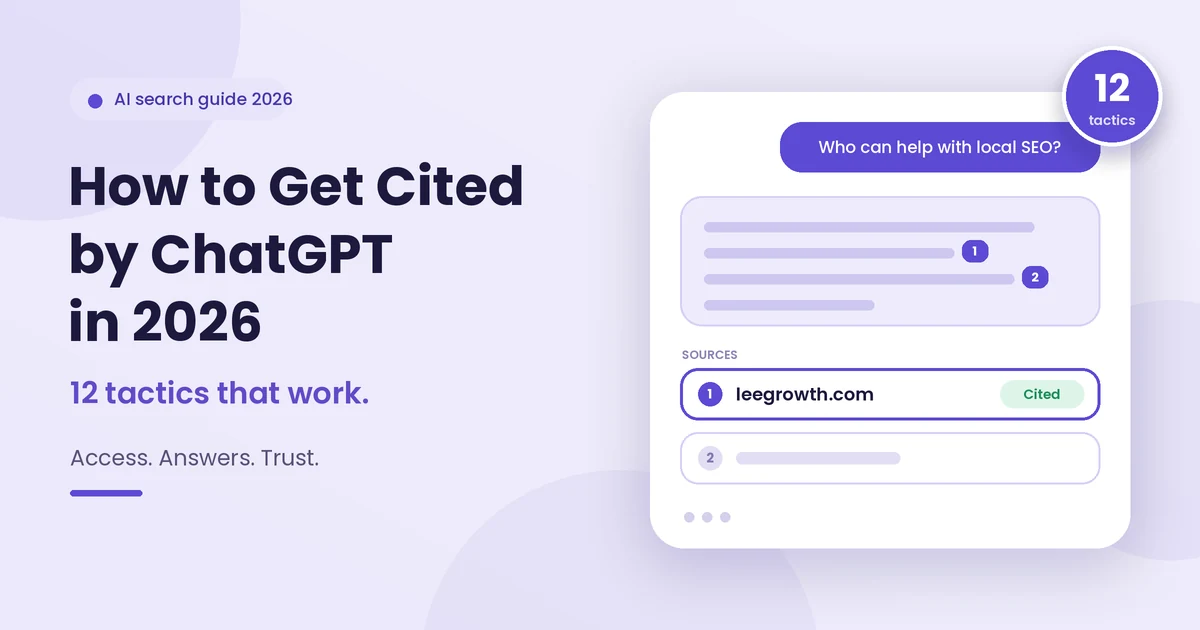
TL;DR: ChatGPT cites pages that it can reach, understand quickly, and trust. To get cited, let OpenAI’s crawlers in, write answer first content, publish original data, make your brand easy to recognize, get mentioned on other sites, keep pages current, and track results with real prompt tests. No tactic guarantees a citation, but together they improve your chances.
Why ChatGPT Citations Matter
When someone asks ChatGPT “What’s the best CRM for a small agency?” or “How do I fix a leaky faucet?”, the answer can include a few linked sources. Those links work like the new page one rankings.
Being cited gives you:
- Visibility in a place where millions of people now start their research.
- Better traffic. People who click from an AI answer have usually read a summary already and want more.
- Brand trust. Even when nobody clicks, being named as a source shapes how people see you.
This is the core of Generative Engine Optimization (GEO), also called Answer Engine Optimization (AEO): making your content easy for AI tools to find, understand and use. This guide is about being cited in ChatGPT answers, not about academic citation styles like APA or MLA.
A quick honest note. ChatGPT does not publish how it picks sources. Results change by prompt and by user, and the product changes often. Everything below comes from published studies and industry reports, and each tactic has an evidence rating. Most of the evidence is observational, so treat these tactics as good ideas to test, not guarantees.
How ChatGPT Decides What to Cite
When ChatGPT uses search, it usually works like this:
- It reads the question and may split it into several smaller searches (this is called query fan out).
- It pulls candidate pages from a search index and live web sources.
- It reads those pages and picks passages that answer the question.
- It writes a reply and links the sources it used.
There are two layers to remember: what the model remembers and what it retrieves. Its built in knowledge decides whether it already knows your brand. Live search decides which pages get pulled in for a question. One academic study of 158,099 answers put it simply: pages get cited when they are searched, and brands get named when they are remembered (arXiv study). So this guide covers on page tactics (for retrieval) and off site reputation (for memory).
To get cited, you need to win three stages: be retrievable, be extractable, and be trustworthy. The 12 tactics below follow those stages, with a last part on measuring results.
What the Research Says
Several studies now look at which pages ChatGPT cites. These are the findings this guide uses:
- Answer capsules: 72.4% of cited blog posts in one audit of 15 domains had a clear answer capsule, the most common trait. Over 90% of those capsules had no links in them (Search Engine Land).
- Original data: It was the second strongest trait. Posts with both a capsule and original insight made up 34.3% of cited posts (Search Engine Land).
- Page depth: About 65% of ChatGPT cited URLs sit two or three folders deep, while 58.8% of referral traffic lands on homepages (VentureBeat).
- Google rankings: 28.3% of ChatGPT’s most cited pages had zero Google organic visibility (VentureBeat).
- Position on the page: 44.2% of 18,012 verified citations came from the first 30% of a page (Growth Memo).
- Section length and data: Sections of 120 to 180 words between headings averaged 4.6 citations, against 2.7 for sections under 50 words. Pages with 19 or more data points averaged 5.4 citations, against 2.8 (SE Ranking).
- Retrieved vs cited: ChatGPT cited only about 15% of the pages it retrieved while researching answers (Search Engine Land).
- Question matching: Within one site, pages whose titles and paragraphs match real user questions get cited more. FAQ blocks, structured data and page speed seemed to matter mainly when comparing different sites (arXiv study).
- Reddit swing: In one tracker’s data, Reddit’s share of ChatGPT Search citations fell from about 3.83% to 0.52% between mid July and mid August 2026. No cause was confirmed (Promptwatch).
- Google overlap: In a 15,000 prompt study, only about 12% of links cited by ChatGPT, Gemini and Copilot appeared in Google’s top 10 for the same prompt. For ChatGPT alone it was roughly 6% to 8%. The data was collected in July 2025 (Ahrefs).
- Google’s own advice: In May 2026, Google said that for its own AI features, optimizing is “still SEO,” and that special schema, llms.txt, content chunking and AI specific rewriting are not required (Google).
How to read these numbers. Nearly all of them are observational. They show what cited pages tend to have in common, not what causes a citation. Several come from vendors or agencies, sample sizes differ, and ChatGPT keeps changing. Use them to decide what to test first.
Scope. Google’s guidance covers Google’s AI features. Do not assume findings about ChatGPT carry over to Gemini, Perplexity or AI Overviews, or the other way round. For example, Claude cites websites only when it runs a web search, which is different from ChatGPT (read more: does Claude cite websites). This guide focuses on ChatGPT.
Evidence ratings used below (these are my own judgment, not an official measure):
- Documented: described in OpenAI’s own documentation, or a basic requirement.
- Moderate: supported by at least one study, but observational.
- Mixed: some parts have data and some do not.
- Early: sensible and widely recommended, but little solid data.
Part 1: Be Retrievable
1. Let OpenAI’s Crawlers Access Your Site
Evidence: Documented. OpenAI publishes its crawler names, and being blocked is a clear way to be left out of search results.
This is the most missed step. If your site blocks AI crawlers, ChatGPT search may not see you, however good your content is. OpenAI uses three user agents:
- OAI-SearchBot: shows sites in ChatGPT search results. This is the one to allow.
- GPTBot: collects content that may be used for model training. Blocking it is a business choice.
- ChatGPT-User: visits a page when a user’s request needs it.
A common setup allows search and blocks training:
User-agent: OAI-SearchBot
Allow: /

User-agent: GPTBot
Disallow: /
Also check that your CDN or firewall (Cloudflare, for example) is not blocking these bots by default, and search your server logs for them. If you see repeated 403 responses, a firewall rule is turning the crawlers away. For the full robots.txt setup, including Google-Extended and PerplexityBot, read my guide on whether to block GPTBot and OAI-SearchBot.
2. Get Indexed and Rank in Traditional Search
Evidence: Moderate. Retrieval draws on web search, but ranking first is not required (VentureBeat, Ahrefs).
ChatGPT search uses web search results, so classic SEO still matters. Pages that are indexed, crawlable and ranking for related queries are more likely to be pulled in.
Practical steps:
- Submit your XML sitemap to Google Search Console and Bing Webmaster Tools.
- Fix crawl errors, broken canonicals and accidental noindex tags.
- Keep important content in the HTML itself, not behind heavy JavaScript or login walls.
- Add internal links so key pages are not orphaned.
Other things that can stop a crawler:
- Robots meta tags or X-Robots-Tag headers set to noindex or nofollow by mistake
- CDN or firewall rules that show a challenge page to non browser visitors, even when robots.txt says allow
- Cookie walls, login pop ups or geo blocking
- Key content that only appears after JavaScript runs
- Many URLs (parameters, copied versions) competing for the same page. Use one consistent canonical tag.
The plain text test. Copy your page text into a plain editor, or fetch it with a text based tool. If the key answer, numbers and headings are all still there and make sense, a crawler can probably use the page. If chart values only exist inside an image or script, add them as an HTML table below it.
SEO helps, but it is not a strict gate. VentureBeat reported that 28.3% of ChatGPT’s most cited pages had no Google organic visibility. Ahrefs found something similar: only about 12% of cited links ranked in Google’s top 10 for the same prompt, and ChatGPT’s own overlap was roughly 6% to 8%. That data is from 2025, so patterns may have changed. Think of being indexed and crawlable as the entry ticket, not ranking number one.
Reports often point to Bing as one source behind ChatGPT search, so Bing Webmaster Tools is worth setting up. But OpenAI does not publish its full retrieval setup, so do not optimize for Bing alone. Check your visibility in both Google and Bing.
3. Match ChatGPT’s Query Fan Out
Evidence: Moderate. One academic study found that pages whose titles and paragraphs match user questions were cited more within the same site (arXiv study).
When a prompt is broad, ChatGPT often splits it into several narrower searches behind the scenes. Your page does not need to answer the whole prompt. It only needs to be the best answer to one of the smaller questions.
Take this prompt: “What CRM works best for a five person marketing agency that needs email automation?” The smaller searches might cover pricing for small teams, email automation features, integrations and ease of setup. A page with a clear section for each has four chances to be pulled in instead of one.
How to use this:
- Break each topic into the 5 to 10 questions a buyer would ask.
- Give each question its own H2 or H3, worded the way a person would ask it.
- Keep each section about one question only.
- Keep page titles and URL slugs close to the question (/best-crm-for-small-marketing-agencies is better than /crm-guide-2026).
- Collect real wording from sales calls, support tickets, People Also Ask, Reddit and Quora.
- Run the prompt in ChatGPT with search on and look at the sources it shows. They hint at which smaller questions it is answering.
This also explains why cited pages often do not rank for the original prompt. Ahrefs noted that AI tools may never search the exact prompt a user typed, and run related queries instead. You cannot see ChatGPT’s exact sub queries, so treat this as an informed guess, then test it.
Part 2: Be Extractable
4. Open Every Section With an Answer Capsule
Evidence: Moderate (observational). Capsules were the most common trait in one audit (Search Engine Land), and early page content gets more citations (Growth Memo). This is correlation, not proof.
AI tools pull passages, not whole pages. An answer capsule is a self contained summary of two to three sentences that gives the answer before any background. Put one at the top of the page and right under each key heading.
- Weak: “There are many factors to consider when thinking about onboarding emails, and it really depends on your business.”
- Strong: “A good SaaS onboarding sequence has 4 to 6 emails sent over the first two weeks, starting with a welcome message within minutes of signup. Each email should push one action, such as connecting an integration or inviting a teammate.”
Rules for a good capsule:
- It makes sense when read alone, with no “as mentioned above.”
- It gives the answer, not a teaser.
- Context, examples and details come after it.
- It has no links inside. Over 90% of capsules in cited posts had none (Search Engine Land). The authors think links inside the capsule may signal that the best answer lives elsewhere. That is only a guess, but it is a cheap test: keep the capsule clean and put links in the paragraphs after it.
Put your best material first. Growth Memo’s analysis of 18,012 verified ChatGPT citations found that 44.2% came from the first 30% of a page, and far fewer from the last stretch. Keep key definitions, numbers and direct claims near the top.
5. Use Clean Structure and Specific Facts
Evidence: Mixed. Specific facts and sensible section lengths have supporting data (SE Ranking). Schema and FAQ blocks have weaker evidence within a single site (arXiv study).
Structure helps machines read your page. Specific facts give them something worth quoting. You need both.
Structure:
- Use a clear H1, H2, H3 order with descriptive headings.
- Use numbered steps for processes, bullets for criteria and comparisons.
- Add a real FAQ section with short answers.
- Define terms plainly: “X is a … that …”.
- Add schema (Article, FAQPage, Organization, Product) where it fits, but keep expectations low. The academic study found FAQ blocks, structured data and summary boxes helped mainly when comparing different websites, not pages on the same site (arXiv study). Google also says no special schema is needed for its own AI features (Google), though that advice does not cover ChatGPT.
- Keep sections substantial. Sections of 120 to 180 words averaged 4.6 citations against 2.7 for sections under 50 words (SE Ranking).
Specifics:
- Replace “many companies” with “in a survey of 200 B2B marketers.”
- Name tools, versions, prices and places.
- Cite your sources so claims can be checked.
- State when the information was last updated.
Vague content is hard to credit. Fact rich content is easy to cite.
Before and after (placeholders in brackets):
- Before: “Our onboarding process helps companies get started faster and see better results.”
- After: “[Company]’s onboarding takes [X] days on average across [N] customers surveyed in [month, year], and [Y%] reached their first goal within [Z] weeks. Method: [one line description].”
The second version has a number, a sample, a date and a pointer to the method. Only use figures you can back up.
A simple Organization schema example (replace every placeholder with real details):
{
  "@context": "https://schema.org",
  "@type": "Organization",
  "name": "Your Brand Name",
  "url": "https://yourdomain.com",
  "logo": "https://yourdomain.com/logo.png",
  "description": "One clear sentence about what you do and who you serve.",
  "sameAs": [
    "https://www.linkedin.com/company/your-company",
    "https://x.com/yourhandle"
  ]
}
Check it with Google’s Rich Results Test or the Schema.org validator before publishing.
6. Go Deep, Not Broad
Evidence: Moderate. Similarweb data shows most cited URLs sit deep in a site (VentureBeat).
About 65% of ChatGPT cited URLs sit two or three folders deep (VentureBeat). This fits how retrieval works: a narrow question is best matched by a narrow, focused page.
There is a twist. The same report found that 58.8% of ChatGPT referral traffic lands on homepages (VentureBeat). The page that earns the citation and the page that gets the visitor are often different, so prepare both.
- Build one page for each question or intent, instead of one giant overview.
- Make each page the best answer on that exact topic.
- Link related pages together (a hub page with supporting pages) and use anchor text that says what the next page covers.
- Do not expect your homepage to earn most citations, but make it ready for visitors from AI answers: say clearly who you are and send people to your deeper pages.
Part 3: Be Trustworthy
7. Publish Original Data and First Hand Experience
Evidence: Moderate. Original data was the second strongest trait in one audit (Search Engine Land) and is linked to higher citation counts in another (SE Ranking).
Original research is hard to copy because it exists nowhere else. If you are the source of a statistic, you become the page everyone, including AI, has to point to.
Original or owned data was the second strongest trait among cited pages in the Search Engine Land audit. SE Ranking found pages with 19 or more data points averaged 5.4 citations against 2.8 for sparse pages (SE Ranking). This is correlation, and lots of data on a weak page will not save it.
Easy ways to create original data:
- Run a small survey of your customers or audience.
- Study your own product or campaign data and publish what you find.
- Run an experiment and share the method and results (for example, “We tested 50 prompts across 5 AI tools”).
- Share screenshots, benchmarks and case studies from real work.
Always explain your method and sample size. Honest limits build trust and make your data easier to cite.
Do not hide your findings.
- Put the headline numbers, a short method and a dated summary in HTML on the page, not only in a PDF or behind a form. If data is gated, a crawler may never see it.
- For long reports, add a 300 to 500 word HTML summary near the top, then the key stats.
- You can still offer the full PDF as a download.
- Where it fits, use Dataset or Report structured data, with named authors and dates.
8. Build a Clear Brand Entity
Evidence: Early. The logic is sound and fits the “remembered brands” finding (arXiv study), but there is no solid test of specific entity tactics.
AI tools think in entities: companies, people, products and topics. The clearer your entity, the easier it is to link you with your expertise.
- Write a strong About page that says who you are, what you do and who you serve in plain words.
- Use one spelling for your brand name everywhere: site, schema, social profiles and directories.
- Add author bios with real credentials and links to professional profiles.
- Keep your LinkedIn, Google Business Profile and directory listings accurate and matching. For local businesses, this is a big part of local SEO.
- Use Organization and Person schema with sameAs links to your official profiles.
- Wikidata is optional. If you meet its rules, a complete entry may help, but evidence for ChatGPT is thin. Never write a promotional Wikipedia page about yourself.
I cover this in more detail in my guide on entity SEO for small businesses. If AI tools already describe your business wrongly, see how to make AI tools describe your business correctly.
9. Earn Mentions on Third Party Sites
Evidence: Early to moderate, and volatile. Widely reported and sensible, but there is no solid study proving it, and platform shares can change fast (Promptwatch).
AI answers often reflect what the wider web says about a brand, not only what the brand says about itself. Focus on:
- Review and comparison sites in your industry.
- “Best of” and roundup articles from credible publishers.
- Honest community answers on Reddit, Quora and industry forums, with your affiliation disclosed.
- YouTube and podcasts, where transcripts become another source that can be indexed.
- Digital PR, guest posts and expert quotes on reputable sites.
The goal is for several independent sources to describe you the same way. That match is a trust signal.
A warning example. Promptwatch tracking, reported by Search Engine Land, showed Reddit averaging 3.83% of ChatGPT Search citations from July 18 to August 7, 2026, then dropping to 0.52% between August 14 and 17, a fall of 86%. No one has confirmed why, and it is one tracker’s data. The lesson is about risk: do not build your visibility on one outside platform. Make your own pages the base and spread your effort. I explain how far community mentions really help in do Reddit, Quora and LinkedIn mentions help AI visibility, and how to use Reddit for research in my Reddit SEO strategy.
How to get into the “best of” pages AI already trusts
- Run 10 to 20 category prompts in ChatGPT with search on, such as “best CRM for small marketing agencies.”
- Note every roundup, review or comparison page it links to.
- Check each one: is the list current, is your category covered, is your brand missing or described wrongly?
- Pitch the author or editor something specific: a data point they lack, a corrected fact, or a quote from a named expert on your team.
- Offer something useful, not a favor. Never pay for hidden placement or ask for fake reviews.
- Run your prompts again after a few weeks to see if anything changed.
This is closer to digital PR than classic SEO, and it is slow. But a mention on a page that ChatGPT already retrieves can matter more than another post on your own site.
10. Keep Content Fresh and Accurate
Evidence: Early. Often recommended, but the supporting figures I found came from weaker sources, so I left them out.
For topics that change, retrieval systems tend to favor current information.
- Review your top pages on a schedule, such as every quarter.
- Update stats, screenshots, prices and tool lists.
- Show a visible “Last updated” date, and make sure it reflects real changes.
- Remove or redirect old content that clashes with your newer pages.
- Update the same URL instead of publishing near copies, and add a short note on data pages (for example, “Updated [month, year]: refreshed survey figures”).
- Do not fake freshness by changing dates without changing the content. It is dishonest and easy to spot.
11. Show Real Expertise (EEAT)
Evidence: Early. A sensible trust standard, with no direct citation data behind it that I could verify.
Experience, expertise, authority and trust are Google ideas, but they are a fair standard for any system trying to pick reliable sources.
- Put named, qualified authors on content, especially for health, money and legal topics.
- Share first hand experience: what you tried, what failed, what you would change.
- Cite primary sources and link to them.
- Include named expert quotes (full name, title, company) where they add real insight. There is no ChatGPT specific evidence that quotes raise citations, so treat this as good credibility practice, not a proven lever. Get permission, and never invent a quote.
- Be open about sponsorships, affiliate links and conflicts of interest.
Part 4: Measure and Improve
12. Track Your AI Visibility and Improve
Evidence: Not applicable. This is measurement, not a ranking factor, but it is how you learn what works for you.
You cannot improve what you do not measure. Use two checks together.
1. A monthly prompt audit. Pick a fixed list of 20 to 50 realistic customer prompts and keep it the same each month. Run each one, note whether you are cited, mentioned or missing, and note which competitors and sources appear instead. Because answers vary, run important prompts a few times and look for patterns. My 20 prompt AI visibility test gives you a ready list and a simple way to score it.
2. GA4 referral traffic:
- Open Reports > Acquisition > Traffic acquisition.
- Change the primary dimension to Session source / medium (or Session source).
- Search for “chatgpt” in the filter box. Visits from ChatGPT often show a source of chatgpt.com, and ChatGPT often adds utm_source=chatgpt.com to the links it shows. The medium label can vary (for example “referral” or “(not set)”), so search by source.
- Go to Reports > Engagement > Landing page, add Session source as a secondary dimension, and see which pages get ChatGPT visits.
- To keep this visible, create a custom channel group (Admin > Data display > Channel groups) with a rule for sessions from chatgpt.com, perplexity.ai and other AI domains.
What you cannot see. If ChatGPT uses your information without a clickable link, or someone sees your brand and never clicks, no referral shows up. Look for indirect signs too: a rise in branded search impressions in Google Search Console, direct visits to pages AI answers cite, a “How did you hear about us?” field with an AI option, and notes from sales calls. Some sources claim hidden AI influence is several times bigger than visible referrals. I could not verify those multipliers, so treat the size as unknown. For a wider view of reporting, see how to measure organic search visibility beyond rankings.
If your numbers fall later, read why AI citations drop and check each cause.
What Not to Do
- Do not stuff keywords. Repeating a phrase adds nothing for a system that matches meaning, and it makes the page worse for people.
- Do not write a “definitive guide” with nothing new in it. If your page repeats what a hundred others say, there is no reason to cite yours. Add data, examples or first hand experience.
- Do not bury the answer. Long intros push key facts down the page, where citations are less likely to come from.
- Do not gate your best findings. Numbers locked behind a form, a PDF or a script only chart are hard for crawlers to use.
- Do not fake freshness. Changing the date without changing the content is easy to catch.
- Do not spam Reddit, Quora or review sites. Hidden promotion gets downvoted, flagged or removed, and hurts your reputation.
- Do not pay for hidden placements or fake reviews. It is deceptive and can break platform rules and advertising law.
- Do not rely on one audit. Answers change from run to run, so check again on a schedule.
- Do not ignore other engines. Perplexity, Gemini and Google AI Overviews have their own habits. Most tactics carry over, but track each one separately.
What You Don’t Need
Plenty of advice makes this sound harder and costlier than it is. You probably do not need:
- An llms.txt file. Google says it is not needed for its AI features (Google), and there is no strong public evidence that ChatGPT relies on it. It is harmless to add.
- A huge site or top Google rankings. Ranking helps, but 28.3% of ChatGPT’s most cited pages had zero Google organic visibility (VentureBeat).
- A paid tracking tool on day one. A manual prompt audit and GA4 are enough to start.
- Perfect schema. Accurate Organization and Article markup is fine. Evidence for heavy schema work is mixed (arXiv study).
- A Wikipedia page. Most small brands do not meet the notability bar. Earn independent coverage instead.
- A separate “AI search” team. For its own AI features, Google says optimization is still SEO (Google). Much of this is good content practice done carefully. The real differences are the focus on answers that can be lifted out, off site mentions, and a different way of measuring.
A 90 Day Plan to Start Getting Cited
This is a suggested order of work, not a promised timeline.
Weeks 1 to 2: Audit and baseline
- Confirm OAI-SearchBot is not blocked and your key pages are indexed in Google and Bing.
- Run 20 to 50 realistic customer prompts in ChatGPT and record who gets cited.
- Note the outside pages that appear most often.
Weeks 3 to 6: Fix and upgrade your own pages
- Add an answer capsule and TL;DR to your 5 most important pages.
- Rewrite headings to match real questions and fan out questions.
- Add specific facts, dates and named authors.
- Add Organization schema and fix your About page and brand naming.
Weeks 7 to 10: Create and earn
- Publish one piece of original data or a documented experiment.
- Pitch 3 to 5 authors of the outside roundups you found.
- Take part honestly in 1 or 2 communities where your customers ask questions.
Weeks 11 to 13: Measure and improve
- Run the same prompts again and compare with your baseline.
- Check GA4 for referral traffic from chatgpt.com.
- Keep what worked, drop what did not, and repeat.
After that, check again every month, because citation patterns shift.
Quick Checklist
- [ ] OAI-SearchBot is not blocked in robots.txt or by your CDN
- [ ] Server logs checked for GPTBot, OAI-SearchBot and ChatGPT-User visits
- [ ] Site is indexed in Google and Bing
- [ ] Headings and URLs match the smaller questions behind each prompt
- [ ] Key answers appear in server rendered HTML (plain text test passed)
- [ ] Each key section opens with a self contained answer capsule
- [ ] Best findings are ungated, with an HTML summary above any PDF or form
- [ ] You can point to the exact sentence or table an AI would cite within ten seconds
- [ ] TL;DR and FAQ added to key pages
- [ ] Facts, numbers and dates are specific and sourced
- [ ] Focused deep pages exist for each key question
- [ ] Original data or first hand experience is included
- [ ] About page, named author bios, schema and one brand spelling are in place
- [ ] Outside roundups that ChatGPT already cites are found and pitched
- [ ] Wikidata entry created, if you meet its rules (optional)
- [ ] Top pages reviewed and updated every quarter
- [ ] Monthly prompt audit and GA4 tracking running (with a chatgpt.com filter or channel group)
Frequently Asked Questions
Can I pay to get cited by ChatGPT?
No. You cannot buy citations in ChatGPT answers directly. You earn them with accessible, useful, trustworthy content and a strong presence on the web.
How long does it take to get cited?
It varies. Pages that are already indexed and trusted can get picked up within weeks. Newer sites may need months of steady publishing and outside mentions. There is no fixed timeline.
Do I need to rank on Google first?
Not strictly. Retrieval often starts with web search, so being indexed matters. But 28.3% of ChatGPT’s most cited pages had zero Google organic visibility (VentureBeat), and Ahrefs found only about 12% of cited links ranked in Google’s top 10 for the same prompt. Treat SEO and GEO as partners.
Does schema markup guarantee citations?
No. Schema helps explain your content, but the evidence is mixed. One academic study found it mattered mainly when comparing different websites, not pages on one site (arXiv study). Content quality and question matching matter more.
Is Bing SEO the same as ChatGPT SEO?
No, though they overlap. Reports often link ChatGPT search to Bing, so setting up Bing Webmaster Tools makes sense. But OpenAI does not share its full retrieval setup, and 28.3% of ChatGPT’s most cited pages had no Google organic visibility (VentureBeat). Treat Bing indexing as one useful step, not the whole plan.
How do I check whether ChatGPT’s crawlers visit my site?
Search your server logs for GPTBot, OAI-SearchBot and ChatGPT-User over the past 30 days. If none appear, check robots.txt, your CDN or firewall bot rules, and whether your site is new. Look for repeated 403 errors in particular.
Does Wikipedia presence matter for ChatGPT citations?
Wikipedia is widely cited in AI answers, but I found no solid study showing that having an article gets a brand more citations. You also cannot write a promotional page about yourself. A more realistic path is earning independent coverage and keeping your brand details consistent across the web.
Do recency signals and “last updated” dates matter?
For topics that change, practitioners report that ChatGPT’s search features prefer current pages. Public data is limited, so update pages only when you have real changes, show an honest date, and never fake freshness.
Should I write content directly for ChatGPT?
Write for people first, with clear structure. The habits that help machines (direct answers, specific facts, clear headings) also help readers. Avoid keyword stuffing, which makes pages worse with no proven benefit.
How do I track my citations over time?
Run a fixed set of realistic prompts every month, note whether you are cited and which sources appear instead, and watch GA4 for referral traffic from chatgpt.com. Tools can automate this, but a manual audit is a good free start. Answers vary from run to run, so look for trends, not single results.
Should I block GPTBot?
That is a business decision. Blocking GPTBot (training) is separate from blocking OAI-SearchBot (search). If you want to appear in ChatGPT search results, do not block the search crawler. See my robots.txt guide for the full setup.
Is an llms.txt file required?
No. It is a proposed convention, and there is no strong public evidence that ChatGPT relies on it. Google has also said it is not needed for its own AI features (Google). It is harmless to add, but do not expect it to move results on its own.
Does Google’s AI search guidance apply to ChatGPT?
Not automatically. In May 2026, Google said that for its own AI Overviews and AI Mode, optimizing for generative AI is still SEO, and that special schema, llms.txt, content chunking and AI specific rewriting are not required (Google). That covers Google’s features only. OpenAI has not published similar guidance, and the ChatGPT evidence here is observational. Clear, answer first content is still good for readers, so I recommend it, but not because Google requires it.
Is GEO or AEO different from SEO?
Partly. Good SEO basics still apply: crawlable pages, clear structure, real expertise and useful content. What changes is the focus: answers that can be lifted out of the page, specific facts, original data, mentions on other sites, and a different way of measuring, since AI citations do not show up in Search Console like rankings do. Whether you call it a new field or an extension of SEO matters less than doing the work.
Why can’t I see all my ChatGPT citations in analytics?
Analytics only records visits where someone clicks a link. If ChatGPT mentions your brand or uses your information without a clickable link, or the user never clicks, there is no referral to count. That is why I suggest combining GA4 referral data with a regular manual prompt audit.
Final Thoughts
Getting cited by ChatGPT is not about tricking an algorithm. It comes down to being the clearest, most credible and most specific answer to a real question, and making sure the systems that look for answers can reach you.
Start with the basics (crawler access and indexing), make your content answer first and full of facts, publish something original, and build your reputation beyond your own site. Then measure, learn and repeat. To begin, pick your 10 most important pages, run the checklist above on each, and test them against a set of real customer prompts. That one exercise will show you where your gaps are.
Want help building an AI visibility plan for your brand? See my AI search optimization work, get a free website SEO audit, or talk to LeeGrowth. You can also read more guides on the LeeGrowth blog.
Sources
- Search Engine Land, “How to get cited by ChatGPT: The content traits LLMs quote most”
- VentureBeat, “AI cites the deep pages but sends humans to the homepage” (Similarweb, Ahrefs and Previsible data)
- DEV Community summary of Growth Memo’s analysis, “ChatGPT Citations Cluster Near the Top of Pages”
- Contently summary of the SE Ranking study of 129K domains, “How to Get Your Brand Cited in ChatGPT”
- Cognizo summary of a Search Engine Land analysis, “ChatGPT AI visibility statistics for 2026”
- arXiv, “What Drives AI Citations? Content, Retrieval and Model Knowledge in Generative Engine Optimization (GEO)”
- Search Engine Land, “Reddit’s ChatGPT Search citations fell 86% in four days: Report” (Promptwatch data)
- Ahrefs, “Only 12% of AI Cited URLs Rank in Google’s Top 10 for the Original Prompt” (published August 2025, data collected July 2025)
- Search Engine Journal, “Google’s New AI Search Guide Calls AEO And GEO ‘Still SEO'”, summarizing Google Search Central’s “Optimizing your website for generative AI features on Google Search” (May 2026)

Leena Kalyana is an SEO and digital marketing consultant in Delhi NCR and the founder of LeeGrowth. She helps clinics, coaching institutes, consultants and small businesses get found on Google, Google Maps and AI search. She works directly with every client and does not guarantee rankings.