In this article
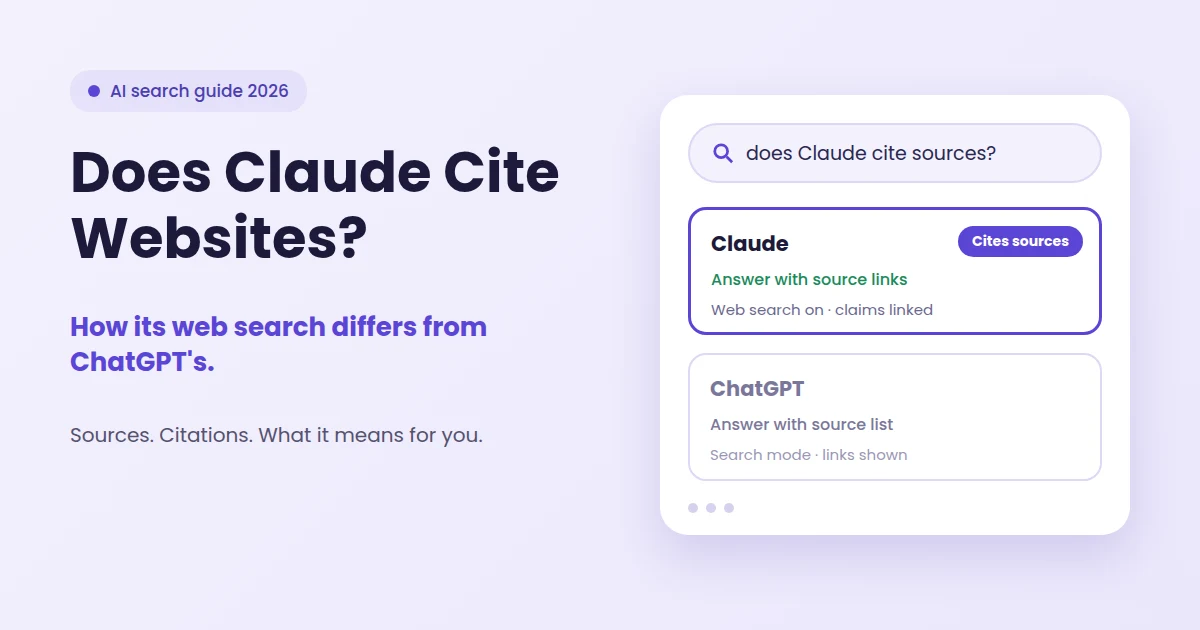
Claude cites websites only when it runs a web search. Without a search, Claude answers from its training data and shows no sources. ChatGPT works the same way, but it searches more often and uses different search systems. Claude’s own search also changed in October 2026, so older advice may no longer fit. This guide explains how both tools pick pages, how many sources Claude cites, when it searches at all, which bots control access, and 10 steps to earn citations.
Key facts about Claude citations
- Claude cites websites only in answers that use web search.
- Claude’s default search appears to have moved off Brave Search in early October 2026, based on one measurement. Anthropic has not confirmed it.
- Claude cites roughly 3.6 to 5.7 sources per answer in three studies. One Opus 5.5 test counted 16 domains in standard mode and 29 in extended mode.
- Whether Claude searches depends on the topic. It searched on every answer about smartphones and on 1.4% of answers about skincare in one study.
- Claude and ChatGPT cite the same pages only about 8% of the time, according to Xponent21.
- Claude-SearchBot controls Claude search visibility. ClaudeBot controls training use only.
- A Claude citation depends on 3 gates: access, search and selection.
Does Claude Cite Websites?
Yes, Claude cites websites in every answer that uses web search. It shows no citations when it answers from memory.
Anthropic states that every Claude web search answer includes citations. Each citation links to the source page. Anthropic explains this in its web search help article. In the API, citations stay on for web search. Each one includes the page URL, the page title and a short snippet of cited text, as the web search tool docs show.
One catch: searching and showing a link are not the same thing. In a November 2026 study by LLM Pulse, 97.8% of Claude Sonnet 5.5 answers that searched showed a source link. For Claude Haiku 5.5 the figure was only 19.0%. A page can sit in the search results behind a Haiku answer and never appear as a link.
Citations also need a manual check. Anthropic notes that some links fail and advises cross-checking sources for important decisions. A model can also write a source from memory when no search runs. Open each link and confirm the claim.
Web search works on the free plan. It counts toward the daily usage limit. Team and Enterprise plans need an admin to turn it on.
Did Claude Change Its Search Engine in October 2026?
Probably. One measurement found that Claude’s default search no longer runs mainly on Brave Search, but Anthropic has not announced a change.
Until recently, most guides said Claude’s web search runs on Brave Search. Anthropic added Brave to its subprocessor list on 19 March 2025, and Profound found an 86.7% overlap between Claude answers and Brave results. That overlap came from only 15 data points.
Writesonic then ran 50 prompts across 16 categories in two search modes and published the results on 20 October 2026. It reports three findings:
- A switch around 5 October. Writesonic’s own search logs showed that every call after 5 October carried a “standard” or “extended” mode label, and no call before it did. This comes from one account, so it is not a confirmed global date.
- Two modes that rarely agree. Standard mode is the default. Extended mode searches more widely. On Opus 5.5, the two shared only 10% of cited domains.
- Brave overlap fell. Standard mode matched Brave’s own results on 13.3% of domains. Extended mode matched on 38.4%. Writesonic also tested Parallel, another provider on Anthropic’s subprocessor list, and found 11.3% in standard mode and 18.6% in extended mode. So the new default index is unidentified.
Anthropic’s subprocessor list also names turbopuffer as a web search provider, added 6 May 2026. Public sources do not explain how Claude uses it.
What does this mean for site owners? Brave and Google crawl access still matter for extended mode and for older data. For the default mode, nobody outside Anthropic can say yet what the index is built from. Writesonic notes that the standard-mode favorite it checked was in Common Crawl, which is a hint, not a rule. Writesonic sells AI visibility software, so treat its test as one vendor’s measurement.
Studies run before October, such as the June 2026 citation study below, describe the old setup.
How Does ChatGPT Search Differ From Claude?
ChatGPT search blends several providers, including Bing, with OpenAI’s own crawler. Claude’s default search now uses an index that outside testers cannot yet name.
OpenAI has never said ChatGPT runs on Bing alone. ChatGPT search answers show inline links and a Sources panel. Plain ChatGPT chats without a search show no sources. AirOps found that about 85% of the pages ChatGPT retrieves never appear in the final answer. Retrieval and citation are two separate steps.
The two tools also cite different pages. Xponent21 reports that Claude and ChatGPT citations overlap only about 8% of the time.
| Attribute | Claude | ChatGPT |
|---|---|---|
| Cites websites | Yes, after web search | Yes, after web search |
| Search rate in studies | 36.6% (Profound test), 56.6% to 61.0% (LLM Pulse, app), 80% (Prefer, API with search requested) | About 90% in Prefer’s test, about 90 to 95% in Profound’s |
| Search backend | Unconfirmed new default index since early October 2026, Brave-like results in extended mode, plus turbopuffer on Anthropic’s list | Several providers including Bing, plus OpenAI’s crawler |
| Sources per answer | About 3.6 to 5.7 in three studies | About 3.1 in two studies, 7.9 in a third |
| Citation display | Numbered inline links | Inline links plus a Sources panel |
| Search bot | Claude-SearchBot | OAI-SearchBot |
| Training bot | ClaudeBot | GPTBot |
| User request bot | Claude-User | ChatGPT-User |
How Many Sources Does Claude Cite Per Answer?
There is no single number. Studies report between about 3.6 and 8.8 sources per Claude answer, depending on the model, the search mode and how the test was run.
Some pages say Claude cites only 2 to 4 sources per answer. A few studies support something close to that, but others do not:
| Study | Claude setup | Claude sources per answer | ChatGPT in the same study |
|---|---|---|---|
| Prefer, 13 Sep 2026 | claude-sonnet-5, API, search requested, 240 answers | 4.58 overall, 5.73 when it searched | 3.05 |
| 1,200-prompt study, Apr to May 2026 (reported by aimode.my) | Not stated | Median 3.6 | 3.1 |
| Qwairy, Jan to Mar 2026 (118,000 responses, reported in a DEV Community post) | Not stated | 5.67 | 7.92 |
| Honeyb, Jul 2026 | claude-haiku-4-5, API, 60 answers | 8.8 | Not reported here |
| Writesonic, Oct 2026 | Opus 5.5, 50 prompts | 16 domains (standard mode), 29 (extended mode) | Not tested |
| LLM Pulse, 31 Oct to 1 Nov 2026 | Claude.ai app, Sonnet 5.5 and Haiku 5.5, 14,400 answers | 2.31 links per answer (Sonnet), 0.23 (Haiku) | Not tested |
Three patterns stand out:
- Studies disagree on who cites more. Prefer found Claude citing more than ChatGPT. Qwairy found the reverse. Method matters more than brand.
- The model changes the result. Sonnet and Haiku showed very different link counts in the same app on the same days.
- Search depth varies. Writesonic counted 2.6 searches per prompt for Opus 5.5 in standard mode and 4.0 in extended mode, against 1.2 for Sonnet 5.5 and 1.1 for Haiku 5.5.
Anthropic’s API docs also say a single request can trigger several searches in a row. In February 2026 Anthropic added dynamic filtering, where Claude writes code to filter search results before reading them. On Anthropic’s own benchmark, accuracy rose from 33.3% to 46.6% for Sonnet 4.6 and from 45.3% to 61.6% for Opus 4.6. A likely effect for publishers is that Claude judges pages on specific facts, not on whole pages. That is an inference, not something Anthropic has stated.
When Does Claude Search the Web at All?
It depends on the topic. Claude searched on nearly every answer about gadgets and money transfers, and almost never on skincare or travel booking.
Profound’s test found Claude searching on 36.6% of prompts. Other tests found much higher rates. Prefer found 80% when it asked for search on every call through the API. LLM Pulse found 56.6% for Sonnet 5.5 and 61.0% for Haiku 5.5 in the Claude.ai app, and the rate swung sharply by category:
| Category (LLM Pulse, Sonnet 5.5) | Answers with a web search |
|---|---|
| Wireless earbuds, robot vacuums, smartphones | 100% |
| Electric cars | 99.7% |
| Banks and money transfers | 98.3% |
| Laptops | 90.0% |
| VPNs | 81.9% |
| CRM software | 33.3% |
| Project management | 23.9% |
| Online courses | 3.6% |
| Travel booking | 3.1% |
| Skincare and language apps | 1.4% |
The choice is also not stable. For 37.2% of questions, Sonnet searched on some of the 18 repeat answers and skipped it on others. When Claude did search, 98.9% of Sonnet’s queries included the year 2026, which suggests it hunts for current pages.
For a site owner, this changes the plan. In topics where Claude rarely searches, a new page has few ways in. In topics where it nearly always searches, your page competes for a citation slot on every answer.
Does Claude Give the Same Citations Twice?
Not exactly. Two identical questions often get different sources, though Claude is steadier than ChatGPT or Gemini.
Prefer asked the same question three times on each engine within 23 seconds. Two Claude runs shared 68% of the sites cited across both, against 37% for ChatGPT, 35% for Gemini and 96% for Perplexity. If runs where Claude cited nothing count as zero overlap, Claude’s figure drops to 59%. LLM Pulse measured it differently and found a cited-domain overlap of 0.46 between two Sonnet answers, so about half the cited sites changed. It also found that two Sonnet answers named exactly the same brands only 11.9% of the time.
So one test run proves little. A page that appears in one answer may vanish in the next. Run each prompt three times before you judge your visibility.
Which Websites Does Claude Cite Most?
In the largest Claude study found, brand and company websites made up 64.0% of citations. That study ran in June 2026, covered SaaS and tech queries only, and predates the October change.
OtterlyAI analyzed 379,321 Claude citations across 16,406 domains in June 2026. Hello Foundry and other sites republished the findings. News and media sites ranked second at 14.9%. Social platforms made up 0.9%, and LinkedIn was 43.1% of that. Reddit received 0 citations. The top 10 domains held just 9.5% of citations, and 32.9% of cited domains appeared only once. That is a long tail, which suggests modest sites can earn citations.
Two newer tests also found no Reddit. Prefer’s September test and LLM Pulse’s November test both recorded zero Claude citations of Reddit. LLM Pulse found zero for Wikipedia and YouTube too. Writesonic’s October test adds a twist. Wikipedia appeared in 14 of 50 extended-mode answers and in only 1 of 50 standard-mode answers.
The same Writesonic test looked at which sites appear mostly in standard mode. Six of the top 10 were directories, content farms or sites that did not load properly. That is one account on one date, so treat it as a warning, not a rule. Standard mode may reward long-tail directories and review sites more than classic authority does.
ChatGPT shows a different pattern. Ahrefs Brand Radar tracked 3.1 million queries in July 2026. Reddit led with 16.7% mention share, and Wikipedia followed at 8.9%.
Studies disagree on the exact mix. An academic brand experiment on arXiv found Claude citing 87.3% earned media, 6.8% brand sites and 5.9% social sources on its query set. Query type changes the result.
Does Claude prefer academic and government sources?
Some pages claim it does. The evidence is mixed. None of the Claude-specific studies above reports academic or government sites as a leading category. In Prefer’s test, arXiv was cited in 9 Claude answers, but the questions were about AI search, where research papers fit. A separate SE Ranking analysis, reported by Contently, found that .gov and .edu domains were cited less than commercial sites on general queries but more on health, science, finance and policy. That analysis covered several AI tools, not Claude alone. The fair reading is that topic decides. If you publish on a research-heavy subject, primary data and clear sourcing help. If you sell a product, a clear page on your own site fits what the studies observed.
Which Bots Control Claude and ChatGPT Visibility?
Each company runs 3 bots: one for training, one for search and one for user requests. Blocking the training bot does not remove a site from search answers.
| Job | Anthropic | OpenAI |
|---|---|---|
| Model training | ClaudeBot | GPTBot |
| Search index (earns citations) | Claude-SearchBot | OAI-SearchBot |
| Fetch on user request | Claude-User | ChatGPT-User |
Anthropic states that all 3 of its bots follow robots.txt. OpenAI treats ChatGPT-User as a proxy for user browsing, and OpenAI states that robots.txt rules do not always apply to it.
This robots.txt keeps both search bots allowed and blocks both training bots:
User-agent: Claude-SearchBot
Allow: /

User-agent: OAI-SearchBot
Allow: /

User-agent: ClaudeBot
Disallow: /

User-agent: GPTBot
Disallow: /
Blocking training bots is a business choice. Blocking search bots removes a site from those answers.
A catch-all rule (User-agent: * with Disallow: /) blocks search bots by accident. WordPress security plugins and CDN firewalls cause the same problem. Many sites block AI crawlers in Cloudflare or another CDN without knowing it. Check robots.txt, the security plugin and the CDN rules together. LeeGrowth’s AI crawler and robots.txt guides cover more of these checks.
What Are the 3 Gates to a Claude Citation?
A page earns a Claude citation by passing 3 gates in order: access, search and selection. A page that fails one gate never reaches the next.
The 3-Gate Rule (LeeGrowth): A Claude citation depends on 3 gates. Claude’s search can reach the page, Claude chooses to search, and the page states its answer clearly.
| Gate | Question it answers | Who controls it | What to do |
|---|---|---|---|
| 1. Access | Can Claude-SearchBot and Claude’s search index reach the page? | The site owner | Keep the page crawlable by Googlebot, allow Claude-SearchBot and check CDN rules |
| 2. Search | Does Claude run a web search for this prompt? | Claude, based on the topic | Cover topics where Claude searches often, and write for current, specific facts |
| 3. Selection | Does Claude pick this page from the results? | Claude, based on the page | State the answer in the first sentence, with exact numbers and dates |
The search gate is the one owners cannot change, but it is more predictable than it looks. Claude searches almost always on product and price topics and rarely on stable, general ones. The selection gate has the least public evidence. No public study explains how Claude chooses among the pages it retrieves. AirOps shows that ChatGPT drops about 85% of retrieved pages before the final answer, so selection is a real step in at least one tool. LLM Pulse found that Sonnet 5.5 received about 17 to 18 pages per searched answer and cited far fewer. The tips below for this gate follow general citation findings, not a published Claude ranking rule.
How Do You Get a Website Cited by Claude?
Make the page crawlable, allow Claude-SearchBot and answer the query in the first sentence. No tactic guarantees a citation. These 10 steps raise the odds, and you can check each one today.
- Confirm Googlebot can crawl the page in Search Console. Brave and Google access still matter for extended mode and for older data.
- Allow Claude-SearchBot and OAI-SearchBot in robots.txt.
- Check the bot settings in Cloudflare or any other CDN, because many sites block AI crawlers there without knowing it.
- Submit the site to Bing Webmaster Tools to support ChatGPT.
- Answer the target question in the first sentence under each heading. Example: the heading “Does Claude cite websites?” is followed by “Yes, Claude cites websites in every answer that uses web search.”
- Add exact numbers, dates and named sources to every claim. Example: write “Claude searched on 36.6% of prompts in one Profound test”, not “Claude searches less often.”
- Publish clear pricing, comparison and specification pages on your own site. Writesonic saw Claude cite other companies’ pages about HubSpot’s pricing instead of HubSpot’s own page, which suggests a gap that a clear first-party page can fill.
- Give each sub-question its own heading and short answer. Claude can run several searches and filter results by code, so pages with separable facts are easier to use. This step follows from how the tool works, and no study has tested it.
- Show the author name and a last updated date, and keep the date current. Claude’s searches often include the year, so stale dates may cost you.
- Earn mentions on other trusted sites, including the directories and review sites that Claude’s default mode cites in your category. This also supports ChatGPT visibility.
Steps 1 to 4 cover the access gate. Steps 5 to 9 cover the selection gate. Step 10 builds the third-party mentions that both tools use.
Structure helps, but schema alone does not. An Ahrefs test of 1,885 pages found no citation gain from JSON-LD by itself across ChatGPT, Perplexity, Claude and Gemini.
How Do You Test Claude and ChatGPT Citations Yourself?
Run the same 5 prompts three times each in Claude and ChatGPT with web search on, then record which domains each tool cites. Repeat the test once a month, because both tools change often.
- Write 5 prompts that your customers ask.
- Turn on web search in both tools.
- Run each prompt three times in each tool, in fresh chats.
- Record whether each run searched the web. A run with no search has no citations by design.
- Record the cited domains and whether your site appears.
- Open every cited link and confirm the claim.
- Save a dated screenshot, and note the model you used.
Use this table to record each test:
| Prompt | Run | Searched? | Domains Claude cited | Domains ChatGPT cited | Your site listed? |
|---|---|---|---|---|---|
| Prompt 1 | 1, 2, 3 | ||||
| Prompt 2 | 1, 2, 3 | ||||
| Prompt 3 | 1, 2, 3 | ||||
| Prompt 4 | 1, 2, 3 | ||||
| Prompt 5 | 1, 2, 3 |
Count how many of the three runs list your site, and read it as a rate. Appearing in one run out of three is a very different result from three out of three. One tester also reports that adding “(extended mode)” to a Claude prompt roughly doubles the sources it reads. Anthropic has not documented this, so treat it as unverified.
A page cited in one tool and missing in the other shows where to work next. A page missing in both needs better crawl access or a clearer answer. For more on how each AI tool picks sources, browse LeeGrowth’s guides on AI search visibility.
Does Claude Matter for Website Traffic in India?
Claude held 3.13% of AI chatbot share in India in August 2026, against 78.72% for ChatGPT. Gemini held 12.68%, Perplexity 3.59% and Copilot 1.88%, per Statcounter.
Claude is therefore a second priority channel for Indian audiences. It matters more for businesses that target US clients, for B2B services and for readers who use Claude daily for research. Ranking in Google and Bing remains the base for every AI platform.
How Was This Article Researched, and What Is Still Unknown?
This article uses Anthropic’s own documentation first, then independent and vendor studies, all reviewed on 2 November 2026. The table grades the evidence behind each key claim.
| Claim | Evidence level | Source |
|---|---|---|
| Claude cites sources after web search | Primary documentation | Anthropic help article |
| API citations include URL, title and cited text; searches can repeat in one request | Primary documentation | Anthropic tool docs |
| Dynamic filtering raised search benchmark accuracy | Anthropic’s own benchmark | Anthropic blog |
| Default search moved off Brave around 5 October 2026; two modes share 10% of domains | One vendor test, one account | Writesonic |
| Brave and turbopuffer on Anthropic’s subprocessor list | Anthropic’s list, reported by a third party | Xponent21 |
| 86.7% Claude and Brave overlap (before the change) | Small sample, 15 data points | Profound |
| Claude searches 36.6% of prompts, ChatGPT 90 to 95% | One vendor test | Xponent21 |
| Claude searched 80% of answers via API; 4.58 sources per answer; 68% repeat-run overlap | Vendor study, 240 answers | Prefer |
| Search rate by category; Haiku shows few links; 11.9% identical brand sets | Vendor study, 14,400 answers in the app | LLM Pulse |
| Claude and ChatGPT citations overlap about 8% | One analysis | Xponent21 |
| Brand sites are 64.0% of 379,321 Claude citations (June 2026, SaaS and tech) | One vendor study | OtterlyAI, reported by Hello Foundry |
| Claude cites 87.3% earned media in a brand experiment | Academic paper, narrow query set | arXiv |
| Reddit leads ChatGPT mention share at 16.7% | Vendor tool data | SaaSylinks, citing Ahrefs Brand Radar |
| About 85% of retrieved ChatGPT pages are never cited | One research report | AirOps |
| JSON-LD alone did not lift citations on 1,885 pages | Independent test, reported by a third party | ThePlusAddons, citing Ahrefs |
| India chatbot share | Public traffic statistics | Statcounter |
Crawler names and robots.txt behavior come from Anthropic’s help center and OpenAI’s bot guidance, as summarized by Superblog and PPC Land.
Vendor studies come from companies that sell AI visibility tools. This article names the source each time and ranks documentation above studies. The sources-per-answer figures from aimode.my and Qwairy are reported second-hand, so check them against the originals before relying on them. LeeGrowth also sells AI search optimization services, and the page ends with a link to them.
Five questions have no public answer yet:
- No public source confirms what Claude’s new default search index is built from.
- No public source explains how Claude uses turbopuffer.
- No public study explains how Claude picks pages from its search results.
- No independent study has tested whether Claude’s October 2026 change affects every account and country.
- No public dataset tracks the Claude and ChatGPT citation overlap over time.
LeeGrowth updates this page when Anthropic or OpenAI changes its search or crawler documentation.
Frequently Asked Questions About Claude Citations
Which search engine does Claude use?
Until recently, Claude’s web search ran mainly on Brave Search. One October 2026 measurement found that the default mode no longer matches Brave closely, with 13.3% domain overlap, while extended mode still matches at 38.4%. Anthropic has not confirmed a change or named the new index. Anthropic’s subprocessor list also names turbopuffer, and Writesonic reports Parallel on it as well. Keep your pages crawlable by Googlebot and allow Claude-SearchBot.
How many sources does Claude cite?
It varies by study. Prefer counted 4.58 per answer through the API, an aimode.my report gives a median of 3.6, and Writesonic counted 16 cited domains per Opus 5.5 answer in standard mode. In the Claude.ai app, Sonnet 5.5 showed 2.31 links per answer and Haiku 5.5 showed 0.23. There is no single figure.
Does Claude always search the web?
No. It decides per prompt, and the topic matters. In LLM Pulse’s study, Sonnet 5.5 searched on every answer about smartphones and on 1.4% of answers about skincare. Searching on 80% of answers happened only when Prefer asked for search on every API call.
Is Claude’s web search free?
Yes, web search works on the free Claude plan. Search activity counts toward the daily usage limit, so free users get fewer searches. Team and Enterprise plans need an admin to turn web search on before staff can use it. Switch it off for questions that need no current information to save usage.
Does Claude cite Reddit?
Not in the studies found. Reddit received 0 of 379,321 citations in OtterlyAI’s June 2026 study, which covered SaaS and tech queries. Prefer’s September test and LLM Pulse’s November test also found zero. ChatGPT behaves differently, and Reddit leads its mention share at 16.7% in July 2026 Ahrefs Brand Radar data. Build strong brand pages and trusted mentions for Claude instead.
Does Claude prefer academic or government sources?
The evidence is mixed. No Claude-specific study shows academic or government sites as its leading category. A multi-tool analysis found .gov and .edu sites cited more on health, science, finance and policy topics and less on general ones. Topic decides.
Should I block ClaudeBot?
Blocking ClaudeBot is a business choice about training data. ClaudeBot collects content that can train Claude models. Claude-SearchBot builds the search index, so keep it allowed to stay visible in Claude answers. Blocking ClaudeBot alone does not remove a site from Claude search.
What Is the Main Takeaway About Claude Citations?
Claude cites websites after a web search, and how often it searches depends on the topic and the model. Its default search changed in October 2026, so Brave-era advice is incomplete. It cites roughly 3.6 to 5.7 sources per answer in most studies, and those sources shift from run to run. ChatGPT blends several providers and leans on third-party sources. The two tools cite different pages, so a result in one tool says little about the other. A Claude citation depends on 3 gates: access, search and selection. Allow both search bots, keep pages crawlable and state your answers plainly with numbers and dates. Then run the 5-prompt test three times this week and save the results.
Want help finding out if AI tools cite your site? See LeeGrowth’s AI search engine optimization services.

Leena Kalyana is an SEO and digital marketing consultant in Delhi NCR and the founder of LeeGrowth. She helps clinics, coaching institutes, consultants and small businesses get found on Google, Google Maps and AI search. She works directly with every client and does not guarantee rankings.