In this article
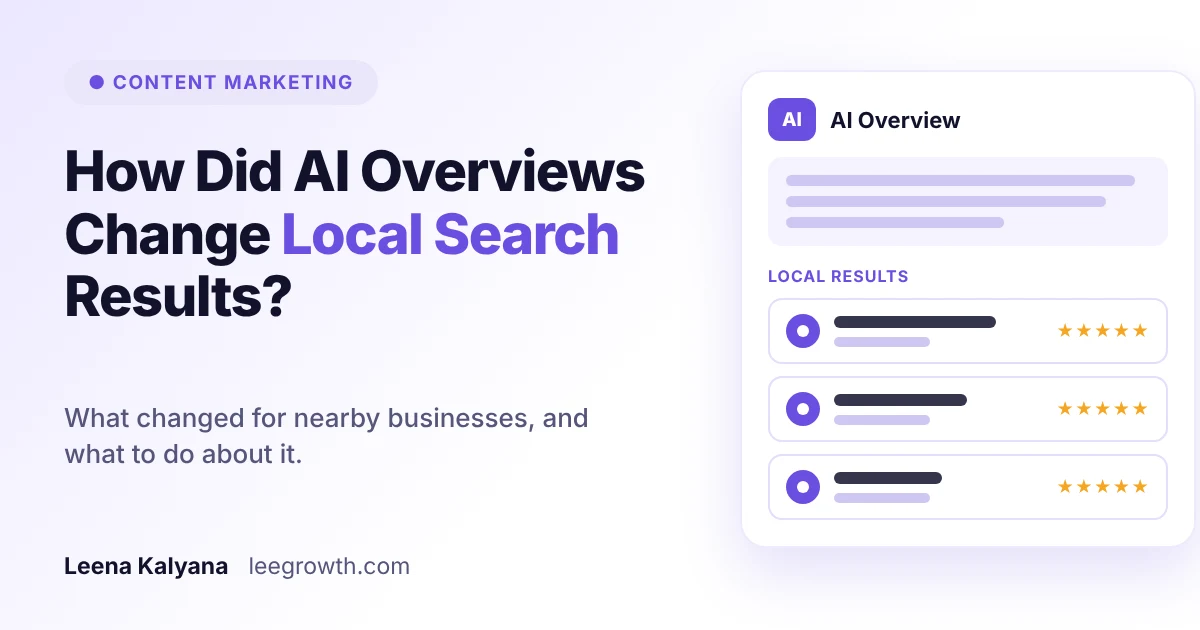
AI Overviews added an AI-written summary above the local map pack and, in Google tests, replaced the pack on about 8% of keywords. The pack still leads on ready-to-act searches such as “plumber near me.” Research-stage and comparison searches now start with the summary.
What Do the Key Terms Mean?
A local pack is the block of three nearby business listings and a map at the top of a local search. Each listing shows ratings, hours, and call and directions buttons.
- AI Overview: an AI-written summary that Google places above the regular results for some searches.
- Business Profile: the free Google listing that supplies a business’s hours, photos, services, and reviews.
- AI Mode: Google’s conversational search experience, where users ask follow-up questions.
- Structured data: code that labels page facts, such as name, address, and opening hours, for search engines.
Did AI Overviews Kill the Local Pack?
No. The local pack appears on more than 90% of simple local searches, while AI Overviews appear on about 15% of them. One analysis produced both figures. A separate click study found the pack still sitting below the summary, with click patterns close to 2024.
Local searchers need live facts: current hours, a phone number, directions, and recent reviews. Summaries handle those facts poorly. The pack handles them well.
What Changed in Local Search Results?
Four things changed: page layout, click behavior, the pack itself, and the arrival of AI Mode.
Page Layout
An Overview takes the top of the screen and pushes the pack and organic links down. On a phone, one Overview fills most of the first view. A business keeps its pack ranking and still loses visibility. Ranking reports show no change.
Click Behavior
Pew Research data, reported by Semrush, shows users clicking an organic result 8% of the time with an Overview present and 15% without one. Bain & Company estimates that nearly 60% of searches end without a click.
Two further figures circulate widely:
- Ahrefs (February 2026): top-ranking pages receive 58% fewer clicks when an Overview appears. The same measure read 34.5% eight months earlier.
- Seer Interactive: click rates on Overview queries rose from 1.3% in December 2025 to 2.4% in February 2026.
Both figures cover the whole web, not local search. The sources report them second-hand, and the original studies were not opened for this article.
The Pack Itself
Search Engine Roundtable reported in January 2026 that Google showed AI-generated local results in place of the three-listing pack on some searches. Local SEO specialist Joy Hawkins documented the change. The AI results name one or two businesses and sometimes omit the call button.
Places Scout data, cited by Hawkins, put these results on about 8% of keywords. Individual businesses reported Business Profile visibility drops of 50% or more, plus higher ad clicks. The drops are single reports, not a measured average. The 8% figure dates from January 2026.
AI Mode and Volatility
Google is building local results into AI Mode. Industry press has reported sharp visibility swings. Layouts, ranking signals, and user behavior in AI Mode continue to change.
Which Local Searches Trigger an AI Overview?
Search type predicts Overviews better than local intent does. Research and comparison searches trigger them most; ready-to-act searches trigger them least.
- Research-stage searches: “do I need a permit for a deck,” “how much does a plumber cost,” “what to look for in an HVAC contractor.” These searches end without a click most often. They come before the “near me” search, so the Overview shapes the shortlist.
- Comparison searches: “best brunch in town,” “family dentist accepting new patients.” The Overview names businesses drawn from reviews, listings, and third-party roundups. The click goes to a Business Profile or a phone call instead of a website.
- Ready-to-act searches: “plumber near me,” “pharmacy open now.” The map pack still leads. The near me SEO guide explains how Google ranks those results.
Search type also explains the conflicting statistics. Seer Interactive’s 83% trigger rate, reported by PinMeTo, covers all queries on the web. BrightEdge reports 48% for tracked queries. Ahrefs data, also reported by PinMeTo, shows 36% for informational queries, 8% for commercial queries, and 5% for transactional queries. The local analysis above found 15%. Each study counts a different mix of queries.
How Do Ranking Signals Differ Between the Pack and AI Answers?
Business Profile signals carry about 32% of map pack ranking weight but only about 12% of AI visibility weight, according to the 2026 Whitespark survey. The survey polled 47 experts on 187 factors.
Whitespark also shows on-page website signals rising from about 15% in the pack to about 24% in AI results. Citations and links gain weight as well. A business with a spotless profile and a top pack position can still go unmentioned in AI answers.
Three further claims come from agency sources and remain unverified:
- Proximity matters less in AI answers. Barking Frog SEO makes this claim and cites unnamed studies.
- Hidden sub-questions drive citations. WP SEO AI (September 2025) says Google expands a query into many sub-questions, so a page that ranks low for the typed words wins a citation by answering one sub-question. It cites no source. Barking Frog separately reports, via Dataslayer, that 92% of cited pages already rank in the top ten.
- Google scores the whole business. Wellows says Google judges the combined profile, site, listings, and reviews, not single pages. Wellows offers no data.
What Can a Local Business Do?
Eight actions cover the sources’ shared advice: profile accuracy, customer-question pages, review quality, third-party lists, consistent details, crawlable pages, revenue-based measurement, and shortcut avoidance.
- Keep the Business Profile accurate. Update categories, services, holiday hours, attributes, photos, and booking links after every change in the business. The profile feeds both the pack and AI answers. Profile optimization is one component of local SEO services.
- Write the pages customers read before they call. Cover four topics: cost and price drivers, process and timeline, local permits and rules, and category comparisons such as repair versus replace. Place the direct answer in the first two sentences under a heading phrased as the customer’s question. State when the cheaper option is enough. The AI search optimization content guide shows how to write these answers.
- Collect specific reviews on several platforms. Ask right after a job goes well. Invite customers to name the service performed. Reply to every review. An AI answer repeats a recurring complaint, such as missed appointments, as fact. Vendor targets such as a fixed number of reviews per month are rules of thumb, not findings.
- Earn places in the lists AI answers cite. “Best in city” answers draw on local publication roundups, chamber and association directories, and trade directories. Local press coverage works the same way.
- Standardize name, address, phone, and service area. Match the details across profile, site, directories, and every language the business serves. Entity SEO for small businesses explains why matching details help search engines and AI tools identify one business. Add LocalBusiness structured data to describe the business accurately. PinMeTo and Barking Frog rank markup as a strong signal. Brand Butter reports Google saying AI features need no special markup. Treat markup as a description, not a lever.
- Confirm Google can read the site. Index every page. Publish key facts as real text, not as images, PDFs, or pop-ups. A free website SEO audit checks crawling and indexing.
- Track revenue signals, not clicks alone. Count calls, direction requests, bookings, and branded searches. Ask each new customer how they found the business. Search Console does not separate Overview traffic, so watch for steady impressions with falling clicks on informational pages. Run 20 to 30 research-stage searches monthly from the real service area. Log whether an Overview appears, what it says, and which sources it cites.
- Avoid shortcuts. Skip packages that promise Overview placement. Skip near-identical city pages for towns the business does not serve. Skip markup sold as a trick. Keep Googlebot unblocked.
How Should Multi-Location Brands Respond?
Multi-location brands need a repeatable process: templated pages, central review handling, and scheduled audits. PinMeTo recommends five elements:
- Templated location pages with accurate structured data
- Centralized review requests and replies
- Quarterly name-address-phone audits
- Head-office press that lifts every location
- Location-level tracking of Overview appearances
Results differ by category. Restaurants, healthcare, and fitness vary more than utilities and business-to-business services. PinMeTo’s timelines (two to four weeks for profile changes, four to eight for structured data, eight to twelve for content and reviews) carry no evidence.
Where Do the Sources Conflict?
Nine conflicts and weaknesses appear across about a dozen pages.
- Whole-web numbers presented as local numbers. The 58% click drop and the 83% trigger rate cover all queries.
- A citation mismatch. The Google AI Overview reviewed for this article attached the 58% figure to a page that reports 34.5%.
- Headlines that outrun the text. Go-Tech Solution titles its post “Replacing the Local Pack,” yet its FAQ says transactional searches still show the pack. Barking Frog places Overviews above every result, which holds only where an Overview appears.
- “Near me” searches. Wellows lists them as triggers. Go-Tech, Way For Web, and Search Beyond Google say transactional local searches usually show the pack.
- Structured data. PinMeTo and Barking Frog treat markup as a top signal. Brand Butter reports the opposite, citing Google. Google’s own documentation was not checked here.
- Review volume versus recency. PinMeTo claims 12 recent reviews outrank 200 older ones and calls reply speed a citation signal. PinMeTo provides no evidence.
- Unsourced statistics. Examples: a 14.2% conversion rate for AI-referred visitors, and 75% of queries ending without leaving Google.
- Dated or off-topic material. WP SEO AI dates from September 2025, discloses AI assistance, and covers search in general. Way For Web targets Mumbai businesses.
- Commercial interest. Eight of the nine sources sell SEO services or software. Search Engine Roundtable is the exception.
What Remains Unknown?
Six questions remain open.
- Frequency: how often Overviews and AI local packs appear for local queries
- Pack position: whether Overviews push the pack down at scale
- Traffic loss: how much traffic local businesses lose
- Markup: whether structured data raises citation odds
- Reviews: whether review velocity works as a citation signal
- Recovery: whether the click recovery Seer reports holds
Google keeps testing layouts, so any snapshot ages within weeks. Nothing guarantees inclusion in an Overview.
What Is the Bottom Line?
Local search now has layers: an AI answer for research and comparison searches, the map pack for ready-to-act searches, an AI substitute for the pack in tests, and AI Mode alongside. Users read the summary, build a shortlist, and finish in Maps. A mention in the summary feeds the pack click that follows.
Businesses that win treat the whole web presence as the ranked asset: site, reviews, listings, and outside mentions. They measure calls and bookings.
How Reliable Are the Sources?
None of the nine sources is an independent study of local search. Read the advice as consistent practitioner opinion and the numbers as directional.
| Source | Date | Contribution | Reliability |
|---|---|---|---|
| Search Engine Roundtable (news report) | Jan 2026 | AI-powered local packs, about 8% of keywords, reported drops | Closest to direct observation; drops are anecdotal |
| PinMeTo (software vendor) | May 2026 | Ahrefs and Seer figures, multi-location advice | Studies unchecked; some thresholds unsourced |
| Search Beyond Google (agency) | Sep 2026 | Query-type pattern, list publishers, content types | Practitioner opinion; no data |
| Brand Butter (agency) | Apr 2026, updated Oct 2026 | Three-way sort, measurement, what to avoid | No data; Google guidance reported but unchecked |
| WP SEO AI (vendor) | Sep 2025 | Query expansion, brand mentions | Oldest source; mostly not local; unsourced figures |
| Go-Tech Solution (agency) | Jan 2026 | Retells the Roundtable report | Derivative; headline overstates |
| Barking Frog SEO (agency) | Jun 2026 | Cited-versus-uncited clicks, sector rates | Mostly second-hand or unsourced statistics |
| Wellows (AI-visibility vendor) | Dec 2025, updated Oct 2026 | Business-level view, review consensus | Sells tracking tools; no data |
| Way For Web (agency) | Nov 2026 | Newest source; states what is unknown | Restates other sources; not US local |
Figures attributed to Ahrefs, Seer Interactive, Pew Research, Bain & Company, BrightEdge, Whitespark, Dataslayer, and Places Scout come from the sources above. The original studies were not opened.

Leena Kalyana is an SEO and digital marketing consultant in Delhi NCR and the founder of LeeGrowth. She helps clinics, coaching institutes, consultants and small businesses get found on Google, Google Maps and AI search. She works directly with every client and does not guarantee rankings.