

In this article
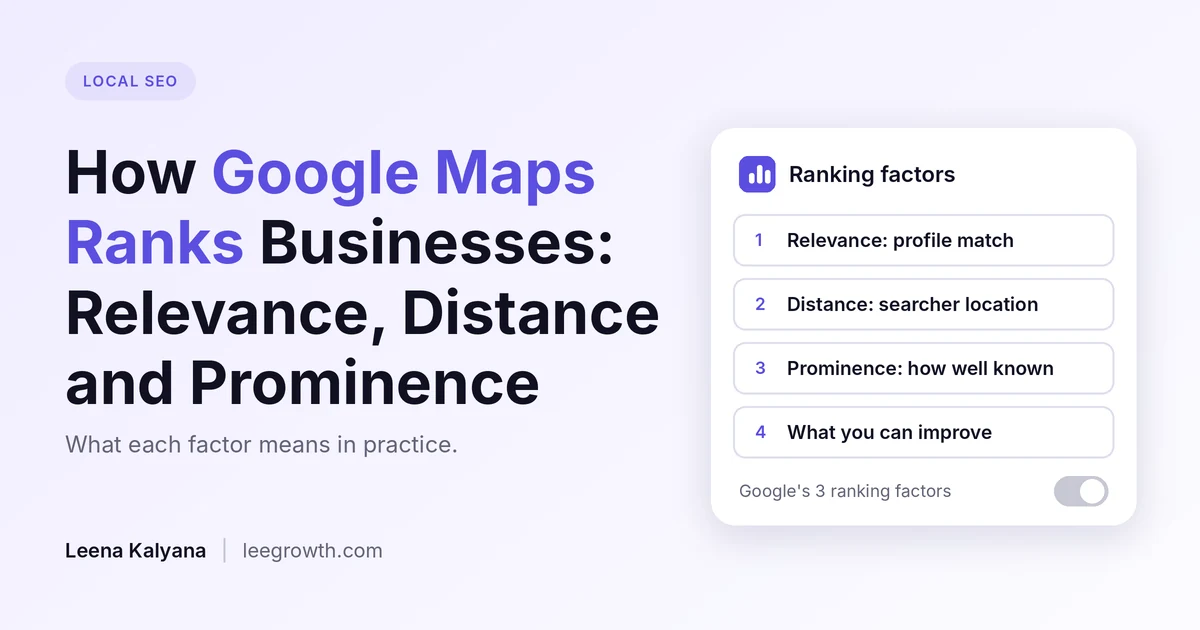
Short answer: Here is how Google Maps ranks businesses. Google says local results are based primarily on relevance, distance and prominence. Relevance is how well your profile matches the search. Distance is how far you are from the searcher or from the place named in the search. Prominence is how well known your business is, judged from reviews, your website’s position in search and information about you across the web. You cannot change distance, but you can improve the other two. Google has not published a formula or weights, so anyone who gives you an exact one is guessing.
For the full process, read the complete local SEO guide. This page explains the ranking factors and separates what Google confirms from what outside researchers have inferred.
What Google confirms about local ranking
Google’s Business Profile Help page states that “Local results are based primarily on relevance, distance, and prominence.” The same page says local results appear in both Google Maps and Google Search, so one profile feeds both.
| Factor | What Google says it measures | Can you control it? | First action |
|---|---|---|---|
| Relevance | How well a listing matches what someone searches for | Yes | Pick the right main category, complete every field |
| Distance | How far the business is from the searcher or the named place | No | Keep your address and service areas accurate |
| Prominence | How well known you are, using reviews, links, articles, directories and your web ranking | Partly | Earn real reviews, reply to them, strengthen your website |
Relevance: does your profile match the search?
Google says businesses with complete and accurate information are easier to match with the right searches. Treat the profile and website as one description of your business that must agree.
- Main category: the strongest relevance choice. Pick the one that describes your core business, not the broadest label. See Google Business Profile categories.
- Services, attributes and description: list what you actually offer in the words customers use.
- Website: a page for each main service that matches your profile.
- Verification: Google says verifying tells it you are authorised to represent the business and makes it more likely to show.
- Business name: use your real name. Adding keywords breaks Google’s guidelines and can lead to suspension.
Distance: where is the searcher?
If a searcher names a place, Google measures distance from it. If not, Google uses what it knows about their location. A business close to the searcher has an advantage you cannot remove, which explains why you can rank first on your own street and lower two kilometres away.
Distance is not the whole story. A Google Product Manager has said a business slightly farther away can be the right fit. Recovered-data analysis by Resoneo, reported in September 2026, also suggests that Maps does not search inside a fixed radius. In dense areas it appears to widen the search until it has enough candidates. That analysis is third-party and Google has not confirmed it, so treat it as a reason to stop thinking in rigid circles, not as a rule.
Prominence: how well known are you?
Google says prominence also draws on information about a business from across the web, such as links, articles and directories. It states that review count and score factor into local ranking, and that your position in normal web results matters, so ordinary SEO practice applies.
Where effort goes:
- Reviews: real reviews from customers, with replies from you. See how to get more Google reviews.
- Consistent information: the same name, address and phone on your website and listings.
- Website strength: pages that other sites link to or mention.
- A complete profile: photos and videos of your business and current opening hours.
A 2018 Moz study, summarised by Search Engine Journal, found that Business Profile signals, links and reviews were the top local signals. It is older evidence, so use it to decide where to spend time, not as a formula.
What the 2026 “72 signals” research does and does not show
On 8 September 2026, Search Engine Land published analysis of recovered Google data, with research from Resoneo. It named 72 signals in an internal Maps system called Oyster Rank, listed inside a place database called Geostore. Reported names include reviews, web query volume, listing impressions, listing opens, direction requests, clicks to the website, chain membership, popularity and prominence.
Read it carefully, because it is easy to misuse:
- It is not a checklist. 25 of the 72 signals are marked deprecated, and the data shows names, not weights. Search Engine Land’s own conclusion: “There isn’t a single Maps ranking formula.”
- It is not confirmed by Google. It is reverse-engineered analysis, not an official release.
- It does not prove current impact. A signal existing in the data does not show it changes a particular search today. The same coverage notes that store visits are measured but there is no evidence they feed local ranking.
What it usefully suggests is that Google understands a business as an entity built from several sources, including the Maps listing, the wider web and merchant data, and matches it to the concepts behind a search. The Resoneo summary says “The engine is not a distance sort.” For you, the practical meaning is simple: your profile, website and listings should describe the same business in the same way, and your site should explain each service clearly.
What to check first: a symptom guide
This is a diagnostic judgement based on the confirmed factors, not a Google rule.
| What you see | Most likely factor | Check first |
|---|---|---|
| Profile barely appears for any search | Relevance or verification | Verified status, main category, complete fields, accurate name |
| Appears, but low everywhere | Prominence | Review count, rating, replies, website quality |
| Ranks well only near your address | Distance plus prominence | Whether competitors farther away have far more reviews and a stronger site |
| Ranks for the wrong services | Relevance | Primary and additional categories, service list, service pages |
| Position keeps changing | Searcher location | Test from several locations before drawing conclusions |
| Duplicate or wrong listings | Data accuracy | Remove duplicate Business Profiles |
Common myths
- “More posts means a higher rank.” Google’s ranking page lists relevance, distance and prominence and does not name posts. Posts keep a profile useful, nothing more can be claimed.
- “Buying reviews is a shortcut.” It breaks Google’s policies, and fake reviews can be removed with damage to your profile.
- “One page per suburb fixes it.” Copied pages with the area name changed add nothing. Write an area page only when you have real things to say.
- “There are 72 ranking factors to tick off.” See the section above.
- “Everyone sees the same ranking.” Distance means two people can see different results for the same search.
How to see why a competitor ranks above you
Search your service and area the way a customer would, from a few locations. Compare the top three results with yours on five points:
- Main category
- Number and quality of reviews, and whether the owner replies
- Completeness of the profile
- How closely their website matches the search
- How close they are to where you searched
The steps are in Google Maps competitor analysis.
How to measure results
A rank check is a rough guide because positions move with the searcher’s location. Watch calls and direction requests instead: track calls and direction requests from Google Maps.
FAQs
What are the three Google Maps ranking factors? Relevance, distance and prominence, according to Google’s Business Profile Help page.
Is Google Maps ranking only about distance? No. Distance is one of three factors, and Google has said a slightly farther business can still be the better match.
Do reviews affect Google Maps ranking? Yes. Google says review count and score factor into local ranking.
Does my website affect my Maps ranking? Indirectly. Google says your position in web results is a factor in prominence.
What are the 72 Google Maps ranking signals? They are 72 signal names reported from recovered Google data in September 2026. 25 are deprecated, no weights are known, and Google has not confirmed them. They are not a checklist.
Does a verified profile rank better? Google says verifying makes your business more likely to show up in search results.
Why does my ranking change from one place to another? Because distance is measured from the searcher, so your position changes with their location.
Next step
Start with the first row of the symptom guide that matches your profile. If a competitor keeps beating you and you want a clear list of what to fix, see Google Maps SEO services or ask for the free website SEO audit.

Leena Kalyana is an SEO and digital marketing consultant in Delhi NCR and the founder of LeeGrowth. She helps clinics, coaching institutes, consultants and small businesses get found on Google, Google Maps and AI search. She works directly with every client and does not guarantee rankings.