In this article
Written by Leena Kalyana · Last reviewed: 21 November 2026
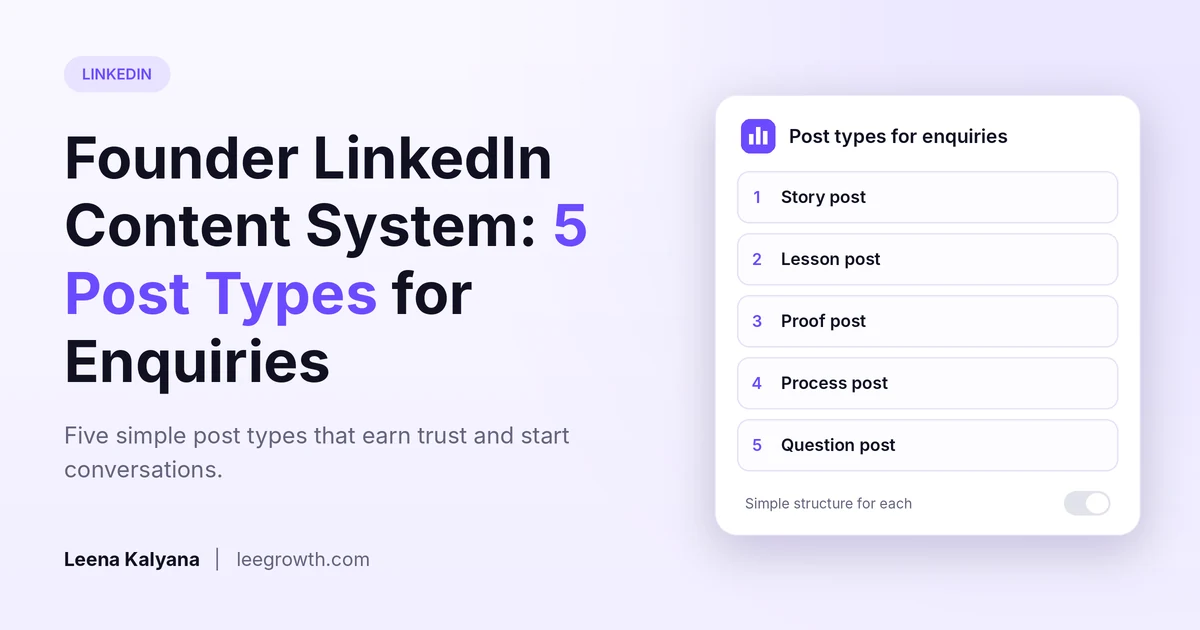
A founder LinkedIn content system is a simple set of post types, topics and a weekly rhythm that you repeat, so that the people who read your posts understand what you do and feel ready to contact you. It replaces the daily question of “what should I post today?” with a short list of formats that each do one job. This guide shows the five post types I use with founders and owners in India, with the structure, example opening lines and a full sample post for each.
Short answer: The LinkedIn posts that bring enquiries for founders are the ones that help a buyer decide: answers to real questions, lessons from real work, explanations of your process, honest opinions and proof of what you did. Mix these five types and a reader learns what it is like to work with you before they message.
I am Leena Kalyana, and I write LinkedIn posts for founders and owners in India. The examples below are illustrations of structure, not real client posts. For help with the writing itself, see LinkedIn post writing.
Who this is for: founders, owners, consultants and agency heads who sell to businesses or professionals and want enquiries from LinkedIn, not only likes. It suits people who can spend a few hours a week writing, and who want a method more than a list of random ideas.
What you will get: why post types matter for enquiries, the five types in detail with sample posts, a way to find topics that never runs out, writing basics, a weekly rhythm and a four-week calendar, how to measure what works, what to avoid and a final checklist.
Find what you need fast
| If you want to… | Go to |
|---|---|
| Understand why post types matter | Why post types |
| See the five types and examples | The five post types |
| Find topics to write about | Finding topics |
| Plan your week or month | Weekly rhythm and calendar |
| Check what is working | Measuring |
Why do post types matter for enquiries?
Post types matter because every buyer has silent questions before they contact you, and each type answers one of them. If you only post one type, such as news about your business, you answer none of them. A buyer who reads five of your posts should be able to say what you do, how you work, whether you know your field and whether you have done it before.
| The buyer’s silent question | The post type that answers it | What it shows |
|---|---|---|
| “Do you understand my problem?” | The question your customers ask | You know what buyers are wondering |
| “Have you actually done this?” | A lesson from real work | Experience, including what did not work |
| “What would working with you be like?” | Your process, made visible | Clarity and a low-risk first step |
| “Can I trust your judgement?” | An honest opinion | How you think |
| “Can you get a result?” | Proof of what you did | Evidence, kept honest |
1. The question your customers ask
This post takes a question buyers really ask and answers it directly. It works because it matches what buyers are already wondering, and it shows you can explain your field in plain words.
Structure: start with the question, give the direct answer, add one example, end with a way to continue the conversation.
Example: “A client asked me last week: should we reply to every Google review? Yes, and here is why a calm reply to a bad review helps the next customer who reads it…”
Ways to open this kind of post:
- “People often ask me whether they need to post on LinkedIn every day.”
- “One question I hear before almost every project: how long will this take?”
- “A founder asked me last week why nobody replies to her messages.”
A full sample post (an illustration, not a real client post):
A founder asked me last week: “Should I put my prices on my website?”
My answer: usually yes, or at least a starting range.
Here is why. A buyer who cannot find any price often assumes it will be too high, and leaves. A buyer who sees a range can decide whether to ask.
You do not need an exact figure. Say what the price depends on, such as the size of the work or how fast you need it, and give a “from” amount.
If you are unsure what to publish, tell me what you sell and I will tell you what I would show.
When to use it: often. It is the easiest type to write and the one most likely to bring a message.
Common mistake: answering a question nobody asked. Use questions from real buyers.
2. A lesson from real work
This post tells a short story from your work, including what did not go as planned. It works because buyers trust people who talk honestly about experience.
Structure: describe the situation, what you tried, what happened and what you would do again.
Example: “We redesigned a client’s service page and the number of enquiries did not change. Here is what we found when we looked at how people used the page…”
Use only real events, and protect client confidentiality by leaving out names and details they have not agreed to share.
Ways to open:
- “I got this wrong on a project last year.”
- “A client’s enquiries did not change after we fixed what we thought was the problem.”
- “The first draft we wrote for a founder sounded like everyone else.”
A full sample post (an illustration):
Last year I rewrote a founder’s LinkedIn headline three times and nothing changed.
The headline was clear. The problem was the next step. Anyone who liked the profile had no obvious way to get in touch.
We added one line to the About section and a link to a simple enquiry page. Messages started to arrive from people who had already been reading.
What I would do again: check the next step before I polish the words.
When to use it: once or twice a month, when you have a real story.
Common mistake: making the story a hidden advert, or inventing details to make it neater.
3. Your process, made visible
This post shows the steps you follow and why each one exists. It works because buyers feel safer when they can picture what happens, and these posts reduce the questions you hear in sales calls.
Structure: show the steps you follow and why each exists.
Example: “Here is what happens in the first week after you hire me: a short call, a review of your current profile and a written plan you approve before anything changes.”
Ways to open:
- “This is what happens when you enquire about working with me.”
- “Here is how I run the first week of every project.”
- “Three steps happen before I write a single word for a client.”
A full sample post (an illustration):
Here is what happens in the first week after you hire me.
Day 1: a 30-minute call. I ask who you want to reach and what you want them to do.
Day 2 and 3: I review your profile and your last ten posts.
Day 5: you get a written plan. Nothing changes on your profile until you approve it.
Why this order? Because most problems come from skipping the plan.
When to use it: when someone asks how you work, and once a month as a standing reminder.
Common mistake: describing steps in jargon. Write them the way you would explain them to a friend.
4. An honest opinion
This post states what most people in your field say, what you think and why. It works because it shows how you think, and people who agree with your thinking are the ones who hire you.
Structure: state what most people in your field say, say what you think and explain why.
Example: “Many agencies promise to rank you in a month. I do not, and here is why nobody can honestly promise that…”
Ways to open:
- “Most advice says post every day. I disagree.”
- “I stopped promising quick results, and this is why.”
- “The common advice on LinkedIn headlines gets one thing wrong.”
A full sample post (an illustration):
Common advice: post on LinkedIn every day.
My view: post as often as you can write something useful, and no more.
I have seen founders burn out in a month, then disappear for a quarter. A steady two posts a week that answer real questions will do more than a daily post that says nothing.
Disagree? Tell me what has worked for you.
When to use it: now and then. One opinion post a month is plenty for most founders.
Common mistake: being contrarian for attention. Only share opinions you hold and can explain.
5. Proof of what you did
This post shows what you did for a client or for yourself, what changed and what is still uncertain. It works because buyers want evidence, and a modest, honest account is trusted more than a big claim.
Structure: the problem, what was done, what changed and what is still uncertain.
Use real results only, and show numbers only when you have permission and can stand behind them. If you do not have a result to share, write about what you learned instead. An honest, modest proof is trusted more than a big claim.
Ways to open:
- “A client came to me with a clear service and no enquiries.”
- “This is what changed after we rewrote one page.”
- “I do not have a big number to share yet, but here is what we learned.”
A full sample post (an illustration):
A consultant came to me with a good service and a profile that listed her jobs but not who she helps.
We rewrote the headline and About section around one type of client, and added her enquiry page to Featured.
What changed: she told me the messages she receives now come from people who match the client she wanted.
What is still uncertain: it is early, and I do not know how many will turn into projects.
When to use it: when you have something real to show, with permission.
Common mistake: claiming results you cannot prove, or naming a client who has not agreed.
How do you find topics that never run out?
Keep a running note of customer questions, because it never runs out of ideas. Every question a buyer asks you is a post waiting to be written.
Sources of topics:
- Sales calls and discovery calls: what people ask, and what confuses them.
- Emails and messages: the questions people send before they hire you.
- Comments on your posts and on other people’s posts in your field.
- Mistakes you see in your clients’ work or in your industry.
- Projects: each one gives you a lesson, a process step and sometimes proof.
- Your own opinions: the advice you disagree with.
Write each idea in one line, with the post type next to it. When you sit down to write, pick the next idea from the list.
What writing basics make a post easier to read?
- Put the point in the first lines. LinkedIn shows only the start of a long post before “see more”, so open with the question, the situation or the claim.
- One idea per post. If you have two, write two posts.
- Use plain words and short sentences. Write as you would explain it to a client.
- Use short paragraphs with space between them, so the post is easy to scan on a phone.
- Be specific. An example, a step or a real situation beats general advice.
- Keep the length as long as it needs. Many good posts are short.
- Use a few relevant hashtags at most. Clear writing matters far more.
- End with a light invitation, not a hard sell.
Examples of light endings:
- “If you want to see what I would change on your profile, send me a message.”
- “Tell me what you do, and I will suggest a first step.”
- “If this is a question you have, ask it in the comments.”
- “I wrote a short guide on this. The link is in the comments.”
- “Curious how this would work for your business? Message me.”
What weekly rhythm works?
You do not need all five every week. A practical mix: mostly questions and lessons, an opinion now and then, a process post when someone asks how you work and proof when you have something real to show. Whatever you choose, keep a running note of customer questions, because it never runs out of ideas.
| Week | Post 1 | Post 2 | Post 3 (optional) |
|---|---|---|---|
| 1 | Customer question | Lesson from real work | Process |
| 2 | Customer question | Honest opinion | Customer question |
| 3 | Lesson from real work | Customer question | Proof, if you have it |
| 4 | Customer question | Process or opinion | Lesson from real work |
After each post, reply to every comment with something useful, and spend ten minutes leaving thoughtful comments on posts by your buyers. Conversations are where leads start.
What does a four-week content calendar look like?
This sample calendar shows how a founder who helps small businesses with their websites might plan a month. The topics are illustrations.
| Week | Post type | Topic |
|---|---|---|
| 1 | Customer question | Should I put my prices on my website? |
| 1 | Lesson from real work | A page we fixed that did not change enquiries |
| 2 | Process | What happens in the first week of a website review |
| 2 | Customer question | How many pages does a small business site need? |
| 3 | Honest opinion | Why I do not promise to rank you in a month |
| 3 | Customer question | What should go on a contact page? |
| 4 | Proof | What changed after we rewrote one service page |
| 4 | Lesson from real work | What I would do differently on the next project |
How do you know which posts bring enquiries?
Judge posts by conversations, not likes. A post with few likes that brings two good messages has done its job.
- Ask every new contact how they found you, and which post they remember.
- Write down which post type came before each message, call or enquiry.
- Look at who engaged, not only how many. Are they the kind of client you want?
- Check profile views after posts, and website visits from LinkedIn in your analytics. See how to track enquiries in GA4.
- Review once a month. Keep the post types that lead to conversations, and write fewer of the rest.
Make sure your profile is ready for the people who arrive. See LinkedIn profile optimization.
What to avoid
- Posts that only announce your services.
- Copying another founder’s post and changing a few words.
- Inventing stories or results to make a point.
- Ending every post with a hard sell.
- Sharing client details without permission.
- Posting every day with nothing to say.
- Judging a post only by likes.
If you already made these mistakes:
- Too many announcements: for the next five posts, write only question and lesson posts.
- Copied or borrowed posts: stop reusing them, and write from your own questions and projects.
- No conversations from posts: add a clear next step to your profile and a light invitation at the end of each post.
- No idea what works: start the question log and ask each new contact how they found you.
What should you check before you publish a post?
- [ ] The post answers one question or makes one point.
- [ ] The first lines tell the reader what the post is about.
- [ ] It is based on something real: a question, a project, a view you hold.
- [ ] Any client detail is anonymous or approved.
- [ ] Any result is real, and I can stand behind it.
- [ ] The ending invites a conversation without a hard sell.
- [ ] My profile and contact route are ready for new visitors.
- [ ] I will reply to every comment today.
Want posts written for you?
I interview you, write the drafts in your voice and you approve everything before it goes live. See LinkedIn ghostwriting services, or read how founders get inbound leads from LinkedIn.
Frequently asked questions
What types of LinkedIn posts bring enquiries for founders? Posts that help a buyer decide: answers to real questions, lessons from real work, explanations of your process, honest opinions and proof of what you did.
How many post types do I need? Five is enough. You do not need all five every week, and a steady mix of questions and lessons with the others now and then works well.
How long should a LinkedIn post be? As long as it needs to be to be clear. Many good posts are short. Put the point in the first lines, because that is what shows before “see more”.
Should I use hashtags? A few relevant ones are fine, but clear writing matters far more than tags.
Can I reuse a post later? Yes, if it is still true and useful. Update the example and share it again for people who missed it.
How often should I post? Pick a pace you can keep, such as two or three posts a week. A steady rhythm that you can sustain beats a burst that stops.
What if I have no results to share? Write about what you learned, or about the questions and process posts. An honest, modest post is trusted more than a big claim.
Can I write about clients? Only with their permission, and leave out names and details they have not agreed to share.
How do I know which post types work for me? Ask each new contact how they found you, note which post came before each conversation, and review once a month.

Leena Kalyana is an SEO and digital marketing consultant in Delhi NCR and the founder of LeeGrowth. She helps clinics, coaching institutes, consultants and small businesses get found on Google, Google Maps and AI search. She works directly with every client and does not guarantee rankings.