In this article
Quick Answer
Neither wins everywhere. Claude is worth testing first for long-form writing, document work and coding. ChatGPT is a strong all-rounder for general tasks, voice conversations, image generation and research.
For SEO, both help with content planning and optimization, but neither replaces keyword research tools or Google Search Console.
Run the same real task in both free plans and keep the one that needs less editing.
The best choice depends on your tasks, budget and the results you get from each tool.
Google Trends data supplied for this article shows a 250% rise in search interest for “Claude vs ChatGPT”. That signals growing curiosity, not exact monthly searches or keyword difficulty. You can check the trend yourself on Google Trends.
Claude vs ChatGPT at a Glance
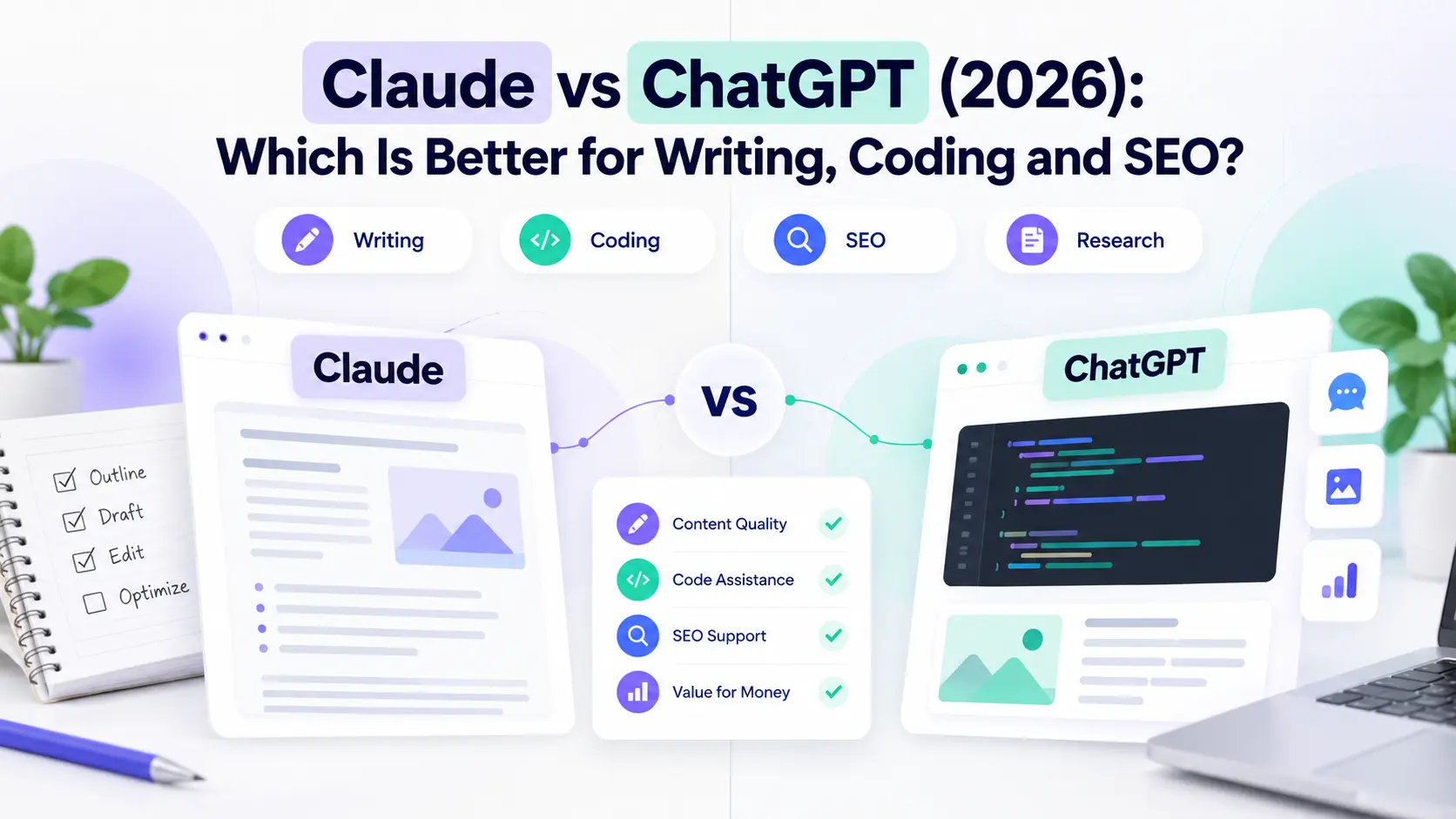
| Feature | Claude | ChatGPT |
|---|---|---|
| Writing | Worth testing for long-form writing | Strong all-rounder |
| Documents | Projects and Artifacts | Projects and file analysis |
| Coding | Claude Code | Codex |
| Voice | Check current availability | Voice conversations |
| Images | Check current capabilities | Image generation and editing |
| Research | Web search and research features | Search and deep research |
| SEO | Content briefs and keyword clustering | Research and on-page SEO |
| Pricing | Free and paid plans | Free and paid plans |
These are differences in product features and possible workflows, not proof that one AI always produces better results.
Table of Contents
- Claude vs ChatGPT: Key Differences
- What Is Claude?
- What Is ChatGPT?
- Claude vs ChatGPT for Writing
- Claude vs ChatGPT for Coding
- Claude vs ChatGPT for SEO
- Claude vs ChatGPT for AI Search, GEO and AEO
- Research and Accuracy
- Voice and Image Generation
- Automation and Agents
- Claude vs ChatGPT Pricing in 2026
- Which Should You Choose?
- A 7-Day Test Plan
- Frequently Asked Questions
- Final Verdict
1. Claude vs ChatGPT: Key Differences
| Feature | Claude | ChatGPT |
|---|---|---|
| Writing | Long-form content and document structure | Writing, editing and content creation |
| Coding | Claude Code supports coding-agent workflows | Codex supports coding and development |
| SEO | Content briefs, keyword clustering and optimization | Research, content planning and on-page SEO |
| Image generation | Check current product capabilities | Offers image generation and editing |
| Voice | Depends on current availability | Offers voice conversations |
| Documents | File analysis, Projects and Artifacts | File analysis, Projects and productivity tools |
| Research | Web search and research features | Search and deep research features |
| Pricing | Free and paid plans | Free and paid plans |
Important: These are differences in product features and possible workflows, not proof that one AI always produces better results.
2. What Is Claude?
Claude is an AI assistant developed by Anthropic. It helps with writing, coding, document analysis, research and problem-solving.
Its features include Projects, Artifacts and Claude Code, which can support longer writing tasks, interactive prototypes and software development, depending on your plan.
It may suit people who work with documents, edit long articles or build software.
Official website: https://claude.com/
3. What Is ChatGPT?
ChatGPT is an AI assistant developed by OpenAI. It supports writing, coding, research, file analysis, voice conversations and image generation in one workspace.
A marketer can research a topic, draft a post, analyze a report and sketch visual ideas without switching tools.
It also offers coding help through Codex, with features that vary by plan.
Official website: https://chatgpt.com/
4. Claude vs ChatGPT for Writing
Which AI is better for writing?
It depends on the content type and how much editing you need.
Claude is worth testing for long-form articles, structured documents and a consistent tone. ChatGPT also writes blog posts, edits drafts, builds outlines and adapts to a brand voice.
Both can help with:
- Blog posts
- Website copy
- Landing pages
- Newsletters
- Social media content
- Proofreading
- Content briefs
Which AI Writes More Naturally?
There is no universal winner.
To compare fairly, give both tools the same topic, audience, source material and instructions. Then check:
- Accuracy
- Clarity
- Repetition
- Tone
- Structure
- Editing time
For example, ask each for a 1,000-word article for US small-business owners, supply identical facts and require simple English.
Writing Verdict:
Test both on a complete article, not one paragraph. The better tool is the one that gives accurate, useful content with less editing.
Need a human expert on top? See our SEO content writing services.
5. Claude vs ChatGPT for Coding
Both can generate code, explain errors and help build websites and apps.
Their dedicated tools, Claude Code and Codex, support more involved workflows. Features, integrations and usage limits depend on the current product and plan.
What to Check When Comparing Coding Tools
- Does it understand your existing code?
- Can it find and explain errors?
- Does it make the requested changes only?
- Does it handle edge cases?
- Can it suggest or run relevant tests where supported?
- Does it explain the solution clearly?
Which Is Better for Beginners?
Explanation quality matters as much as the code.
Try a small website SEO audit script that flags:
- Missing title tags
- Duplicate H1 headings
- Missing meta descriptions
Ask for each step in simple English, then run it and check the results.
AI-generated code can contain errors and security problems, so review and test it before it touches a live site.
Coding Verdict:
Compare both on a real project. Do not choose from a demo or a claim that one model is smarter.
6. Claude vs ChatGPT for SEO
Can Claude or ChatGPT help with SEO?
Yes. Both can assist with keyword research workflows, content planning, on-page optimization and technical troubleshooting.
However, they need reliable data to give useful recommendations.
SEO Task Comparison
| SEO Task | How AI Can Help | What You Must Verify |
|---|---|---|
| Keyword research | Group keywords and suggest related topics | Search volume and keyword difficulty |
| Search intent | Classify likely user needs | Actual Google results |
| Competitor analysis | Analyze supplied pages and headings | Current rankings and competitor data |
| Content briefs | Create outlines and section requirements | Intent and source accuracy |
| SEO titles | Suggest title tags | Length and relevance |
| Meta descriptions | Write concise descriptions | Accuracy and relevance |
| Internal linking | Suggest links from a supplied URL list | URLs exist and fit the context |
| Schema markup | Draft structured data | Validity and search-engine requirements |
| Technical SEO | Explain crawl reports and errors | Real crawl and Search Console data |
| Content updates | Spot outdated information | Current sources and performance data |
Keyword Research with AI
Both tools can group keywords by topic and intent and suggest long-tail ideas.
Neither is a source of verified search volume.
Starting from “Claude vs ChatGPT”, you could explore:
- Claude vs ChatGPT for SEO
- Claude vs ChatGPT for writing
- Claude vs ChatGPT for coding
- Claude vs ChatGPT pricing
- Is Claude better than ChatGPT for bloggers?
- Claude vs ChatGPT for small businesses
Then confirm demand with a keyword tool and read the live Google results to understand search intent.
To choose a tool, see our comparison of Semrush vs Ahrefs vs Ubersuggest.
A Safe Workflow for SEO Content
- Pick a keyword with a clear search intent.
- Review the current search results.
- Outline answers to the reader’s main questions.
- Draft using reliable sources.
- Check facts, dates, statistics and links.
- Add relevant internal links.
- Review title, meta description, headings and structure.
- Measure performance after publishing.
Do not repeat keywords for density. Use them where they help explain the topic.
Can AI-Written Articles Rank on Google?
AI-assisted content can appear in Google Search, but AI use guarantees nothing.
Google’s guidance on generative AI content centres on useful, reliable content made for people.
Its scaled content abuse policy targets mass-produced pages that add no value, however they were written.
Its people-first content guidance is the standard to meet.
At LeeGrowth, the goal is articles that answer real questions with accurate, practical advice beyond a summary of other sites.
7. Claude vs ChatGPT for AI Search, GEO and AEO
Will using Claude or ChatGPT help your content show up in AI answers?
Not by itself.
Which tool wrote the draft does not decide whether ChatGPT, Gemini, Perplexity or Google’s AI features cite you.
Clear answers, accurate facts, crawlable pages and original value do.
GEO (Generative Engine Optimization) and AEO (Answer Engine Optimization) are industry labels.
Google says that for its own AI features, optimizing for generative AI search is still SEO.
How to Make Content Easier for AI Search Engines to Understand
- Put a direct answer in the first two to four sentences under each heading.
- Use descriptive headings and name entities precisely (Google Search Console, not “the tool”).
- Make sure important pages are crawlable, indexed and eligible for snippets. See Google’s AI features and your website.
- Support claims with primary sources.
- Add first-hand examples only you can write.
No one can guarantee an AI citation.
For the full method, read:
- How to write content AI search engines can understand
- AI search optimization checklist
- Why ChatGPT cites your competitor, not you
8. Research and Accuracy
Both assistants summarize information, analyze documents and organize research. Both also make mistakes.
A real source link does not make an AI statement accurate.
How to Verify AI-Generated Answers
- Open the original source for every important claim.
- Check that it actually supports the statement.
- Verify prices and features on official product pages.
- Use government or primary sources for legal and regulatory topics.
- Remove claims you cannot verify.
Which Is Better for Long Documents?
Both support document analysis within plan limits and file restrictions.
A larger context window can take in more text, but it does not guarantee every detail is read correctly.
Test with your own files.
Research Verdict: Use AI to organize research, but verify important claims before you publish or act on them.
9. Voice and Image Generation
Voice:
ChatGPT offers voice conversations for brainstorming, explanations and hands-free use.
Compare availability, responsiveness, language support and accent handling before relying on it.
Images:
ChatGPT offers image generation and editing, subject to plan limits.
Review every image for accuracy, quality and suitability.
Claude’s visual features differ, so check its current documentation before assuming the same workflow.
Verdict: If voice or image creation matters daily, test those features directly before you subscribe.
10. Automation and Agents
Coding agents and connected tools can support multi-step workflows.
For an SEO audit, a crawler or script should collect titles and meta descriptions. Then the assistant can flag duplicates, draft a report and suggest fixes for your review.
Automation needs testing, correct permissions and human review.
Neither tool should be trusted to finish every task unsupervised.
11. Claude vs ChatGPT Pricing in 2026
Both offer free and paid plans, and prices, limits and features change.
Confirm on:
Pricing Comparison
| Plan | Claude | ChatGPT |
|---|---|---|
| Free | Free access with usage and feature limits | Free access with usage and feature limits |
| Individual Paid | Pro and higher-usage Max plans | Go, Plus and Pro plans |
| Business | Team and Enterprise options | Business and Enterprise options |
Which Offers Better Value?
The cheapest plan is not always the best value.
Ask yourself:
- Can the free plan handle my normal tasks?
- Do I need coding, research, voice or image features?
- Will usage limits interrupt my work?
- Does the time saved justify the cost?
Compare the limits on your own account, not general claims.
12. Which Should You Choose?
A Simple Decision Guide
If you mainly need long-form work:
Test Claude first for long articles and documents, then compare with ChatGPT.
If you mainly need voice and images:
Start with ChatGPT and check Claude’s current features.
If you mainly need coding or SEO:
Test both on one real project or page.
Then verify the facts and keep the tool that needs less editing.
Comparison by Use Case
| If You Mainly Need | What to Compare |
|---|---|
| Long-form blog writing | Readability, structure and editing time |
| SEO content | Search intent, factual accuracy and content briefs |
| Coding | Correctness, testing and workflow |
| Voice conversations | Availability and speech recognition |
| Image creation | Image quality and editing controls |
| Research | Source quality and citation accuracy |
| Business productivity | Integrations, privacy, usage limits and cost |
Bloggers and marketers should test both free plans on one real task first.
You can also use both: one drafts, the other reviews structure or flags claims to verify.
Two tools are only worth it if the extra review improves the result.
If you would rather have a specialist handle strategy, explore LeeGrowth’s SEO services, or for local visibility, local SEO for small businesses.
13. A 7-Day Test Plan to Pick Your Tool
Use this simple seven-day process to compare both assistants.
| Day | Activity |
|---|---|
| Day 1 | Pick one real task and write a brief |
| Day 2 | Run the same brief in both tools |
| Day 3 | Fact-check both outputs |
| Day 4 | Edit each draft and time it |
| Day 5 | Repeat with coding or research |
| Day 6 | Note limits, speed and missing features |
| Day 7 | Keep the one needing less editing |
Your Daily Action Plan
- Day 1: Choose one real task and write one detailed brief.
- Day 2: Run the same brief in both tools with identical source material.
- Day 3: Fact-check both outputs against original sources.
- Day 4: Edit each draft and note the minutes it takes.
- Day 5: Repeat with a coding or research task.
- Day 6: Note limits, speed and any features you missed.
- Day 7: Keep the tool that gave accurate results with less editing.
14. Frequently Asked Questions
Is Claude better than ChatGPT in 2026?
Neither is best for every task. Claude may suit writing and document workflows, while ChatGPT offers a broad toolset for general work, voice and image generation. Compare both on your own tasks.
Is Claude better than ChatGPT for writing?
Some users prefer Claude’s first drafts, others prefer ChatGPT. Use the same brief and compare accuracy, tone, structure, repetition and editing time.
Which is better for coding?
Both support coding and debugging. Compare Claude Code and Codex on a real project and check that changes work and pass relevant tests.
Which is better for SEO?
Both help with keyword clustering, briefs, on-page optimization and technical explanations. Neither replaces keyword tools, a crawler or Google Search Console.
Which is better for bloggers?
Both help research, outline, write and edit. Choose the one that produces accurate drafts with less editing and fits your publishing process.
Is Claude free to use?
Yes. Claude has a free plan with usage and feature limits. See the official pricing page.
Is ChatGPT free to use?
Yes. ChatGPT has a free plan with limits on some models and features. See the official pricing page.
Is Claude cheaper than ChatGPT?
It depends on the plans and billing options compared. Check current prices, limits and included features first.
Can Claude replace ChatGPT?
For some workflows, yes, but not necessarily all. Check whether it covers the voice, image, coding or integration features you rely on.
Should I pay for Claude or ChatGPT?
Start free. Upgrade only if you need more features or capacity and the time saved justifies the cost.
Can AI-written content rank on Google?
It can, if it is helpful, original and reviewed. Google focuses on quality, not how content is produced, and mass-produced low-value pages risk breaking its spam policies.
Will AI tools cite my website because I used Claude or ChatGPT?
No. Citations depend on crawlable pages, clear answers, credible information and the platform’s own systems. No one can guarantee them.
Can I trust AI for facts, prices and legal topics?
Not without checking. Verify important claims against primary sources and official product pages.
15. Final Verdict
Claude vs ChatGPT is not a one-winner comparison.
The right choice depends on your main tasks, the features you need and how each assistant performs for you.
- For writing, compare drafts.
- For coding, test the output.
- For SEO, verify with real search data.
- For research, open the sources.
Choose the assistant that gets your work done accurately with less effort.
Want SEO That Gets You Found and Trusted?
I help small businesses get found on Google, build trust with useful content and turn visitors into inquiries.
Start with a free website SEO audit or learn more about Leena.
Talk about your business: https://calendly.com/leenakalyana/30min
Explore SEO services: https://leegrowth.com/digital-marketing-services/seo-services/
Sources and Further Reading
- Google Search Central: Using generative AI content
- Google Search Central: Optimizing for generative AI features
- Google Search Central: AI features and your website
- Google Search Central: Creating helpful, reliable, people-first content
- Claude Pricing
- ChatGPT Pricing

Leena Kalyana is an SEO and digital marketing consultant in Delhi NCR and the founder of LeeGrowth. She helps clinics, coaching institutes, consultants and small businesses get found on Google, Google Maps and AI search. She works directly with every client and does not guarantee rankings.