


Short answer
Why is my competitor ranking higher than me? Because Google ranks pages for a search, not whole websites. A competitor can be above you because their page fits the search better, Google is showing a different page of yours, their page has relevant links, or your own site supports your page weakly. A tool score cannot tell you which one. Write down what you see, label each idea as a guess, and run the cheapest test first.
Key takeaways
- To answer why is my competitor ranking higher than me, compare one page against one page for one search. Do not compare two websites.
- Authority scores (DA, DR, Authority Score) come from third-party tools. Google says these tools cannot see its internal ranking data.
- Use Search Console as your main source of truth. It is data from Google about your own site.
- Check two things most people skip: which of your URLs Google shows, and what the results page looks like (AI answers, videos, forums).
- Change one thing at a time and write down the date.
- “Not enough evidence yet” is a real and useful answer.
Why Is My Competitor Ranking Higher Than Me? A Smaller Site Can Be Above You
You search for a phrase you want to win. A smaller site is above you. A tool says your site has more pages and a higher authority score. That does not settle anything, because those numbers describe two websites, and Google shows pages.
So when you ask why is my competitor ranking higher than me, this guide works at page level: your URL, their URL, and one search.
Scope: This guide covers normal Google results. If you mean map results, read our Google Maps competitor analysis guide.
About the example
The sites and numbers in this guide are made up. They are not Lee Growth, not a real competitor, and not real data. They only make the steps easier to follow.
Observation, Guess or Confirmed Problem?
When you ask why is my competitor ranking higher than me, the biggest risk is treating a guess like a fact. That is where most wasted SEO work starts. Use three labels for everything you write down:
| Label | Meaning | Example |
|---|---|---|
| Observation | Something you saw yourself, with a date | “My page is second for this search on my laptop today.” |
| Hypothesis (guess) | A possible reason you have not tested | “Their page may match the search better.” |
| Confirmed problem | A report shows a specific fault on a specific URL | “URL Inspection says indexing is not allowed.” |
A difference between two pages is only an observation. It becomes an explanation when a test supports it. Even then, “consistent with” is safer than “caused by”.
Google’s guidance on third-party SEO tools says those tools cannot see Google’s internal ranking data, and it points site owners to Search Console. So use authority scores and traffic estimates to decide where to look, not to decide what the cause is.
The Evidence vs Assumption Table
Use this table every time you ask why is my competitor ranking higher than me and start comparing two pages. The first column holds only things you saw.
| What you observed | What it may mean | What it does NOT prove | Next test |
|---|---|---|---|
| Their page is above yours | A ranking gap for that search, device, place and day | That everyone sees this order, or that it will last | Repeat on another device and location in a private window. Write the date. |
| Their first screen gives something yours does not (a template, a tool, a worked example) | Your page may serve a different need | That the format is why they rank higher | Compare the top results. Ask if your page’s purpose matches the search. See our SEO keywords examples guide. |
| Search Console shows few impressions for the target search on your page, and many for other searches | Google may show your page for a different intent | That your page cannot rank for the target search | Filter by the target query. Compare queries with the page’s purpose. |
| Two of your URLs get impressions for the same search | Two pages may compete | That overlap causes the gap, or that you should merge | Compare both pages’ purpose. Run URL Inspection on both. Check internal links. |
| Google’s selected canonical differs from the one in your page source | Google may see duplicates, or your signals conflict | That this lowers your ranking | Make redirects, rel canonical, sitemap and internal links all name the same URL. |
| URL Inspection says “URL is on Google” and canonicals match | No sign of an indexing blocker for this URL | That nothing else is wrong, or that it will rank | Move on to content fit, links and internal links. |
| A backlink tool shows more referring domains for their URL | The tool’s index holds more linking sites | That links explain the gap | Open the linking pages. Check topic, context and destination. |
| A tool gives their site a lower authority score | The tool rates their domain lower | Anything about how Google ranks that URL | Do not use it as a test. Go back to page-level evidence. |
| Few relevant pages on your site link to your URL | Your site may support the page weakly | That more links will lift it | Add helpful contextual links. Recheck later. |
How to use it:
- Fill the first column with observations only.
- Pick the row where the test is cheapest and the answer would change your plan.
- After the test, write what you found and what it still does not prove.
Step 0 (New for 2026): Look at the Results Page Itself
Before you work out why is my competitor ranking higher than me, look at what the results page looks like. A competitor may seem “above you” because of the layout, not because their page is better.
Check:
- Is there an AI Overview or AI answer at the top? Who is cited in it?
- Are there videos, forum threads, or “People also ask” boxes above the normal blue links?
- Are the top results all the same type (guides, product pages, tools, templates)? That shows what Google thinks the search wants.
- Does the search have a local or map block? If yes, use the Google Maps guide.
Write it down as an observation. If every top result is a template and yours is a long guide, you may have found your first lead.
Quick tip
Take a screenshot with the date. Results change often, and a screenshot saves you from relying on memory.
Search Console in Plain English
To answer why is my competitor ranking higher than me, you need Google’s own data. Search Console shows your own data only. It cannot show competitor data. If you are new to it, start with our Search Console guide for small businesses.
| Part of the report | What it tells you |
|---|---|
| Queries (Performance, Queries tab) | What people searched when your site appeared. It does not show who was above you. |
| Pages (Performance, Pages tab) | Which of your URLs appeared. |
| Query + Page together | Add a page filter to see the queries for one URL. Add a query filter to see which of your URLs appeared for one search. The second view finds overlap. |
| Impressions | Counted when your link appears in results, even if nobody scrolls to it. |
| Average position | The highest spot your site held for each search, averaged. It is not what everyone sees. Filter by one query to get a more useful number. |
| Indexing (URL Inspection) | Whether Google has the page. This is eligibility, not ranking. |
| Canonical | Clicks and impressions are given to the canonical URL Google chose. It may not be the one you expected. |
| AI features | Google’s help says links in AI Overviews and AI Mode count in Search Console data. An AI Overview takes one position, and every link in it shares that position. So some impressions may not come from classic blue links. |
Read your page’s data in six steps
- Open Search Console and pick your property. Go to Performance, then Search results.
- Add a Page filter for the exact URL you want to rank. Turn on clicks, impressions, CTR and average position.
- Open the Queries tab. Write down the top queries and whether your target search is there.
- Remove the page filter. Add a Query filter for the target search. Open the Pages tab. Write down every URL of yours that appears.
- Run URL Inspection on each of those URLs.
- Label each finding: observation, hypothesis, or confirmed problem.
Quick tip
If impressions are fine but clicks are low, the problem may be your title and snippet or the AI answer above you, not your ranking. Check CTR separately from position.
Check What Google Indexed and Chose
A technical problem is the easiest answer to why is my competitor ranking higher than me to confirm, so check it early.
- Paste the full URL into the bar at the top of Search Console. Google explains this tool on its URL Inspection help page.
- Read the verdict. “URL is on Google” means the page is probably indexed. It is not a promise to rank. The tool does not test manual actions or spam problems.
- Open Page indexing. Read: crawl allowed, page fetch, indexing allowed, and the canonical Google selected.
- Compare that canonical with the rel canonical tag in your page source. If they differ, find out why.
Overlap and canonical problems are different
- Canonical problem: duplicate or very similar pages. Google’s canonical guidance treats redirects and the rel canonical tag as strong signals, and sitemap inclusion as a weaker one. If your signals disagree, Google may pick another URL.
- Overlap: two pages with different content compete for one search. A canonical tag does not fix this. An editorial decision does (change the purpose, merge, or link them clearly).
Indexing is eligibility, not performance. A page can be indexed, with matching canonicals, and still sit below a better match. Our technical SEO audit checklist covers the other technical checks.
Links: Compare the Pages, Not the Sites
Google’s link guidance says links help it find pages and understand relevance. It does not say that more links always win.
When you ask why is my competitor ranking higher than me, links are one possible answer, not the only one. Use a backlink tool. Remember every tool estimates and has its own index. Note the date. Our Semrush, Ahrefs and Ubersuggest comparison can help you choose. Look up the exact ranking URLs and compare:
- Referring domains to that URL, not the homepage
- Relevance: do the linking pages cover the same topic?
- Context: is the link inside the text as a recommendation, or in a directory or footer?
- Destination: do links go to the page, or only to the homepage?
- Anchor text: does it read naturally?
A link gap is an observation. Whether it matters depends on whether your page already fits the search. Google’s spam policies list buying or selling links for ranking as link spam, so a bought link is a risk, not a test.
Your internal links
Google’s guidance says every page you care about should be linked from at least one other page, and the words around a link matter. To check:
- Search Google for
site:yourdomain.complus the topic phrase to find pages that already mention the topic. - In Search Console, open the Links report and look at internal links.
- Make sure links are normal
<a href>links, not buttons that need a script.
Then ask: does the anchor describe the page, and does the linking page relate to the topic?
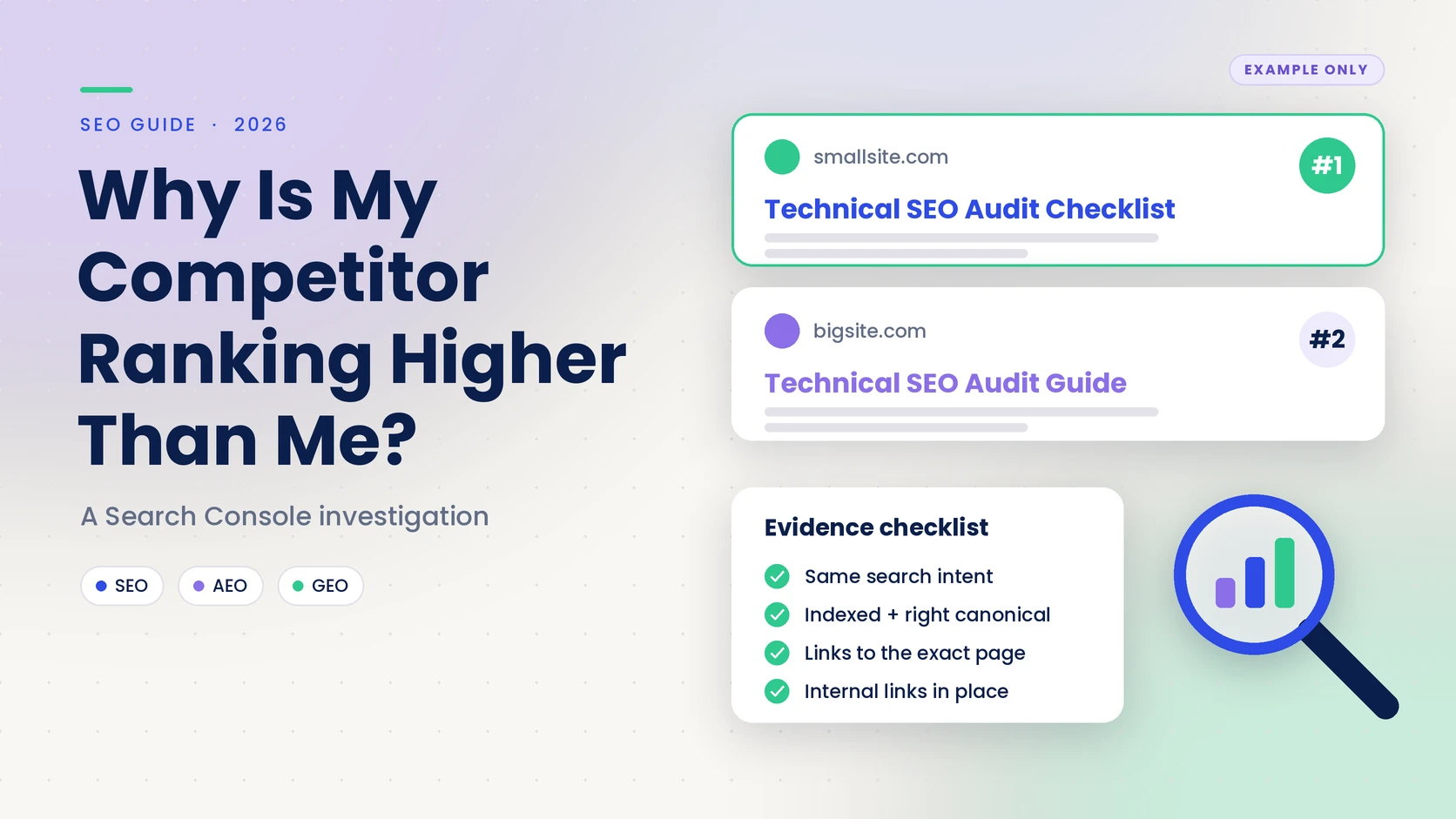
A Made-Up Example: “Technical SEO Audit Checklist”
The sites and numbers are invented for teaching. They are not real data.
- Search: “technical SEO audit checklist”
- Site A (yours): a general marketing site with a big archive and a high authority score in a tool. It has two audit pages: a long guide and an older page about audit tools.
- Site B: a small specialist site with one audit page and a lower authority score in the same tool.
Observation: on the day you check, Site B’s page is above Site A’s guide. Here is how the question why is my competitor ranking higher than me looks in practice.
| Step | What you see | Guess | What it does NOT prove |
|---|---|---|---|
| Compare pages | Site B opens with a numbered list of checks. Site A opens with a definition and a long intro. | The search may want a list to work through, and Site B gives it sooner. | That the opening is why Site B ranks higher |
| Search Console for Site A’s guide | Top queries are about what a technical audit is. The target search has fewer impressions. | Google may show the guide for a definition intent. | That the guide cannot rank for the checklist search |
| Filter by target query | Two Site A URLs appear: the guide and the older tools page. | Two pages may blur Site A’s purpose. | That overlap causes the gap, or that pages should merge |
| URL Inspection on both | Both are on Google, each names itself canonical, Google agrees. | No indexing or canonical problem here. | That nothing else is wrong |
| Links per URL (tool, dated) | 14 referring domains for Site B, 9 for Site A. Several of B’s come from small business blogs that cite the checklist. Many of A’s are directory profiles pointing to the homepage. | Site B may have more relevant links to the exact URL. | That links explain the gap |
| Internal links | The guide has links from two pages. Six other posts mention audits without linking. | The guide may be weakly supported inside Site A. | That adding links will lift it |
Choosing the next test
Ask two questions: Which test is cheapest? and Which answer would change my plan?
- Move the checklist to the first screen of the guide. It is cheap and it tests the intent guess directly.
- Decide what the older tools page is for. If its purpose is different, make that clear in its title and headings. If it repeats the guide, plan a merge with a redirect, but not yet.
- Add contextual links from the six posts.
- Hold link outreach until the guide fits the search.
After each change, write down the date and the exact change. Then look at the same Search Console view after Google has recrawled. No result is promised.
How to Choose the Next Test
Once you have a guess about why is my competitor ranking higher than me, choose your test in this order.
- Rule out blockers first. If the page is not indexed or is blocked, fix that.
- List your guesses with labels. Drop any that your own data already contradicts.
- Pick the cheapest test that separates two guesses. Change one thing at a time.
- Record the date and the exact change.
- Recheck the same view (same page filter, query filter and date comparison).
- If the result is unclear, say so. “Not enough evidence” is a valid finding.
The Decision Tree
Use this tree to answer why is my competitor ranking higher than me, one question at a time. Start with the exact search, your URL and their URL.
- Is your URL indexed and allowed? (URL Inspection)
- No: fix the reported reason first. This is a confirmed problem.
- Yes: go to 2.
- Does your page get impressions for the target search?
- Few or none: check that the search matches the page’s purpose and that the page has internal links.
- Impressions, but mostly for other searches: your page may serve a different intent. Change the page or aim at a different search.
- Yes: go to 3.
- Does another URL of yours also get impressions for it?
- Yes, same purpose: merge or clearly separate them.
- Yes, different purpose: make it clear with titles, headings and internal links.
- No: go to 4.
- Does their page serve the search better? (format, first screen, examples, real updates)
- Yes: improve your page for that gap.
- Not clear: go to 5.
- Does their URL have relevant links yours lacks?
- Yes, and your page already fits: look for realistic editorial opportunities.
- No: go to 6.
- Is your page weakly linked inside your site?
- Yes: add contextual links from relevant pages.
- No: you do not have enough evidence to name a cause. Record what you checked and test one change at a time.
SEO, AEO and GEO: Make Your Fix Work Everywhere in 2026
People now find answers in Google results, AI Overviews, AI Mode and AI chat tools, and they ask why is my competitor ranking higher than me in all of them. The good news: the same good page works for all of them. Google’s own guidance on AI features says normal SEO basics still apply. Here is how to cover each one in simple terms.
| Term | What it means | What to do |
|---|---|---|
| SEO | Be found in normal search results | Match search intent, get indexed, have a clear page purpose, earn relevant links, link internally |
| AEO (Answer Engine Optimization) | Be the clear answer to a question | Put a short direct answer at the top. Use question headings. Add an FAQ. |
| GEO (Generative Engine Optimization) | Be a source that AI tools can understand and quote | Write clear facts, name sources, show who wrote it, add original examples, keep your brand details consistent |
SEO (still the base)
- One page, one clear purpose, one main search, such as why is my competitor ranking higher than me.
- Title and H1 match what the searcher wants.
- Page is indexed, with the right canonical.
- Relevant internal links with descriptive anchor text.
- Links to your exact URL from relevant sites, earned and not bought.
AEO (win the direct answer)
- Start the page with a short answer in 40 to 60 words. For this topic, the answer to why is my competitor ranking higher than me sits in the first box of this page.
- Use headings written as real questions (“Can a smaller site outrank a bigger one?”).
- Give the answer in the first sentence under each question heading, then explain.
- Use short lists and simple tables for steps and comparisons.
- Add a small FAQ with real questions from your Queries report.
GEO (be easy to trust and quote)
- Write one clear idea per paragraph. AI tools pull short, self-contained passages.
- Define terms in plain words the first time you use them.
- Show a real author and a short bio. Add the date and update it only when you really change something.
- Name your sources (for example, Google documentation) instead of saying “experts say”.
- Add original value: your own worksheet, your own checklist, your own real client example (with permission) or a clearly labelled made-up example.
- Keep your brand name, services and location the same on your site, Google Business Profile and social profiles, so your brand is easy to recognise.
- Be honest about limits. Clear “what this does not prove” lines make a page more trustworthy to readers and easier to quote correctly.
Reality check
Nobody outside Google or the AI companies can promise that a page will be shown or cited in an AI answer. Treat GEO as “make the page clear and trustworthy”, not as a trick.
How to check your AI visibility (simple version)
- Write down 5 to 10 questions your customers really ask.
- Ask them in Google (look for an AI Overview) and in one or two AI chat tools.
- Note who is cited or named, and whether your brand or page appears. Add the date.
- Repeat once a month. Answers change, so look for a trend, not a single result.
- In Search Console, check if impressions and clicks change for those queries.
Quick Tips for 2026
Quick tips
- Check clicks, not just position. AI answers and extra boxes can reduce clicks even when your rank stays the same.
- Answer first. Put the short answer to why is my competitor ranking higher than me in the first screen. Details can follow.
- Match the format of the top results. If they all show templates, a long essay may not fit.
- Keep a change log. Date, URL, and the exact change. It is free and very useful.
- Use filters, not guesses. Page and Query filters in Search Console find overlap in two minutes.
- Update with real changes. A new date with no new content is a warning sign.
- Link new posts to older ones the same day. Do not leave orphan pages.
- Use real examples. One real, specific example beats five general statements.
- Fix confirmed problems first. Indexing and canonical issues come before content rewrites.
- Use the words people really type. If readers search why is my competitor ranking higher than me, use that wording in one heading and in the first paragraph.
- Read the live results page every time. The layout can explain more than the page itself.
Which Fix First? A Simple Priority Check
After you answer why is my competitor ranking higher than me, you may have several fixes to choose from. This is an editorial rule of thumb, not a Google metric. Rate each action from 1 to 3 for:
- Confidence: how strong is the evidence? (3 = you saw it directly)
- Relevance: how closely does it connect to your target search?
- Effort: 1 is quick, 3 is a lot of work.
Do high-confidence, high-relevance actions first. If two are close, pick the one with less effort. In the made-up example:
| Action | Confidence | Relevance | Effort | Decision |
|---|---|---|---|---|
| Move the checklist to the top of the guide | High | High | Low | Do first |
| Add internal links from six posts | Medium | High | Low | Do second |
| Decide what to do with the older tools page | Medium | Medium | Medium | Wait for more data |
| Link outreach | Low | Medium | High | Hold |
What Not to Change Before You Have Evidence
Even when you think you know why is my competitor ranking higher than me, do not rush into big changes. Avoid these:
- Do not publish another page for the same search. A third overlapping page makes data harder to read.
- Do not rewrite a page that already does its job only because another page ranks higher.
- Do not buy links because a competitor has more.
- Do not merge pages only because keywords overlap. Merge when the purpose is the same.
- Do not fix every audit tool warning. Fix confirmed problems on pages that matter.
- Do not rewrite titles again and again. Many changes at once hide which one mattered.
- Do not change the date to look fresh when the content has not really changed.
- Do not write to a word count. Google says it has no preferred length.
Competitor Investigation Worksheet
Copy this into a sheet to answer why is my competitor ranking higher than me for each search. One row per search.
- Search, date checked, device, location
- What the results page shows (AI answer, videos, forums, map block)
- Your URL and their URL
- Same intent? Yes, no or unsure
- Differences in format and first screen (label: observation)
- Search Console: top queries for your page, and impressions for the target search
- Other URLs of yours that show for the same search
- URL Inspection: on Google or not, canonical in your source, canonical Google selected
- Referring domains to each exact URL (tool and date), with three examples
- Relevant internal links to your URL (count and examples)
- AI check: who is named or cited for this question, and the date
- Your guess, and what it does not prove
- One change to make, and the date you made it
- Date to recheck, and what you saw (record it, do not assume it)
Frequently Asked Questions
Why is my competitor ranking higher than me even though my site is bigger?
Because Google compares pages, not site size. A bigger site can have a weaker page for that one search. If you keep asking why is my competitor ranking higher than me, compare the two pages, check your Search Console data, and test one change at a time.
Can a smaller website outrank a bigger one?
Yes. Google shows pages for searches, so a smaller site with a better fit can appear above a bigger one. Nobody outside Google can say exactly why a page ranks where it does. Google’s helpful content guidance asks whether a page gives real value compared with other pages in the results. That is the comparison to make.
Is Domain Authority a Google ranking factor?
No. Domain Authority is a score made by Moz, and other tools have their own versions. Google says third-party tools cannot see its internal ranking data. Use these scores to compare sites inside one tool, not to explain a ranking.
Why does Search Console show a different position from what I see?
The report shows an average across searches. Your own search can differ because of time, place, device and search history.
Should I copy the competitor’s page?
No. Google’s guidance asks whether content simply copies or rewrites other sources. Use their page to learn what searchers need, then add what it lacks: a clearer example, a working tool, better steps, or detail only you have.
Do I need a different plan for AI search (GEO and AEO)?
Not a completely different plan. A clear, trustworthy page that answers the question early, names its sources, and shows who wrote it helps in normal search and in AI answers. Add a short answer at the top, question headings, and an FAQ.
How long until I see a change?
There is no fixed time. Google must recrawl and process the page first. URL Inspection shows the last crawl date. Change one thing at a time and write down the date.
Final Takeaway: Why Is My Competitor Ranking Higher Than Me?
The honest answer to why is my competitor ranking higher than me is “it depends on the page and the search”. A ranking gap starts as an observation. Label it, test one guess at a time, and write what each result still does not prove. Make your page clear enough that both people and AI tools can understand it and quote it. If the evidence does not point to one cause, say so, and collect more data before you change more.
Still asking why is my competitor ranking higher than me on one page? Get a second opinion. You can ask for a free website SEO audit from Lee Growth.
Sources used:
- Google Search Central: Creating helpful, reliable, people-first content
- Google Search Central: How to specify a canonical URL
- Google Search Central: Link best practices
- Google Search Central: Spam policies for Google web search
- Google Search Central: AI features and your website
- Search Console Help: Performance report
- Search Console Help: URL Inspection tool
No ranking, featured snippet, AI citation or backlink result is promised.

I’m Leena Kalyana, a Delhi-based freelance digital marketer and graphic designer. I work across SEO, content marketing, social media, and digital design. I’m interested in helping businesses build a stronger online presence through practical SEO strategies, useful content, and creative digital marketing.