


By Leena Kalyana | Last updated: October 2026
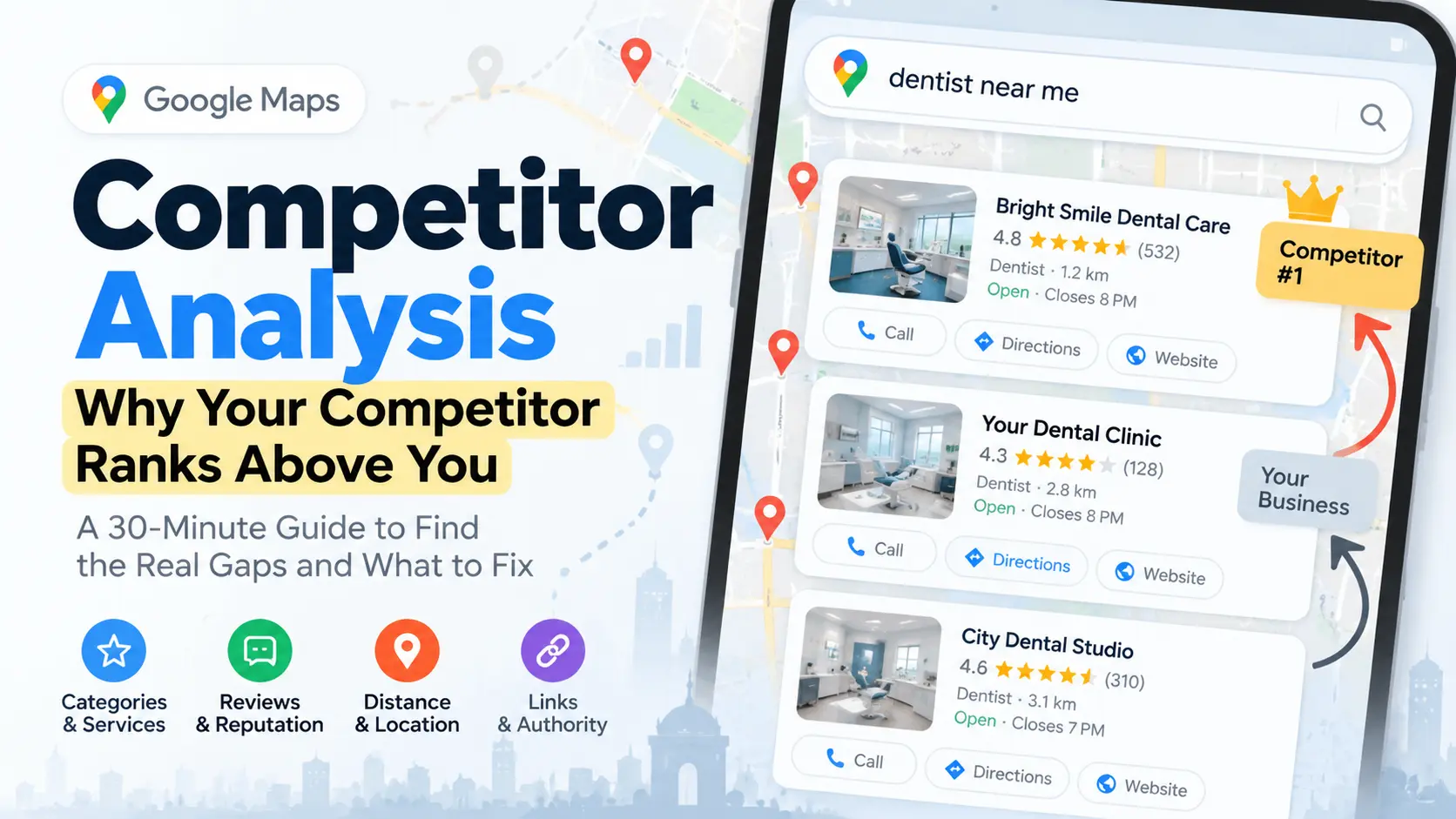
Short answer: A competitor usually shows above you on Google Maps because they do better on one or more of the three things Google looks at: how well they match the search, how close they are, and how well known they are. To find out which one it is, run a Google Maps competitor analysis: put your Google Business Profile next to theirs and compare the same things in the same order. Then fix what you can control, and accept what you can’t.
You search for your own service on Google Maps and a competitor is sitting above you. Maybe their shop is smaller. Maybe they started later. So you wonder what they are doing that you are not.
The question to ask is not “What does Google Maps look at?” It is: what is different between my business and the businesses Google shows above me?
A Google Maps competitor analysis answers that. You compare your profile with theirs, point by point, and see where the real gap is. Some gaps you can close in a week. Some you can’t close at all, and it helps to know that early so you don’t waste months on them.
This Google Maps competitor analysis guide is updated for 2026. When Google has said something officially, I say so. When something is just my experience or common practice, I say that too.
Table of Contents
The real reason your competitor ranks above you on Google Maps
Google says local results are based mainly on three things: relevance, distance and prominence.
- Relevance: how well your profile matches what the person searched for.
- Distance: how far you are from the person (or the place they searched).
- Prominence: how well known your business is. Google says this comes from information all over the web, like links, articles and directories. It also says your review count and star rating count.
Google is not asking “who is the best business?” It is asking “who is the best fit for this search, from this spot?” Google also says there is no way to pay for a better local ranking.
You don’t have one Google Maps ranking
Your position is not one fixed number. It changes with:
where the person is + what they typed + how well you match + who else is nearby
So before you compare anything, check the same search from different places. Take a search like “dentist near me” and try it from:
- Your home
- Your shop or office
- A different Delhi area
- An incognito window
- Google Maps directly
- Google Search (the three map results at the top)
Write down who shows up each time. You will often see the list change. A business that is first near its own street can be fourth two kilometres away. That tells you something useful: your problem may be about where people are searching from, not about your profile.
Start with the exact search
The same two businesses can show in a different order for different searches, and sometimes a completely different set of businesses shows up. Take four searches a Delhi marketing consultant might care about:
- SEO consultant
- SEO consultant near me
- local SEO consultant Delhi
- Google Maps SEO consultant
Each one can bring up different competitors, and you may be strong in one and invisible in another. So before you compare anything, write down the exact search you want to win, and do one Google Maps competitor analysis per search. If you mix searches together, your results won’t make sense.
The Google Maps Visibility Grid
Once you have tried a few places, turn your Google Maps competitor analysis into a simple grid. I use this to see where a competitor wins, not just whether they win.
- Pick one search, for example “emergency dentist”.
- Pick 6 to 9 spots across the area your customers come from. In Delhi that could be Karol Bagh, Connaught Place, Rajendra Place, Patel Nagar, Lajpat Nagar and Saket.
- Search the same words from each spot and note who is in the top 3.
- Mark each spot: Top 3, Top 10, or Not seen.
Do it for yourself and for your strongest competitor, then put them side by side:
| Area | You | Competitor A |
|---|---|---|
| Karol Bagh | Top 10 | Top 3 |
| Connaught Place | Not seen | Top 10 |
| Rajendra Place | Top 10 | Top 3 |
| Patel Nagar | Top 3 | Top 3 |
| Lajpat Nagar | Not seen | Top 10 |
| Saket | Not seen | Not seen |
Sample only, with made-up results.
Look for the pattern. Competitor A may be strong in the north-west and weak in the south. That shows you where it is realistic to compete. You don’t need to win the whole city. You need to be strong where your customers are.
Where do your customers really come from?
Before you chase rankings across the whole city, look at your last 20 to 30 customers or enquiries and note where they came from. If most are within 5 km of you, those areas matter most. Winning there is worth more than ranking in an area you will never serve. Use the grid above, but give extra weight to the areas that bring you money.
The distance trap
Sometimes a competitor ranks higher for a simple reason: they are closer to the person searching. That is not a mistake on your side, and no amount of profile editing will fix it.
Google lists distance as one of its three main points. It also says a business that is farther away can still rank higher if it looks more likely to have what the person wants. So distance matters a lot, but it is not everything.
The years they have on you
There is another thing you can’t edit: time. A competitor that has been in the area for eight years may have collected reviews, mentions, links and name recognition all that time. So ask:
Is this competitor really doing a better job, or have they just had more years to build trust in the area?
If it’s mostly years, the answer is steady catching up. It is not a panic rewrite of your profile.
Three kinds of gap
When a competitor is above you, the difference is usually one of three types. Don’t treat all of them as an SEO problem.
- Ranking gap: they are simply higher. This is only what you see.
- Fixable gap: a weak spot you can repair, like a poor main category or a short services list.
- Market gap: an advantage you can’t copy, like being 1 km closer or 10 years older.
Example: Ranking gap: 5 places. Fixable gap: your main category doesn’t match the search well. Market gap: the competitor is closer to the person searching. Fix the second one and plan around the third.
Now sort every gap you find into one of three groups.
Fixable
- Your profile details
- Categories
- Services
- Website pages
- Asking for reviews and replying to them
- Listings on other sites
Partly in your control (slow)
- Getting more reviews
- Mentions in local places
- Links from other websites
- Being better known
Not in your control
- Where your competitor is
- Where the person is searching from
- How long your competitor has been around
This keeps you honest. Nobody can promise “do these 10 things and you’ll beat everyone”, because distance and history are out of your hands.
You have more than one kind of competitor
The businesses you lose customers to are not always the businesses Google shows above you. You can have a different set of competitors in each place:
| Kind | Who they are | Where you meet them |
|---|---|---|
| Customer competitor | Takes the customers you want | Anywhere |
| Maps competitor | Shows in the map results for your search | Google Maps |
| Google Search competitor | Shows in the normal website results | Google Search |
| AI competitor | Gets named when people ask an AI tool | ChatGPT and similar tools |
| One-search competitor | Shows up only for one particular search | A single search |
A clinic down the road may take your patients but never show on the map. A directory website may beat you in normal Google results. This Google Maps competitor analysis is about your Maps competitors, so start there. If you also want to know why AI tools name someone else, read why ChatGPT names your competitor instead of you.
Step 1: Start your Google Maps competitor analysis by mapping your rivals
Don’t only open their profiles. Make a simple map.
- Search your main keyword from the place your customers search from.
- Write down the top 3 to 10 businesses.
- Mark where each one is on Google Maps. A paper map or a sheet with their area is enough.
- Compare distance, category, reviews, website, services and local reputation.
Then ask one question: is this competitor really stronger, or just closer? If the top results are all near the person and you are far away, the answer may be “closer”. If a competitor ranks above you even though you are closer, look harder at the gaps below.
Step 2: Compare three competitors in your Google Maps competitor analysis
Don’t build your plan around the #1 business alone. Look at three businesses that rank above you, and look for what they have in common, not just single differences.
Here is why. Say Competitor A has 500 reviews, B has 120 and C has 80. Then review count alone is probably not what puts them above you. But if all three have the same main category, a page for the service and the same details everywhere online, you have found something much more useful.
Make a “what the winners share” table:
| What to check | You | Competitor A | B | C | Do the winners share it? |
|---|---|---|---|---|---|
| Main category matches the search | No | Yes | Yes | Yes | Yes |
| 100+ reviews | Yes | Yes | No | Yes | No |
| Own page for the location | No | Yes | Yes | Yes | Yes |
| Rating of 4.8 or more | Yes | Yes | Yes | Yes | Yes, but you have it too |
Sample only.
The rule: don’t copy something only one competitor has. Work first on what the winners share and you are missing. In the sample above, that is the main category and the location page.
Don’t mistake a link for a cause
Be careful with the conclusions you draw from a Google Maps competitor analysis. If a competitor has more reviews, more years, a better website and more links, you can’t say “reviews are the reason.” They just happen to go together. Comparing several competitors, and changing one thing at a time (see below), is how you get closer to the real answer.
Write each finding as a guess to test
In your Google Maps competitor analysis, don’t write “this is why they rank.” Write “this is a guess worth testing.” Use four lines for each one:
- Guess: the competitor has stronger local trust.
- Evidence: they have 23 local mentions and you have 4. (Sample only.)
- How sure am I: medium, because two of the three competitors have it.
- Action: find local mentions I can realistically get.
Here is how to mark how sure you are:
| How sure | What it means |
|---|---|
| High | It shows up across 4 or 5 competitors |
| Medium | It shows up across 2 or 3 competitors |
| Low | Only one competitor has it |
Also remember that a thing the winners share is not a line you must cross. Many of them may have 100 or more reviews, but 100 is not a magic number.
Which problem do you actually have?
Sometimes you think “they are doing better SEO than me”, but the real reason is that they are closer, older, better known, or a better fit for the search. Before you change anything, work out which problem you have:
- Match problem: your profile doesn’t match the words people search.
- Distance problem: they are simply closer.
- Fame problem: they are better known, online or offline.
- Profile problem: your Business Profile is incomplete or set up wrongly.
- Website problem: your website doesn’t back up your service or area.
- Trust problem: they get more mentions and links from other places.
Most businesses have two or three of these, not all six. The rest of this guide helps you spot yours. If it turns out to be a profile or match problem, my local SEO services cover exactly that.
What if the competitor is doing nothing special?
Sometimes your Google Maps competitor analysis shows no clear gap. That happens. Common reasons:
- They are closer to the person searching.
- They have been around for years.
- People already know their name offline.
- Few businesses nearby offer the same service.
- Google reads the search in a way that favours them.
It also helps to ask what kind of advantage they have. A business advantage is a better location, a bigger team or a stronger brand. An SEO advantage is a better website, profile or local trust. A market advantage is higher demand for what they sell. Only the second one is something SEO can fix.
So sometimes the answer is not another fix. It is a different search to go after, or a bit more patience.
What to compare in a Google Maps competitor analysis
Category check
Google confirms categories are part of your profile.
Compare the main and extra categories on your profile with your competitor’s. For example (sample only):
- You: Dental clinic
- Competitor: Dentist, plus extra categories for Orthodontist and Cosmetic dentist
Then ask:
- Are we both describing the same service?
- Which category fits the search better?
- Are the right extra categories being used?
- Did I pick my categories because they are true, or because I think people search for them?
Never add a category for a service you don’t offer. Google’s rules for representing your business ask you to be honest and accurate, and profiles that break them can be changed or removed.
Does your profile match the search?
Say someone searches “emergency dentist Delhi”. Google may show the businesses that look like the best fit for those exact words. Follow this chain for yourself and for the competitor:
What they typed → category → services → website → reviews → area
At each step ask: am I really the best match for the search I want to win? This is more useful than “add keywords to your profile.” Your gap may be that your profile says “general dentistry” while the competitor lists emergency care in their services, on their website and in their reviews.
Example. Someone searches “emergency plumber Delhi”. The competitor’s profile says “24/7 emergency plumbing”, “emergency repairs” and “same-day service”. Yours says “plumbing services”, “bathroom fitting” and “kitchen plumbing”. They may not be better. They may just be a closer match to what the person wants. No trick is involved.
Ask yourself:
- What does the person searching really want?
- Does my main category show it?
- Do my services list it?
- Does my website have a page for it?
- Do my reviews show it naturally?
The Search Match Score
To make this easy to measure, score how well each business matches one exact search. Give each row 0 to 5:
| What to score | You | Competitor A | B | C |
|---|---|---|---|---|
| Main category fits the search | ||||
| Services listed | ||||
| Website page for this search | ||||
| Area you mention | ||||
| What customers say in reviews | ||||
| Profile details filled in | ||||
| Total (out of 30) |
This is my own Google Maps competitor analysis tool at LeeGrowth. It is not a Google score. It helps you compare yourself with competitors for the same search and see which row is pulling you down.
Reviews: count, speed and topics
Google confirms that review count and rating affect local ranking. But “they have 500 reviews and I have 100” is only where you start. Compare:
- Total reviews and average rating
- How often new reviews come in (reviews in the last 30 and 90 days)
- Which services and products customers mention
- Which areas customers mention
- Which problems customers mention
- Whether the owner replies, and how helpful the replies are
Look at speed, not just the total. A big total shows how long a business has been collecting reviews. The last 90 days show whether customers are talking about them now.
| Business | Total reviews | Last 90 days | Recent pace |
|---|---|---|---|
| You | 200 | 4 | Slow |
| Competitor A | 800 | 70 | Fast |
| Competitor B | 500 | 12 | Medium |
Sample only. If Competitor A adds about 23 reviews a month and you add 1 or 2, that is a gap in your review habit, and it is one you can fix. Google has not said review speed is a ranking factor, so use it to compare, not as a promise.
What do the reviews talk about? Read 20 to 30 reviews for each business and note the topics. A competitor’s customers may keep mentioning emergency visits, same-day appointments, braces and South Delhi. Yours may only say “good service” and “nice staff.” That is a gap in detail: their customers describe what the business does and where. This is my observation. Google has not said that words in reviews help ranking. It still shows you what customers say about a competitor, and what you can honestly invite your own customers to talk about.
Never buy reviews or write fake ones. Don’t ask only your happiest customers either. Google’s policies say all content on a Business Profile, including reviews, must be genuine, and a pattern of breaking the rules can get your profile restricted. Google’s own tips for getting more reviews also say business owners shouldn’t offer incentives for them. A review link or QR code is the honest way to make leaving one easy.
Photo gap
Compare:
- How many photos and how recent they are
- Outside, inside and team photos
- Photos of your work, products or before and after results
- Photos that show the real place
- Whether the look matches the brand
Don’t assume “more photos means higher rank.” Google has not said that. A photo gap mostly shows how actively a competitor looks after their profile, and customers do use photos to decide.
Does your website back up your profile?
The best Google Maps competitor analysis looks at the whole picture, not only the profile. Open the competitor’s website and look for:
- A page for their location, or a page for each service and area
- The same name, address and phone number as on their profile
- An embedded map
- Local customer testimonials
- Page titles that mention the service and the area
- Local business structured data (schema) with their hours, address and phone
- Pages about each service, linked to each other
Then check your own site the same way. If your profile says one thing and your website says another, fix that first. You can ask for a free website SEO audit if you want a second pair of eyes. If your site is missing service or area pages, my WordPress website service and SEO content writing can help you build them.
Links and mentions from other websites
“Get more links” is not a plan. Instead, find where your competitors get their local trust from. Look for:
- Local news sites and magazines
- Business groups and trade associations
- Local directories
- Events and sponsorships
- Community groups
- Supplier or partner pages
Then ask: which of these could I realistically get too? A page on a local association site or an event sponsor page may be easy. A feature in a national newspaper is not. Google says links and mentions from across the web help how well known you look, but it doesn’t say how much. A backlink tool makes this check much faster, and my comparison of Semrush, Ahrefs and Ubersuggest shows which one suits a small budget. My SEO services page explains how I approach this.
Is your business information the same everywhere?
Ask: is it easy for Google to tell who this business is? Compare, for you and the competitor:
- Business name, address and phone number
- Website and About page
- Services and categories
- Listings on other sites
- Mentions and local references
- Social media pages
Small mismatches, like “Pvt Ltd” on one site and not on another, or an old phone number on an old directory, make it harder to tell which listing is the real one. Google doesn’t publish a score for this, but clear, matching details help. For Delhi businesses, check JustDial, Sulekha and IndiaMART as well as the big global directories. Clear details also help AI tools decide which business to name. I explain that in why ChatGPT names your competitor instead of you.
A 20 point gap check for your Google Maps competitor analysis
Use this table for one competitor. Score each row: +1 if you are ahead, 0 if equal, -1 if behind. Add short notes in the last column.
| # | What to compare | Can you change it? | Score | Notes |
|---|---|---|---|---|
| 1 | Main category | Yes | ||
| 2 | Extra categories | Yes | ||
| 3 | Services listed | Yes | ||
| 4 | Profile details (hours, phone, description) | Yes | ||
| 5 | Number of reviews | Slowly | ||
| 6 | Star rating | Slowly | ||
| 7 | How recent and how often reviews come in | Yes | ||
| 8 | What the reviews say | Partly | ||
| 9 | Replies to reviews | Yes | ||
| 10 | Photos (number, quality, how recent) | Yes | ||
| 11 | Website page for the service | Yes | ||
| 12 | Pages for each area | Yes | ||
| 13 | Listings on other sites | Yes | ||
| 14 | Same name, address and phone everywhere | Yes | ||
| 15 | Links from local websites | Slowly | ||
| 16 | Local name and mentions | Slowly | ||
| 17 | Distance from the person searching | No | ||
| 18 | How well known the business is (age, size, offline fame) | Mostly no | ||
| 19 | Match with the exact search words | Yes | ||
| 20 | Overall visibility | Result of the above |
Row 20 is the result, not a cause. Score it last.
The Gap Score: you vs 3 competitors
The 20 point check works for one competitor. For a full Google Maps competitor analysis, compare yourself with three. Here is a sample with made-up numbers, for illustration only:
| Area | You | Competitor A | Competitor B | Gap |
|---|---|---|---|---|
| Main category | Matches | Matches | Matches | Small |
| Extra categories | 4 | 7 | 6 | Medium |
| Reviews | 87 | 241 | 156 | Big |
| Reviews in last 90 days | 6 | 38 | 9 | Big |
| Services listed | 8 | 15 | 12 | Medium |
| Website pages for the area | Some | Many | Some | Medium |
| Links from other sites | 12 | 31 | 24 | Big |
| Listings on other sites | 18 | 35 | 29 | Big |
| Photos | 42 | 120 | 74 | Medium |
| Distance | 2.4 km | 0.8 km | 1.7 km | Can’t change |
Don’t try to beat the competitor on everything. Pick the 3 to 5 biggest gaps you can actually do something about. In this sample, reviews, links and listings are big gaps you can work on. Distance is a gap too, but you can’t change it, so let it shape your expectations, not your to-do list.
Which gap first?
Once your Google Maps competitor analysis shows your gaps, score each possible fix from 1 to 5 on three things:
- Impact: how much could this help your visibility?
- Control: how much is really in your hands? (5 means fully)
- Effort: how much time or money will it take? (5 means a lot)
Priority = (Impact × Control) ÷ Effort
A higher number means do it sooner. Sample scores, for illustration only:
| Fix | Impact | Control | Effort | Priority |
|---|---|---|---|---|
| Correct a wrong category | 5 | 5 | 1 | 25 (High) |
| Improve the services list | 3 | 5 | 2 | 7.5 (High) |
| Get more recent reviews | 4 | 4 | 3 | 5.3 (High) |
| Get one local link | 4 | 3 | 4 | 3 (Medium) |
| Move your business | 5 | 1 | 5 | 1 (Low) |
The formula matters less than the habit. It makes you pick the quick wins you control before chasing things you can’t change. If you want a ready plan for the first month, my 30 day local SEO plan for small businesses lays it out week by week.
Look for their weak side too
Don’t only ask “why are they winning?” Also ask “where are they weak?” Check for:
- Poor reviews, or reviews the owner never replies to
- An old website
- Services they don’t list
- Thin or missing content
- Few local mentions
- Few extra categories
- Only a small area covered
You don’t need to be better than them at everything. You need to be clearly stronger in one area that matters to your customers.
Beat the gap, don’t copy the competitor. Say they have 800 reviews and you have 120. Don’t try to reach 800. Instead, make your services match the search more closely, earn local mentions, invite detailed reviews, and go after a service they have ignored. That is a plan you can keep up.
Change one thing at a time
Treat each fix like a small test, not a guess. A Google Maps competitor analysis only helps if you test what it tells you.
- Your guess: “My competitor beats me for this search because my main category fits it less well.”
- The change: fix the category, if the new one is true for your business.
- Watch: track your visibility and enquiries for 4 to 6 weeks, from the same places.
- Compare: before and after.
If you change five things at once, you will never know which one worked. Where you can, change one big thing at a time.
Don’t fight them. Find the search they are missing.
Sometimes the smartest move is not to fight the strongest competitor on their best search. Say a rival owns “dentist near me”. Instead of spending a year chasing that, look for related searches where fewer businesses are competing, like:
- emergency dentist
- root canal dentist
- children’s dentist
- braces dentist
- weekend dentist
Then build real strength there: list the service on your profile, add a page on your website, and invite honest reviews from customers who used that service (only if you really offer it). The path is competitor gap, then a search they are missing, then your chance. It is often faster, and the customers are often more ready to buy.
Which searches are worth winning?
The search with the most people is not always the best one for you. Compare them like this (sample only):
| Search | What the person wants | How many compete | Value to you | Where you show now |
|---|---|---|---|---|
| dentist Delhi | Just looking | Many | Medium | 12th |
| dentist near me | Ready to visit | Many | High | 8th |
| root canal dentist | One specific treatment | Some | Very high | 4th |
| emergency dentist | Needs help today | Some | Very high | 2nd |
Here, “root canal dentist” may be worth more than “dentist Delhi”, even though fewer people type it. Pick the searches that bring you customers, not just the ones with the biggest numbers.
Rankings are not the goal. Customers are.
A good Google Maps competitor analysis ends with more customers, not just a higher position. A competitor may be first for “best dentist Delhi” while your business earns more from “root canal dentist near me”. Your position on the map is only a means. Alongside rank, keep an eye on:
- Calls
- Direction requests
- Website visits
- Booking clicks
- Enquiries
- Actual new customers
The goal is not “beat the competitor.” The goal is more of the right customers near you. Use the Performance report inside your Business Profile (it shows calls, direction requests and more) and your own enquiry notes to see whether your changes are bringing in the right people.
What not to copy from competitors
A competitor ranking above you doesn’t mean everything they do is the reason. Don’t copy:
- Categories that don’t fit
- Business names or descriptions stuffed with keywords
- Fake or bought reviews
- Spammy directory listings
- Many near-identical pages for different areas
- Copied content
- Review habits that only ask happy customers
- Misleading details, like a fake address
Some of these can get a profile suspended. Copy what is true and useful for your business, and skip the rest.
The 30 minute Google Maps competitor analysis
Here is the whole Google Maps competitor analysis in seven steps.
- Pick one search, the exact words a customer types.
- Note the top 3 competitors, searching from the right place.
- Compare each one:
- [ ] Main category
- [ ] Extra categories
- [ ] Reviews, rating and how often new ones come in
- [ ] Services and profile details
- [ ] Website and area pages
- [ ] Listings on other sites
- [ ] Links from other sites
- [ ] Photos
- [ ] Distance
- [ ] Local mentions
- Look for what two or three of them share, not just one, and mark how sure you are (high, medium or low).
- Pick your 5 biggest gaps and sort them: fixable, partly in your control, or not in your control.
- Choose the top 3 fixes using Impact × Control ÷ Effort.
- Check again in 4 to 6 weeks, from the same place, with the same search.
How long does a Google Maps competitor analysis take to work?
Google gives no official timeline, and anyone who quotes you a fixed number is guessing. From my own work, small profile changes like categories and services can show an effect within a few weeks. Reviews, listings and links usually take a few months of steady work. Treat that as experience, not a promise. A business with a big “well known” gap will take longer than one with an incomplete profile.
A sensible order looks like this:
- Fix the obvious: categories, services, profile details, photos.
- Line up your website: pages for your services and areas that match your profile.
- Build a review habit: steady, honest requests and helpful replies.
- Earn local trust: listings, local mentions, useful links.
- Run the grid and the 20 point check again to see what moved.
- Count customers: calls, enquiries and sales.
Key takeaways
- Google says local ranking is based mainly on how well you match the search, how close you are, and how well known you are. You can’t pay for a better rank.
- You don’t have one Google Maps ranking. It changes with where the person is, what they type and who is nearby. Test it with the Visibility Grid.
- Before you change anything, work out which problem you have: match, distance, fame, profile, website or trust.
- Separate the ranking gap, the fixable gap and the market gap. Only the fixable one is purely your job.
- A competitor may be closer or older, not better. Put them on a map to check.
- Compare three competitors and look for what the winners share. Don’t copy what only one of them has.
- A Google Maps competitor analysis works best when you compare three businesses for one exact search.
- Compare reviews by speed, topics and replies, not just the total.
- Review speed, words in reviews and photo counts are worth studying, but Google has not confirmed them as ranking factors.
- Don’t mistake things that go together for a cause. Change one thing at a time.
- If you can’t beat a competitor on their main search, find a related search they are missing.
- Count calls, enquiries and customers, not just rank.
- Write down the exact search first. The same businesses can rank differently for different searches.
- You can have different competitors on Maps, in Google Search and in AI answers. Start with your Maps competitors.
- Write each finding as a guess, and mark how sure you are, so you don’t act on one-off differences.
- Look at where your competitor is weak, not only where they are strong.
- Sometimes there is no clear gap to fix. Closeness, years in business and brand fame can explain a lot.
- Never copy fake reviews, stuffed categories or misleading details.
Frequently asked questions
What is a Google Maps competitor analysis?
It is a side by side check of your Google Business Profile against your competitors’ profiles, plus their websites and local mentions. The goal is to find what is different between you and the businesses ranking above you, and decide which gaps you can fix.
Why do competitors rank higher on Google Maps?
Usually because they do better on one or more of Google’s three main points: how well they match the search, how close they are, and how well known they are. They may have a better category, more and newer reviews, a stronger website, or they may simply be closer to the person searching.
Why is my competitor above me even though I have better reviews?
Reviews are only part of how well known you look. Their category, services, distance, website and mentions from other places can outweigh a better star rating. Compare all of these, not only the stars. A Google Maps competitor analysis compares all of these side by side.
How do I outrank competitors on Google Maps?
Run a Google Maps competitor analysis, then fix your biggest gaps first, and keep a steady habit of reviews and profile updates. Don’t expect to beat a competitor on distance, because you can’t change where either business is.
Is distance more important than SEO on Google Maps?
Distance is one of Google’s three main points, so it can matter a lot. But Google also says a business farther away can rank higher if it looks more likely to have what the person wants. Good SEO can help you win searches where you are not the closest.
Why does my ranking change from place to place?
Local results depend on where the person is searching from. The same search from home, from your shop and from another area can show different businesses in a different order. That is why you should test from several places, or build a visibility grid, before judging your rank.
How many Google reviews do I need to beat a competitor?
There is no magic number. Google says review count and rating affect local ranking, but the right target depends on your area and your type of business. Look at the top 3 competitors, then aim to match their pace and quality over time.
Does review speed affect ranking?
Google has not said so. It is still a useful way to compare, because recent reviews show how active a business is right now. Use it to understand the gap, not as a promise.
Do words in Google reviews help ranking?
Google has not said that words in reviews are a ranking factor. Reviews that naturally mention your services and areas may give more detail about your business. Invite honest, detailed reviews, but never write or script them for customers.
Do photos help you rank higher?
Google has not confirmed that more photos mean a higher rank. Photos still help customers choose you, and a big photo gap can show that a competitor keeps their profile active. Add real, recent photos of your place, team and work.
Do I need my details to match on every site?
Google says information from across the web helps show how well known you are, and matching details make it clear which listing is yours. Fix wrong or old listings first, then add new ones. For Delhi, include JustDial, Sulekha and IndiaMART.
Should I copy my competitor’s categories?
Only if they are true for your business. Use the category that best describes your main service, and add extra categories only for services you really offer. Wrong categories can hurt trust and cause problems with your profile.
Can I pay to rank higher on Google Maps?
No. Google says there is no way to request or pay for a better local ranking. Paid ads are separate and are labelled as ads.
Do I need a website to rank on Google Maps?
A website is not the only thing that matters, but a clear page for your service and area gives Google and customers more to go on. It also makes your business details easier to confirm.
What if I can’t beat the competitor on my main search?
Look at related searches where fewer businesses compete, such as one specific service, one specific problem or one specific area. Build real strength there first. It is often faster, and those customers are usually closer to buying.
Who counts as my competitor on Google Maps?
Anyone who shows in the map results for the exact search you want to win. That may not be the same as the businesses you compete with for customers, or the ones who beat you in normal Google results. Check each search separately. Decide this before you start your Google Maps competitor analysis.
What if I can’t find any gap between me and my competitor?
That can happen. They may be closer, older or better known offline, and none of that shows up in a profile check. In that case, look for their weak side, or aim at a related search where fewer businesses compete.
How often should I repeat a Google Maps competitor analysis?
Every one to three months is enough for most small businesses, or sooner if your rank drops after a change. Always repeat it from the same place with the same search so you compare fairly.
Your Google Maps competitor analysis template
Copy this Google Maps competitor analysis template into a document or spreadsheet and fill it in. It keeps everything from this guide in one place.
GOOGLE MAPS COMPETITOR ANALYSIS SHEET

Business:
Exact search:
Where I searched from:
Date checked:

COMPETITORS
A:
B:
C:

WHAT I FOUND
Match with the search:
Distance:
Reviews (total, last 90 days):
Categories:
Services:
Website:
Links and local mentions:
Listings on other sites:
Where I show on the map (grid):

MY GUESSES (with how sure I am: high, medium, low)
1.
2.
3.

THEIR WEAK SIDE
1.
2.

BIGGEST GAPS I CAN FIX
1.
2.
3.

MY NEXT ACTIONS
1.
2.
3.

RECHECK DATE:
Conclusion: start your Google Maps competitor analysis small
Your competitor probably didn’t beat you with one secret trick. It is usually a mix: a closer shop, a better matching category, newer reviews, a clearer website, more local mentions, or simply more years in the area. The way forward is to stop guessing and compare.
Start your Google Maps competitor analysis small. Pick one search, three competitors and 30 minutes. Fill in the gap score, mark what is fixable, and fix the top three things first. Run your visibility grid again in a month, from the same places. Over a few months, steady changes add up, and you will know which battles are worth fighting, which ones are only about distance, and where an easier chance is waiting.
If your Google Maps competitor analysis tables are filled in but you still can’t tell what to fix first, I can look at them with you. You can see how I work with clients as a freelance SEO or book a free 30 minute call.
The Visibility Grid, Search Match Score and Gap Score are my own checking tools at LeeGrowth. They help you compare businesses. They are not Google scores.
Sources:
- Google Business Profile Help, How to improve your local ranking on Google
- Google Business Profile Help, Guidelines for representing your business on Google
- Google Business Profile Help, Overview of Google Business Profile policies
- Google Business Profile Help, Tips to get more Google reviews
- Google Business Profile Help, Manage customer reviews
- Google Business Profile Help, Understand your Business Profile performance
- Google Search Central, Local business structured data

I’m Leena Kalyana, a Delhi-based freelance digital marketer and graphic designer. I work across SEO, content marketing, social media, and digital design. I’m interested in helping businesses build a stronger online presence through practical SEO strategies, useful content, and creative digital marketing.