


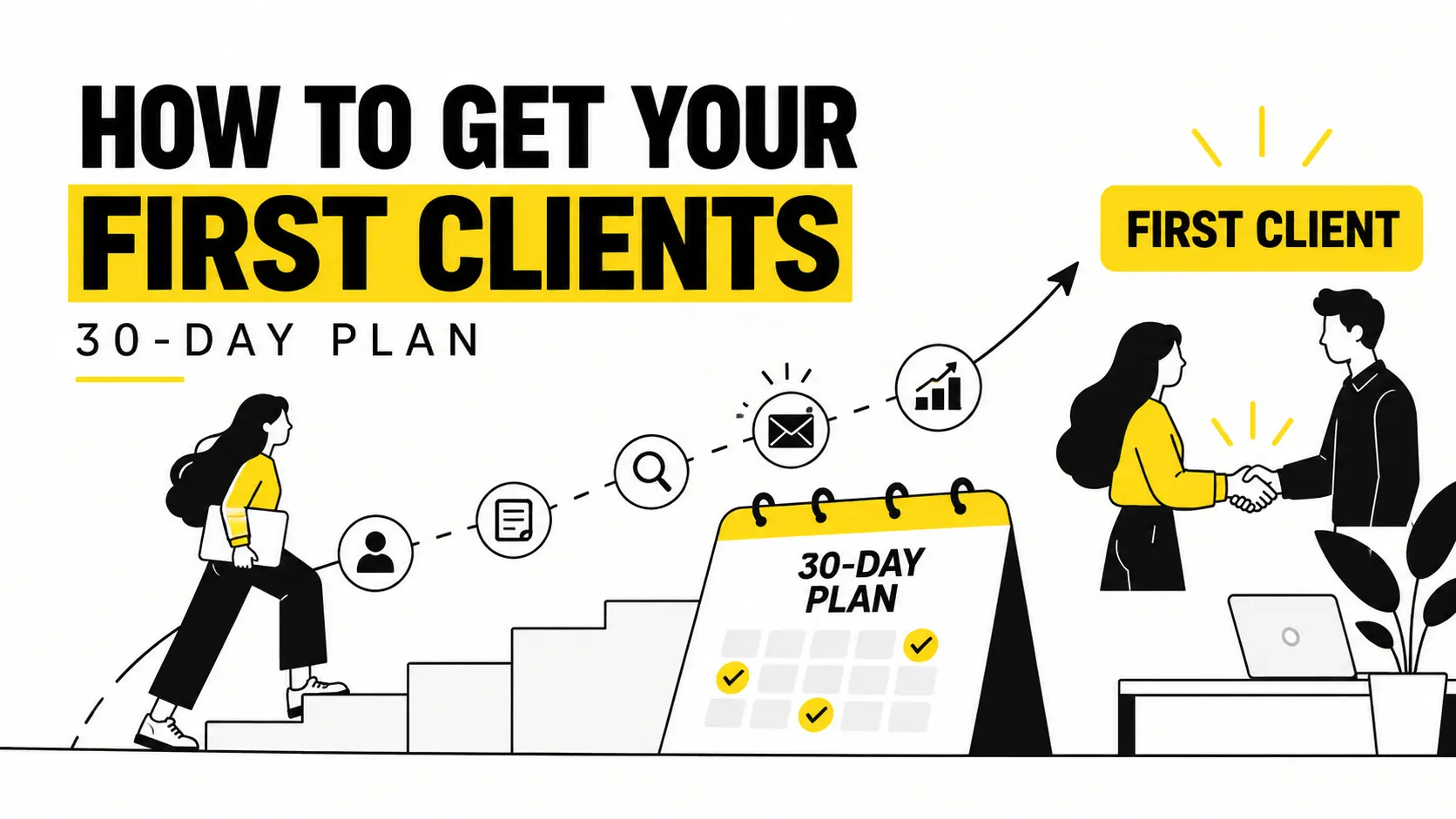
Learning how to get your first clients is mostly about choosing one type of customer, making one clear offer, and talking to people directly. This guide gives you a simple 30-day plan, scripts you can copy, and a way to see where things are going wrong.
Quick answer: To get your first clients, pick one type of customer and write one clear offer. Then message 30 to 50 people directly, starting with people you know. Ask for introductions, offer a small paid trial project, and follow up every time. Do this before you spend money on ads or wait for SEO to work.
Key takeaways on how to get your first clients
- Your first client usually comes from a conversation, not from a post or an ad.
- “Everyone” is not a customer. Choose one type of person or business.
- One clear offer sells better than a list of services.
- Try one or two ways of finding clients for 30 days before you decide they do not work.
- No portfolio is fixable. A small paid trial project and honest, specific proof are enough to start.
- Not every enquiry is worth taking. Check if the client is a good fit before you say yes.
- Most first clients are lost to silence, not to a “no”. Follow up.
Table of Contents
What do the numbers say about how to get your first clients?
Good data on “first clients” for small service businesses is thin, so I only use numbers I can name a source for. Three are worth knowing:
| Number | What it says | What it means for you |
|---|---|---|
| 83% | In a Nielsen survey of 30,000 online respondents in 60 countries, 83% said they trust recommendations from friends and family (2015). | This is why you start with people you know and ask for introductions. A warm intro carries trust that an ad cannot. |
| 70% | In the same survey, 70% said they trust brand websites. | People will check you out before they reply. A clear, simple page of your own is worth having. |
| 42% | CB Insights studied 101 failed startups, and 42% named “no market need” as a reason. Companies could name more than one reason. | These are tech startups, not freelancers, but the lesson fits. Find out if people want your offer before you pay for ads. |
These are older, broad studies. Use them as direction, not as a promise about your results. Source for the first two: Nielsen, Global Trust in Advertising.
Why is the first client harder than the next ones?
The first client is harder because you have nothing to show yet: no past clients, no reviews, no one who can say you did good work. Each stage after that has a different job, so the advice on how to get your first clients changes too.
| Stage | Your job | What to focus on |
|---|---|---|
| 0 to 1 client | Get someone to pay | People you know, direct messages, a simple offer |
| 1 to 3 clients | Build proof | Reviews, a short results story, introductions from client one |
| 3 to 10 clients | Make it repeat | A weekly routine, content, SEO, partners |
If you are at zero, skip the last row for now. Posting daily and building a blog will not get you client number one.
The 7 steps in how to get your first clients are:
- Choose who you help
Pick one type of customer and name 50 potential clients. - Make your offer
Explain what problem you solve and what result you provide. - Be easy to find
Create a clear LinkedIn profile and one simple page. - Reach out first
Message 10 people a day, starting with people you know. - Show proof
Offer a small paid trial and ask for a specific review. - Talk and close
Hold a short call and send a proposal within 24 hours. - Follow up
Follow up on Day 1, Day 3–5 and Day 10.
| Step | Plain question | Short name |
|---|---|---|
| 1 | Who am I helping? | Position |
| 2 | What problem do I fix, and what do they get? | Offer |
| 3 | Where can they find and check me? | Visibility |
| 4 | How do I reach them first? | Outreach |
| 5 | Why should they believe me? | Trust |
| 6 | How does interest turn into a paying client? | Conversion |
| 7 | How do I avoid losing people who were interested? | Follow-up |
Step 1: How do you choose your first client?
The first step in how to get your first clients is to choose one type of customer you could find 50 of this week. If you cannot list 50, the group is too small or too vague.
Fill in this worksheet. If you are guessing on a line, write “guess” next to it. Your first ten conversations will correct it.
- Who they are: for example, small dental clinics in Delhi NCR, or coaches who sell online courses
- Size: just the owner, or 2 to 10 people
- Their problem right now: what they complain about
- What just happened: a new launch, fewer enquiries, a competitor ranking above them
- Who says yes: the owner, the founder, the marketing head
- Can they pay: do they already spend on things like this?
Your first client may not turn out to be your perfect client, and that is fine. Use the first one to learn, then narrow down. What matters is that they pass the four-question test below.
A quick test for picking between two groups
Choose the group where all four are true:
- You can name at least 50 of them.
- They already feel the problem.
- They can afford to pay you.
- You have helped someone similar, or can show you understand their work.
Step 2: How do you write an offer people understand?
Write one sentence that says who you help, what problem you fix, and what they get. Use this pattern: I help [who] get [result] by [what you do].
Weak: “I provide digital marketing services.”
Better: “I help local clinics get more patient calls from Google Maps by fixing their Google Business Profile and local search.”
A good first offer has three things:
- A clear result. More calls, more bookings, more enquiries. Not “better presence”.
- A fixed scope. “A 30-day project” is easier to say yes to than “a monthly plan”.
- A price or a starting price. Share it once someone is serious. Hiding it wastes time for both of you.
Do not promise rankings, sales or a fixed number of leads. You do not control those, and good clients know it.
Build a three-step offer ladder
Do not lead with your biggest package. Give people a small first yes, then a bigger one once they have seen your work.
| Step | What it is | Why it works |
|---|---|---|
| 1. Quick review | A short written look at their site, profile or page. Free, once per prospect, capped at 30 minutes of your time. | Shows how you think. Starts a real conversation. |
| 2. Paid trial | A fixed price, a fixed scope, 2 to 4 weeks. | Gives you your first proof, from someone who paid. |
| 3. Bigger or ongoing work | A longer project or monthly work, offered after the trial worked. | Easier to say yes to once they have seen results. |
Free work stops at step 1. After that, people pay.
Step 3: How do you make it easy for people to check you out?
People will look you up before they reply. Make sure what they find is clear. That means three things for most people:
- A LinkedIn headline that says who you help, not just your job title
- One simple page that states your offer, shows your contact details, and has any proof you have
- If you serve a local area, a complete Google Business Profile. Our Google Business Profile setup guide for India shows how
You do not need a big website to get a first client. You need a clear one. SEO and blogging help later, but they take months, so treat them as the slow channel. If you want to see how findable you are right now, run our free website SEO audit.
Step 4: How do you reach out first?
You reach out by messaging people directly, one at a time, with something that is useful to them. Start with the people closest to you and move outward.
Message people you already know
Most first clients come from people who already know you: past colleagues, old bosses, friends of friends. Do not post “looking for clients” and hope. Message people one by one.
Hi [name], I have started helping [type of customer] with [problem]. I am taking on a few new clients this month. Do you know anyone who struggles with this, or is it something you deal with at [company]? Happy to share what I would look at first. No pressure.
Ask for introductions
Referrals work because the person already trusts the one who sends you. Ask right after you have done something good for someone, and make it easy for them.
Thanks for the kind words about [project]. I am looking for more [type of customer] like you. Is there one person you would feel comfortable introducing me to? I can send you a two-line note to forward.
Use LinkedIn without spamming
LinkedIn works best when you sell to other businesses. Fix your headline first. Then leave useful comments on posts by the people you want to work with. Then send short, personal messages. Do not send a pitch with every connection request.
Message people who do not know you yet
Keep it short and about them. Use this pattern: something you noticed, what you do, an easy question.
Hi [name], I noticed [something specific, for example: your clinic does not show up on Google Maps when I search “dentist near [area]”]. I help [type of customer] fix this. Want me to send you a short list of what I would change?
Keep it under 70 words. Write 10 to 15 of these a day to people you researched, not 200 to a bought list. If you get almost no replies after 30 good messages, change the message or the list before you send more.
The same message works on WhatsApp
For many Indian businesses, WhatsApp gets a faster reply than email. India is WhatsApp’s biggest market, and WhatsApp said in 2020 that more than 15 million people in India use its Business app every month. That number is likely higher now. Only message people who have shared their number publicly for business, keep it to two or three lines, and stop if they do not reply after a follow-up.
Join groups, and help first
Pick two or three groups where your customers ask questions: LinkedIn, Facebook, WhatsApp communities or founder forums. Answer questions properly for a few weeks before you mention your work. People notice who helps.
Team up with businesses that serve the same customer
A web designer can send you work that needs SEO. An accountant can send you a founder who needs a website. Offer to send work back. Start with two or three people, not twenty.
Where do ads fit?
Ads work after your offer has already sold to a real person. If nobody has paid for it yet, ads mostly show you that something is unclear, and you pay for the lesson. Sell it by hand first.
What to say when they ask for your portfolio or your price
These two questions come up early. Answer honestly and move the talk forward.
“Can you send your portfolio?”
I am still building my list of [type of customer] projects, so I do not have a long one yet. What I can do is look at [their business] and send you three things I would change. Then you can judge my work on your own site. Want me to do that?
“What do you charge?”
It depends on [two things, for example: how many pages and how competitive your area is]. Projects like this usually start at [your starting price]. Can I ask two quick questions so I can give you an exact figure?
Step 5: How do you get clients with no portfolio or reviews?
If you wonder how to get your first clients with no portfolio, the answer is small, honest proof instead of big, fake proof. You do not need ten past clients. You need one person who can say what you did and what changed.
- Do a short review. Look at a prospect’s public website, Google profile or social page. Send three clear points on what you would fix. It shows how you think and starts a conversation.
- Offer a small paid trial. A fixed price, a fixed scope, a clear end. Paid, because free work attracts people who do not value it.
- Make a demo and label it as a demo. A before-and-after on your own site works if you say it is your own project.
- Ask for a specific review straight after you finish. “What problem did we fix and what changed?” gets a better answer than “Can you write a review?”
- Write a short results story the same week. What the problem was, what you did, what happened. Keep the facts exact.
The proof ladder: which proof counts most
Not all proof is equal. Here it is from strongest to weakest. Aim to move up one rung with every client.
- A named client quote with real numbers (for example, calls went from 12 to 30 a month)
- A named client quote with no numbers
- A screenshot of a real result, shared with permission
- A before-and-after on your own project, clearly labelled
- A written review you did of a prospect’s page
- Your own opinions in posts
Tip: before you start any trial project, ask the client to note one number, such as monthly enquiries. Then you have a real “before” and can show a real “after”.
Never invent results, and never show demo work as client work. One trust-breaking lie costs more than a thin portfolio. For more on this, read what actually gets freelancers hired with no portfolio.
Step 6: How do you talk to them and close the deal?
Closing is the part of how to get your first clients that most people fear, but it is simple. Have a short first call, listen more than you talk, and send a clear one-page proposal within 24 hours. Spend most of the call asking questions:
- What is the problem, and how long has it been going on?
- What have you already tried?
- What would a good result look like in 3 months?
- Who else needs to agree?
- What budget have you set aside?
Your proposal needs five things: the problem, what you will do, the price, the timeline, and the next step.
Is this client worth taking?
A bad first client costs time you need for the right one. Think twice if any of these show up:
| Good sign | Warning sign |
|---|---|
| They can explain the problem | They cannot say what they want |
| One person can say yes | Nobody will name who decides |
| Budget fits the work | Big scope, tiny budget |
| Realistic about results | Wants guaranteed rankings or sales |
| Agrees to a clear scope | Wants unlimited changes |
| It is a problem you solve | It is outside your skills |
A simple fit score: give each of these 0 (no), 1 (somewhat) or 2 (yes): a clear problem, the decision-maker is on the call, the budget fits the work, realistic hopes about results, and a scope you both agreed on. A score of 8 to 10 means take it. 5 to 7 means take it only if you shrink the scope or change the price. Below 5, walk away politely.
Keep a “words log”
After every call, write down the exact words the customer used to describe their problem. After 10 calls, look for the phrases that repeat. Use those words in your offer, your LinkedIn headline and your messages. It is free market research, and your message starts to sound like the people you want to help.
Step 7: How do you follow up without being annoying?
Follow-up is the part of how to get your first clients that most people skip. Follow up on a simple schedule, and make every message add something useful. Most people do not say no. They get busy and go quiet.
- Day 1: send the proposal within 24 hours of the call
- Day 3 to 5: a short check-in with one useful point
- Day 10: ask if the timing is wrong
- After that: send one closing line and stop
Hi [name], I will leave this with you for now. If the timing changes, message me any time and I will pick it up from here.
Keep a simple sheet with five columns: name, date, stage, next step, next date. A spreadsheet is enough.
How many messages does it take to get one client?
There is no fixed number, but you can work it out for yourself. Count how many people move from one stage to the next, then work backwards. Here is an example to show the method:
| Stage | Example rate | Out of 100 messages |
|---|---|---|
| Messages sent | 100 | |
| Replies | 10% reply | 10 |
| First calls | 4 in 10 repliers take a call | 4 |
| Proposals sent | 6 in 10 calls | 2.4 |
| Clients | 3 in 10 proposals | 0.7 |
At these example rates you would need about 140 messages for one client. These rates are numbers I picked to show the method. They are not benchmarks. Yours will be different, and people you know will usually reply more than strangers, so count them separately.
For two weeks, write down five counts: messages sent, replies, calls, proposals, clients. Then use them.
Where is it breaking? Fix one stage at a time
| What you see | Likely cause | What to change |
|---|---|---|
| Few replies | The message is too long, too general, or sent to the wrong person | Rewrite the first line. Tighten your list. |
| Replies, but few calls | The offer is unclear, or the problem is not urgent for them | Rewrite your offer. Ask a better question. |
| Calls, but few proposals | The wrong type of customer, or no budget | Ask fit questions earlier in the call. |
| Proposals, but few yes | Price, proof or slow follow-up | Add proof. Follow up faster. Offer a smaller trial. |
Most people change everything at once and never learn what worked. Change one thing, then watch the next 20 messages.
How to get your first clients: which way should you pick?
The best plan for how to get your first clients is to pick the one or two ways that fit your business and your budget. This table shows the trade-offs.
| Way | Cost | Speed | Effort | Best for | Pays off long term? |
|---|---|---|---|---|---|
| People you know | Free | Fast | Low | Almost everyone | Medium |
| Referrals | Free | Medium | Low | Service businesses | High |
| Direct messages | Low | Fast to medium | Medium | Services, B2B | Medium |
| Free | Medium | Medium | B2B, consultants | High | |
| Groups and communities | Free | Slow to medium | Medium | Niche audiences | Medium |
| Partners | Free | Slow | Medium | Related services | High |
| Social media | Free | Slow | Medium | Visual or consumer offers | Medium |
| Blog and content | Time | Slow | High | Building trust over time | High |
| SEO and Google | Low | Slowest | High | Local and search-led demand | Very high |
| Paid ads | Paid | Fast | Medium to high | Offers that already sell | Low, stops when you stop paying |
Quick way to choose
- No money and no audience: people you know, referrals, direct messages
- You sell to businesses: LinkedIn, direct messages, partners
- You serve a local area: Google Business Profile, reviews, referrals
- Your offer is visual: social media, content, partners
- You want steady growth in a year: add SEO and content once you have your first clients
For more on getting found online, see How to Get More Customers Online (India Guide).
How to get your first clients with no budget: a 30-day plan
If you want a plain schedule for how to get your first clients, spend week one getting ready, weeks two and three messaging people, and week four closing and following up. This plan costs only time.
Week 1: Get ready
- Choose your customer and write your one-sentence offer
- Fix your LinkedIn headline and about section
- Make a list of 30 people you know and 50 businesses you want to reach
Week 2: Message people you know
- Send 5 to 8 personal messages a day
- Ask two people for an introduction
- Offer three short reviews to ideal prospects
Week 3: Message people you do not know
- Send 10 researched messages a day
- Leave 5 useful comments a day on your prospects’ posts
- Book and hold first calls
Week 4: Close and follow up
- Send proposals within 24 hours of every call
- Follow up on every open conversation
- Offer a paid trial project to the best-fit prospect
A 60-minute daily routine
- 10 minutes: check replies and answer them first
- 25 minutes: send new messages to your list
- 15 minutes: follow up with people who have gone quiet
- 10 minutes: update your tracking sheet and the words log
An hour a day, kept up for 30 days, beats a long weekend of effort followed by nothing.
What to aim for: about 100 messages sent, 8 to 10 calls, and 1 to 3 proposals by day 30. These are planning targets to keep you moving, not promises. Your results will depend on your offer, your niche and the quality of your list.
If you want a different path based on your situation, our guide to generating leads without ads shows what to add after your first month.
How is it different if you sell to businesses or to a local area?
If you sell to other businesses
Find the person who decides, not just the company. Reach them on LinkedIn or by email with a note about a real problem you saw. Offer a short call or a small review, and expect to follow up two or three times. A short results story from your first client helps a lot here.
If you serve a local area
Your Google Business Profile does most of the work. Fill it in fully, ask every happy customer for a review, and keep your name, address and phone number the same everywhere. Then add local referrals and groups. Our 30-day local SEO plan goes through it step by step.
How do you know if it is working?
To know whether your plan for how to get your first clients is working, check one simple number for each way of finding clients, and give it at least 30 days.
- Direct messages: are people replying within a few days? Almost no replies after 30 good messages means the message or the list needs work.
- Referrals: are people introducing you without being asked?
- Content and SEO: is traffic going up month by month, and are some visitors getting in touch? Judge this at 3 to 6 months, not 3 weeks.
- Anything: if a way of finding clients has produced no real conversation after 60 to 90 days of steady effort, change it.
What mistakes waste the most time when you learn how to get your first clients?
These are the most common errors I would avoid first.
- Trying every way at once
- Rebuilding your website before talking to a single customer
- Selling a list of services instead of a result
- Doing free work with no scope and no end date
- Sending proposals late or leaving the price vague
- Skipping follow-up
- Taking the first client who says yes, even when the fit is wrong
Should you do this yourself or hire help?
Do it yourself while you are still learning how to get your first clients and finding out what works. It costs little, and you learn what customers actually say.
Hire help when you know what works and your time is the problem.
Our guide to freelancer vs agency for digital marketing in India explains how to choose. If you want to build a simple system as you grow, see 7 steps to a marketing funnel without a big team or budget.
Frequently asked questions: how to get your first clients
How do I get my first client?
Pick one type of customer, write one clear offer, and message people directly. Start with people you already know, then a researched list of 30 to 50 businesses. Ask for introductions, offer a small paid trial, and follow up. Most first clients come from conversations, not from ads or posts.
How long does it take to get your first client?
It depends on your offer, your price and how many people you talk to. Some people get a first paying client within a few weeks of steady messaging. Others take a few months. Be careful with anyone who promises a fixed date.
How do I get clients with no portfolio or experience?
Offer a small paid trial project or a short review of the person’s website or profile. Then ask for a specific testimonial and write a short results story when the work ends. Never make up results or show demo work as client work.
How do I get clients without spending money?
Use your network, referrals, LinkedIn, online communities, partnerships and direct messages. They cost time, not money. Keep free work to short reviews with a clear end.
How do I get clients online?
Make sure you have a clear LinkedIn profile and a simple page that explains your offer. Then message people directly, answer questions in groups where your customers spend time, and, if you serve a local area, set up a Google Business Profile.
How do I get B2B clients?
Work out who makes the buying decision, find them on LinkedIn, and send a short message about a problem you noticed in their business. Offer a short call or a small review. Follow up two or three times.
Can SEO get me clients?
Yes, but slowly. SEO usually takes months, so use it as a long-term channel next to direct messaging, not instead of it.
How many messages do I need to send to get one client?
There is no fixed number. As an example, if 10 in 100 people reply, 4 of those take a call, and a few get a proposal, you may need around 140 messages for one client. Track your own numbers for two weeks and work backwards.
How many ways should a new business try at once?
Pick one or two for the first 30 days. Doing five things at once usually means none of them gets enough effort to show results.
Should a new business run ads?
Only after at least one person has paid for your offer and you know roughly what a client is worth. Ads help a working offer reach more people. They do not fix an unclear one.
How much should I spend on marketing at the start?
Many first clients cost nothing but time. If you do spend, keep it small and put it into the one way that already gets you replies.
Your next step
Now you know how to get your first clients, but do not try to do all seven steps today. Do the first one: write down the one type of customer you want, and list 10 people or businesses that fit. Then write your one-sentence offer. That alone puts you ahead of most people who are still “working on marketing”.
If you want a second pair of eyes on how to get your first clients, your customer choice, your offer or your first 30 days, you can book a free 30-minute call. You can also see how I help small businesses.

I’m Leena Kalyana, a Delhi-based freelance digital marketer and graphic designer. I work across SEO, content marketing, social media, and digital design. I’m interested in helping businesses build a stronger online presence through practical SEO strategies, useful content, and creative digital marketing.