


If you’ve searched for “how to generate leads without ads,” you’ve probably already read a handful of articles telling you to blog more, post on LinkedIn, run a webinar, gate an ebook, and start a referral program. All solid tactics. All useless if you don’t know where to start first.
That’s the real problem with most free lead generation advice — it hands you a list of 15 things to do without ever telling you which ones actually work when you have no audience, no email list, and no traffic yet. A referral program is great advice for a business with happy customers. It’s completely irrelevant to someone reading this on day one.
This guide is organized differently. Instead of a flat list, it’s sequenced by what actually works depending on where you are right now — starting from true zero, building toward tactics that compound over time, and eventually layering in the ones that only work once you already have some traction. We’ll also talk honestly about how long each of these takes, because “just be consistent” isn’t a timeline, and knowing what to skip is just as useful as knowing what to try.
Table of Contents
Why Most “Free Lead Generation” Advice Fails You
Here’s the pattern you’ll notice if you read enough of these guides: they list SEO content, gated lead magnets, referral programs, webinars, and partnerships all in the same breath, as if they’re equally accessible to everyone. They’re not.
SEO content takes months to rank. Referral programs need existing customers to refer people. Webinars need a list to invite. Partnerships need something valuable to offer the other side. If you try to do all of this at once with zero starting point, you’ll spread yourself thin and get discouraged before anything gains traction.
The better approach is to think in phases. Some tactics are designed to get you your first few leads manually, by hand, with no shortcuts. Others are designed to build assets that compound over months. And a few only make sense once you already have some proof that your offer works. Trying to jump straight to the compounding or scaling tactics before you’ve validated anything is probably the single biggest reason free lead gen efforts stall out.
So let’s start where you actually are.
How to Generate Leads Without Ads When You Have Zero Audience (Week 1–4)
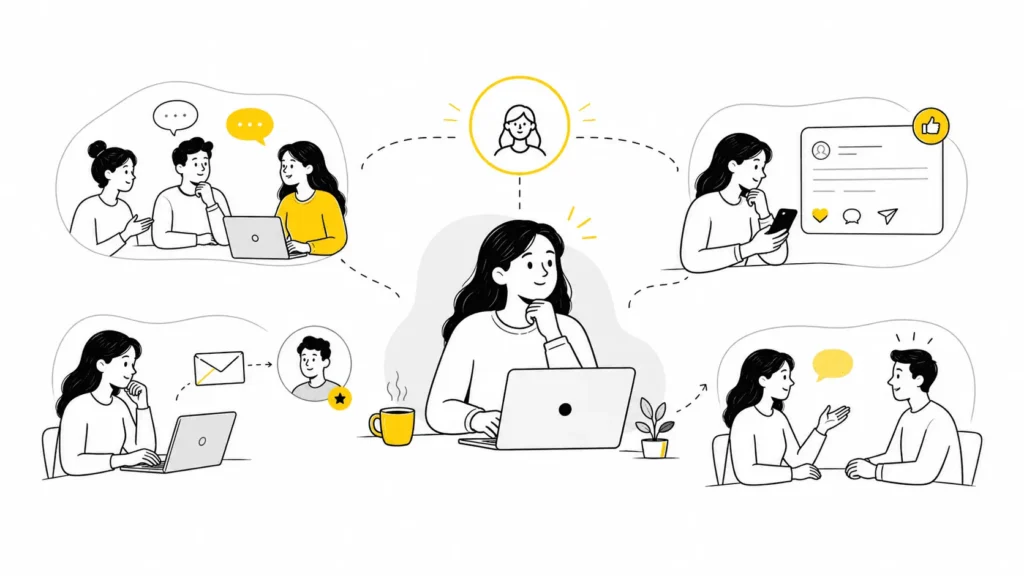
If you’re starting from nothing — no website traffic, no email list, no social following — this is the phase for you. These tactics won’t scale, and that’s fine. Their job isn’t to scale yet. Their job is to get you your first 5 to 10 leads, some direct feedback on your offer, and proof that people actually want what you’re selling.
Show up in the communities where your buyers already are. Find the subreddits, Slack groups, LinkedIn groups, or niche forums where your ideal customers hang out and ask questions. Spend real time reading before you post anything. When you do contribute, answer the actual question thoroughly — don’t turn every comment into a pitch. People can smell a drive-by promotion from a mile away, and it tends to backfire. Genuine, specific, useful answers are what get you noticed and, eventually, DM’d.
Engage thoughtfully on LinkedIn, even without a following. You don’t need thousands of followers to get in front of the right people. Comment on posts from people in your target audience, or from creators your buyers follow. A sharp, specific comment in front of the right small audience often does more than a polished post that nobody sees.
Send genuinely personalized outreach to a short, specific list. Not a mass email blast — a list of 30 to 50 people who are an unusually good fit for what you offer. Reference something real about their business or situation. This is slow and manual, but at this stage, quality beats volume every time.
Join two or three communities and just be present. Whether that’s a niche Slack, a Discord, or an industry forum, show up consistently over a few weeks. Trust builds before leads do.
The key thing to understand about this phase: it’s unscalable by design. You’re not trying to build a machine yet — you’re trying to learn what resonates, get a few real conversations going, and start collecting proof that your offer lands. If a generic tactic (like blogging) hasn’t produced anything after a few posts, that’s normal. It’s not supposed to yet.
Build Your Compounding Assets (Month 2–6)

Once you’ve had a few real conversations and know your offer resonates, the next step in learning how to generate leads without ads is building assets that keep working even after you’ve stopped actively promoting them.
Write content that targets people close to a decision. Instead of broad, top-of-funnel topics, focus on bottom-of-funnel search terms — comparison pages, “how to solve [specific problem]” guides, and content that answers questions people ask right before they’re ready to buy. This tends to convert far better than generic thought-leadership content, even with less traffic.
Build one strong lead magnet instead of five mediocre ones. A single well-made template, calculator, or guide that solves a real, specific problem will outperform a pile of generic ebooks nobody downloads. Put real effort into the one thing rather than spreading thin.
Optimize your CTAs and forms once you actually have traffic to convert. This step is wasted effort before you have visitors, but once you do, keep your calls-to-action clear and specific (“Get the template” beats “Learn more”), and keep your forms short — every extra field you ask for costs you conversions.
Here’s the honest part nobody likes to hear: SEO content typically takes four to nine months to start ranking and generating consistent leads. That’s not a flaw in the strategy — it’s just the timeline. Publishing one blog post and checking back in two weeks isn’t going to tell you anything. What actually moves the needle is publishing consistently and pairing it with distribution — sharing it in the communities you’re already part of, repurposing it into LinkedIn posts, mentioning it in outreach. Content sitting alone on a blog with no distribution behind it is the most common reason this phase disappoints people.
Scale What’s Working (Month 6+)
Once you have some traction — a handful of customers, some inbound interest, content that’s starting to convert — this is where the “leverage” tactics finally make sense. Notice that these are the same tactics most other guides tell you to start with. They’re not wrong that these work; they’re wrong about when.
Referral programs work once you have happy customers to ask. Offering a discount or credit for referrals is a great, low-cost tactic — but it depends entirely on having customers who are already satisfied enough to vouch for you. Trying to run a referral program with three customers you’re not sure are happy yet is putting the cart before the horse.
Partnerships and co-marketing work once you have something to trade. Whether that’s an audience, useful content, or a base of customers, partnerships are an exchange. Reaching out to a complementary business before you have anything to offer them in return rarely goes anywhere.
Webinars work once you have a list to invite. A webinar with no audience is just you talking to an empty room. Once you’ve built even a small list through the earlier phases, webinars become a strong way to go deeper with people who are already warm.
The underlying logic here is simple: these are compounding, leverage-based tactics. They require an existing base — of customers, content, or an audience — to actually produce anything. That’s exactly why they tend to disappoint people who try them too early.
A Worked Example: 90 Days From Zero

To make this concrete, here’s roughly how this sequence plays out for a small B2B service business starting with nothing.
Weeks 1–4: The founder spends time in two industry-specific LinkedIn groups and one niche Slack community, answering questions and occasionally sharing a genuinely useful resource. They also send 40 personalized outreach messages to a hand-picked list of ideal-fit prospects. Result: 6 real conversations, 2 of which turn into paying customers, and a clearer sense of the specific language prospects use to describe their problem.
Weeks 5–12: Using the language and objections learned from those early conversations, the founder writes three bottom-of-funnel blog posts targeting specific problem-solving searches, and builds one genuinely useful template as a lead magnet. They keep showing up in the same communities, now occasionally linking to the new content when it’s relevant. Traffic starts slowly — a few dozen visitors a week by month three.
Days 60–90: The first blog post starts getting occasional organic traffic and a handful of email sign-ups from the lead magnet. It’s not a flood — maybe 3 to 5 leads a month from content at this point — but it’s the beginning of something that will keep working without ongoing manual effort. Meanwhile, with two happy customers now on board, the founder sets up a simple referral offer and mentions it in a follow-up email. One referral comes in during month three.
None of this is explosive. But by month three, there’s a small, working system: community engagement bringing in occasional manual leads, early content starting to compound, and referrals just beginning to kick in — each tactic introduced at the point where it could actually work.
Tactics to Skip Until You’re Ready
Most guides treat every tactic as equally worth doing right away. It’s more useful to be direct about what to hold off on:
- Webinars, before you have any list to invite. Save this until you have even a small group of warm contacts.
- Referral programs, before you have customers who are genuinely happy. Asking too early can feel awkward and produces little.
- Influencer or affiliate partnerships, before you have proof points. Without case studies or results to point to, it’s a hard pitch to make.
- Content syndication, before you have cornerstone content worth syndicating. Syndicating a thin, generic post to a bigger site doesn’t help if the content itself isn’t strong.
Skipping these early isn’t giving up on them — it’s sequencing them for when they’ll actually work.
How to Know a Free Channel Is Working
You don’t need a complicated dashboard to know whether something’s worth continuing. A few practical signals matter more than vanity metrics:
- For outreach: Are you getting replies within a few days? If your reply rate is near zero after 30 well-targeted messages, the message or the list needs work — not just more volume.
- For content: Is traffic slowly increasing month over month, and are visitors actually converting into leads, even at a low rate? A few leads a month from content is a real signal at month three; zero traffic at all after six months of consistent publishing is a signal to revisit your topics or distribution.
- For communities: Are people starting to reach out to you unprompted, or referencing something you shared? That’s the tipping point where community presence starts converting into leads on its own.
A simple rule that helps cut through the noise: if a channel hasn’t produced a single lead or meaningful conversation after 60 to 90 days of consistent effort, it’s worth pausing and rethinking rather than pushing forward on faith alone.
Frequently Asked Questions
How long does organic lead generation take without ads?
It depends on the channel. Manual tactics like community engagement and personalized outreach can produce your first leads within a few weeks. Content and SEO-driven leads typically take four to nine months to become consistent, since they depend on both ranking and building enough traffic to convert.
What’s the fastest way to get leads with no website traffic?
Direct, personalized outreach to a small, well-chosen list and genuine participation in communities where your buyers already spend time. Both can produce real conversations within days, since they don’t depend on traffic or an existing audience at all.
Can a solo founder or small team realistically generate leads without ads?
Yes, and in some ways it’s easier — smaller operations can be more personal and specific in outreach and community engagement, which tends to perform better than generic content at a small scale. The main constraint is time, not budget, so sequencing matters even more.
Do free lead generation tactics work for B2C, not just B2B?
The same phased logic applies, though the specific channels shift — communities might mean Facebook groups or Instagram rather than LinkedIn, and referral programs tend to kick in earlier since B2C purchase cycles are shorter. The core idea still holds: manual tactics first, compounding assets second, leverage tactics once you have a base.
Learning how to generate leads without ads isn’t about finding one magic tactic. It’s about choosing the right strategy for the stage you’re in and giving compounding channels enough time to work. Start with manual outreach and genuine conversations, build content and SEO assets that generate leads over time, and add referrals and partnerships once you have a strong foundation.

I’m Leena Kalyana, a Delhi-based freelance digital marketer and graphic designer. I work across SEO, content marketing, social media, and digital design. I’m interested in helping businesses build a stronger online presence through practical SEO strategies, useful content, and creative digital marketing.