


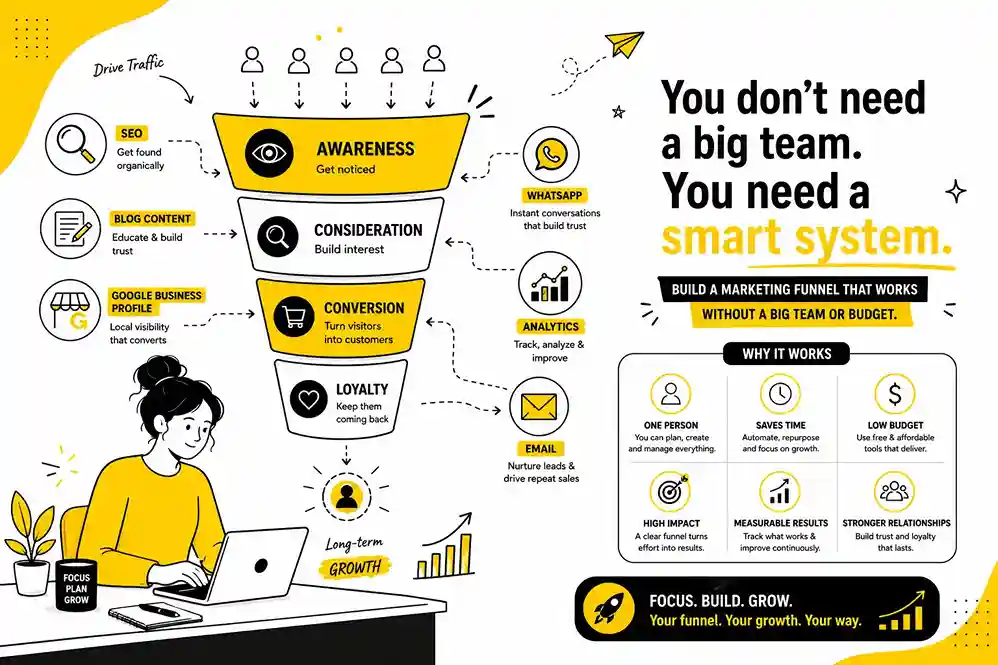
Building a marketing funnel without a big team or budget is easier than it sounds — you don’t need a marketing department or ad spend, just a clear path from stranger to loyal customer, and a handful of free tools to run it.
This guide skips the theory-heavy explanations you’ve probably already read elsewhere. Instead, it gives you a real marketing funnel without a big team or budget that you can start building this week: what to do at each stage, which free tools to use, how many hours it actually takes, and what to deliberately skip when you’re working alone.
Table of Contents
Replace this manual list with Rank Math’s Table of Contents block in WordPress (see note on the SEO page above) — this list is just a placeholder for the Word doc.
- What Is a Marketing Funnel? (A Simple Explanation)
- Step 1–4: Marketing Funnel Stages and Tactics for a Small Budget
- Step 5: The Free Tool Stack for Each Stage
- Step 6: How Much Time a No-Budget Funnel Actually Takes
- A Real Example: Marketing Funnel for a Local Service Business
- What to Skip When You Don’t Have a Team
- Common Mistakes Solo Founders Make
- Step 7: How to Show Up in AI Search, Not Just Google
- Marketing Funnel Case Study: Building One From Zero
- A Simple Funnel Worksheet You Can Copy
- FAQs
What Is a Marketing Funnel? (A Simple Explanation)
A marketing funnel is the path a person takes from first hearing about your business to becoming a paying, repeat customer. It has three core parts:
- Awareness — they discover you exist
- Consideration — they compare you to other options
- Conversion — they buy, book, or sign up
Everything after that — repeat purchases, referrals, reviews — is the loyalty stage, and for a small business, it’s often the cheapest and most valuable part of building a marketing funnel without a big team or budget.
A sales funnel is a related but different idea. It focuses on individual deals and one-to-one outreach, usually after someone has already raised their hand. A marketing purchase funnel starts earlier — it’s how you get people to raise their hand in the first place.
Step 1–4: Marketing Funnel Stages and Tactics for a Small Budget
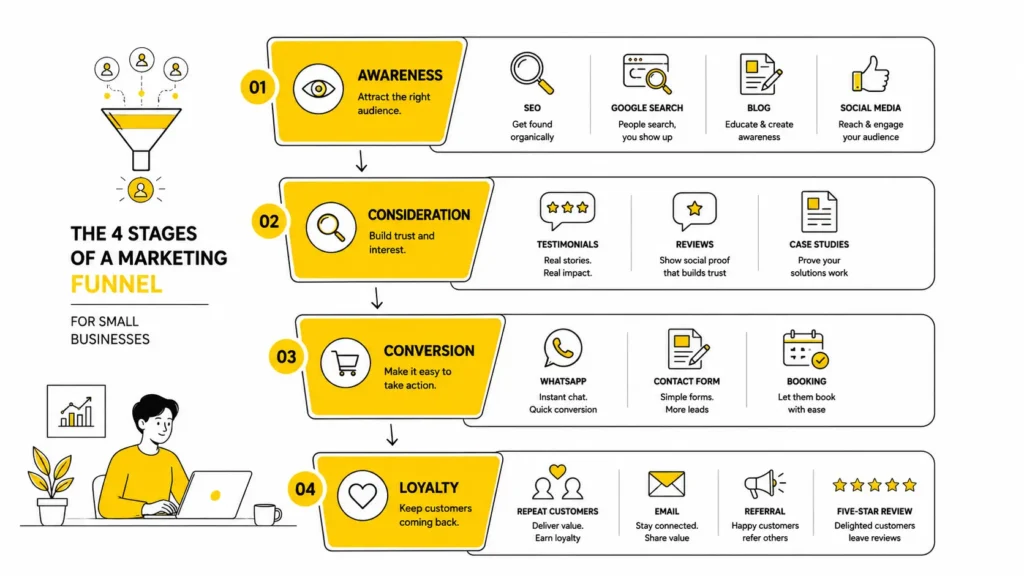
Here’s the same funnel, mapped to marketing funnel stages and tactics that cost time, not money.
| Stage | Goal | Low-Cost Tactic |
| Awareness | Get seen by the right people | SEO blog posts, Google Business Profile, short-form video, answering questions on Reddit or Quora |
| Consideration | Build trust | Case studies, testimonials, a simple free guide or checklist |
| Conversion | Get the enquiry or sale | One clear CTA, a short form, or a WhatsApp “book now” link |
| Loyalty | Keep them coming back | Follow-up messages, a simple email or WhatsApp broadcast |
Notice what’s missing: paid ads, a six-step email automation, and a custom-built website. None of those are required to start a marketing funnel without a big team or budget. They’re additions for later, once you know your funnel actually converts.
Step 5: The Free Tool Stack for Each Stage
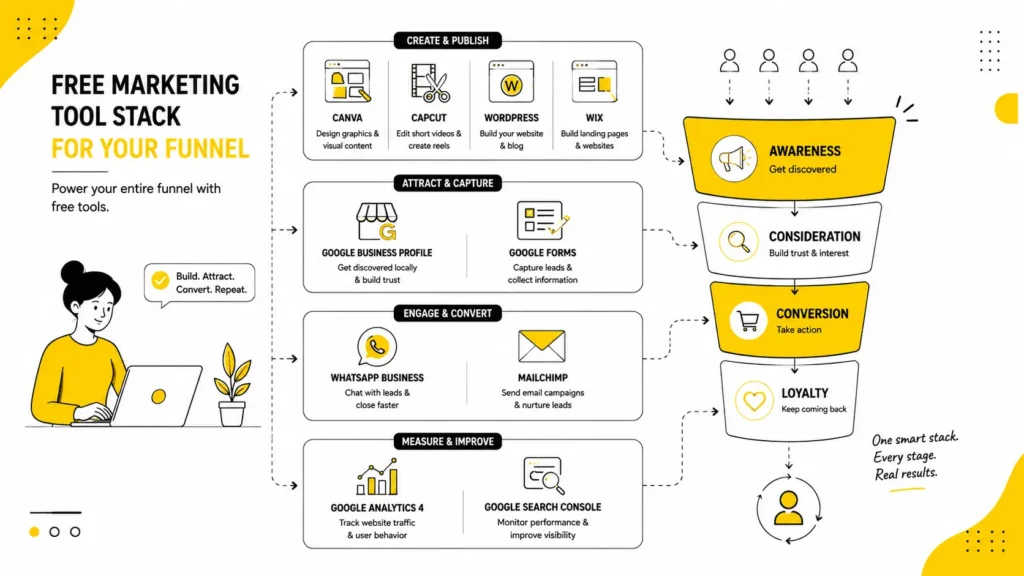
You can run this entire funnel without paying for a single tool. Here’s what to use:
Content & Design
- Canva (free plan) — social posts, simple graphics, one-page guides
- CapCut — short-form video editing for Reels and Shorts
Website & Visibility
Fully set up Google Business Profile — free, and often the highest-ROI channel for local SEO.
- WordPress or Wix free/starter themes — a single-page site is enough to begin
Lead Capture
- Google Forms or Tally — simple enquiry forms
Set up WhatsApp Business (free app) — click-to-chat links, catalogues, quick replies.
Follow-Up & Retention
- Mailchimp free plan (up to 500 contacts) — email sequences
- WhatsApp Business broadcast lists — for local and service businesses, this often outperforms email
Measurement
Use Google Analytics 4 and Google Search Console — both free, both enough to measure a marketing funnel without a big team or budget.
Step 6: How Much Time a No-Budget Funnel Actually Takes
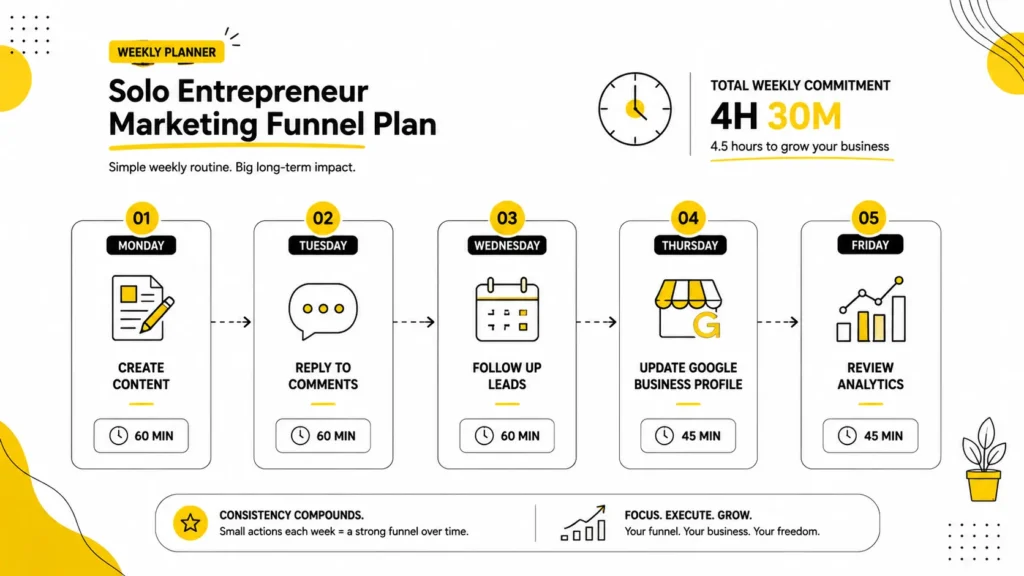
Most guides skip this, but time is the real currency when you have no team. Here’s a realistic weekly plan — around 4 to 5 hours total:
| Task | Time |
| Create one piece of content (post, reel, or blog section) | 60 min |
| Reply to comments, DMs, and relevant threads | 60 min |
| Follow up with warm leads (WhatsApp or email) | 60 min |
| Update Google Business Profile / local listings | 45 min |
| Check analytics and adjust one thing | 45 min |
This is deliberately small. A marketing funnel without a big team or budget only survives if you can actually maintain it every week — a complex funnel you abandon after a month is worse than no funnel at all.
A Real Example: Marketing Funnel for a Local Service Business
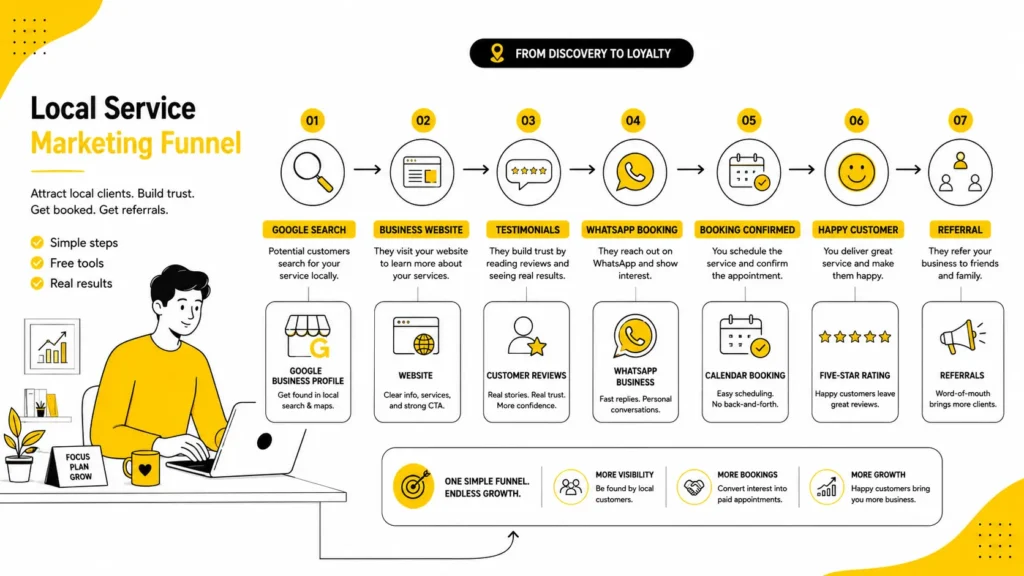
Here’s what a no-budget funnel looks like for a small, local service business — a clinic, a studio, or a consultant — rather than a funded SaaS startup with an ad budget.
Awareness
Short reels answering common client questions, plus a fully filled-out Google Business Profile with real photos and consistent name, address, and phone details.
Consideration
A pinned WhatsApp broadcast or Instagram highlight with 2–3 genuine testimonials, and one simple explainer post about what working together actually looks like.
Conversion
A single, obvious next step — a WhatsApp “book now” link or a short enquiry form. No multi-page checkout, no unnecessary fields.
Loyalty
A follow-up message a few days after the first booking, and a light-touch WhatsApp broadcast when there’s a genuinely useful update or offer — not constant selling.
The point isn’t the exact channels — it’s that every stage has exactly one owned action, and none of it requires ad spend or extra hands.
🖼 Video placement — a 30–60 second reel walking through this local-business example works well embedded here.
What to Skip When You Don’t Have a Team
Permission to do less is often more useful than another tactic. Skip these until your simple funnel is already converting:
- Paid ads — prove the funnel converts organically first
- Long, multi-step email automations
- Webinars or live events
- A custom landing page for every campaign
- A CRM — a spreadsheet or WhatsApp labels are enough at this stage
Pick one traffic source, one way to capture interest, and one way to follow up. Add complexity only once that simple version is working.
Common Mistakes Solo Founders Make
- Chasing new tools instead of sticking with one channel long enough to see results
- Having no follow-up system, so warm leads quietly go cold
- Trying to perfect every stage before launching anything
- Doing everything manually with no templates, leading to burnout within a few weeks
Step 7: How to Show Up in AI Search, Not Just Google
Awareness no longer happens only on the Google results page. Tools like AI Overviews, ChatGPT, and Perplexity are becoming a discovery layer that sits above traditional search — this is often called GEO and AI search visibility, or Generative Engine Optimisation.
A few low-cost habits help here:
- Write content in clear question-and-answer form, so it’s easy for AI tools to extract and summarise
- Keep your business details (name, address, services) consistent everywhere — directories, your Google Business Profile, and your website — since AI tools pull from multiple sources, not just backlinks
- Earn genuine mentions on review sites and local directories, not just links on your own site
None of this requires a budget. It requires consistency, which is exactly what a marketing funnel without a big team or budget already gives you when it’s built well.
Marketing Funnel Case Study: Building One From Zero
Here’s an illustrative marketing funnel case study of how this comes together in practice, month by month.
- Month 1: Set up Google Business Profile fully, post 2–3 times a week, add one WhatsApp “book now” link everywhere.
- Month 2: Add 3 testimonials, start replying to relevant questions on Reddit or Quora in your niche, send a simple follow-up message to every new enquiry.
- Month 3: Review what content actually led to enquiries, drop what didn’t work, double down on the one channel that did.
This mirrors how most bootstrapped funnels actually grow — not with a single big campaign, but with a small, repeatable loop that gets slightly sharper every month.
A Simple Funnel Worksheet You Can Copy
Use this table as a weekly planner. Duplicate it in a spreadsheet or Notion page.
| Stage | This Week’s Task | Tool | Done? |
| Awareness | |||
| Consideration | |||
| Conversion | |||
| Loyalty |
FAQs
What is a marketing funnel?
A marketing funnel is a model of the path someone takes from first discovering your business to becoming a paying, repeat customer — typically moving through awareness, consideration, conversion, and loyalty.
What is the difference between a marketing funnel and a sales funnel?
A marketing funnel draws people in through content, SEO, and social visibility, starting before they’re ready to buy. A sales and marketing funnel picks up once someone is already engaged, focusing on individual conversations, demos, and closing — it’s a purchase funnel for people already close to deciding.
Can I build a marketing funnel without paid ads?
Yes. An ads funnel strategy can speed up results later, but a working marketing funnel without a big team or budget can be built entirely on organic tactics — content, local search visibility, and direct follow-up — especially in the first few months.
What is a brand marketing funnel?
A brand marketing funnel focuses on the awareness stage specifically — building recognition and trust before someone is actively looking to buy, through consistent content, visibility, and reputation rather than direct-response tactics.
How long does it take to see results from a marketing funnel?
Most small businesses start seeing early signals — enquiries, follow requests, saved posts — within 4 to 8 weeks of consistent effort, with clearer conversion patterns emerging over 2 to 3 months.
Is there a simple marketing funnel case study for small businesses?
Yes — see the month-by-month example earlier in this guide, which shows how a local service business can build a full marketing funnel without a big team or budget using only free tools and a few hours a week.
Final Thoughts
You don’t need a big team or a big budget to build a marketing funnel that works — you need one clear path from awareness to loyalty, a handful of free tools, and a few consistent hours every week. Start small, track what actually leads to enquiries, and add complexity only once the sim

I’m Leena Kalyana, a Delhi-based freelance digital marketer and graphic designer. I work across SEO, content marketing, social media, and digital design. I’m interested in helping businesses build a stronger online presence through practical SEO strategies, useful content, and creative digital marketing.