


Looking for a Local SEO Checklist for Delhi?
If you’re a small business owner in Delhi, this guide is designed specifically to help you improve your Google Maps rankings, optimize your Google Business Profile, and attract more local customers in 2026. This Local SEO Checklist for Delhi includes practical, Delhi-specific strategies that you can implement even without a large marketing budget.
Let me ask you something.
If someone in your colony right now opened Google and typed “best [your service] near me”, would your business show up?
For most small business owners in Delhi, the honest answer is: probably not.
And here’s what makes that frustrating—it isn’t because your business isn’t good enough. Your chai is better than the café three lanes down. Your tailoring work speaks for itself. Your clinic has served the neighbourhood for years. Yet when someone searches online, they find your competitor instead.
That’s exactly the problem Local SEO solves.
This Local SEO Checklist for Delhi will walk you through every important step—from Google Business Profile optimization and local citations to neighbourhood keyword targeting, Google Reviews, and Delhi-specific SEO strategies that actually work.
Most Local SEO guides treat Delhi like any other city. They won’t tell you about Hindi and Hinglish searches, Metro-based search behaviour, or Delhi’s unique seasonal search trends.
This guide treats Delhi like Delhi—not like a generic SEO case study.
Table of Contents
Why This Local SEO Checklist for Delhi Works Better Than Generic SEO Guides
Every city has its own local search behavior, but Delhi is unique. That’s why this Local SEO Checklist for Delhi goes beyond generic SEO advice and focuses on how people in Delhi actually search for businesses. From Hindi and Hinglish searches to Metro-based navigation and neighbourhood-specific keywords, these local factors can significantly impact your Google Maps rankings and local search visibility.
Picture Delhi as not one market but thirty markets sitting inside each other. The electronics buyer in Nehru Place behaves differently from the homemaker in Pitampura looking for a tiffin service. The startup founder in Saket searching for a CA is not the same as the shopkeeper in Chandni Chowk looking for a packaging supplier.
Each of these people searches differently. And if your Local SEO strategy treats them the same, you’re leaving customers on the table.
Here’s what makes Delhi genuinely different from every other city:
- The language reality. A significant chunk of local searches in Delhi happen in Hindi, transliterated Hindi, or Hinglish. Someone looking for an AC repair service might type “AC repair near me” in English, or “Delhi mein AC repair wala” in Hinglish, or “दिल्ली में AC ठीक करने वाला” in Hindi. These are three separate search queries. Most business websites are optimised for exactly one of them.
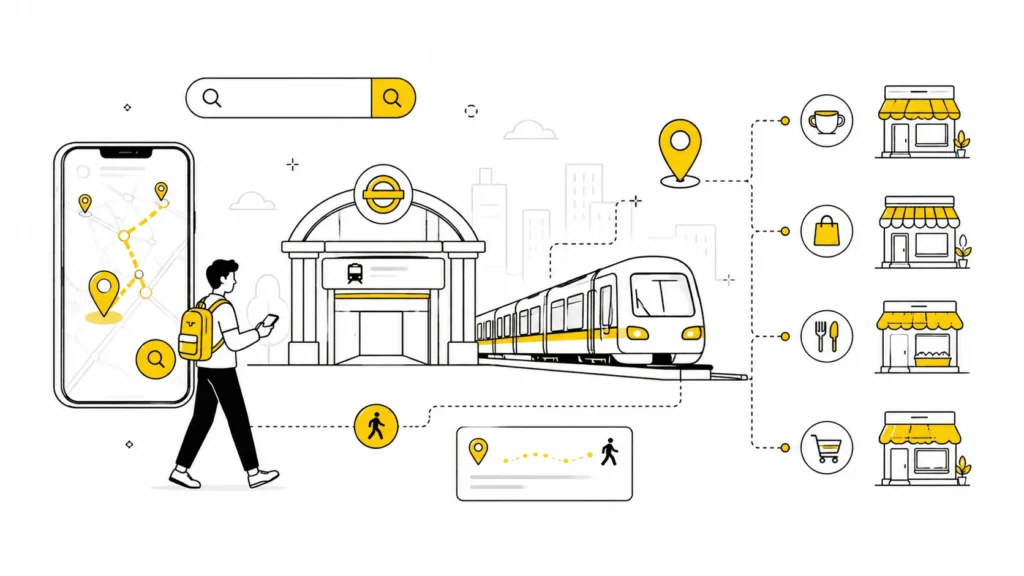
- Metro proximity shapes search. Delhi Metro is woven into how people navigate the city. When someone alights at Rajiv Chowk and is looking for lunch, they don’t search for “food in Connaught Place” — they search “lunch near Rajiv Chowk metro exit 7.”
- Delhi has competitive micro-clusters. Nehru Place for IT, Karol Bagh for electronics, Lajpat Nagar for fashion — these markets are brutally competitive for generic keywords. But the side streets inside these clusters? Almost no one is optimising for those hyperlocal variations.
- Seasonal peaks are extreme. Wedding season (October to February), Diwali, board exam season in March, the summer heat wave — Delhi’s search behaviour swings dramatically through the year. A good Local SEO strategy rides these waves, not ignores them.
Local SEO Checklist for Delhi – Complete 2026 Guide
The following Local SEO Checklist for Delhi is designed to help small businesses improve their visibility in Google Search and Google Maps. Complete each step in order to build a strong local SEO foundation and attract more customers from your neighbourhood and across Delhi.
Step 1: Claim and Fully Optimise Your Google Business Profile
If you only do one thing from this entire guide, let it be this.
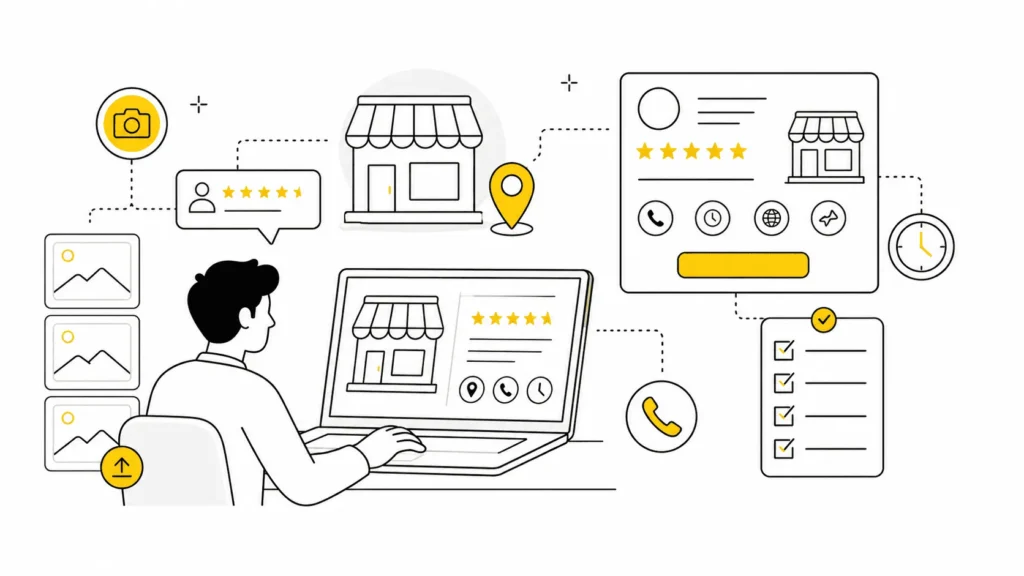
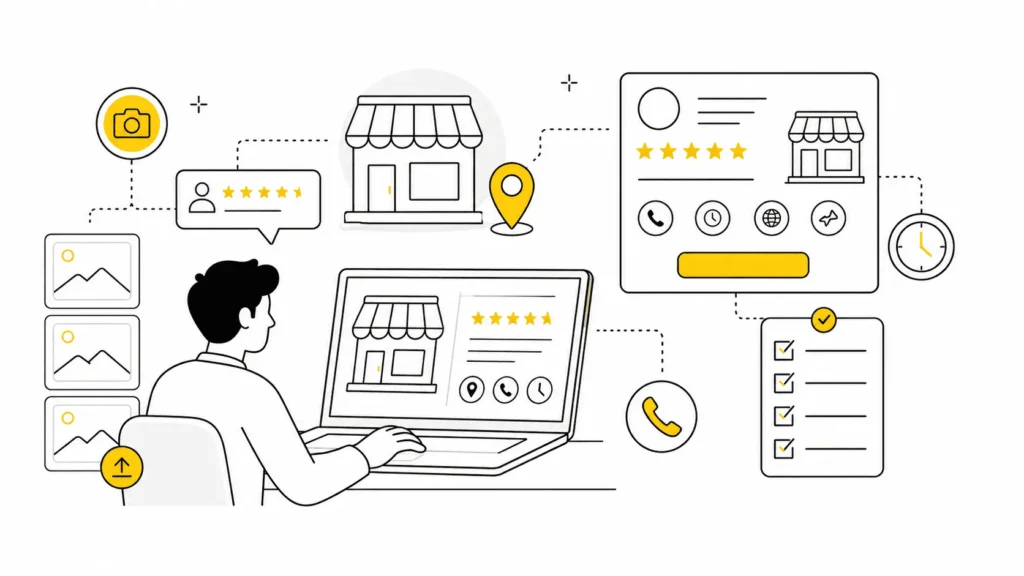
Your Google Business Profile is the single most powerful free tool. If you’d like professional help setting it up, explore our Google Business Profile Optimization Services.. It’s what makes you appear on Google Maps, in the local pack (those three business listings that show up at the top of local search results), and increasingly in Google’s AI-generated summaries.
Here’s how to do it properly:
- Claim your listing first. Go to business.google.com and search for your business. If it already exists, claim it. If it doesn’t, create one. Verify via video verification — it’s the fastest option in 2026 and usually gets done within a few days.
- Fill every single field. Your business name should match exactly what’s on your signboard and GST certificate — don’t stuff keywords into the name. Choose the most specific primary category available. Add secondary categories too.
- Write a description that works. Keep it under 750 characters. Include your locality name, your core service, and one or two surrounding areas you serve. Example: “Kapoor Tailoring is a custom clothing boutique in Safdarjung Enclave, New Delhi, serving customers from South Delhi, Green Park, and Hauz Khas for over 15 years.”
- Add a Hindi description. If your customers are predominantly Hindi-speaking, add a version of your description in Hindi. GBP supports this, and it’s a straightforward way to appear in Hindi-language searches.
- Add photos and keep adding them. Start with at least ten: your shopfront, interior, products or work samples, team photos, and the landmark near you. After that, add fresh photos at least twice a month.
- Use the Posts feature. Post updates about offers, new products, seasonal changes, or local events. Aim for one to two posts per week.
- Pre-seed the Q&A section. Log in and ask the most common questions your customers ask you, then answer them yourself. “What are your working hours during Diwali?” “Do you offer home delivery in Dwarka?” These answers show up in your profile and get picked up by voice search.
- Add all your services with descriptions. Don’t just list “Tailoring.” Add “Bridal Lehenga Stitching,” “Blouse Alterations,” “Suit Tailoring for Men” — each with a short description and a price range where possible.
Step 2: Fix Your NAP Consistency Across Delhi’s Digital Directories
NAP stands for Name, Address, Phone Number. Google cross-references this information across dozens of platforms to verify that you are a real, legitimate business at the address you claim. Even small inconsistencies — “Phase 1” on one platform and “Ph-1” on another — can quietly pull your rankings down.
Your Delhi-specific directory audit list — check every single one:
- Google Business Profile
- Justdial (heavily indexed for Delhi searches — check for old listings)
- Sulekha
- IndiaMart (essential for B2B businesses)
- Tradeindia.com
- Delhi Yellow Pages (delhiyellowpages.com)
- Facebook Business Page
- Instagram bio
- LinkedIn Company Page
- Your website — header, footer, and Contact page
Common Delhi NAP traps: “New Delhi” vs “Delhi”, missing pin codes, old landline numbers still live on Justdial, and “Sector 6, Dwarka” vs “Dwarka Sector 6” — all of these create mismatches that hurt your rankings.
Step 3: Build a Neighbourhood-Level Keyword Strategy
Here’s where most Delhi businesses make the biggest strategic mistake: they chase keywords like “best restaurant in Delhi” or “top CA firm India” — and then wonder why they never rank.
The smarter play is to start with the Keyword Pyramid:
- Tier 1 — Mohalla Level (fastest to rank, highest purchase intent): “Tiffin service Pitampura,” “plumber Dwarka Sector 12,” “beauty parlour near Laxmi Nagar metro.” Competition here is almost zero. The people searching are often ready to call immediately.
- Tier 2 — Zone or District Level (3–6 months): “Catering service West Delhi,” “accountant South Delhi.” Once you’ve built authority from Tier 1 keywords, move up to these.
- Tier 3 — City Level (6–12 months): “Best caterer in Delhi,” “CA firm Delhi NCR.” Build from the ground up through Tiers 1 and 2 first.
The Delhi-specific layer most guides completely ignore: Hindi and Hinglish keywords.
A sizeable portion of your potential customers are searching in Hindi or Hinglish. “Pitampura mein tiffin service,” “sabse sasta salon near me,” “bijli ka kaam karne wala Rohini” — these are real searches happening every day in Delhi, and almost no business website is optimised for them.
How to find Hindi/Hinglish keywords: Type your service into Google with Hinglish phrasing and look at autocomplete suggestions. Use Google Trends to compare Hindi vs English variants. Ask your own customers what they typed to find you.
Step 4: Optimise Your Website for Delhi Local Search
Your GBP is your first impression on Google. Your website is what converts that impression into a customer. The two need to work together.
- Title tags with location: Every service page should include your city and locality. Not “Tailoring Services” — but “Custom Tailoring in Safdarjung Enclave, New Delhi | Kapoor Tailoring.”
- A properly built Contact page: Full address with pin code, embedded Google Map, phone number, a WhatsApp Business link, and working hours. If you serve specific areas, list them: “We serve clients across South Delhi, Green Park, Hauz Khas, Vasant Kunj, and neighbouring areas.”
- LocalBusiness schema markup: A piece of code (JSON-LD) that tells Google your business name, address, phone, category, and opening hours in structured format. If you use WordPress, RankMath generates this automatically with no technical knowledge needed.
- An “Areas We Serve” page: Create a dedicated page listing every Delhi locality and NCR area you cover. Write a sentence or two about your work in each area. This is a powerful local relevance signal most small business websites completely lack.
- WhatsApp Business integration: Delhi’s SMB communication culture runs heavily on WhatsApp. Adding a click-to-chat button on your website significantly increases enquiries — Delhi customers are far more likely to message than fill out a contact form.
- Page speed and mobile: Over 85% of local searches in Delhi happen on mobile. Run your website through Google PageSpeed Insights. Three quick wins: compress images to WebP format, switch to faster hosting, and enable browser caching.
Step 5: The Metro Station SEO Opportunity (Unique to Delhi)
This one belongs exclusively to Delhi. You will not find it in any other Local SEO guide — which is exactly why it’s worth paying attention to.
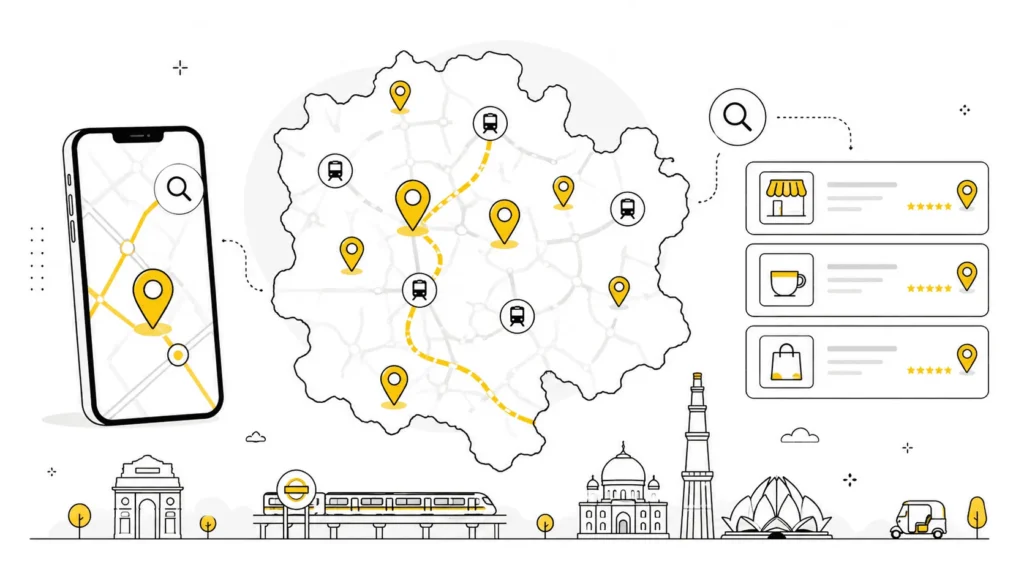
Delhi Metro carries over 60 lakh passengers every day. A huge portion of local searches in Delhi are not “near me” in the traditional GPS sense — they’re Metro-relative. People getting off at Hauz Khas station search for “restaurant near Hauz Khas metro.” People stepping out of Rajiv Chowk search “lunch near Rajiv Chowk metro exit 7.”
This is a real, high-volume search behaviour that almost no Delhi business is actively optimising for. Here’s how to capture it:
- In your GBP description, add a line about Metro accessibility: “We are a 3-minute walk from Malviya Nagar Metro Station on the Yellow Line.”
- Add a “How to Reach Us” FAQ entry on your GBP with step-by-step Metro directions. This targets voice search queries like “how to reach [business name].”
- On your website’s Contact page, add a Metro directions section with its own subheading: “Nearest Metro Station.”
- Create one or two blog posts targeting “[your service] near [metro station name]” for your closest stations. “Best salon near Rajouri Garden Metro,” “affordable dentist near Janakpuri West Metro” — these are genuinely low-competition keywords with clear purchase intent.
Step 6: Get and Manage Google Reviews (With Delhi Consumer Psychology in Mind)

Google Reviews are one of the top three factors that determine where you appear in local search results. A business with 80 reviews at 4.6 stars will almost always rank above a business with 15 reviews at 4.1 stars for the same search — even if the second business has been around longer.
Here’s the honest reality about Delhi consumers and reviews: they read reviews religiously but leave them rarely without being asked. You have to ask. And you have to ask the right way.
The Delhi WhatsApp Review Method works better than any other review-generation technique in this market. After you deliver a good service, send a WhatsApp message within 24 hours. Example:
“Namaskar [Name]ji, umeed hai aapko hamara kaam pasand aaya hoga. Agar aap thoda time de sakein toh Google pe ek chhota sa review bahut helpful hoga — [link]. Bahut shukriya!”
- Respond to every review — positive and negative. For negative reviews, respond professionally and offer to resolve offline. You’re not writing to that one unhappy customer — you’re writing to every future customer who will read that exchange.
- Aim to accumulate reviews steadily over time. Getting 50 reviews in a week looks suspicious to Google. Two to three a week consistently for six months is both credible and powerful.
- Festival season review pushes: October through February is when Delhi businesses serve the highest volume of happy customers. This is the best time to run focused review ask campaigns — customer satisfaction is at its peak.
Step 7: Build Local Citations and Backlinks from Delhi Sources
Citations and local backlinks both tell Google: this business is a legitimate, established part of the Delhi community. Beyond the directory stack in Step 2, here are Delhi-specific sources worth targeting:
- Local news websites: Getting mentioned in Delhi Wires, Times of India Delhi edition, or Hindustan Times Delhi creates a powerful, high-authority citation.
- RWA websites: Resident Welfare Association websites across Delhi often have community business directories. Getting a mention from your local RWA website is a strong hyperlocal authority signal.
- Delhi chambers of commerce: PHDCCI, FICCI Delhi, and CII Delhi chapter all have member directories. A listing here is both a credible citation and a networking opportunity.
- Delhi government portals: Delhi Tourism’s vendor listings, the Delhi government’s MSME directory, and StartupDelhi portals are all free and authoritative — yet very few small businesses bother to register.
- Sponsoring local events: Colony festivals, school events, and local cultural programmes often feature sponsors on their websites and social media. The community goodwill and local visibility are the real win.
Step 8: Delhi’s Local SEO Calendar — Seasonal Optimisation
This section exists in no other Local SEO guide for Delhi businesses — which is surprising, because seasonality is one of the most defining features of this market. Here’s how to plan your Local SEO strategy through the year:
- October to February — Wedding and Festival Season: Peak for caterers, decorators, jewellers, boutiques, salons, and wedding photographers. Start updating your GBP with seasonal offers four to six weeks before the peak. Run a focused review ask campaign. Add seasonal photos to your GBP weekly.
- March to April — Board Exam and Admission Season: Peak period for coaching centres, stationery shops, and printing shops. Create GBP posts with exam season offers. Write local content around exam preparation resources in your area.
- May to June — Summer Season: Peak searches for AC repair, cooler sales, summer camps, and hill station travel. Update your services section on GBP. Create seasonal posts with summer-specific offers.
- July to September — Monsoon Season: Waterproofing services, plumbers, electricians see sharp spikes. A simple blog post like “How to monsoon-proof your home in Delhi” can drive significant local traffic for a plumbing business.
- October to November — Diwali Season: Gift shops, sweet shops, home décor stores, and cleaning services see enormous peaks. Diwali GBP posts should start appearing three to four weeks before the festival.
- December to January — New Year and Winter Season: Event venues, restaurants, and coaching centres taking new year admissions. If you run an academy, January is your most important month for local visibility.
The single most useful habit: set calendar reminders six weeks before each peak and prepare your GBP posts, seasonal photos, and relevant content in advance.
Step 9: Track Your Progress and Keep Improving
Local SEO is not a one-time task. But once the foundation is in place, maintaining it doesn’t take more than a couple of hours a month.
- Google Business Profile Insights: Check monthly. Monitor search views, map views, direction requests, phone calls, and website clicks. If your call count is growing, your Local SEO is working.
- Google Search Console: Shows which queries are bringing people to your website. Look specifically for neighbourhood-level searches in your data — if they’re appearing, your Tier 1 strategy is working.
- Review velocity: Are you receiving new reviews consistently? Set a monthly reminder to check and respond to every one.
- NAP consistency audit: Every three months, re-check the top five directories to make sure nothing has slipped out of sync.
Realistic milestones to expect: By month one, a fully optimised GBP should appear for branded and hyperlocal queries. By month three, you’ll see measurable improvement in GBP Insights. By month six, a well-executed strategy should have you appearing in the local pack for your most important Tier 1 and Tier 2 keywords.
The Delhi Local SEO Free Toolkit
⬇ Download the Free Delhi Local SEO Checklist Template →
The free template is a Google Sheets file that contains everything in this guide formatted as a tick-box checklist, plus:
- Tab 1: All 9 steps as a checklist with a status tracker (Not Started / In Progress / Done)
- Tab 2: Delhi Directory List — 30 directories with a column for you to paste your live listing URL
- Tab 3: Delhi Seasonal Calendar — a 12-month planning grid for GBP posts and content
- Tab 4: NAP Audit Tracker — compare your current NAP across all platforms and flag inconsistencies
Beyond the template, here are the free tools every Delhi small business should be using:
- Google Business Profile — business.google.com. Your most powerful Local SEO asset. Free.
- Google Search Console — search.google.com/search-console. Shows how your website performs in Google Search. Free.
- Google PageSpeed Insights — pagespeed.web.dev. Check your website’s loading speed and get recommendations. Free.
- RankMath (WordPress plugin) — If your site is on WordPress, RankMath’s free tier handles schema markup, meta tags, and local SEO settings with no technical knowledge required.
- Whitespark Citation Finder — The free tier helps you find citation sources relevant to your business type and Delhi location.
- Ahrefs Webmaster Tools — Free if you verify your own website. Shows your backlink profile and basic keyword rankings.
Common Local SEO Mistakes Delhi Small Businesses Make
- Using a virtual office address on your GBP. If Google verifies your listing and finds the address doesn’t match a real operating location, your listing can be suspended entirely.
- Ignoring Hindi and Hinglish search traffic. If your website and GBP are entirely in English, you’re invisible to a significant portion of your potential customers.
- Targeting only city-level keywords. “Best salon in Delhi” is a keyword you will not rank for in the near term. “Salon in Tagore Garden” is a keyword you could own within two to three months.
- Setting up GBP once and forgetting it. Google rewards active listings. A profile that hasn’t been updated in four months signals an inactive business. Post updates. Add photos. Keep the listing breathing.
- Getting reviews from family and friends in bulk. If fifteen reviews come in over three days from accounts that have never reviewed anything before, Google’s algorithm notices. Earn reviews organically from real customers.
- No mobile-optimised website. If your website doesn’t work well on a smartphone, the 85% of Delhi local searchers who are on mobile will bounce immediately.
- Only listing a phone number, not a WhatsApp link. Delhi customers don’t like calling unfamiliar businesses cold. If you don’t have a WhatsApp Business link on your website and GBP, you’re losing customers who would have become your most loyal regulars.
Frequently Asked Questions
How long does Local SEO take to show results in Delhi?
Google Business Profile improvements are the fastest — a fully optimised GBP can start showing results within four to six weeks for hyperlocal searches. Website organic rankings take longer: typically three to six months for Tier 1 (mohalla-level) keywords and six to twelve months for Tier 2 and Tier 3. The businesses that see the fastest results work consistently — regular GBP posts, steady review accumulation — rather than doing everything at once and then going quiet.
Can I do Local SEO without a website?
Yes. Your GBP alone can generate calls, direction requests, and WhatsApp messages. But a website significantly amplifies your results. At minimum, a single-page website with your services, contact details, address, and an embedded map gives Google more to index and gives customers more confidence in your legitimacy.
What is the most important factor for a new Delhi business just starting?
Google Business Profile optimisation, followed immediately by consistent review accumulation. These two elements drive the majority of local pack rankings in the first six months. Everything else builds on top of this foundation.
Do I need separate GBP listings for Delhi and NCR cities like Noida and Gurgaon?
Only if you have a physical location in each city. What you can do is update your “service area” settings in GBP to include Noida, Gurgaon, Faridabad, or Ghaziabad — this tells Google you serve those areas without a physical address there. For your website, create dedicated service area pages for each NCR city you cover.
How do I optimise for Hindi searches without building a whole Hindi website?
You don’t need a full Hindi website. Add a Hindi sentence or two to your GBP description, add a Hinglish FAQ section to your website’s contact or service pages, and incorporate Hinglish terms naturally into your content. Even these small additions start making a difference over time.
Is Justdial still worth using for Local SEO in Delhi in 2026?
Yes. Justdial listings continue to rank in Google’s local results for many Delhi service categories — especially trades and home services like plumbers, electricians, tutors, and caterers. A free Justdial listing is a worthwhile citation that takes ten minutes to set up.
Start Today — Three Actions That Take Under an Hour
You’ve just read through a comprehensive strategy. It can feel like a lot. So let’s make it simple.
Here are three things you can do in the next sixty minutes that will immediately start improving your Local SEO:
- Go to business.google.com right now. If you don’t have a GBP listing, create one. If you do have one, spend twenty minutes filling in every empty field — description, services, photos, Q&A. This single action is the highest ROI thing you can do for your local search visibility.
- Open the top five directories from Step 2 (GBP, Justdial, Sulekha, Facebook, your website) and check that your name, address, and phone number match exactly across all five. Fix any inconsistencies you find.
- Download the free checklist template, save it to your Google Drive, and set a reminder in your calendar for one month from now to review your progress.
Local SEO is not magic. It doesn’t happen overnight. But it is genuinely one of the most cost-effective things a Delhi small business can invest time in — because when someone in your colony searches for what you offer, there’s no reason in the world it shouldn’t be your business that shows up first.
You know your neighbourhood. Now let Google know it too.
⬇ Download the Free Delhi Local SEO Checklist Template →
Have a question about implementing any of these steps for your specific business or locality? Drop it in the comments below — we read and respond to every one.

I’m Leena Kalyana, a Delhi-based freelance digital marketer and graphic designer. I work across SEO, content marketing, social media, and digital design. I’m interested in helping businesses build a stronger online presence through practical SEO strategies, useful content, and creative digital marketing.