

In this article
Short answer: To brief a blog writer well, tell them who the post is for, what the reader searches for, what the post must say, which page it should lead to and what you do not want. Most weak posts come from vague briefs, not from poor writers. The SEO content brief template below takes about ten minutes to fill in.
I am Leena Kalyana, a SEO and digital marketing consultant in Delhi NCR, and I write SEO blog posts for businesses. I use a version of this template myself.
Why a good blog brief matters more in 2026
Anyone can now get a decent first draft from an AI tool in a minute. That is exactly why generic posts are everywhere. Google now shows AI Overviews for many searches, so a post that only repeats common advice has very little reason to be clicked or ranked.
What still works is a post with a clear purpose, real experience and a specific answer. A brief is where you decide all of that, before a single word is written. It also saves you from rounds of edits later.
What is a blog brief?
A blog brief (also called a content brief) is a short document that gives a writer everything needed to write one post. It covers the reader, the keyword, the search intent, your angle, the page to link to and the limits.
A brief is not the article and it is not the outline. It is the set of instructions that make the article useful for your business.
What a brief must answer
- Reader: who is searching, and what are they trying to do?
- Search: the main phrase they type and two or three related questions.
- Intent: do they want to learn, compare or buy? A post for someone ready to buy looks different from a step by step guide.
- Angle: what can your business say that a generic article cannot, such as experience, examples and local knowledge?
- Next step: which page should the post lead to?
- Limits: claims to avoid, competitors not to name, tone and length.
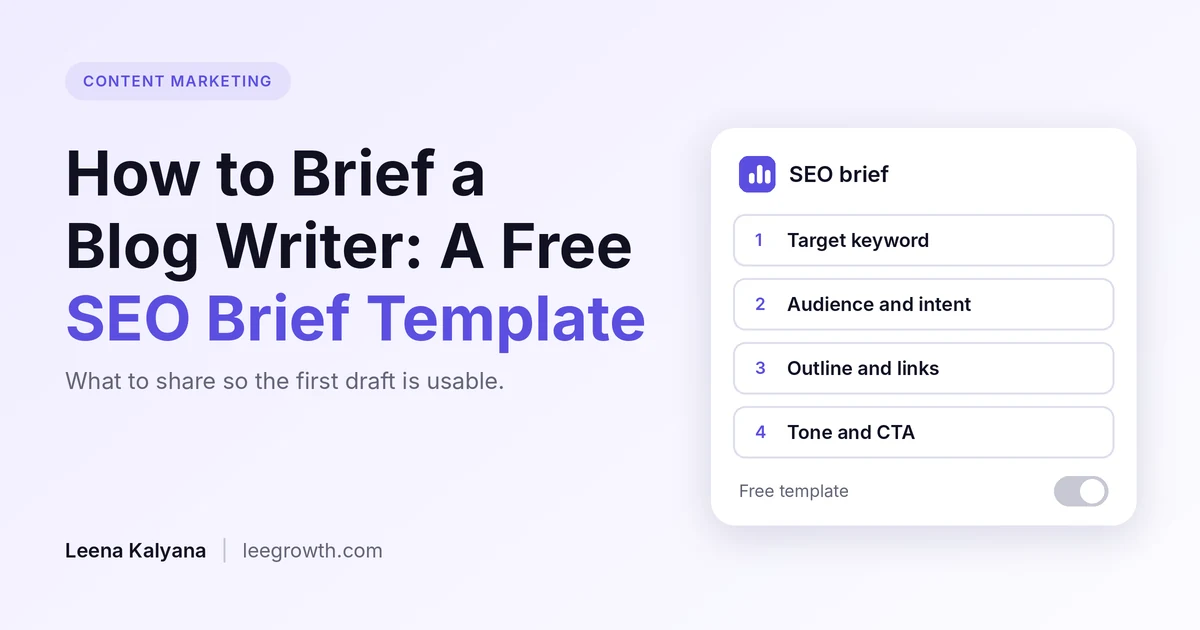
The SEO content brief template (copy and paste)
Copy this into a document and fill it in.
- Working title:
- Main search phrase (focus keyword):
- Secondary keywords:
- Related questions (3 to 5):
- Who is the reader, and what is their situation?
- What should they know or do after reading?
- Search intent: learn / compare / buy
- Our angle or experience to include:
- Facts or numbers we can share, with sources:
- Page the post should link to (and the anchor text):
- Other posts to link to:
- Claims we must not make:
- Tone and reading level:
- Length (a guide, not a target):
- Who reviews it, and by when:
How to choose the search phrase and related keywords
Use real data where you can.
- Google Search Console: shows what people already type to find your site. Look for phrases where you get impressions but few clicks.
- Google suggestions and People Also Ask: show the related questions people have. These can become your H2 headings and FAQs.
- Related searches at the bottom of the results page: show nearby topics for your content cluster.
Also check that you do not already have a post on the same subject. Two posts on one question compete with each other, which is called keyword cannibalization. If you already have one, update the old post instead of writing a new one.
Search intent: what the reader wants
The same keyword can need a different post depending on intent. Write this in the brief so the writer does not guess.
- Learn (informational): the reader wants an answer or a guide. Example: “what is a content brief”. Keep it simple and clear, with examples.
- Compare (commercial): the reader is choosing between options. Example: “freelance writer vs agency”. Give pointers, pros and cons, and who each option suits.
- Buy (transactional): the reader is ready to hire or pay. Example: “hire SEO blog writer”. Focus on process, proof and a clear next step.
Give the writer what only you know
The best part of any post is something a generic article cannot say: a mistake you see clients make, a local detail, a process you follow. This is what Google calls experience, and it is a big part of E-E-A-T (experience, expertise, authoritativeness and trust).
Write three bullet points of this in the brief. Without it, the writer can only repeat what is already online.
Internal links and anchor text
Tell the writer which page the post should lead to and what anchor text to use. Also list one or two older posts on related topics. Internal links help readers find the next step, and they help Google understand how your pages connect as a topic cluster.
Common mistakes
- Giving only a keyword and a word count.
- Asking for the post to be “SEO friendly” without saying who it is for.
- Not saying which page the post should lead to.
- Skipping fact checks, especially on health, legal or tax subjects.
- Changing the brief halfway.
- Not telling the writer what to avoid, so you get claims you cannot stand behind.
Brief vs outline: what is the difference?
- Brief: explains the why. Reader, intent, angle, goal, limits.
- Outline: explains the what. Headings and the order of points.
- Best practice: send the brief first. Ask the writer for an outline if the topic is new or important, then approve it before the full draft.
After the draft: a quick checklist
Check the draft against the brief:
- Does it answer the main question in the first paragraph?
- Does it say something specific to your business?
- Is each claim true, with a source where needed?
- Does it match the search intent?
- Does it lead to the right page?
FAQ
How long should a brief be?
One page is enough. A longer brief that nobody reads is worse than a short, clear one.
Should I give the writer competitor posts?
Give two or three as examples of what to beat, and say what they miss. Do not ask the writer to copy them.
Who owns the final decision on facts?
You do. In regulated fields such as health, law and tax, a qualified person should review the draft.
Can I use this template for AI drafts too?
Yes. A clear brief helps an AI tool as much as a human writer. But always add your own experience and fact check the draft before it goes live.
What is the difference between a content brief and an SEO brief?
An SEO brief is a content brief with keyword details added, such as the focus keyword, secondary keywords, search intent and internal links.
Need help with your blog posts?
If you want posts written from a brief like this, see my blog writing service page for what I check before sending a draft. You can also read how many blog posts you need to plan your schedule.

Leena Kalyana is an SEO and digital marketing consultant in Delhi NCR and the founder of LeeGrowth. She helps clinics, coaching institutes, consultants and small businesses get found on Google, Google Maps and AI search. She works directly with every client and does not guarantee rankings.