



Here’s something worth knowing before reading any other “freelancer vs agency” article on Google: nearly every one was written by a digital marketing agency. Every comparison table has agencies winning every category. Every freelancer “cons” list runs to eight bullet points.
This one is different. We run a boutique digital marketing practice — not a large agency, not a solo freelancer. There’s a direct incentive to be honest about when each option works, because recommending the wrong one just costs clients who weren’t the right fit anyway.
So here’s the version of this comparison most sites won’t write: real Indian rupee pricing, a three-way framework instead of the usual fake binary, an honest look at India’s freelancer talent market, and seven questions to ask before you hire anyone.
| Quick answer: For Indian businesses under ₹15,000/month with a single-channel need, a specialist freelancer is usually the smarter choice. For ₹15,000–₹50,000/month needing 2–4 channels working together, a boutique operator (a 1–5 person specialist team) delivers the best mix of quality and personal attention. Full-service agencies make sense above ₹60,000/month with national-scale needs and in-house oversight. |
Table of Contents
Why Most Freelancer vs Agency Comparisons Are Biased
The conflict of interest is simple: agencies write articles recommending agencies. They dress it up as balanced content, but the top-ranking pieces on this topic follow the same pattern — the comparison table has agencies winning every single row.
Cost? Agency wins (long-term ROI, apparently). Expertise? Agency wins (full team). Scalability? Agency wins. Even “personal attention” somehow goes to the agency, despite the fact that a 30-person shop with 80 clients is objectively less personal than a single experienced professional dedicated to your account.
A genuinely balanced answer looks different: for many Indian small businesses — especially at an early stage, with budgets under ₹20,000/month, or with a single-channel need — a good freelancer is genuinely the better choice. A large agency at that price point is almost always running your account on a template, managed by someone junior.
The most effective option for most Indian SMBs under ₹50,000/month is usually neither extreme. It’s the third option that almost no comparison article acknowledges exists.
The Three Real Options: Freelancer, Boutique, or Full-Service Agency
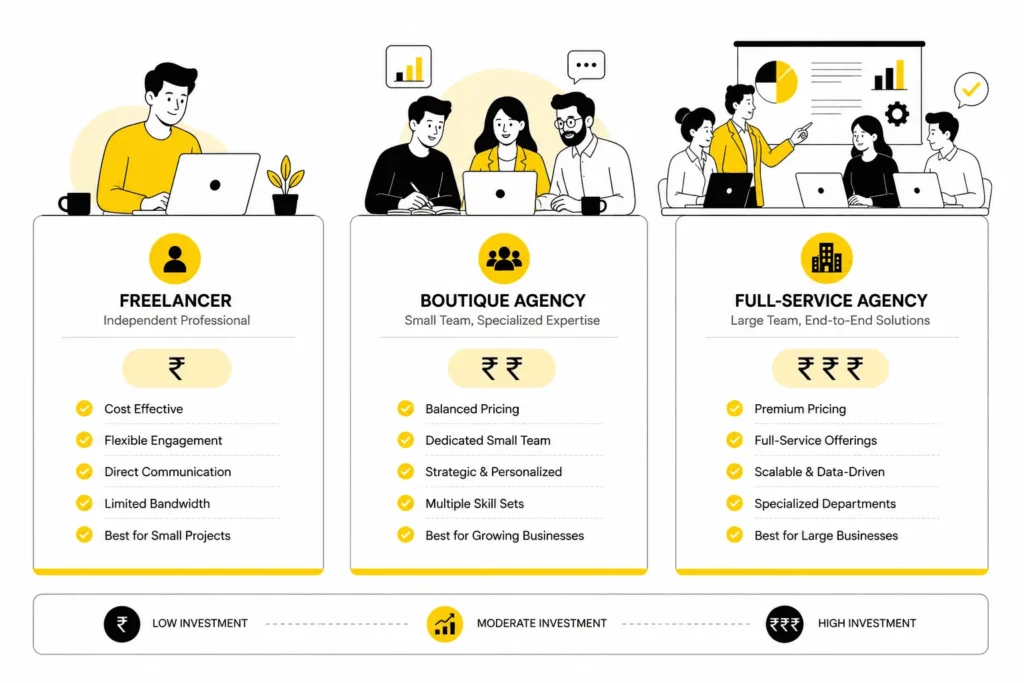
The real Indian digital marketing market has three distinct tiers. Most business owners decide without knowing the middle tier exists — and it’s often the best fit.
| Solo Freelancer | Boutique Operator | Full-Service Agency | |
| Team size | 1 person, working alone | 1–5 person specialist team | 10+ people, structured company |
| Channel focus | 1–2 channels | 2–4 channels together | Multi-channel, multi-city capable |
| Who you deal with | The person directly | The senior person | An account executive |
| Monthly cost | ₹5,000–₹30,000 | ₹15,000–₹60,000 | ₹50,000–₹2,00,000+ |
Solo Freelancer
An independent professional working alone, typically specialising in one or two channels — SEO, social media, Google Ads, content writing, or graphic design. You deal directly with the person doing the work; no account managers, no handoffs, no re-briefing someone new every quarter.
Quality range here is enormous. A 22-year-old with a certificate and a 45-year-old ex-CMO who went independent are both technically “freelancers.” Price alone tells you nothing about seniority — that’s what the questions later in this guide are for.
Boutique Operator
A 1–5 person specialist team, often a senior professional who has brought in one or two trusted collaborators for design, video, or copywriting. It combines the personal attention of a freelancer with multi-channel capability.
This is how most good “agencies” serving Indian SMEs under ₹60,000/month actually operate, even when they call themselves agencies. You know who you’re dealing with, and they know your business. If something needs adjusting, you WhatsApp the person who makes the call.
Full-Service Agency
A structured company with dedicated teams across SEO, paid ads, content, social media, design, and account management. Strong for national campaigns, multi-city reach, and high-volume integrated marketing.
The honest caveat: the senior expert you meet in the sales meeting is rarely the person managing your account day to day. At most large agencies, your account is handled by an account executive coordinating between specialist teams, often in their first or second year on the job.
| The one question that reveals everything: “Who specifically will manage my account — and can I meet them before I sign?” A freelancer will introduce you to themselves. A boutique operator will introduce you to the senior person leading your work. A large agency may introduce you to someone hired after your onboarding call. This single question tells you more than any proposal document. |
What Each Option Actually Costs in India (Real Rupee Numbers)
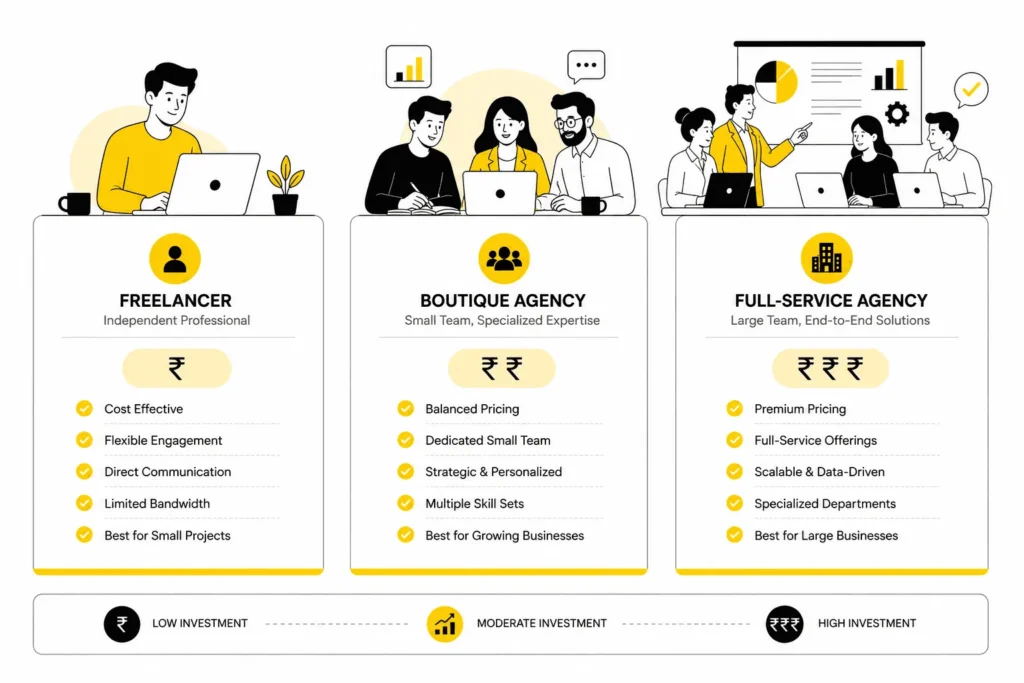
Most articles discuss cost in abstractions — “freelancers are more affordable,” “agencies deliver better ROI.” Here’s actual Indian market pricing.
| Option | Monthly Cost Range | What You’re Really Paying For | Watch Out For |
| Solo Freelancer | ₹5,000 – ₹30,000 | Their time, expertise in 1–2 areas, basic tools | Enormous quality variation — an ₹8K fresher vs. a ₹25K senior ex-agency professional |
| Boutique Operator | ₹15,000 – ₹60,000 | Senior strategy + multi-channel execution + coordination | Confirm the founder or senior person is actually handling your work |
| Full-Service Agency | ₹50,000 – ₹2,00,000+ | Team output across channels, tools, and account management | At the lower end of the range, you often get mid-tier attention at premium pricing |
A few things price tables never tell you:
The attention paradox: at ₹18,000/month, a boutique operator gives you genuine senior attention because you’re one of 6–8 clients. At ₹18,000/month with a large agency, you might be one of 80 accounts. Same rupees, completely different experience.
The senior independent gap: some of the best digital marketers in India are independent. Someone who spent 8 years as SEO lead at a Delhi agency and went solo at 33 might charge ₹25,000–₹35,000/month — and deliver results a ₹60,000/month agency team can’t match in that specific channel. The “freelancers are junior” assumption is outdated.
Hidden costs to factor in: ad spend (always separate from management fees), photography and video production, tool subscriptions, and revision rounds beyond the quoted scope. Always ask what’s not included before you sign.
Which Option Fits Your Stage? A Decision Framework
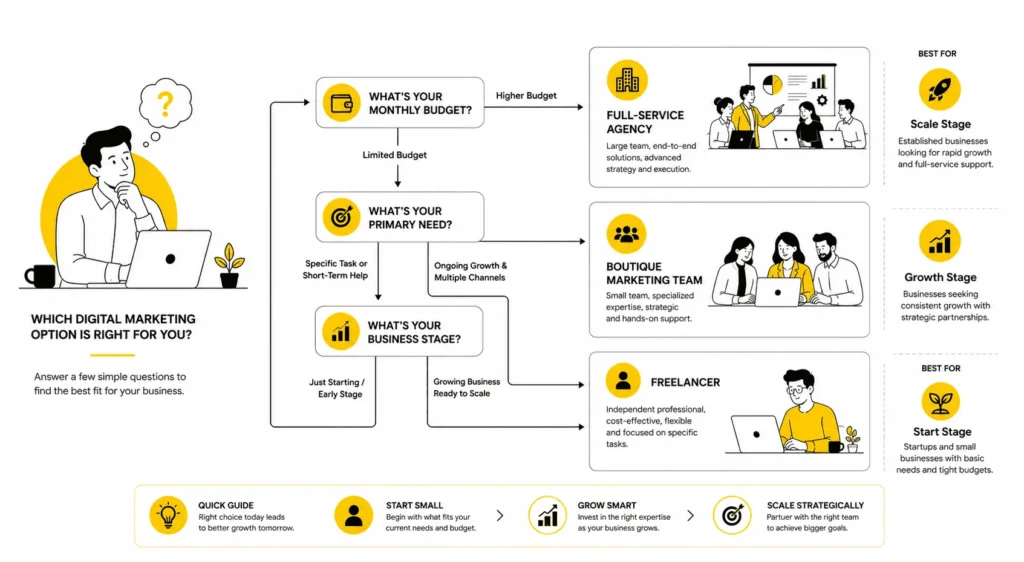
The most expensive digital marketing mistake Indian businesses make is hiring the wrong tier for their stage — not because the provider is bad, but because there’s a mismatch between what you need and what you’re paying for.
Choose a Solo Freelancer When:
You need one channel done really well, your budget is under ₹15,000/month, the work is short-term or project-based, and you want direct access to the person doing the work with zero layers in between.
- You have a single-channel focus — only SEO, or only Instagram, or only Google Ads. A specialist freelancer with deep experience in that channel will outperform a generalist agency team.
- Your business is early-stage and still testing what works. Month-to-month flexibility matters more than multi-channel scale right now.
- You’ve already got the basics in place and just need a specialist to improve one thing.
Choose a Boutique Operator When:
You need 2–4 channels working together, your budget is ₹15,000–₹50,000/month, and you want a long-term relationship with someone who knows your business rather than someone just executing tasks.
- You need SEO + social media + some ad management working together, but you’re not big enough for a full agency.
- You’ve had a bad experience with either a disappearing freelancer or a large agency where your account kept changing hands.
- Your business is in a specific industry (healthcare, coaching, real estate, D2C) and you want someone with experience in your sector.
- You want someone who proactively suggests what to do next, not someone waiting for a brief to arrive.
Choose a Full-Service Agency When:
Your budget is ₹60,000+/month, you need national or multi-city presence, you have an in-house marketing manager to oversee them, and you need high-volume content or campaign scale that genuinely requires a team.
- You’re running performance marketing at scale — ₹5L+ monthly ad spend where agency tools and team structures make economic sense.
- You need the credibility of an agency name for investor presentations, board reporting, or enterprise client pitches.
- You have a dedicated in-house marketing person who will manage the agency relationship. Without internal oversight, large agencies often underperform on SME accounts.
Why Senior Indian Freelancers Are More Underrated Than You Think
Most competing articles treat freelancers as the budget option — something you settle for when you can’t afford better. That framing is wrong for the Indian market, and it’s worth correcting.
India has a growing cohort of senior digital marketing professionals who’ve chosen to go independent. Many spent 8–12 years at agencies or in-house at known brands before leaving. They have zero overhead, and they typically charge 30–50% less than the agency they left while bringing the same depth of experience.
Some of the most effective digital marketing in India is being done by industry-specialist independents: a healthcare-only content marketer in Bengaluru, a real estate Instagram specialist in Delhi NCR, a LinkedIn ghostwriter who works exclusively with startup founders. These people generally don’t want to work at agencies, and they’re not available through agency pitches — the only way to find them is to know they exist.
| How to tell a senior independent from a fresher. Ask: (1) How many years have you been working independently? (2) Can you show results from a client in my specific industry, in business metrics rather than follower growth? (3) What does your onboarding process look like? (4) What happens if you’re unavailable for a week — do you have a backup? Senior independents answer all four confidently and specifically; freshers hedge, generalise, or redirect. Rough rate signal: ₹5,000–₹8,000/month = fresher or part-timer. ₹12,000–₹25,000/month = 3–7 years’ experience. ₹25,000+/month for a single channel = genuine seniority. |
Signs It’s Time to Switch Providers
Most articles treat this as a one-time decision. In reality, most Indian businesses cycle through different options as they grow. Here are the signals that something needs to change.
Signs you’ve outgrown your freelancer:
- You’re managing 3–4 separate freelancers for different channels and spending more time coordinating them than running your business.
- You need campaigns that work together across channels, and no single person owns the full picture.
- Your freelancer has been executing for 18 months without once proactively suggesting a strategy change — they’re doing the work, but they’ve stopped thinking.
- Deadlines are slipping or quality is inconsistent, because what worked when you were their only client isn’t working now that they’ve taken on ten others.
Signs you’re paying a large agency more than they’re worth:
- A different person handles your account every 3–4 months, and you’re constantly re-briefing someone new on your business, industry, and goals.
- Your monthly report is full of metrics, but you couldn’t explain how any of them connect to actual revenue.
- You haven’t spoken to a senior person at the agency in two months — all communication goes through an account executive who escalates everything.
- You’re paying ₹40,000/month and fairly certain a good freelancer would produce the same output for ₹15,000.
Signs a boutique is right for you right now:
- You want one senior person who knows your business, manages your channels, and is reachable when you need them.
- Your budget is ₹15,000–₹50,000/month and you want quality and accountability without agency-level overhead.
- You’ve had one bad experience on either end — a disappearing freelancer or a revolving-door agency team — and want something in between.
7 Questions to Ask Before You Hire Anyone
These work equally well for a freelancer, a boutique, or a 30-person agency. The answers — and how confidently they’re delivered — tell you more than any proposal or case study deck.
- Who specifically will manage my account day to day? Not “our team,” not “our dedicated specialist” — a name, a person you can meet before signing.
- Can you show me results from a client in my industry, in actual business metrics? Follower counts and reach are vanity metrics. Ask for leads generated, ROAS, enquiry volume, or website traffic growth. If they only show engagement data, their reporting doesn’t connect to revenue.
- What happens when results aren’t coming? A confident provider answers without hesitation — they know what they measure, when they escalate, and what they’d change. Watch the reaction as much as the answer.
- Who owns the accounts and content we create together? Your business name should be on every social account, ad accounts should be in your name, and all content created should belong to you. If any of these sit in the provider’s name, you lose everything the moment you leave.
- What’s the notice period to exit? Month-to-month is standard and fair for a new relationship. Six- or twelve-month lock-ins before results are proven are a real risk, especially with someone you haven’t worked with before.
- How do you stay updated on platform changes and algorithm updates? This separates professionals from people who learned marketing in 2021 and stopped. A good answer mentions specific communities, certifications, testing habits, or tools — “I follow industry blogs” isn’t a good answer in 2026.
- What kind of client is NOT a good fit for you? The most revealing question on the list. Experienced professionals know exactly who they can’t serve well and will tell you honestly. “We work with everyone and any budget” isn’t versatility — it’s the absence of specialisation.
| What good answers look like: you don’t need perfect answers to all seven — look for specificity (vague answers to specific questions are a red flag), honesty about limitations (the best providers tell you what they’re not good at), examples over promises (“we generated 35 qualified leads for a Rohini dental clinic in 60 days” means something; “we deliver results” means nothing), and comfort with questions 4 and 5 — if they get defensive about account ownership or exit terms, remember that feeling when month 5 arrives. |
FAQs: Freelancer vs Agency for Digital Marketing in India
Is a freelancer or an agency better for digital marketing in India?
It depends on your budget, stage, and channel needs. For businesses under ₹15,000/month with a single-channel focus, a good freelancer is the smarter choice. For growing SMEs needing multi-channel strategy at ₹20,000–₹50,000/month, a boutique operator delivers the best combination of quality and personal attention. Large agencies make sense at ₹60,000+/month with national-scale needs.
How much does a digital marketing freelancer charge in India per month?
Entry-level freelancers charge ₹5,000–₹10,000/month. Experienced specialists with 3–7 years charge ₹12,000–₹25,000/month. Senior independents with agency or brand backgrounds charge ₹25,000–₹50,000/month for full-channel management. The wide range reflects real variation in experience — always verify with a portfolio and at least one client reference.
What is a boutique digital marketing agency in India?
A boutique digital marketing agency is typically a 1–5 person specialist team, often led by a senior professional, offering multi-channel service with the personal attention of a freelancer. For most Indian SMEs with budgets of ₹15,000–₹60,000/month, boutique operators deliver the best balance of quality, accountability, and direct access to experienced people.
What are the risks of hiring a digital marketing freelancer in India?
The main risks are availability gaps if they take on too many clients, limited scalability as your needs grow, and no backup if they’re unavailable. Mitigate these with a clear written contract, a 30-day notice period, and making sure you own all accounts and content from day one.
When should an Indian small business switch from a freelancer to an agency?
When you’re managing multiple separate freelancers and coordination is eating your time, when you need integrated campaigns across 3+ channels, or when inconsistent marketing is visibly costing you leads as your business grows. The real signal isn’t “agency” — it’s “multi-channel coordination under one strategic owner.” A boutique operator often solves this before a large agency becomes necessary.
The Bottom Line

There’s no universally right answer to the freelancer-vs-agency question — only the right answer for your business, your budget, and where you are right now.
Under ₹15,000/month and need one channel done well? Find a specialist freelancer with a solid portfolio and client references. At ₹15,000–₹50,000/month and need multi-channel work with genuine senior attention? A boutique operator is almost always the best fit. Above ₹60,000/month with national ambitions and an internal marketing person to manage the relationship? A full-service agency makes sense.
What doesn’t make sense at any budget is signing before asking the seven questions, confirming account ownership, and getting a written scope of what’s actually included. Those twenty minutes of due diligence are the difference between a marketing investment and a marketing mistake.
Not sure which option fits your business?
Book a free 20-minute fit call with the leegrowth.com team. We’ll ask about your business, your goals, and your budget, and give you an honest answer about which option makes the most sense — even if that answer isn’t us. No sales pitch, no obligation, just a straight answer.
Book a free 20-minute fit call →
Written by the leegrowth.com team — Delhi-based digital marketing specialists working with clinics, coaching centres, retailers, and service businesses across India. Last updated June 2026.

I’m Leena Kalyana, a Delhi-based freelance digital marketer and graphic designer. I work across SEO, content marketing, social media, and digital design. I’m interested in helping businesses build a stronger online presence through practical SEO strategies, useful content, and creative digital marketing.