


By Leena Kalyana, LeeGrowth | Last updated: October 2026
I am a digital marketer in Delhi, and one of the most common questions I hear from small business owners is simple: “What will SEO actually cost me, and what do I get for it?” This guide answers that using published SEO pricing data, a practical breakdown of what different budgets can realistically cover, and the way I would prioritize a small SEO budget if the website were mine.
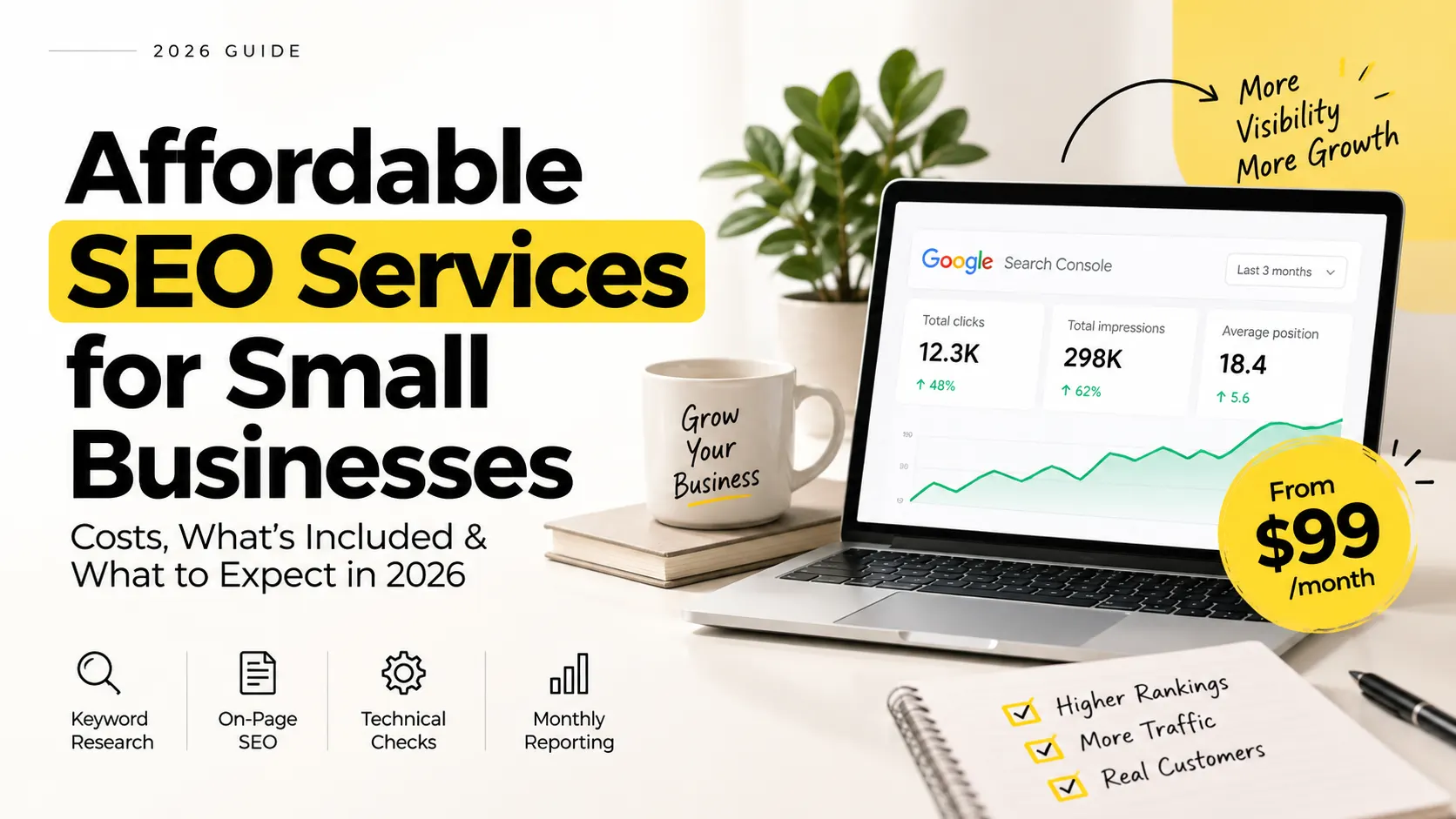
Short answer: Affordable SEO services are SEO work with a clear, limited scope, priced for small businesses and startups. They commonly cover keyword research, on-page optimization, basic technical checks, content improvements, internal linking and reporting. In Ahrefs’ 2024 survey of 439 SEO providers, the most commonly reported monthly pricing band was $501 to $1,000, although pricing varies widely by provider and scope. LeeGrowth offers an entry-level plan from $99/month because the scope is intentionally focused. Affordable does not mean unlimited SEO at the lowest possible price; it means matching the work to the available budget and business need.
Table of Contents
How much do affordable SEO services cost?
Most SEO providers use a monthly retainer or recurring fee. In Ahrefs’ 2024 survey of 439 SEO providers, $501 to $1,000 was the most commonly reported monthly pricing band. That survey is useful as a market reference, but it should not be treated as a fixed industry rate.
The Ahrefs page was last updated in August 2024, so use the numbers as a guide, not a quote.
| Measure | Ahrefs survey result |
|---|---|
| Average monthly fee, all providers | $2,917 |
| Average monthly fee, agencies | $3,209 |
| Average monthly fee, freelancers | $1,348 |
| Average monthly fee, local SEO | $1,557 |
| Most common monthly band | $501 to $1,000 (20.4% of providers) |
| Providers who charge a monthly retainer | 78.2% |
| Average hourly rate, all providers | $111 |
| Average hourly rate, freelancers | $71.59 |
Source: Ahrefs, “SEO Pricing: How Much Does SEO Cost? 439 People Polled”.
These figures are market benchmarks, not a recommended budget for every business. A small local website and a large international website can have completely different SEO requirements.
If you are searching for small business SEO pricing, one thing helps more than any average: since most SEO is sold as a fixed monthly fee, compare what you get, not only the price.
Here is what each budget usually buys. This is my own estimate based on the survey, not an industry standard.
| Monthly budget | What it usually buys | Best for |
|---|---|---|
| Under $200 | A few pages, basic fixes, light monitoring | New or very small sites in low competition niches |
| $200 to $500 | On-page work, some content updates, reports | Small local businesses and small service sites |
| $500 to $1,500 | Ongoing improvements, regular content, some authority building | Growing businesses and small online stores |
| $1,500 and up | Fuller campaigns: content, technical work, authority building | Competitive markets, many locations, larger sites |
If you are comparing monthly SEO packages for small businesses, notice that the price jumps are really scope jumps. More money mostly buys more hours, more pages and more content.
What do affordable SEO services include?
A small plan cannot do everything. It should cover the work that helps a small site the most. Use this table as a checklist.
| Service | What it means | What to expect on a small budget |
|---|---|---|
| Keyword research | Finding what your customers search for | A short list matched to your key pages, not thousands of terms |
| On-page SEO | Improving headings, text, URLs and images on each page | A few important pages each month |
| Titles and meta descriptions | The title and summary people see in search results | Written for each key page |
| Technical checks | Making sure Google can crawl and index your site | A first check, then regular spot checks. See our free website SEO audit to understand what an SEO audit can uncover |
| Content optimization | Updating pages you already have | Often the first task, because it costs less than new content. If the site needs new content, see our SEO content writing services |
| Internal linking | Linking related pages together | Low cost and high value. Links help Google find your pages |
| Search Console monitoring | Checking which searches bring clicks and which pages are indexed | Monthly checks. Learn more in our Google Search Console guide for small businesses |
| Reporting | A monthly summary of work done and results | Impressions, clicks, indexed pages and enquiries |
| Website updates | Editing pages, fixing broken parts, publishing content | Often extra. Ask what is included. If SEO work requires website changes, see our WordPress website development services |
Two details to ask about before you start:
- Own your accounts. Your Search Console, analytics and website admin should stay in your name. Google advises giving an SEO read-only access at the start.
- Ask for the scope in writing. List the tasks, the pages covered, how often the work happens and what is not included.
What can $99 a month realistically cover?
An affordable plan has a finite scope. That is not a flaw. It just means the plan should be honest about where the hours go.
Ahrefs reported an average freelancer rate of $71.59 per hour in its survey. As a rough benchmark, $99 represents only a small amount of professional SEO time at that average rate. That’s why a plan at this price needs a clearly defined scope rather than unlimited SEO work.
The more useful question is not “How many SEO tasks can fit into $99?” It is “Which SEO tasks are most valuable for this particular website?”
What a plan at this level can reasonably cover:
- Keyword research for a short list of priority pages
- On-page optimization for a few key pages
- Basic technical checks such as indexing, canonical URLs, XML sitemaps and obvious performance issues
- Title tag and meta description fixes
- Content recommendations and a limited content plan
- Internal linking recommendations
- Search Console monitoring and a simple monthly report
- A short SEO roadmap so you know what comes next
A website SEO audit can help identify which technical and on-page issues deserve attention first.
What usually needs extra time or budget:
- Large scale content production
- Heavy link acquisition and digital PR
- Technical SEO for big or complex sites
- International SEO across many countries
- Ecommerce SEO across thousands of URLs
- Major website development or redesign
- Continuous conversion rate optimization
Scope varies by provider and by website. Two plans at the same price can hold very different amounts of work, so always ask what the monthly hours or deliverables are.
| Factor | A $99 plan is likely a fit | You likely need more |
|---|---|---|
| Site size | New or small site, a few key pages | Dozens of pages or a big catalog |
| Competition | Niche searches or a small local area | Crowded markets or big cities |
| Site condition | Working site that needs strong basics | Penalties, migration issues, many technical errors |
| Content | You can write content with light guidance | You need regular articles written for you |
| Goal | Get indexed, fix basics, improve key pages | Fast growth or national reach |
This table is LeeGrowth’s own guidance, not a rule for everyone.
No plan at $99 or $10,000 can guarantee rankings, traffic, leads or sales.
Indexing and ranking are not the same thing
Getting a page indexed is only the first step. An indexed page can still receive little or no organic traffic if it does not satisfy the search intent well enough to compete with other results.
That’s why affordable SEO should not simply mean “publish more content and wait.” A sensible process starts with crawlability and indexability, then moves into search intent, page quality, internal linking, content and measurement.
What affordable SEO looks like in a real project
Illustrative project scenario: not a client case study. This example is made up to demonstrate how I would approach the work. It does not represent a real client’s results, traffic growth or revenue.
The situation: A small service business has a website with five or six service pages. Organic traffic is very low. The homepage is trying to rank for a broad keyword. Nobody has mapped keywords to pages. Internal links are weak. Two pages seem to target almost the same search.
Step 1: Diagnose before publishing. I would not write a single new article yet. I would first check the important pages in Google Search Console to see what is indexed and which queries already show impressions. I would also start with a website SEO audit to identify technical and on-page issues. Then I would look at:
- Canonical URLs and the XML sitemap
- What each page is trying to rank for, and whether two pages compete for the same query (keyword cannibalization)
- Titles, meta descriptions, headings and page structure
- Internal links to the money pages
- What the top results in the SERP look like and what search intent they serve
- Content gaps against a few real competitors
Step 2: Prioritize pages. With a small budget, I do not recommend 20 new articles at once. The question is which page deserves the next hour of work. Usually it is one of these:
- The homepage, if it is the only page with any authority
- A service page that already gets impressions but few clicks
- A location page, if the business serves a specific area
- An existing blog post that ranks on page two
- A new commercial landing page, only if no current page can serve that search
Step 3: Map keywords to existing pages. One page, one main intent. A simple map looks like this:
| Search intent | Keyword type | Recommended page |
|---|---|---|
| Commercial | Service keyword | Service page |
| Informational | How or why query | Blog post |
| Local | Service plus location | Local landing page |
| Comparison | Alternative or comparison query | Comparison article |
Step 4: Improve existing pages. This is usually the cheapest win. I would fix:
- Search intent match: does the page answer what the searcher wants?
- The H1 and H2 structure
- Title tag and meta description
- Supporting terms and entities a reader would expect to see
- Internal links in and out
- A short FAQ, only where real questions exist
- Helpful examples and image alt text
- Schema, only where it fits the page
Step 5: Build supporting content. Once the main pages are solid, a few supporting articles can answer related questions and link back to the service page. This builds topical coverage and gives the commercial page more context. Two or three useful posts beat twenty thin ones.
Step 6: Measure. This is what I would watch, not a result I am claiming:
- Indexed pages
- Impressions, clicks, CTR and average position
- Query growth (new searches the site starts appearing for)
- Organic traffic per page
- Enquiries or conversions, where tracking exists in Google Analytics
The goal is not to promise a particular ranking or traffic increase. It is to make sure each hour of SEO work has a clear reason behind it and something that can be measured later.
If I had a small SEO budget, here is how I would prioritize it
Here is the order I would follow, and why.
| Priority | What I would do | Why |
|---|---|---|
| 1 | Fix discoverability and indexing problems | A page Google cannot index cannot rank. No amount of content fixes this |
| 2 | Improve pages that already have potential | A page with impressions is easier to lift than a new page with none |
| 3 | Target realistic keywords | A new site rarely beats established sites for broad head terms |
| 4 | Build topical relevance | Supporting content around one core service gives it context |
| 5 | Strengthen internal linking | It is cheap and helps readers and crawlers move to money pages |
| 6 | Measure before scaling | Search Console and analytics show what deserves more investment |
For example, suppose a small website has 20 possible service-related keywords. I would not automatically choose the keyword with the highest search volume. A lower-volume query with clear commercial intent may be more useful if the website has a realistic chance of competing for it.
Search volume tells you how many people may search for something. It does not tell you how difficult the result will be to compete for or how likely the searcher is to become a customer. A service-focused SEO strategy can help prioritize the pages most closely connected to enquiries.
And an example of priority 2: if a service page sits on page two with a weak title and thin copy, rewriting it is often a better use of a small budget than a new blog post, because the page already has some relevance.
Affordable SEO vs cheap SEO
Affordable SEO has a clear scope and honest limits. Cheap SEO chases the lowest price, often with guarantees, vague tasks or risky shortcuts. The deciding factors are scope, quality, strategy, transparency and business fit.
| Affordable SEO | Cheap SEO |
|---|---|
| Defined scope | Unclear scope |
| Prioritization | Volume first approach |
| Relevant keywords | Keyword stuffing |
| Strategic content | Mass produced content |
| Transparent reporting | Vanity metrics |
| Realistic timelines | Guaranteed rankings |
| Sustainable optimization | Shortcuts |
Affordable does not automatically mean good, and expensive does not automatically mean better. The useful comparison is the actual scope of work, the quality of the strategy, the methods being used, the transparency of reporting and whether the service matches the website’s needs.
A few more differences you can spot early:
- Methods. Affordable providers follow Google Search Essentials. Cheap ones often use link schemes, mass directory sign ups or copied content.
- Access. Good providers work with read-only access where possible and explain changes. Risky ones want full control and will not explain.
- Terms. Clear cancellation terms are a good sign. Long lock ins with unclear deliverables are not.
Google says in its guide to hiring an SEO that no one can guarantee a number one ranking. It also warns about SEOs who claim a special relationship with Google, and says you are responsible for what companies you hire do to your site.
How long does affordable SEO take?
There is no fixed number. Google says some changes show in a few hours and others take months. It suggests waiting a few weeks before judging a change. Not every change has a visible effect.
How fast things move depends on:
- Website age and existing authority
- Competition and search demand
- Search intent (a local service query behaves differently from a broad informational one)
- Technical condition and content quality
- Location and industry
- Existing backlinks
These are different milestones, and they happen at different speeds. The ranges below are rough planning estimates for a small website, not promises. Different sites can move at very different speeds depending on competition, technical condition, content quality, authority and search demand.
| Milestone | Rough expectation | What affects it |
|---|---|---|
| Pages indexed | Days to a few weeks | Technical health, sitemap, crawlability |
| First impressions in Search Console | A few weeks to a couple of months | Content quality, site age |
| Rankings for low competition queries | Often two to four months or longer | Competition, page relevance |
| Rankings for competitive terms | Often six months to well beyond a year | Authority, backlinks, market |
| Consistent organic leads | Varies widely | All of the above plus conversion quality |
Judge progress by impressions, clicks and enquiries together, not by one ranking screenshot.
Is affordable SEO right for a small business?
It can be, especially when the business has a focused offer and a small site. It suits companies that need strong basics and steady progress more than fast growth in a crowded market.
| Business type | A suitable affordable SEO approach |
|---|---|
| Local service business | A few service pages, a location page and Google Business Profile support. See Local SEO services |
| Consultant or coach | One page per core offer, a small set of helpful posts, clear enquiry path |
| Small agency | Service pages and a few case style posts based on real work |
| Small B2B company | Focus on the pages buyers compare before contacting you |
| Startup with a focused offer | Start at launch: tracking, core pages, one or two supporting posts |
| Professional services | Trust pages, service pages and answers to client questions |
| Small ecommerce store | Category pages, product titles and descriptions. See Google’s ecommerce guide |
If you’re building a new website, see our guide to startup SEO costs for a separate breakdown of what different startup SEO budgets can cover.
If you search for affordable SEO services near me, remember that being near you matters less than whether the provider can explain the plan. Many freelancers work online and serve clients across cities and countries.
A small package may not be enough when:
- You compete in a crowded market or a big city
- You need new content every week
- Technical problems need development time
- You have many locations or a large catalog
- Most of your growth depends on search
You do not have to jump straight to $2,917 a month. Fix the basics first, check Search Console, then spend more on what shows progress. Google also says a small local business can probably do much of the SEO work itself with its SEO Starter Guide, so hiring help is about saving time and adding expertise.
Can affordable SEO work for international businesses?
Sometimes, but not automatically. One generic English page does not rank in every country just because it is in English.
What changes when you target other markets:
- Country targeting. Decide which countries matter. Trying to rank everywhere usually means ranking nowhere.
- Search intent differences. People in different countries often use different words and expect different pages.
- Location modifiers. A query with a country or city name behaves differently from a generic one.
- International keyword research. Search demand differs by country, so each market needs its own research.
- Localization. Currency, spelling, examples and legal details may need to change.
- Country specific landing pages. Often better than one page for everyone.
- Hreflang. Useful when you have real versions of a page for different languages or regions. It is not needed for every site.
On a small budget, my advice is to pick one or two target markets first. LeeGrowth’s higher plan covers international SEO for businesses that need it.
If international search is a major part of your growth strategy, see LeeGrowth’s SEO services for the broader service scope.
Red flags when choosing an affordable SEO service
Keep your judgment factual. A low price alone is not a red flag. These are:
- Guaranteed number one rankings
- Promises like “10,000 backlinks every month”
- Huge numbers of articles with no strategy behind them
- No clear explanation of deliverables
- No access to reporting
- No talk of search intent
- No website audit before starting
- No discussion of your existing pages
- No clear contract or scope
- Promises of instant traffic
- Claims that one trick will make Google rank your site
How to evaluate an SEO provider
Use these questions before you hire. Most points come from Google’s advice on hiring an SEO.
| Question to ask | What a good answer sounds like |
|---|---|
| What exactly is included every month? | A written list of tasks, pages and frequency |
| Who does the work? | A named person, not “our team” with no detail |
| Will I get keyword research? | Yes, tied to specific pages |
| Will existing pages be optimized? | Yes, usually first |
| How is content chosen? | Based on search intent and gaps, not volume alone |
| How are backlinks handled? | Honest about limits, no link schemes |
| What reporting will I get? | Search Console data, work done, enquiries |
| Which SEO tools are used? | Named tools and what they are used for |
| How is success measured? | Impressions, clicks, enquiries, not just rankings |
| What if a page does not perform? | A plan to review, adjust or stop |
| Are technical issues included? | Clear about which are in and out of scope |
| Are there extra costs? | Listed upfront |
Also:
- Ask for a sample report. A newer provider may have fewer examples, so judge the quality of their thinking.
- Keep ownership of your accounts. Start with read-only access.
- Compare scope, not price. A cheaper plan is not better value if it covers a third of the work.
Does SEO help you show up in AI answers?
Yes, the basics still matter. Google says the best practices for SEO still apply to its AI features, such as AI Overviews and AI Mode. These features use pages from Google’s normal search index. Google also says “AEO” and “GEO” are, from its view, still SEO.
For a small business, that means:
- Crawlability and indexability. For Google’s AI search features, the underlying page generally needs to be accessible to Google and eligible to appear in its search systems. Indexing does not guarantee that Google will select a page as a source.
- Original expertise. Google recommends creating original, useful content that provides value beyond what users can easily find elsewhere. For a small business, that can include first-hand explanations, practical examples, original processes and genuinely useful information based on experience.
- Clear answers first. Put the direct answer at the top of each section, then explain. It also helps readers.
- Clear entities. Use your business name, services and location consistently, so it is obvious what you do and where.
- Structured information. Use clear headings, tables where they help and structured data where it fits the page.
- Topical coverage. Cover a subject properly instead of scattering thin pages.
- Fresh pages. Show a clear “last updated” date and fix old facts.
- Check your results. Search Console has a Generative AI performance report.
Google also says you can ignore some popular “AI hacks” for Google Search. You do not need an llms.txt file, you do not need to chop content into tiny pieces, and you do not need to rewrite pages just for AI. Google’s guidance covers Google only. Other AI tools work differently, and nobody can promise visibility in them. Clear, accurate, helpful pages are a safe base for all of them.
Read Google’s full guide: Optimizing your website for generative AI features on Google Search. For a broader explanation, see our AI search engine optimization services.
LeeGrowth affordable SEO services
LeeGrowth is the digital marketing brand of Leena Kalyana, based in Delhi. I provide SEO and digital marketing services for small businesses, startups, service businesses and online businesses in India and international markets.
I work directly with clients on strategy and implementation, with the scope agreed before work begins.
A note about the $99 plan
A $99/month SEO plan is not designed to compete with a large national brand spending thousands of dollars every month.
It is designed for focused work on a smaller website: identifying the highest-priority opportunities, improving important pages, building a sensible content direction and measuring what happens.
If a website needs substantially more work than the entry plan can realistically cover, the right approach is to increase the scope rather than pretend that unlimited SEO fits into a $99 budget.
| Plan | Price | What it covers |
|---|---|---|
| Get Found | $99 / month | SEO basics: keyword research, on-page SEO, content strategy, digital presence analysis |
| Get Growing | $199 / month | SEO, content, social media, local SEO and creative support together |
| Go Global | $399+ / month | International SEO and a custom growth plan for global markets |
Want to know which plan fits? Read about our SEO services, contact LeeGrowth with your website and goals, or book a free 30-minute call.
Frequently asked questions
What are affordable SEO services?
They are ongoing or one time SEO services priced for small businesses and startups. A typical plan covers keyword research, on-page fixes, basic technical checks, content improvements and reports within a set scope.
How much should small businesses spend on SEO?
It depends on competition and goals. Most providers in the Ahrefs survey charge $501 to $1,000 a month, and the average is $2,917 because large agencies raise it. Many small sites start lower and increase spending once Search Console shows what is working.
Is $99 a month enough for SEO?
It can be for a small, new site with a narrow, written scope and low competition. It is not enough for a competitive market, a large site or fast growth. No plan can guarantee rankings.
Is affordable SEO worth it?
It is worth it when the scope matches your site and your expectations are realistic. It is a poor fit if you need fast growth in a crowded market.
What is included in an affordable SEO package?
Usually keyword research, on-page SEO, titles and meta descriptions, basic technical checks, content improvements, internal linking, Search Console monitoring and a monthly report.
What is the difference between cheap SEO and affordable SEO?
Affordable SEO has a clear scope, honest limits and open reporting. Cheap SEO chases the lowest price, often with guarantees or tactics that break Google’s rules.
How long does SEO take to work?
Google says some changes work in hours and others take months. Wait a few weeks before judging a change. Competitive searches take longer.
Can affordable SEO generate leads?
It can, if the pages match what buyers search for and the site has a clear way to enquire. Leads usually come after indexing, impressions and clicks, so they take longer than the first wins.
Can startups use affordable SEO?
Yes. Starting at launch or redesign helps most: set up tracking, build the core pages and avoid fixing structure problems later. You can also see our guide to startup SEO costs.
Can affordable SEO work internationally?
It can for one or two focused markets. Each country needs its own keyword research and often its own pages. See the international section above.
Should I hire an SEO agency or a freelancer?
Freelancers charged an average of $1,348 a month in the Ahrefs survey, against $3,209 for agencies. A freelancer suits a small site and gives you direct contact. An agency may suit larger projects that need many specialists. Judge the scope and the person, not just the label.
How do I choose an affordable SEO company?
Get the scope in writing, ask how success is measured, ask for a sample report and avoid anyone who guarantees rankings. See the checklist above.
Can I do SEO myself?
Often yes, at least in part. Google says a small local business can probably do much of the work itself. Our list of SEO tools for small businesses can help you start. Hire help to save time, add expertise or when you launch or redesign a site.
Do I need to pay for link building?
Not at the start. Google says links from other sites tend to come naturally over time, and it warns against link schemes. Link building can matter later in competitive niches.
Conclusion
Affordable SEO works best when the scope matches the website and expectations are realistic. A small, new or low-competition site can often make meaningful progress with a focused monthly SEO budget, although the pace depends on competition, website condition, content quality and the amount of work required.
Compare scope before price, get deliverables and timelines in writing, and be cautious of anyone who guarantees rankings or specific traffic results.
If you want to see whether a focused SEO plan fits your website, contact LeeGrowth or book a free 30-minute call.
Sources
- Ahrefs, SEO Pricing: How Much Does SEO Cost? 439 People Polled (page updated August 2024)
- Google Search Central, Do you need an SEO?
- Google Search Central, SEO Starter Guide (updated December 2025)
- Google Search Central, Optimizing your website for generative AI features on Google Search (updated July 2026)
- Google Search Central, Search Essentials
- Google Search Central, Ecommerce guide

I’m Leena Kalyana, a Delhi-based freelance digital marketer and graphic designer. I work across SEO, content marketing, social media, and digital design. I’m interested in helping businesses build a stronger online presence through practical SEO strategies, useful content, and creative digital marketing.