



Written by Leena Kalyana, Lee Growth
Search is changing. People no longer only use Google and click on blue links. Many people now ask AI tools like Google AI Overviews, ChatGPT, Microsoft Copilot and Perplexity to answer their questions directly. This gives businesses a new way to be found, if they already invest in search, content and their online presence.
AI search engine optimization services help a business become easier to find, easier to understand and more trustworthy across these AI powered search tools. In this guide, we explain what AI SEO really means, how it works, what it can do, what it cannot promise, and what to expect if you invest in it.
Table of Contents
AI SEO Is Not a Shortcut
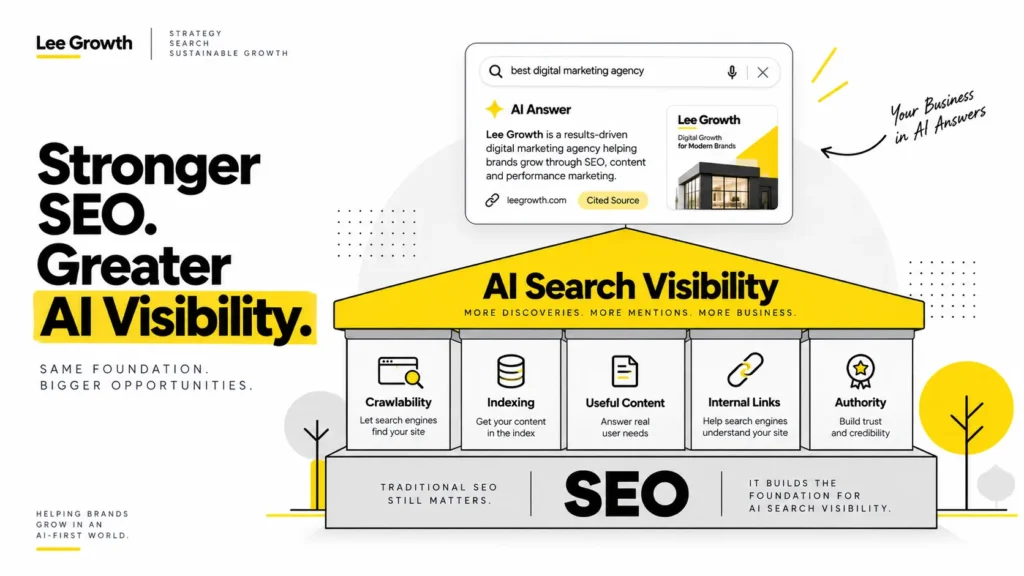
Let’s be clear about one thing first. AI SEO is not a replacement for normal SEO. It is not a secret trick for ChatGPT either.
AI SEO is simply the practice of making your business, your content and your online presence easier to find and understand. This applies to normal search engines and to AI powered search tools together.
Google has said clearly that there is no special technical setup or special code needed just to appear in AI Overviews or AI Mode. The normal rules of good SEO still apply. In simple terms, this means:
- You still need pages that search engines can crawl.
- You still need your pages to be indexed.
- You still need content that is actually useful.
- You still need good internal links.
- You still need trust and authority.
- You still need a website that works well for visitors.
- You still need clear and correct business information.
The goal is not to trick ChatGPT or Google. The goal is to build a website and online presence that is genuinely useful, easy to understand, trustworthy and easy to find. If your technical SEO foundation is not solid, AI visibility will not fix that on its own.
What Is AI Search Engine Optimization?
What is AI SEO?
AI SEO means setting up your website, your content and your online presence so that search engines and AI tools can find you, understand you, and mention you when it makes sense. It builds on top of normal SEO. It does not replace it.
How is AI search different from normal search?
Normal search shows a list of links. You click through and compare them yourself. AI search tools work differently. They read information from many sources, put it together, and give you one direct answer. Sometimes they mention or link to a few sources, instead of showing ten results.
What does it mean to be visible in AI search?
It means an AI tool can find your business, understand what you do, and confidently mention you when it is relevant. This could be a direct mention, a link, or a spot in a short list of recommended options.
Why AI Search Matters for Businesses in 2026
More and more people now research and compare things by talking to AI tools instead of typing into a search bar. They ask AI to compare options, summarise reviews, or suggest a local business. The AI’s answer affects which businesses even get considered.
This changes what “being found” means. A business can rank well on Google and still get left out of AI answers, if its content is not clear enough for these tools to understand and trust. At the same time, it is important to stay realistic. Normal search is still very much alive. Most customers still use a mix of different channels to research a business.
It would not be accurate to say that Google is dead, or that everyone has switched from Google to ChatGPT. The real picture is simpler. AI search is now one more channel to think about. It works alongside normal search, not instead of it.
What We Check During an AI SEO Audit
Many “AI SEO” articles feel like they could apply to any business. Here is what we actually check during a real audit.
- Search visibility. What does the business already rank for?
- AI visibility. What happens when someone asks an AI tool a question about this business or its category?
- Content gaps. Which real customer questions are not being answered anywhere on the site?
- Entity clarity. Can search engines and AI tools clearly understand who the business is, what it offers, and where it works?
- Website accessibility. Can search engines actually read and understand the important pages?
- Authority. What outside sources support and confirm this business is trustworthy?
- Conversion. If more people find the business through AI or search, can the website actually turn them into leads or customers?
That last point matters a lot. More visibility does not help much if the website cannot convert visitors into enquiries. This is why we treat it as a full digital marketing audit, not just a technical SEO checklist. You can see the full process on our website SEO audit page.
A Simple 6 Part AI SEO Framework
It helps to think about AI SEO in six clear steps.
- Discoverability. Can search engines and AI tools find your content at all?
- Understanding. Can these systems clearly understand your business and your topics?
- Relevance. Does your content actually answer the real question?
- Evidence. Do you back up your claims and show real expertise?
- Authority. Do other trusted sources support your business?
- Measurement. Can you actually tell if your visibility is improving?
Each step builds on the one before it. There is little point measuring results if discoverability is broken, or chasing authority if your basic business information is unclear.
AI SEO vs Normal SEO
Here is the simplest way to see how the two connect.
| What it looks at | Normal SEO | AI SEO |
|---|---|---|
| Main outcome | Search rankings | AI visibility |
| What it optimises | Keywords | Topics, entities and questions |
| Where you show up | Result pages | AI generated answers |
| What you earn | Clicks | Mentions and citations |
| Scope | Single pages | Full brand understanding |
| End goal | Search engine visibility | Visibility inside AI generated answers |
AI SEO does not replace normal SEO. Good technical SEO, easy crawling, useful content and real authority are still the foundation. AI visibility is simply built on top of that foundation.
SEO vs AEO vs GEO: What Is the Difference?
These three terms get mixed up a lot, so here is a clear side by side view.
| SEO | AEO | GEO | |
|---|---|---|---|
| Main goal | Search visibility | Direct answers | Visibility inside AI answers |
| Main focus | Pages and rankings | Questions and answers | AI retrieval and mentions |
| Key foundation | Technical SEO | Clear information | SEO plus authority plus clear business identity |
| How it is measured | Rankings, clicks, traffic | How often you answer questions | Mentions, citations, AI visibility |
| How it connects | The foundation | Overlaps with SEO | Builds on top of SEO |
These are not three separate marketing channels. They overlap a lot. Clear, useful, well organised content tends to do well across all three at once. In practice, one solid content strategy can serve normal search, answer boxes and AI tools all at the same time.
How to Write Content for AI Answer Tools
This is the practical side of Answer Engine Optimization, or AEO. Current guidance from Bing points to clear structure, clear headings, short sections, tables, FAQ style content, real evidence and fresh information as helpful for AI generated answers.
Answer the question first
Do not make readers wait through 500 words before getting to the point. Give the answer early. Explain it after.
Use clear headings
Your headings should describe exactly what is in that section. Avoid vague or clever titles. This helps both readers and AI tools scan the page quickly.
Break long explanations into short sections
Long blocks of text are hard to read and hard for AI tools to process. Shorter, clearly labelled sections are easier to understand and easier to pull information from.
Use tables to compare things
If you are comparing two or more options, a table is much clearer than a paragraph of text.
Explain your terms clearly
Do not assume the reader already knows your industry’s terms. Explain them simply.
Add real examples
A concrete example makes advice much easier to understand. See the example later in this article.
Answer follow up questions too
Think about what the reader would naturally ask next, and answer it in the same article instead of leaving it out.
Back up your claims
If you make a claim, support it with a source, a fact, or an example. Claims without any support are easy for readers, and for AI tools, to ignore.
What Actually Affects AI Search Visibility?
Instead of chasing random “GEO tricks,” it helps to understand the real factors that AI tools look at.
- Content relevance. Does the page actually answer the question?
- Content quality. Is it genuinely useful, not just present on the page?
- Expertise. Does the writer clearly know the subject?
- Entity clarity. Is the business clearly and consistently described?
- Outside support. Do other trusted sources agree with this information?
- Technical access. Can these systems actually read the content?
- Freshness. Is the information still current?
- User intent. Does the content give people what they actually want, not just match a keyword?
Google has openly said that chasing so called AEO or GEO “hacks” is not a smart strategy. Instead, they recommend strong basic SEO and genuinely useful, original content. If someone tells you they can help you “rank” inside ChatGPT with a list of tricks, that claim does not match what Google or OpenAI have actually said.
What Does an AI SEO Service Actually Include?
A full AI SEO project usually follows a clear method, not just a list of buzzwords.
| Service | What we check | What you receive | Why it matters |
|---|---|---|---|
| AI Search Visibility Audit | Where and how your business currently appears in AI tools | A clear picture of your current visibility and the gaps behind it | You cannot fix a visibility problem you have not measured |
| AI Query Research | The real questions and prompts your customers ask AI tools | A list of content ideas based on real customer language | Content built on real questions performs better than keyword guesses |
| Technical SEO | Crawlability, indexing, internal links, page experience | A prioritised list of technical fixes | Nothing else works if these systems cannot access your site |
| Content Strategy | Topic coverage against real customer questions | A structured content plan, not random blog ideas | Scattered articles rarely build the depth needed to earn trust |
| Entity Optimisation | Business details, author info, services, location, consistency | A corrected, consistent business profile everywhere online | Unclear or inconsistent information is a top reason AI tools skip a business |
| AI Visibility Monitoring | Prompts, mentions, citations, competitor visibility over time | An ongoing trend, not a single snapshot | AI visibility changes as models change, so a one time audit goes stale |
You can see how this fits into our wider digital marketing services.
How to Get Your Business Mentioned in AI Search
Getting mentioned by name in an AI answer usually depends on several things working together, not one single trick.
- Well written, well organised website content
- Clear and consistent business information
- Real industry mentions and partnerships
- A healthy number of reviews
- Trusted mentions from other credible sources
- Expert level content that shows real knowledge
- Strong local information, for local businesses. See our local SEO services for more on this
- More people searching for your brand name directly
- Clear topic authority in your area of work
What AI SEO Cannot Promise
No honest consultant can promise:
- A mention in ChatGPT
- A citation in Google AI Overviews
- A specific position in an AI answer
- A specific citation spot
- A fixed number of leads from AI search
AI tools choose information based on the question, the sources available, how they retrieve information, and their own internal ranking process. If someone promises you a guaranteed mention, they are not being fully honest with you. The real goal is to build the signals that make a mention more likely over time. No one can promise a guaranteed result, because no one fully controls these systems.
Can ChatGPT Find and Read Your Website?
This is a fair and common question, so let’s answer it directly.
OpenAI has confirmed that public websites can appear in ChatGPT search. They also say that publishers should avoid blocking OAI SearchBot if they want their content to be found, shown and cited inside ChatGPT search. A few practical points:
- Being crawlable matters. If a crawler cannot reach your pages, it cannot mention them.
- Check your robots.txt file. Make sure you have not accidentally blocked the right crawlers.
- Know the difference between bots. OAI SearchBot is used for search discovery. GPTBot relates to training data controls. Blocking one does not automatically mean the same as blocking the other.
- Watch your referral traffic from AI platforms, so you can see real visits coming in.
- Use your analytics tools to track AI driven visits separately from normal traffic.
This does not need to become a deep technical project. But checking that your site is not accidentally blocking discovery is a quick and worthwhile task, and it’s one of the first things we check in a website audit.
How to Measure AI Search Visibility
You cannot improve something you do not measure. AI search visibility can be measured, just through different tools than normal ranking reports. Bing Webmaster Tools, for example, now has an AI Performance report that shows pages cited in AI answers, common search topics, and citation trends over time.
| Metric | What it tells you |
|---|---|
| AI mentions | Is your brand showing up in AI answers? |
| AI citations | Is your website being used as a source? |
| Cited pages | Which pages are actually being referenced? |
| Common topics | Which subjects trigger your visibility? |
| Citation share | How visible are you compared to competitors? |
| AI referral traffic | Are people actually visiting from AI tools? |
| Leads | Is this visibility turning into real business results? |
AI SEO for Small Businesses
Does a small business really need AI SEO?
Not urgently in every case. But ignoring it completely means letting competitors take this space instead. Small businesses with a real online presence and local customers can benefit a lot from this.
Where should a small business start?
Start with the basics. Correct and consistent business information. A technically healthy website. Content that clearly answers what customers are actually asking.
Should you fix normal SEO first?
In most cases, yes. AI visibility is built on the same base as normal SEO. A site with technical problems or thin content will not do well in either system.
How much content does a small business need?
Depth and clarity matter more than the amount of content. A smaller number of genuinely useful, well written pages usually works better than a large amount of thin, low value content.
How can a small business compete with bigger brands?
By being more specific and more trustworthy in a smaller, focused area. Real expertise, a genuine local presence, and consistent information can outweigh a big brand’s wider but shallower content.
A Simple Example
It helps to see the difference between weak and strong content.
Weak content: “SEO is important for businesses because it helps improve rankings.”
Stronger, AI friendly content: “For a Delhi based interior designer, a useful service page should explain which design services are offered, which areas of Delhi are served, common project types, typical timelines, and what clients should think about before hiring a designer.”
The second version works better for a simple reason. It answers the real questions a customer, or an AI tool summarising the options, would actually need answered. It is specific, it shows real knowledge of the business, and it gives an AI system something clear to reference. The first version could apply to any business in any industry, which is exactly the kind of generic content that struggles in both normal and AI search.
When Should You Hire AI SEO Services?
Hiring professional help usually makes sense when:
- The business already has an established website
- Search and online discovery genuinely matter for revenue
- Competitors are clearly gaining ground in AI answers
- Content is already being produced, but not structured for AI visibility
- The business specifically wants better AI search visibility
- There is no internal time or skill to manage this properly
- Ongoing measurement and reporting is needed
On the other hand, if a website has major unresolved technical problems, no regular content, or very low traffic overall, it is often better to fix those basics first before adding AI SEO on top.
How Much Do AI SEO Services Cost?
There is no single honest price to quote here. Cost depends on several factors specific to each business:
| Factor | Why it changes the price |
|---|---|
| Website size and number of pages | More pages usually means more audit and fix time |
| Technical complexity | Custom or older sites often need more work |
| Competition in your industry | Harder markets need more content and authority building |
| Amount of new content needed | More content needs more research and writing time |
| Geographic market and locations | Multiple locations add more entity and local SEO work |
| Existing SEO authority | A stronger starting point can lower the effort needed |
| Ongoing monitoring needs | Regular tracking adds a recurring cost |
| Type of engagement | One time consulting costs differently than ongoing work |
For a proper estimate based on your actual site and goals, request an audit and we can walk through the numbers together.
Using Structured Data the Right Way
It helps to clear up a common misunderstanding. Structured data is not a special “AI SEO requirement.” Google has clearly said that no special AI schema or special machine readable files are needed just to appear in AI Overviews or AI Mode.
The correct approach is simpler. Use structured data where it accurately describes what is actually on the page, and where it supports a real search feature. Do not add schema just because you believe an AI system needs it. Google’s own structured data guidance says clearly that markup must match what is actually visible on the page, not describe an idealised version of it.
AI SEO Audit Checklist
Technical
- [ ] Page is indexable
- [ ] Important pages are crawlable
- [ ] XML sitemap is healthy
- [ ] Internal links work correctly
- [ ] Canonical tags are correct
- [ ] Mobile experience works well
- [ ] Page speed is acceptable
Content
- [ ] Search intent is clear
- [ ] Important customer questions are answered
- [ ] Content shows real expertise
- [ ] Information is current
- [ ] Content includes original insight
- [ ] Claims are supported with evidence where needed
Entity
- [ ] Business name is consistent everywhere
- [ ] Services are clearly listed
- [ ] Location is clear
- [ ] Contact information is consistent
- [ ] About or author information exists
- [ ] Related profiles and mentions match up
AI visibility
- [ ] Test real AI queries about the business
- [ ] Record brand mentions
- [ ] Record citations
- [ ] Note which competitors show up instead
- [ ] Track changes over time
Conversion
- [ ] Clear call to action
- [ ] Strong service pages
- [ ] Trust signals are visible
- [ ] Contact process works smoothly
- [ ] Lead tracking is set up
Related Reading
This article is the main guide in a wider set of articles about search and AI visibility. You may also find these useful:
- SEO for Coaches in India
- Best Free SEO Tools for Small Businesses in India
- Local SEO Companies for Coaching Institutions
- Why Use AI Search Monitoring Tools? A Guide for Businesses (coming soon)
- Best AI Search Monitoring Tools in 2026 (coming soon)
- How to Get Your Business Mentioned in ChatGPT (coming soon)
Frequently Asked Questions
What is AI SEO? AI SEO means making your website and online presence easier for search engines and AI tools to understand, find and mention when relevant. It builds on top of normal SEO instead of replacing it.
What are AI search engine optimization services?
These are professional services that check, improve and track a business’s visibility across AI powered search tools, alongside normal search.
How does AI SEO work?
It combines being easy to find, having clear business information, writing content that answers real questions clearly, and earning trust from other sources, so AI tools can confidently mention a business.
Is AI SEO different from normal SEO?
It is related but not the same. Normal SEO focuses on ranking positions. AI SEO focuses on being understood and mentioned inside AI generated answers. Both rely on the same technical and content basics.
What is GEO?
GEO, or Generative Engine Optimization, means improving how clearly your content and business details can be understood and mentioned by AI tools. It relies on the same basics as normal SEO.
What is AEO?
AEO, or Answer Engine Optimization, means structuring your content so it clearly and directly answers specific questions.
How do I optimise my website for AI search?
Start with clear, question focused content, consistent business information, solid technical SEO, and trusted mentions from outside sources. These are the same basics that support normal search too.
How do I get my business mentioned in ChatGPT?
Build strong, trustworthy content, keep your business information consistent across the web, make sure your site does not block the right crawlers, and earn real mentions and reviews. There is no way to guarantee a specific mention.
Can small businesses benefit from AI SEO?
Yes, especially businesses with a genuine local presence and a website that already explains their services clearly.
How much do AI SEO services cost?
It depends on your site size, competition, content needs, and how much ongoing monitoring is required.
How long does AI SEO take?
Like normal SEO, real visibility usually builds over months rather than days, since it depends on trust and authority building up over time.
Can an AI SEO company guarantee AI search visibility?
No honest provider can guarantee a specific mention or citation. Any promise of guaranteed AI visibility should be treated carefully.
Is Your Business Visible in AI Search?
Find out how your website and brand currently appear across AI powered search tools, and find out what opportunities you are missing.
What you will get:
- A current AI visibility snapshot
- The key content gaps in your site
- Any technical SEO issues
- A look at your competitors’ visibility
- Priority recommendations
- Clear next steps
Request an AI Search Visibility Audit
You can also reach out directly at Contactleegrowth@gmail.com or call 7217666430 / 9968225310.
Leena Kalyana works across digital marketing, SEO, website strategy and content, helping businesses become easier to find online. Learn more about Lee Growth.

I’m Leena Kalyana, a Delhi-based freelance digital marketer and graphic designer. I work across SEO, content marketing, social media, and digital design. I’m interested in helping businesses build a stronger online presence through practical SEO strategies, useful content, and creative digital marketing.