


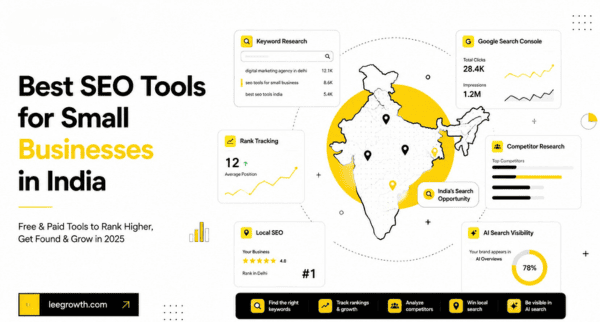
SEO tools for small businesses in India work best when they match your budget, your business type and how far along you already are. This guide covers the free and paid SEO tools worth using in India, what each one actually does, what they really cost in rupees once forex and GST are counted, and how to build a stack that fits your budget.
Quick answer
- Best free starting point: Google Search Console, plus Keyword Planner, Google Trends, GA4 and PageSpeed Insights.
- Best budget paid tool: Ubersuggest. It is the only mainstream paid tool here that can come in near or under ₹2,000 a month.
- Best mid-range all-rounder: SE Ranking.
- Best for serious competitor and backlink research: Semrush or Ahrefs (pick one, not both).
- Paying in India: most tools bill in USD. UPI works only where the tool’s payment provider has switched it on, so check the checkout page first. Details below.
What Makes an SEO Tool Worth Paying For
Every SEO tool does one or more of these jobs:
- Keyword research: finding what people search for, including Hindi and Hinglish terms
- Competitor research: seeing what keywords and content your competitors rank for
- Local SEO: your Google Business Profile, local rankings, and Indian directories
- Technical SEO: crawling, indexing, page speed, broken links, schema
- AI search visibility: showing up in Google AI Overviews, ChatGPT, and Perplexity
- Pricing and accessibility: INR vs USD pricing, forex charges, UPI support, free plan limits
Keep these six in mind when you choose SEO tools for small businesses in India. Every tool below fits into one or more of them.
Best Free SEO Tools for Small Businesses in India
1. Google Search Console
Search Console shows which queries bring you clicks, your average ranking position, which pages are indexed, and where errors are hurting visibility.
Filter the Performance report by country, then by city. This shows you where your traffic is actually coming from, not where you assumed it would.
2. Google Keyword Planner
Keyword Planner sits inside Google Ads but works fine for free keyword research too.
Compare these three:
- “digital marketing agency”
- “digital marketing agency in Delhi”
- “digital marketing agency near me”
The third one is someone ready to hire, today. Chase intent, not just volume.
3. Google Trends
Google Trends shows if a search term is rising or falling, filtered by state or city. You can also compare a Hindi term against its English version to see which one people actually use more.
Use it for seasonal planning too. Festivals, admission cycles, and weather-linked demand all show up here ahead of time.
4. Google Analytics 4
Search Console shows what people searched before landing on your site. GA4 shows what they did after. Use both together:
- Search Console: are people finding you?
- GA4: does your site convince them to act?
5. Google PageSpeed Insights
PageSpeed Insights scores your page speed and points out exactly what is slowing it down.
Your site might feel fast on office WiFi. It can still be slow for a customer on a mid-range phone over patchy 4G in a Tier 2 city. Test on mobile, not just desktop.
6. Screaming Frog
Screaming Frog crawls your site like Google does. The free version covers 500 URLs, which is enough for most small sites. It finds:
- Broken links and redirect chains
- Missing or duplicate meta titles
- Duplicate content
- Pages accidentally blocked from indexing
Run it after any redesign or migration, since that is when things quietly break. If you are planning a Wix to WordPress migration, this step matters even more.
7. Bing Webmaster Tools
Bing Webmaster Tools takes ten minutes to set up and gives similar indexing data to Search Console. Worth having, especially for desktop users on Edge.
Best Paid SEO Tools
These paid SEO tools for small businesses in India have indicative prices only. Vendors change plans, regional pricing and billing options often, and listed prices differ between sources, so confirm on the tool’s own pricing page before you buy.
8. Ubersuggest
Ubersuggest is the most beginner-friendly and usually the cheapest paid tool here. It covers keyword research, a basic site audit, competitor overview, and simple rank tracking in one interface. It has also offered a one-time lifetime plan alongside monthly billing, which is worth a look if you want to avoid recurring USD charges. Entry plans have been listed anywhere from roughly $12 to $29 a month depending on plan and region, so check what you are quoted.
9. SE Ranking
SE Ranking covers rank tracking, keyword research, competitor analysis, site audits, and backlinks at a lower price than Semrush or Ahrefs. Its city-level rank tracking is useful if you serve more than one location.
10. Semrush
Semrush is the broadest all-in-one platform. Its Keyword Magic Tool groups keywords by intent (informational, commercial, transactional), which saves you from guessing what type of page to build. Plans start at roughly $130 a month, making it the most expensive tool on this list.
11. Ahrefs
Ahrefs has the deepest backlink data of any tool here. Its Content Gap feature shows keywords your competitors rank for that you don’t, which is one of the most useful reports across any platform. Paid plans start at roughly $99 a month.
12. Moz Pro
Moz has fallen a bit behind Ahrefs and Semrush on data depth. It is still a reasonable pick if you want something simple with a short learning curve.
13. Mangools
Mangools bundles five tools (KWFinder, SERPWatcher, LinkMiner, SERPChecker, SiteProfiler) into one subscription. It is built for freelancers and solo operators who don’t need agency-level complexity. Entry-level plans have been listed at roughly $30 to $60 a month depending on tier and whether you pay monthly or annually, which puts it in the mid-range for most Indian budgets rather than the cheapest bracket.
SEO Tools Under ₹2,000 a Month
If you are searching for an SEO tool under 2000 rupees, here is the honest picture. The free Google stack costs ₹0 and covers most early needs. Among paid SEO tools for small businesses in India, only Ubersuggest’s lower-priced plans (and its lifetime option, if you pay once) come close to this range, and whether you stay under ₹2,000 depends on the plan, the billing period and the exchange rate on the day. Most other paid tools, including Mangools, SE Ranking, Semrush and Ahrefs, usually land above it.
| Budget | What fits | What you get |
|---|---|---|
| ₹0 | Search Console, Keyword Planner, Trends, GA4, PageSpeed Insights, Screaming Frog (free, 500 URLs) | Keyword discovery, technical health, speed, performance tracking |
| Around ₹2,000 or less | Free stack + Ubersuggest entry plan (confirm current price) | Bulk keyword lists, basic audit, simple rank tracking |
| ₹2,000 to ₹5,000 | One tool such as SE Ranking or a Mangools plan | Reliable rank tracking, city-level tracking, cleaner reporting |
| ₹5,000+ | Semrush or Ahrefs + free Google tools | Deep competitor, content gap and backlink research |
Annual or lifetime plans can lower the effective monthly cost, and they also mean fewer forex transactions. Just don’t prepay for a year of a tool you haven’t tested.
Best SEO Tools for Small Businesses in India, by Job
| What you need | Best starting tool |
|---|---|
| Check what Google sees | Google Search Console |
| Basic keyword ideas | Google Keyword Planner |
| Search trend data | Google Trends |
| Technical crawl | Screaming Frog |
| Page speed check | PageSpeed Insights |
| Budget all-in-one | Ubersuggest |
| Multi-city rank tracking | SE Ranking |
| Deep competitor research | Semrush |
| Backlink research | Ahrefs |
| Simple, low learning curve | Moz Pro |
| Solo freelancer’s stack | Mangools |
The Best Stack for a Solo Business Owner
You are a solo founder, freelancer, or local business owner with no SEO team. Here are the SEO tools for small businesses in India to use at each budget.
- ₹0 a month: Search Console, Keyword Planner, Trends, GA4, PageSpeed Insights. Covers keyword discovery, technical health, speed, and performance tracking. Most small businesses can run on this for six months to a year.
- Around ₹2,000 a month or less: Keep the free stack and add an Ubersuggest plan. This gives you bulk keyword lists and a proper site audit instead of manual checks.
- ₹2,000 to ₹5,000 a month: Pick one serious platform, usually SE Ranking or a Mangools plan, instead of stitching together three or four tools. One tool used properly beats four tools half-used.
- ₹5,000 a month and above: Semrush or Ahrefs, plus the free Google tools, plus Screaming Frog for technical audits.
Don’t buy both Semrush and Ahrefs at once. Their features overlap heavily. Pick one based on your bigger need and add the second only if you hit a wall the first can’t solve.
The Real Cost of SEO Tools in India
Most paid SEO tools for small businesses in India bill in USD. Your actual cost in rupees moves with the exchange rate every billing cycle, even when the advertised price stays the same.
International transactions on Indian cards usually carry a forex markup from your bank, plus GST on that markup. The number on the pricing page is not the number that hits your statement.
To work out the real cost:
- Take the advertised USD price
- Convert at the current rate
- Add your bank’s forex markup
- Add GST on that markup
Illustrative example (the numbers below are made up to show the method; use today’s rate and your own bank’s charges): a plan advertised at $20 a month, an exchange rate of ₹90 per dollar, a 3.5% forex markup and 18% GST on the markup.
- $20 × ₹90 = ₹1,800
- 3.5% markup = ₹63
- 18% GST on the markup = about ₹11
- Total: about ₹1,874 a month
That is your actual monthly cost, not the number on the pricing page. Ask your bank for its exact forex markup, since it varies by card.
Can You Pay for SEO Tools with UPI?
Short answer: sometimes, and you can’t assume it. UPI is the main way Indians pay online, but whether you can use it for SEO tools for small businesses in India depends on the tool’s payment provider and on whether the plan is priced in rupees or dollars.
- INR-priced plans: some billing providers now support UPI for rupee subscriptions, including UPI Autopay for recurring payments. Autopay renewals involve a pre-debit notification and per-renewal limits, so a large annual plan may not qualify.
- USD-priced plans: UPI is usually unavailable, or limited to a separate “UPI International” route that works only for one-time dollar payments with supported banks, typically on desktop. Don’t count on it for a monthly subscription.
- Most SEO tools still bill in USD, so card payment is the default.
How to check before you commit:
- Start the signup and go to the payment step. The available methods are shown there, with no charge until you confirm.
- Look at the currency. A rupee price is far more likely to offer UPI than a dollar price.
- If UPI isn’t offered, use an Indian debit or credit card with international transactions enabled, a virtual card, or a prepaid forex card.
- Consider annual or lifetime billing, which means fewer separate forex charges.
This changes quickly as providers add UPI, so treat the checkout page as the final word.
Why Group-Buy SEO Tools Are Not Worth the Risk
Search for “cheap Semrush” or “Ahrefs for ₹500” and you will find group-buy resellers selling shared logins to premium tools. They look like a shortcut to a sub-₹2,000 stack of SEO tools for small businesses in India, but they are a poor trade for a business:
Why it is a poor trade
- They break the tool’s terms. Shared accounts can be banned without warning, taking your saved projects with them.
- You don’t control the account. Your keyword lists, tracked sites and competitor research sit on a login other people can change.
- Security is a real risk. You are handing your browsing to a stranger’s session, often with extensions or credentials you can’t verify.
- The tool you actually need is often free. The free Google stack plus an entry-level plan beats an unreliable shared login for most small businesses.
Keyword Research for Hindi and Hinglish
A lot of Indian search happens in Hindi or Hinglish, not clean English. Someone looking for a salon might search “mere paas salon” just as often as “salon near me.” Standard keyword tools mostly miss this.
To find these keywords:
- Type your seed term into Google and read the autocomplete in both languages
- Set Google Trends to your state or city and compare the Hindi and English versions
- Check the People Also Ask box for related phrasing
- Search the term on YouTube, since its suggestions often show more natural, spoken phrasing
- Check what your competitors already rank for
Don’t trust the volume number alone. Regional search demand is often split across several spellings of the same query, so a term showing “low volume” may have more real demand than the number suggests.
A simple way to validate a regional keyword:
- Discover the term
- Compare spelling and phrasing variations
- Search it manually and check what is currently ranking
- Publish your content
- Check Search Console to see which exact phrase actually brings clicks
Best Local SEO Tools for India
Most local SEO guides point to BrightLocal and Whitespark, built for the US market. When you pick SEO tools for small businesses in India, these local options matter more:
- Google Business Profile: still the foundation. Accurate categories, hours, photos, and regular reviews outperform most paid tools on their own.
- JustDial: one of the most used directories in India, especially for local services. Often the first place a customer checks.
- Sulekha: strong for service-based businesses where customers compare quotes before choosing.
- IndiaMART: for B2B and product sellers, this works more like a lead-generation channel than a directory.
- Industry directories: Practo for healthcare, Zomato for restaurants, TripAdvisor for travel, Urban Company for home services.
Not every listing is a direct ranking factor the way a backlink is. Some drive referral traffic directly. Some keep your name, address, and phone number consistent across the web, which does support local rankings. Treat each one on its own merits.
AI Tools and AEO in India
You will see AI writing and optimization tools such as Surfer, Frase and ChatGPT on many lists of SEO tools for small businesses in India. They help with drafting, outlining and optimizing content against what already ranks. They don’t replace keyword data, technical audits or rank tracking, so treat them as an add-on once the basics above are in place.
AEO (Answer Engine Optimization) means structuring your content so AI tools like Google AI Overviews, ChatGPT, and Perplexity can pull accurate information from it, even if the person never clicks through to your site.
A small Indian business can show up here if:
- Your content clearly answers specific questions
- Your business information is consistent across the web
- You have genuine expertise showing through, not generic reworded information
What to monitor:
- Brand mentions when people search related terms
- Accuracy of your business details wherever they appear online
- Clear FAQs and structured answers on your pages
- Correct schema markup so AI tools can read your content properly
AEO builds on top of traditional SEO. It doesn’t replace it. Fix your fundamentals first.
Why Mobile Performance Matters in India
Most Indian users browse on mobile first, often on mid-range phones over 4G that varies a lot by location. A site heavy on images or unnecessary scripts will feel noticeably slower here than in markets with more consistent infrastructure.
Check your Core Web Vitals on mobile, not just desktop. If you control your hosting, a server or CDN based in India will cut load time for local visitors. Improving website speed and Core Web Vitals is part of getting this right.
A Simple SEO Workflow
Here is a simple workflow that ties your SEO tools for small businesses in India together:
- Find demand: Keyword Planner and Trends
- Study competitors: Semrush, Ahrefs, or Ubersuggest
- Create or optimize pages: build around validated intent
- Check technical health: Screaming Frog and Search Console
- Track rankings: SE Ranking, Semrush, or Ahrefs
- Measure outcomes: GA4 and Search Console together
- Monitor AI and local visibility: AI Overview mentions, GBP, directories
A ₹0 Stack in Practice
Business: A Delhi-based digital marketing consultant working solo
Budget: ₹0
Tools: Search Console, Keyword Planner, Trends, GA4, PageSpeed Insights
Steps:
- Find location-specific service keywords using Keyword Planner and Trends
- Build dedicated service and location pages, not one generic “services” page
- Fully optimize the Google Business Profile
- Publish content answering the actual questions prospects ask
- Track impressions and clicks weekly in Search Console
- Refine pages based on the exact queries showing up, since these are often phrased differently than what was originally targeted
This is the same process paid SEO tools for small businesses in India automate and scale. It is slower done manually, but it works, and it is how most small businesses should start.
Common Mistakes to Avoid
- Buying Semrush or Ahrefs before having any strategy
- Subscribing to overlapping tools that do the same job
- Using group-buy or shared logins to save money
- Chasing keyword volume over intent
- Ignoring Hindi and Hinglish search behavior
- Skipping Indian directories in favor of Western ones
- Only checking rankings, not clicks or conversions
- Treating tool scores like Domain Authority as if they are Google’s own metrics
- Testing speed only on office WiFi, not mobile
- Forgetting how forex and GST affect the real cost
- Assuming UPI will work at checkout without checking
- Expecting AI tools to replace SEO fundamentals
FAQs
What is the best free SEO tool for small businesses in India?
Google Search Console. It shows exactly what Google sees for your site and everything else builds on it.
What are the best SEO tools for small businesses in India?
Start with the free Google tools: Search Console, Keyword Planner, Trends, GA4 and PageSpeed Insights. When you need more, add Ubersuggest for a low-cost paid option, or SE Ranking and Mangools for mid-range rank tracking. Choose Semrush or Ahrefs only when you need deep competitor and backlink research.
Which SEO tool is best for beginners in India?
Ubersuggest, for its low cost and simple interface.
What is the cheapest paid SEO tool in India?
Ubersuggest is usually the cheapest mainstream option. Its lifetime plan is a one-time payment if you prefer to avoid recurring charges. Check the current price, since plans and regional pricing change.
Is there a good SEO tool under ₹2,000 a month?
The free Google stack costs nothing and covers most early needs. For a paid tool, an Ubersuggest entry plan is the most likely to fit under ₹2,000, depending on the exchange rate and your card’s forex charges. Most other paid tools cost more.
Can I pay for SEO tools using UPI?
Sometimes. It depends on the tool’s payment provider and whether the plan is priced in rupees or dollars. Most SEO tools bill in USD and default to cards, so check the payment step at checkout before you assume.
Are group-buy SEO tools safe?
No. They usually break the tool’s terms, can be shut off at any time, and put your data and browsing at risk. A free tool or an entry-level paid plan is the safer way to start.
Is Semrush worth it for a small business?
Only once you have outgrown the free tools and need deeper competitor or content research. It is rarely the right first purchase.
Is Ahrefs better than Semrush?
Neither is better overall. Ahrefs has stronger backlink data, Semrush has broader features. Pick based on your specific gap.
Can I do SEO without paying for any tools?
Yes, for quite a while. The free Google stack covers most of what a small business needs early on.
Which tool is best for local SEO in India?
Start with Google Business Profile, then add relevant Indian directories based on your business type.
How do I research Hindi keywords?
Use Google autocomplete and Trends set to your region, check YouTube’s suggestions, and validate what you find against real clicks in Search Console.
How much should a small Indian business spend on SEO tools?
Most solo operators using SEO tools for small businesses in India do well starting at ₹0 to ₹2,000 a month, scaling up only when a specific gap appears.
Do SEO tools improve rankings automatically?
No. They surface data and issues. Someone still has to act on it.
Final Verdict
Here is the short version of how to choose SEO tools for small businesses in India:
- ₹0 budget: start with Search Console, Keyword Planner, Trends, GA4, and PageSpeed Insights
- Under about ₹2,000: add an Ubersuggest plan once the free tools feel limiting
- Solo freelancer or growing service business: move to SE Ranking or Mangools for rank tracking and competitor research
- Serious SEO operation: choose Semrush or Ahrefs, not both
- Local Indian business: prioritize Google Business Profile, location keywords, and Indian directories over Western citation tools
- Hindi or Hinglish audience: validate demand manually, don’t rely on English-only keyword databases
- Paying in India: check the checkout for UPI, calculate the real INR cost with forex and GST, and avoid group-buy logins
- AI search focused: get traditional SEO right first, then layer AEO monitoring on top
If you want a second pair of eyes on where your site currently stands, a free SEO audit is a good starting point before you spend on SEO tools for small businesses in India.

I’m Leena Kalyana, a Delhi-based freelance digital marketer and graphic designer. I work across SEO, content marketing, social media, and digital design. I’m interested in helping businesses build a stronger online presence through practical SEO strategies, useful content, and creative digital marketing.
[…] For more guidance, see our SEO tools for small businesses in India. […]