


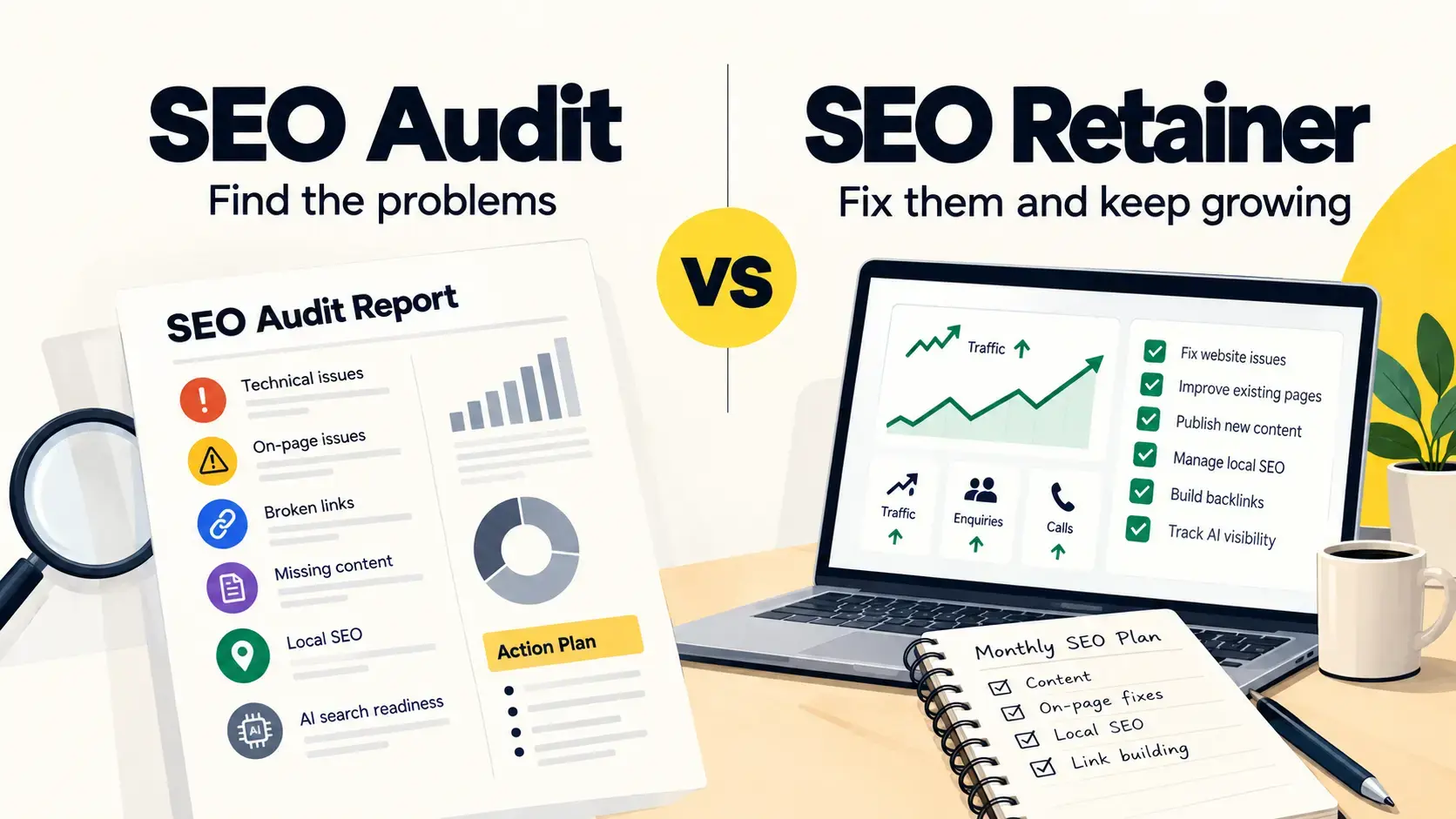
Quick answer: SEO retainer vs one-time audit comes down to this: an audit finds the problems on your website, and a retainer pays someone to fix them and keep improving your site every month. Choose an audit if you have someone who can make the fixes. Choose a retainer if search brings you customers and you don’t have time to do the work. Not sure? Start with an audit.
(SEO means making your website easier to find on Google.)
Short Summary
- An audit finds problems. A retainer fixes them and keeps going. The big question is: who will do the work?
- Audit: one payment, usually about ₹8,000 to ₹25,000 or more in India. The risk: you get a report and never use it.
- Retainer: a monthly fee, usually about ₹15,000 to ₹35,000 in India. The risk: you pay for busywork and see no growth.
- Best path for most small businesses: audit first, retainer later.
- Judge results by enquiries, calls, and sales, not just website visits.
- Check the numbers. Divide the monthly cost by what one customer is worth to see how many new customers you need.
1. What Is a One-Time SEO Audit?
A one-time SEO audit is a check-up for your website. You get a list of problems, ordered by importance, usually as a PDF report or checklist. You can see what one looks like with our free website SEO audit.
A good audit looks at:
- Site health: Is your site fast? Does it work on phones? Are there broken links? (You can test speed yourself with Google’s free PageSpeed Insights.)
- Your pages: Are your page titles, headings, and text clear and easy for Google to understand?
- Site layout: Is your site easy to move around, and do your pages link to each other well?
- Local search: Is your Google Business Profile and business info (name, address, phone) correct everywhere?
- AI search: Can tools like ChatGPT and Google’s AI answers easily understand and quote your content?
What is an audit for?
An audit answers one question: what is holding my website back? Use it to:
- See where you stand before spending more money
- Get a clear to-do list for your team or web developer
- Check for problems after a new website or redesign
- Get a second opinion on another company’s work
- Set a starting point so you can measure progress later
An audit does not grow your traffic by itself. It shows you what to fix. It does not fix it.
What does an audit report look like?
A good report is clear, short, and ends with a to-do list. These are the usual parts.
| Part of the report | What it checks | Example of a finding |
|---|---|---|
| Site health | Speed, phone-friendliness, broken links | “The home page loads slowly on phones.” |
| Page titles and text | Titles, headings, and clear wording | “Five service pages use the same title.” |
| Missing content | Pages your customers search for but you don’t have | “There is no page for a service people often ask about.” |
| Local search | Google Business Profile and local listings | “Opening hours differ between Google and your website.” |
| Links from other websites | Who mentions or links to you | “Very few other sites mention your business.” |
| AI search readiness | Whether answers on your pages are clear and easy to quote | “Key pages have no short FAQ answers.” |
| Action list | The top fixes, ranked by impact and effort | “Fix these 10 things first, in this order.” |
A report without a ranked action list is only a list of problems. Ask for the action list before you pay. You can see how Lee Growth checks a site with the free website SEO audit.
How much does an audit cost?
In India, a paid audit usually costs about ₹8,000 to ₹25,000 or more, depending on how big your site is and how deep the check goes. (In the US, audits usually cost $500 to $5,000.)
The biggest risk
The report ends up in a drawer. You pay for a good report, nobody uses it, and nothing changes.
When an audit is the right choice
- Your budget is tight
- You have a developer or team member who can make the fixes
- You want a plan before spending more
- You just launched or redesigned your site
- You want a second opinion
2. What Is a Monthly SEO Retainer?
A monthly SEO retainer means you pay a provider every month to do the work for you. They don’t just point out problems. They fix them and keep improving your site. Here is what SEO services usually include.
A retainer can include:
- Fixing website problems
- Improving your existing pages
- Planning and writing new content (see SEO content writing)
- Keeping your local listings and Google Business Profile up to date (see local SEO)
- Getting other websites to mention and link to you
- Checking how you show up on Google and in AI answers
- Monthly reports on enquiries, calls, and sales
SEO builds over time. Each month of work adds to the last, so steady effort usually beats a one-time push, especially when your competitors are active.
How much does a retainer cost?
In India, small businesses usually pay about ₹15,000 to ₹35,000 per month. Crowded industries and bigger jobs cost more. Many providers ask for a 3 to 12 month commitment because results take time. (In the US, small business retainers usually cost $500 to $2,500 per month.)
The biggest risk
Paying for busywork. This means automatic reports, generic blog posts, and charts that don’t connect to real customers. It happens most with very cheap monthly plans.
When a retainer is the right choice
- Search is a big source of your customers
- Your industry is crowded, and competitors keep adding content and improving their sites
- Nobody on your team has the time or skills to keep up with content, local listings, and fixes
3. SEO Retainer vs One-Time Audit: Key Differences
Short answer: In the SEO retainer vs one-time audit choice, an audit is a check-up that you pay for once. A retainer is a monthly service where someone does the work for you.
| One-Time Audit | Monthly Retainer | |
|---|---|---|
| What it is | A check-up and a plan | Ongoing work and improvement |
| How you pay | One payment | Monthly (often 3 to 12+ months) |
| Typical cost in India | ₹8,000 to ₹25,000+ | ₹15,000 to ₹35,000+ per month |
| Who does the work | You or your developer | The provider |
| Biggest risk | The report never gets used | Paying for busywork |
| Time to see results | Depends on how fast you make the fixes | Usually 2 to 6 months |
| Flexibility | High: no ongoing commitment | Lower: you commit for several months |
| Best for | Tight budgets with someone to make the fixes | Crowded markets that need fresh content |
4. SEO Retainer vs One-Time Audit Cost: What Do You Get at Each Price?
Short answer: A one-time audit costs about ₹10,000. A full monthly plan costs about ₹25,000 to ₹35,000, and a local plan starts near ₹15,000.
Most agencies hide their prices. Here is what three common budgets get you, using real Lee Growth prices (all exclude GST).
| ₹10,000 (one time) | ₹25,000 (per month) | ₹35,000 (per month) | |
|---|---|---|---|
| What it is | Standalone SEO audit and roadmap (₹9,999) | SEO Growth plan (₹24,999) | SEO + AI Authority plan (₹34,999) |
| Who does the work | You or your developer | The provider | The provider |
| Best for | A clear plan you use yourself | Growing businesses that want a full monthly program | Crowded markets where you want to lead |
| Keywords researched | Covered in the check-up | 30, with a content plan | 50, with a 90-day roadmap |
| Pages improved | None (you get the list) | 10 | 15, plus fixes for weak pages |
| New articles | None | 4 | 6, plus updates to old posts |
| Links from other websites | None | 3 | 5, with outreach |
| Google Business Profile | Reviewed in the audit | Fully managed | Fully managed, plus reputation work |
| AI search work | Reviewed in the audit | Set up for ChatGPT, Gemini, and Perplexity | Building mentions, plus monthly tracking of 20 customer questions |
| Calls and support | None | WhatsApp and a call every two weeks | Priority WhatsApp and a weekly call |
In between: The ₹14,999 Local Starter plan suits local businesses. It covers 15 keywords, 5 pages, 2 articles, and Google Business Profile setup.
Be careful with very cheap plans. A monthly plan far below ₹10,000 often means automatic reports instead of real work. Ask exactly what you get each month.
Prices exclude GST, ad spend, website redesign, and tool fees.
5. What Does a Retainer Do in the First 90 Days?
Short answer: Month 1 is checking and fixing. Month 2 is building. Month 3 is growing and measuring. Early results usually show after 2 to 3 months.
Many owners pay a retainer without knowing what happens each month. Here is a typical plan.
| Month | What happens | What you may see |
|---|---|---|
| Month 1: Check and fix | A full check of your website. Research on what your customers search for. The biggest website problems get fixed (speed, broken pages, page titles). Your Google Business Profile is cleaned up. Tracking is set up so progress can be measured. | Little change in rankings yet. This month builds the base. |
| Month 2: Build | Your most important pages are improved. The first new articles go live. Local listings are fixed. The first links from other websites are earned. Pages get clear answers that AI tools can quote. | The first signs: more people seeing your site in search. |
| Month 3: Grow and check | More content and links. The team looks at what is working and updates the plan. You get a report on enquiries and calls. | Often, early movement in clicks and enquiries. Crowded searches can take longer. |
This is a general plan. Every provider works a little differently, and nobody can promise rankings. What matters is that you know what is happening each month and why.
How do you know if SEO is working?
Check these numbers every month. The first three matter most.
| What to check | Where to find it | What good looks like |
|---|---|---|
| Enquiries (calls, WhatsApp messages, form fills) | Your phone, inbox, and website forms | More enquiries from search over time |
| Google Business Profile actions (calls, direction requests, website clicks) | Your Google Business Profile | Rising month after month |
| Clicks and views in search | Google Search Console | Slowly growing, not jumping up and down |
| Rankings for your main searches | Search Console or a rank checker | Moving up, but treat this as a side signal |
| AI answers check | Ask ChatGPT or Google’s AI 10 questions your customers ask | Your business named more often over time |
Rankings alone are not the goal. If rankings go up but enquiries don’t, ask your provider why.
6. Is a Retainer Worth It? A Simple Break-Even Example
Short answer: Divide the monthly cost by the value of one customer. The answer is how many new customers you need each month to break even.
Here is a quick way to check if a retainer can pay for itself.
New customers needed each month = monthly cost ÷ value of one customer
Example: One new customer is worth ₹20,000 to you. The retainer costs ₹25,000 a month. That is 25,000 ÷ 20,000 = 1.25, so you need 2 new customers a month to break even.
| Value of one customer | Retainer cost | Customers needed to break even |
|---|---|---|
| ₹5,000 | ₹25,000 per month | 5 per month |
| ₹20,000 | ₹25,000 per month | 2 per month |
| ₹1,00,000 | ₹25,000 per month | 1 every 4 months |
A worked example (illustrative, not a real client)
Imagine a dental clinic in Delhi. These numbers are assumptions for illustration, not real results.
- One new patient brings the clinic ₹6,000 in profit.
- The clinic chooses a ₹14,999 monthly local plan.
- Break-even: 14,999 ÷ 6,000 = about 2.5, so the clinic needs 3 new patients a month from search.
- If search brings 5 new patients a month, profit is 5 × ₹6,000 = ₹30,000, minus ₹14,999 in cost = about ₹15,000 a month.
- If search brings only 2 patients, the clinic loses money that month.
Work out your own numbers this way before you buy.
Two tips:
- Use profit, not sales. If a customer pays ₹20,000 but your cost is ₹8,000, their value to you is ₹12,000.
- Expect a slow start. SEO often takes 2 to 3 months to bring customers. At ₹25,000 a month, that is about ₹75,000 before results show. Make sure you can afford to wait.
If the numbers don’t work, an audit is the safer first step.
7. How Do You Choose Between an Audit and a Retainer?
Short answer: For the SEO retainer vs one-time audit decision, go by who will make the fixes. If you have someone, start with an audit. If you don’t, choose a retainer, or an audit first and a retainer after.
1. Does search bring you a lot of customers? If most customers come from referrals, ads, or social media, an audit may be enough. If search brings in a lot of business, ongoing work is easier to justify.
2. Who will make the fixes? This is the most important question. If you have someone, an audit is great value. If not, the report may just sit there.
3. How crowded is your industry? In a quiet local market, fixing the basics can be enough. In a crowded one, competitors keep improving, so standing still means falling behind.
4. What is your budget and timeline? An audit is one payment. A retainer needs a few months to show results. If you can’t stick with it for at least 3 months, it may not get a fair chance.
5. Do you know how healthy your site is? If not, start with an audit. You can’t plan ongoing work until you know what needs fixing.
| If this sounds like you | Choose |
|---|---|
| Search is a small part of your business and you have someone to make fixes | One-time audit |
| Search brings you customers, your industry is crowded, and nobody has time | Monthly retainer |
| You’re not sure | Audit first, then decide |
8. Which Option Fits a Clinic, Coaching Institute, Restaurant, or Online Store?
Short answer: Clinics and restaurants usually need local search work first. Coaching institutes and online stores usually need ongoing content.
These are general guides. Your own market and budget matter most.
| Business | What matters most | Good starting point |
|---|---|---|
| Clinic in Delhi | People search “doctor near me.” Google Maps, reviews, and an accurate Google Business Profile bring most patients. | Start with an audit. In a busy area with many clinics, a local plan such as Local Starter (₹14,999) makes sense. In a quiet area, fixing your profile yourself may be enough. |
| Coaching institute | Parents and students compare many institutes. Competitors publish lots of content. Enquiries peak before admissions. | A retainer fits best, started a few months before admission season. If your site is new or messy, audit first. |
| Restaurant | Most customers come from Google Maps, photos, reviews, and a clear menu. | An audit, or a quick clean-up, is often enough. Keep your Google Business Profile fresh yourself. A retainer helps only in a very crowded area. |
| Online store | Many product pages, site speed, and technical problems. Competitors add products and content often. | Audit first, because stores often have hidden problems. Then a retainer if you want steady content and category-page work. |
9. Quick Quiz: Audit or Retainer?
This takes about 2 minutes. Keep a count of A (audit) and R (retainer) points.
| # | Question | If Yes | If No |
|---|---|---|---|
| 1 | Does search bring you customers, or could it? | R | A |
| 2 | Do you have someone who can make website fixes? | A | R |
| 3 | Do your competitors often add content or improve their sites? | R | A |
| 4 | Can you pay every month for at least 3 months? | R | A |
| 5 | Do you have time to write content and update listings yourself? | A | R |
| 6 | Has someone checked your website for problems in the past year? | R | A |
Your result:
- More A points: Start with a one-time audit.
- More R points: A monthly retainer is likely a good fit.
- A tie: Start with an audit, then decide.
- If you answered No to question 6, start with an audit, whatever your score.
Want help reading your result? Send your website on WhatsApp and Leena will tell you.
10. Should You Start With an Audit, Then Add a Retainer?
For many small businesses, doing both in order is the safest plan.
- Start with an audit. It’s the lowest-risk way to learn where you stand.
- Pick the most important fixes first. A good audit ranks them for you.
- Decide who does what. Do the easy fixes yourself. Get help for work that needs steady effort, like content and local listings.
- Add a retainer when the plan is clear. Then you know what you’re paying for.
The audit stops you from paying for work without a plan. The retainer stops the audit from sitting in a drawer.
11. How Do You Tell a Good SEO Retainer From a Bad One?
Short answer: A good retainer lists clear tasks each month, starts with a plan, and reports on enquiries and sales. A bad one is vague, locks you in, and talks only about rankings.
| Good Retainer | Bad Retainer | |
|---|---|---|
| What you get | Specific tasks each month (for example: “improve 5 service pages, publish 2 articles, fix 6 website problems”) | Vague promises like “SEO work” or “link building” |
| Plan | Starts with a check-up and a written plan | Starts “working” with no plan |
| Reports | Show enquiries, calls, and sales, with a clear explanation | Show visits and rankings only, or automatic reports with no explanation |
| Contact | A named person you can talk to | A general inbox and silence |
| Promises | Honest about how long it takes | “Page 1 in 30 days” or guaranteed rankings |
| Contract | Clear scope, fixed price, fair way to leave | Long lock-in with extra add-ons |
| Ownership | You own your website, content, and accounts | The provider keeps your logins |
| Content | Written for your customers by someone who knows the topic | Generic articles made in bulk |
Warning signs
- Guaranteed rankings. Nobody controls Google.
- A “free audit” that is just a software printout. A real audit includes a person’s advice.
- Reports that never mention enquiries or sales.
- They won’t explain what they did. A good provider is happy to show you.
Questions to ask any provider
- What exactly will I get each month?
- How will you decide what to fix first?
- How will you measure success beyond rankings?
- Who will do the work, and who will I talk to?
- Is there a lock-in, and what happens if there are no results after a few months?
Retainer agreement checklist
Before you sign, make sure the agreement says:
- What is done each month, in writing (pages, articles, fixes, links)
- The price, and whether GST is extra
- How long the commitment is, and how to stop
- Who owns the accounts and content (website, Google Business Profile, Analytics, Search Console, articles)
- What is not included (ad spend, website redesign, tool fees)
- How links from other websites are earned, with no bought or spammy links
- What reports you get, and when
- Who your contact is, and how fast they reply
- No ranking guarantees
12. Quick Tips
- Don’t buy an audit unless you know who will use it.
- Ask for a short, ranked list, not a 90-page report. The first five fixes matter most.
- Not sure? Start small with an audit.
- Give a retainer at least 3 months, but expect clear work every month from day one.
- Ask for reports on enquiries and sales, not just website visits.
- Own your accounts. Your website, Google Business Profile, and Google Search Console should be in your name.
- Check AI tools too. Search your services in ChatGPT or Google’s AI answers and see if your business shows up. Google says the basics of good SEO still apply there. You can read its guide to AI features and your website.
- Learn the basics yourself. Google’s free SEO starter guide helps you ask better questions.
- Re-check your site every year or so. New problems appear over time.
Four common myths
| Myth | The truth |
|---|---|
| “SEO is a one-time fix.” | SEO is ongoing. Competitors keep improving, so your site needs steady care. |
| “A cheap monthly plan is the same as a good one.” | Very cheap plans often mean automatic reports, not real work. |
| “I’ll be on page 1 in a month.” | Most sites take 2 to 3 months to show movement, and some take longer. |
| “AI search makes SEO useless.” | AI tools pull from clear, trusted pages, and Google says SEO basics still apply. |
13. Should You Hire a Freelancer or an Agency?
Short answer: Most small businesses do well with a freelance consultant, because they deal directly with the person doing the work. Larger businesses with many locations may need an agency’s bigger team.
| Freelance consultant | Agency | |
|---|---|---|
| Who does the work | The person you talk to | Often a junior team, with an account manager in front |
| Cost | Usually lower, with less overhead | Usually higher |
| Speed of decisions | Fast and direct | Can be slower, with more layers |
| Range of skills | One person’s skills | A team with different specialists |
| Capacity | Limited by one person’s time | Can handle large, multi-location jobs |
| Risk | If the freelancer is unavailable, work can pause | More people, but also more hand-offs |
| Best for | Small and mid-size businesses | Large or multi-city businesses |
Whoever you choose, ask who will actually do the work.
14. Why Choose Lee Growth?
Lee Growth is a one-person SEO practice in Delhi, run by Leena Kalyana. It helps small businesses get found on Google, Google Maps, and AI tools like ChatGPT.
- You work with the person doing the work. Leena plans, writes, and fixes everything herself. No account managers and no juniors.
- No lock-in. Plans run month to month with a fixed scope and a fixed price.
- Honest promises. No guaranteed rankings, because nobody honest can give them.
- Reports on enquiries, not vanity numbers.
- Quick answers on WhatsApp, not ticket queues.
- Works with businesses across India, and some abroad, fully online.
Plans start at ₹14,999 a month, and a standalone audit is ₹9,999. See the price table above or the SEO services page.
Not sure whether you need an audit or a retainer? Get a free SEO audit, send your website on WhatsApp, or book a free call. We’ll point you to the right first step.
15. Frequently Asked Questions
SEO retainer vs one-time audit: which is better for a small business?
Neither is better for everyone. Choose a one-time audit if you have someone to make the fixes and a tight budget. Choose a monthly SEO retainer if search brings you customers, your industry is crowded, and you have no time to do the work. If you are unsure, start with an audit.
What is an SEO retainer?
An SEO retainer is a monthly service where a provider does the work for you instead of just listing problems. You pay every month. The provider fixes your site, improves your pages, writes content, updates your local listings, and reports on results. It works best when search brings you customers, your industry is crowded, and your team has no time to do it.
When is an SEO audit the right choice?
An audit is right when you want a clear plan and you have someone who can make the fixes. It fits if your budget is tight, you just redesigned your site, you want a second opinion, or you want a plan before spending more. It only works if someone acts on it.
What is the difference between an SEO audit and an SEO retainer?
An audit is a one-time check-up that gives you a list of fixes. A retainer is a monthly service where someone makes those fixes and keeps improving your site.
How much does an SEO audit cost in India?
Usually about ₹8,000 to ₹25,000 or more, depending on the size of your site and how deep the check goes. At Lee Growth, a standalone audit and roadmap costs ₹9,999.
How much does an SEO retainer cost in India?
Small businesses usually pay about ₹15,000 to ₹35,000 per month. Crowded industries and bigger jobs cost more. Lee Growth plans start at ₹14,999 per month.
How do I tell a good retainer from a bad one?
A good retainer lists clear tasks each month, starts with a plan, reports on enquiries and sales, gives you a named contact, and never guarantees rankings. A bad one is vague, locks you in, hides its work, and only talks about visits and rankings.
How long should I commit to a retainer?
Many providers ask for 3 to 12 months because SEO builds slowly. A very short commitment rarely works. Lee Growth plans have no lock-in, but you should still plan for at least 2 to 3 months to see movement.
Do I need an audit before a retainer?
Not always, but it’s a good idea. It gives any provider a clear starting point and shows whether their plan targets the right problems.
Is an audit enough for a small business?
Sometimes. If search is a small part of your business and you can make the fixes, yes. If you rely on search and your industry is crowded, you usually need ongoing work too.
Can I do the fixes myself?
Often, yes. Many fixes, like page titles, links between pages, and content updates, are easy to do yourself. Harder website problems may need a developer.
What does an SEO audit report include?
A good audit report checks your site health, page titles and text, missing content, local search, links from other websites, and AI search readiness. It should end with a ranked action list that shows what to fix first.
How do I know if my SEO retainer is working?
Check enquiries (calls, WhatsApp messages, and forms), Google Business Profile actions, and clicks in Google Search Console every month. Rankings matter less than enquiries. If rankings rise but enquiries don’t, ask your provider why.
Should I hire a freelancer or an agency for SEO?
Most small businesses do well with a freelance consultant, because they work directly with the person doing the job. Large businesses with many locations may need an agency’s bigger team.
Does Lee Growth work with businesses outside Delhi?
Yes. Lee Growth is based in Delhi and works online with businesses across India, and some abroad, through calls and WhatsApp.
Does SEO still matter now that people use AI search?
Yes. AI tools pull answers from clear, trusted, well-organized websites, which is what good SEO builds. Google itself says SEO best practices still apply to its AI features.
The Bottom Line
In the SEO retainer vs one-time audit choice, an audit tells you what’s wrong and a retainer does the work to fix it. The right choice depends on how much search matters to your sales, how crowded your industry is, and who will do the work. If you’re unsure, start with an audit.
Want more help on your own? Read more on the Lee Growth blog.
How This Article Was Written
- Written by Leena Kalyana, a freelance SEO consultant in Delhi.
- Lee Growth prices (₹9,999 audit; ₹14,999, ₹24,999, and ₹34,999 monthly plans) are from the Lee Growth website, last updated October 2026, and exclude GST.
- Other price ranges are typical figures for small businesses. They vary by provider, so always ask for a written scope.
- Google sources: SEO starter guide, AI features and your website, and how to optimize for generative AI features.
- No ranking promises. Nobody can guarantee rankings or AI citations.
Want to know where your website stands?
Get a free SEO audit and a ranked list of fixes you can use yourself or work on with Lee Growth.
Free review, no lock-in contract, and no ranking promises I can’t keep. Prefer a form? Request a free SEO audit.

I’m Leena Kalyana, a Delhi-based freelance digital marketer and graphic designer. I work across SEO, content marketing, social media, and digital design. I’m interested in helping businesses build a stronger online presence through practical SEO strategies, useful content, and creative digital marketing.
[…] reading: SEO Retainer vs One-Time Audit, Affordable SEO Services for Small Businesses, Local SEO Services in […]