


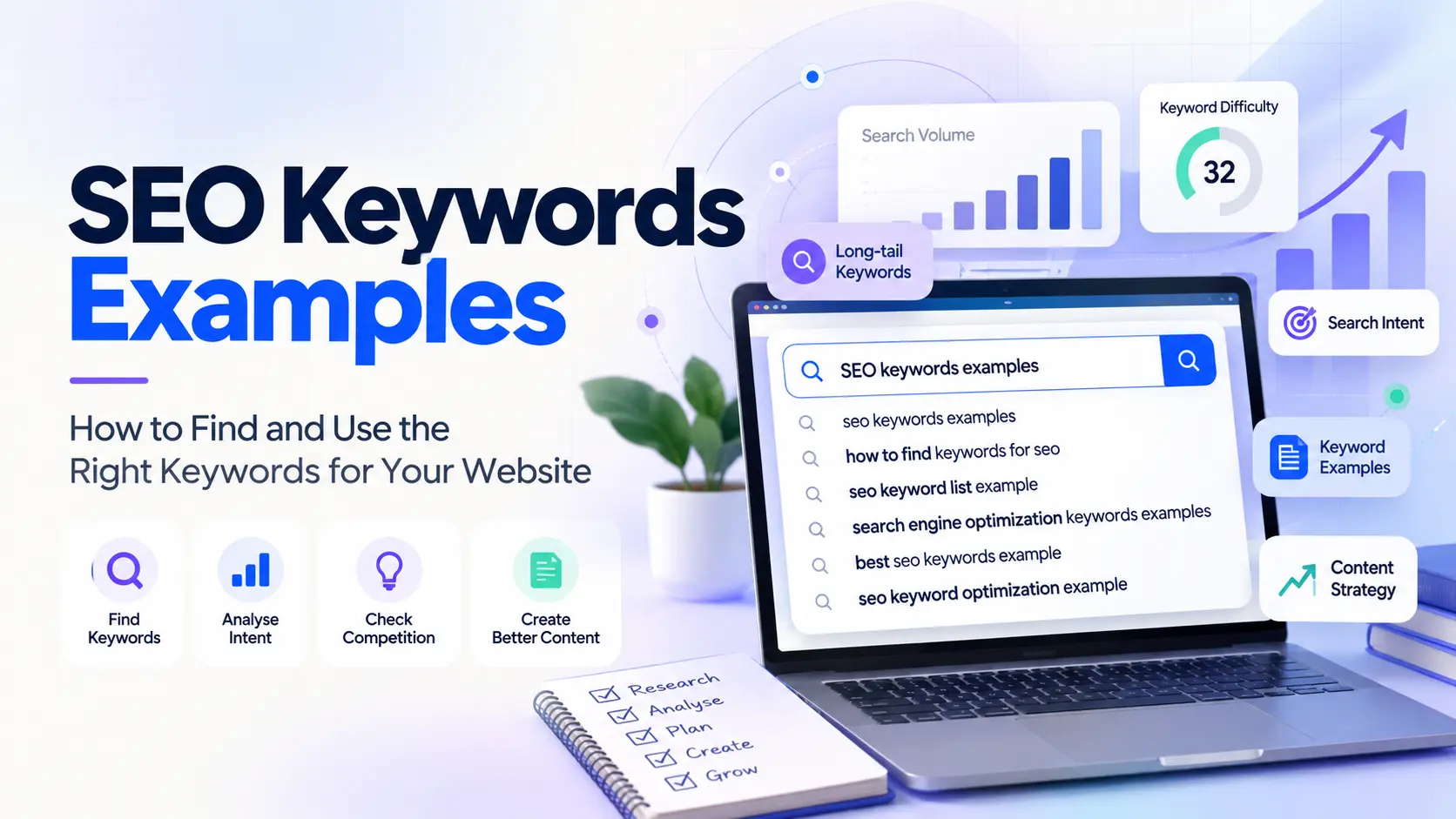
SEO keywords examples can help you understand what people type into Google, how they search for information, and which phrases may be worth targeting on your website. But choosing keywords is not just about finding popular search terms. You also need to understand what the searcher wants and whether your page can answer that need better than competing pages.
In this guide, you will learn how to find SEO keywords, understand search intent, build a keyword list, and use keywords naturally in blog posts and business pages. You will also see practical examples you can adapt to your own website.
Quick answer: The right SEO keyword matches your topic, your audience’s search intent, and the purpose of your page. Start with a broad topic, find specific search phrases, check the competing results, and choose one primary keyword with closely related secondary keywords.
What Are SEO Keywords?
SEO keywords are words and phrases people use when searching for information, products, services, or solutions online. Website owners use keyword research to understand those searches and create pages that answer them.
For example, someone who searches for what is SEO probably wants an explanation. Someone searching for SEO consultant for small businesses may be comparing service providers. These searches relate to the same subject, but the people behind them may need different pages.
Keywords can help you plan blog topics, improve existing website content, organise service pages, and understand the questions your audience asks. They should guide your content rather than dictate every sentence.
Google’s SEO Starter Guide explains how clear, useful content and descriptive page structure help people and search engines understand a website.
SEO Keywords Examples: A Quick Overview
Here are examples of SEO keywords for different goals. The best choice depends on the page you are creating and what you want the visitor to do.
| Keyword type | SEO keyword example | Likely search intent | Suitable content |
|---|---|---|---|
| Informational | What is SEO? | Learn a concept | Beginner’s guide |
| How-to | How to find keywords for SEO | Follow a process | Step-by-step tutorial |
| Commercial investigation | Best SEO tools for small businesses | Compare options | Comparison article |
| Transactional | Hire an SEO consultant | Find or buy a service | Service or contact page |
| Local | SEO consultant in Delhi | Find a nearby provider | Relevant local service page |
| Long-tail | How to find low-competition keywords for a new blog | Solve a specific problem | Detailed tutorial |
| Branded | Lee Growth SEO services | Find a particular brand | Brand or service page |
These are examples, not verified search-volume estimates. Use a keyword research tool and inspect the current search results before deciding which phrases to target.
Types of SEO Keywords With Examples
1. Short-tail keywords
Short-tail keywords are broad phrases, often consisting of one or two words. Examples include SEO, digital marketing, and keyword research.
They can cover large topics, but their intent may be unclear and competition can be strong. A new website may find it easier to start with a more specific phrase that better matches a reader’s needs.
2. Long-tail keywords
Long-tail keywords are more specific search phrases. Examples include how to do keyword research for a new website and SEO content strategy for a small business.
They often reveal more about what someone needs. However, a longer phrase is not automatically easy to rank for or valuable. Check its relevance, search results, and potential value to your audience.
3. Informational keywords
Informational keywords show that someone wants to learn or solve a problem. Examples include:
- What are SEO keywords?
- How does keyword research work?
- How to optimise a blog post for SEO
- What is search intent in SEO?
These searches often suit tutorials, explainers, definitions, and guides.
4. Commercial investigation keywords
These keywords suggest that someone is comparing products, tools, or providers before making a decision.
- Best keyword research tools
- SEMrush vs Ahrefs for keyword research
- Best SEO tools for small businesses
- SEO agency vs independent SEO consultant
Comparison articles can work well for these searches when they provide honest differences, practical examples, and clear criteria instead of simply declaring one option the winner.
5. Transactional keywords
Transactional keywords suggest that a person is ready to take action. Examples include book an SEO audit, hire an SEO consultant, and SEO content writing services.
These terms may be more suitable for service pages than educational blog posts. A business should create the page that matches the visitor’s goal instead of trying to make every keyword fit a blog article.
6. Local SEO keywords
Local SEO keywords include a city, neighbourhood, or other location, such as SEO consultant in Delhi or digital marketing consultant in Delhi NCR.
Local phrases can help you understand location-based demand, but only use locations you genuinely serve. For more detail, read the Lee Growth guide to near me SEO and local search.
7. Branded and non-branded keywords
Branded keywords include a company, product, or person’s name. For example, Lee Growth is branded, while SEO consultant for small businesses is non-branded.
Branded searches help people find a specific business. Non-branded searches can introduce your website to people who have not heard of you yet. A useful content plan considers both.
How to Find Keywords for SEO: A Step-by-Step Process
Step 1: Start with your audience and topic
Before opening a keyword tool, write down the questions your audience might ask. Think about their problems, goals, knowledge level, and the language they use.
If you run a small business website, your starting topics might include:
- SEO basics
- Keyword research
- Website content optimisation
- Local SEO
- SEO reporting and measurement
These are seed topics. They help you discover more specific phrases, but they are not yet your final keyword targets.
Step 2: Expand your seed keywords
Enter your seed topics into a keyword research tool. Options include Semrush Keyword Overview, Google Keyword Planner, and Google Trends.
Depending on the tool, you may find related terms, estimated search volume, keyword difficulty, trends, and other useful metrics. Some features or data may require an account or paid plan.
For a seed keyword such as keyword research, related ideas could include:
- How to do keyword research
- SEO keyword research for beginners
- SEO keywords examples
- How to find long-tail keywords
- How to choose keywords for a blog post
Use these as research ideas, then confirm their relevance and actual search results before adding them to your final keyword list.
Step 3: Check Google autocomplete and related questions
Search your topic on Google and note the autocomplete suggestions. Review the People Also Ask questions and related searches when they appear.
For example, research around SEO keywords may surface questions such as:
- How can I find the right keywords for my SEO strategy?
- Can you give me examples of keywords used in SEO?
- How do you find keywords for SEO?
- What are good SEO keywords?
These questions can reveal useful subtopics for your article. They are research clues, not proof of a specific search volume, and you do not need to include every question in one post.
Step 4: Understand search intent
Search intent is the reason behind a search. Before choosing a keyword, look at the pages Google currently shows for it.
| Search phrase | Likely intent | Page to consider |
|---|---|---|
| SEO keywords meaning | Understand a term | Definition or beginner’s guide |
| SEO keywords examples | See examples and learn how to use them | Examples-led guide |
| Best keyword research tool | Compare tools | Comparison article |
| SEO consultant in Delhi | Find a provider | Relevant local service page |
If the results for a keyword mostly contain product pages, a general educational blog post may not be the best match. If the results contain tutorials and guides, an informative article may be more appropriate.
Step 5: Review keyword difficulty and competition
Keyword difficulty is an estimate provided by a tool. Different tools calculate it differently, so do not treat the score as a universal measure or a guarantee of ranking difficulty.
Review the current search results as well. Consider whether the competing pages answer the query clearly, whether they come from established websites, and whether you can offer a more useful or specific resource.
A low difficulty score is not enough on its own. A keyword should also be relevant to your website and useful to the people you want to reach.
Step 6: Check volume, relevance, and business value
Search volume estimates can help you compare keyword opportunities, but they are not exact predictions of traffic. A lower-volume keyword may be more valuable if it attracts the right audience.
Evaluate each keyword using these questions:
- Does it relate directly to my website or business?
- Can I create a page that fully answers the search?
- Does the search intent match the page I plan to publish?
- Is the competition realistic for my website?
- Would the right visitor benefit from finding this page?
Step 7: Group similar keywords into topics
Do not create a separate article for every small keyword variation. Group phrases that share the same intent and can be answered well by one page.
For example, SEO keywords examples, SEO keyword list example, and examples of keywords for SEO may be closely related. Check the search results before deciding whether one page can serve all three.
For broader guidance on how content supports visibility in traditional search and AI-driven discovery, see Lee Growth’s guide to AI search engine optimization.
SEO Keyword List Example
Here is a sample keyword list for a website that publishes beginner-friendly SEO guides. It is a planning example, not a report of verified keyword metrics.
| Topic cluster | Primary keyword idea | Related keyword ideas | Possible page |
|---|---|---|---|
| Keyword research | SEO keywords examples | SEO keyword list example; SEO keyword optimization example | Examples-led guide |
| Keyword research | How to find keywords for SEO | Keyword research for beginners; long-tail keywords | Step-by-step tutorial |
| On-page SEO | How to optimise a blog post for SEO | SEO title; meta description; heading structure | Practical checklist |
| Local SEO | Local SEO for small businesses | Local search visibility; Google Business Profile | Local SEO guide |
| AI search | AI search engine optimization | AI search visibility; content for AI search | AI search guide |
When building your own spreadsheet, add columns for search intent, location or database, volume, difficulty, current ranking URL, priority, and content status. Record the date and tool used so that you know where the figures came from.
How to Choose the Right Keyword for a Blog Post
Choosing a primary keyword should be a decision, not a guess. Use this simple process before writing.
- Define the page’s purpose. Decide what the reader should understand or be able to do after reading.
- Choose a relevant primary keyword. Select a phrase that describes the main subject and matches the search intent.
- Add closely related secondary keywords. Include variations and supporting questions where they fit naturally.
- Review competing pages. Check what currently ranks and identify what your article can explain better.
- Check your existing website. Make sure another page is not already targeting the same intent without a clear reason.
- Build a useful outline. Arrange sections in the order readers need them, not just in the order keywords appear in a tool.
Practical rule: Choose one clear primary topic for each page. Use secondary phrases to cover related questions, not as a list of terms that must be repeated a fixed number of times.
SEO Keyword Optimization Example
Imagine you are writing a guide about finding keywords for a new website. Your target phrase is how to find keywords for SEO.
| Page element | Example |
|---|---|
| WordPress H1 | How to Find Keywords for SEO: A Beginner’s Guide |
| SEO title | How to Find Keywords for SEO: Beginner’s Guide |
| URL slug | /how-to-find-keywords-for-seo/ |
| Opening paragraph | Explain how keyword research helps you find the searches relevant to your audience. |
| H2 sections | Finding seed keywords; checking search intent; assessing competition; building a keyword list |
| Internal link | Link to a related keyword examples guide using descriptive anchor text. |
| External reference | Link to Google’s SEO documentation when explaining a relevant search guideline. |
This example demonstrates placement and structure. It does not mean that every page needs the exact keyword in every element. Keep titles accurate, headings helpful, and paragraphs natural.
Where Should You Use SEO Keywords?
Page title and main heading
Use a clear page title and a descriptive H1 that reflect the main subject. They can be similar, but they serve different purposes: the title helps describe the page in search results, while the H1 identifies the main heading readers see on the page.
Opening paragraph
Introduce the topic early so readers can quickly tell that they are in the right place. Use the primary keyword if it fits naturally, but do not force it into an awkward sentence.
Subheadings and body content
Use H2s for the main sections and H3s for supporting sections. Add related terms when they accurately describe what the section covers. Do not create headings purely to repeat keyword variations.
URL slug
Keep the URL concise and descriptive. Use words that help readers understand the page, and avoid unnecessary parameters or repeated phrases.
Images and alt text
Write alt text that describes the image’s purpose or meaningful content. Do not turn alt text into a list of keywords. If an image is decorative, an empty alt attribute may be appropriate.
Internal links
Link to related pages when they offer a useful next step. For example, an article about local keywords could point readers to the Lee Growth guide to near me SEO. A post about SEO strategy could link to a relevant service page or a deeper guide on the same subject.
Use descriptive anchor text so readers understand what they will find after clicking. Avoid repeating the same exact-match anchor unnaturally across every section.
Meta description
Write a clear summary that explains what the page offers. Google may generate a different search snippet, so a meta description is not a guarantee that the exact text will appear in search results.
How to Build Better Internal Links
Internal links connect pages on the same website. They help readers discover related information and help search engines find and understand your pages.
For this article, useful internal links should connect the keyword research topic with relevant Lee Growth resources, rather than linking to every service page without a clear reason.
- For local keyword examples: Link to Near Me SEO: How Google Decides Who Shows Up.
- For AI search and content visibility: Link to AI Search Engine Optimization Services.
- For readers exploring professional support: Link to Digital Marketing Consultant in Delhi, where it makes sense in the article.
- For the brand: Use Lee Growth when readers need to learn more about the website or its work.
Place internal links in the paragraph where the destination becomes useful. Avoid adding several links to the same page close together, using vague anchors such as “click here,” or linking every mention of a keyword.
Before publishing: Check that the destination page is live, relevant to the sentence, and accessible to readers. Add a link from at least one relevant existing page to this new article after it is published. This helps the article fit into your website’s content structure instead of becoming an isolated page.
Which External Websites Should You Link To?
External links point to pages on other websites. Use them when they support a factual statement, provide an official explanation, or let readers explore a tool mentioned in your guide.
- Google Search Central’s SEO Starter Guide — for foundational SEO guidance.
- Google’s link best practices — for crawlable links and descriptive anchor text.
- Google Search Console — to monitor search performance and inspect queries that bring people to your website.
- Google Keyword Planner — for keyword research and planning in Google Ads.
- Google Trends — to explore how interest in search topics changes over time.
Only link to sources that support the specific point being made. Do not add external links just to increase the number of links on a page. Check that the destination still works before publishing and revisit important links during content updates.
Common SEO Keyword Mistakes to Avoid
1. Choosing a keyword only because its volume is high
A popular phrase is not automatically the best target. If it does not match your business, audience, or page purpose, it may bring visitors who are unlikely to find your content useful.
2. Repeating the exact keyword too often
There is no universal keyword density that guarantees better rankings. Repeating the same phrase unnaturally can make writing harder to read. Use related wording and answer the reader’s questions clearly.
3. Ignoring search intent
A keyword may look relevant in a spreadsheet but produce search results that do not match the page you want to create. Review the results before deciding on the format and purpose of your content.
4. Creating multiple pages for the same intent
If several pages target almost the same query and offer similar answers, they may compete for the same audience. Review existing pages before publishing another article. Consolidate overlapping content when that would give readers a clearer, more complete resource.
5. Using irrelevant internal links
Internal linking is not about inserting links wherever a keyword appears. A link should help a reader move naturally to a related resource. Relevance and context matter more than hitting a link-count target.
6. Treating tool metrics as facts
Keyword volume and difficulty are estimates. Use them alongside current search results, your own Search Console data, and your understanding of the audience. Recheck important opportunities when the market or search results change.
How SEO Keywords Support Helpful Content and AI Search
Keyword research helps you understand the language people use, but the final article should answer their questions rather than simply mirror a spreadsheet. Explain important concepts clearly, support factual claims with reliable sources, and structure the page so readers can find answers quickly.
For AI-driven search experiences, clear definitions, meaningful headings, useful examples, and trustworthy references can make information easier to interpret. However, no keyword placement, schema markup, or writing formula guarantees that a page will be cited by an AI system.
Traditional SEO and AI search optimisation both benefit from a strong foundation: relevant content, accessible pages, descriptive links, and a clear explanation of what your website offers. For a deeper look, read the Lee Growth guide to AI search engine optimization.
SEO Keyword Research Checklist
- Define the audience and purpose of the page.
- Collect seed keywords and related search phrases.
- Review autocomplete suggestions and relevant search questions.
- Check search intent by examining the current results.
- Compare volume and difficulty estimates without treating them as guarantees.
- Choose one clear primary keyword and relevant secondary topics.
- Review existing pages to avoid unnecessary overlap.
- Use a logical H2 and H3 hierarchy beneath the page’s H1.
- Add relevant internal links with descriptive anchor text.
- Cite authoritative external sources where they support the content.
- Write useful title text, a concise URL, and an accurate meta description.
- Check links, mobile usability, indexability, and the published page.
- Monitor performance in Google Search Console and update the article when needed.
Frequently Asked Questions About SEO Keywords
How can I find the right keywords for my SEO strategy?
Start with your audience’s needs and the topics your website can genuinely cover. Expand seed terms using keyword research tools, review Google suggestions, analyse search intent, compare competition, and choose phrases that match your goals. Revisit the results after publishing to see which queries bring relevant visitors.
Can you give me some examples of keywords used in SEO?
Examples include what is SEO, how to find keywords for SEO, best keyword research tools, SEO consultant in Delhi, and SEO content writing services. They represent different intents, so they may need different types of pages.
What are some good SEO keywords?
Good SEO keywords are relevant to your audience, match the page’s purpose, and give you a realistic opportunity to provide a useful answer. Search volume can help with prioritisation, but relevance and intent should come first.
How many keywords should a blog post target?
Start with one primary topic and a group of closely related secondary terms and questions. There is no fixed number that works for every article. Cover the subject fully without forcing every variation into the text.
What is the difference between a keyword and a search query?
A search query is the phrase a person enters into a search engine. A keyword is the term a content creator or marketer uses to research, plan, or evaluate content around that search behaviour. The terms are often used interchangeably in everyday SEO discussions.
What is the 80/20 rule in SEO?
The 80/20 rule is a general prioritisation idea: a relatively small share of your pages or activities may contribute a large share of results. It is not a guaranteed SEO formula or a fixed Google rule. Use your own performance data to identify which pages and improvements deserve attention first.
Should I use the same keyword on every page?
No. Give each important page a distinct purpose and primary topic. Related pages can naturally share some terms, but avoid creating unnecessary duplicates or making every page target the same search intent.
Does a higher search volume mean a keyword is better?
Not necessarily. A high-volume phrase may be broad or highly competitive, while a more specific phrase may attract a better-matched visitor. Consider intent, relevance, competition, and the value of the audience alongside volume estimates.
Final Thoughts
Finding SEO keywords is about understanding what people need and creating a page that meets that need. Use keyword tools to discover opportunities, search results to understand intent, and a clear content structure to organise your answer.
Choose relevant primary and secondary keywords, connect your article to useful pages on your website, and cite reliable external sources where they add value. Then monitor how the page performs and improve it based on real data—not keyword repetition or assumptions.
For more practical guidance on improving your website’s search visibility, explore the resources on Lee Growth.

I’m Leena Kalyana, a Delhi-based freelance digital marketer and graphic designer. I work across SEO, content marketing, social media, and digital design. I’m interested in helping businesses build a stronger online presence through practical SEO strategies, useful content, and creative digital marketing.