


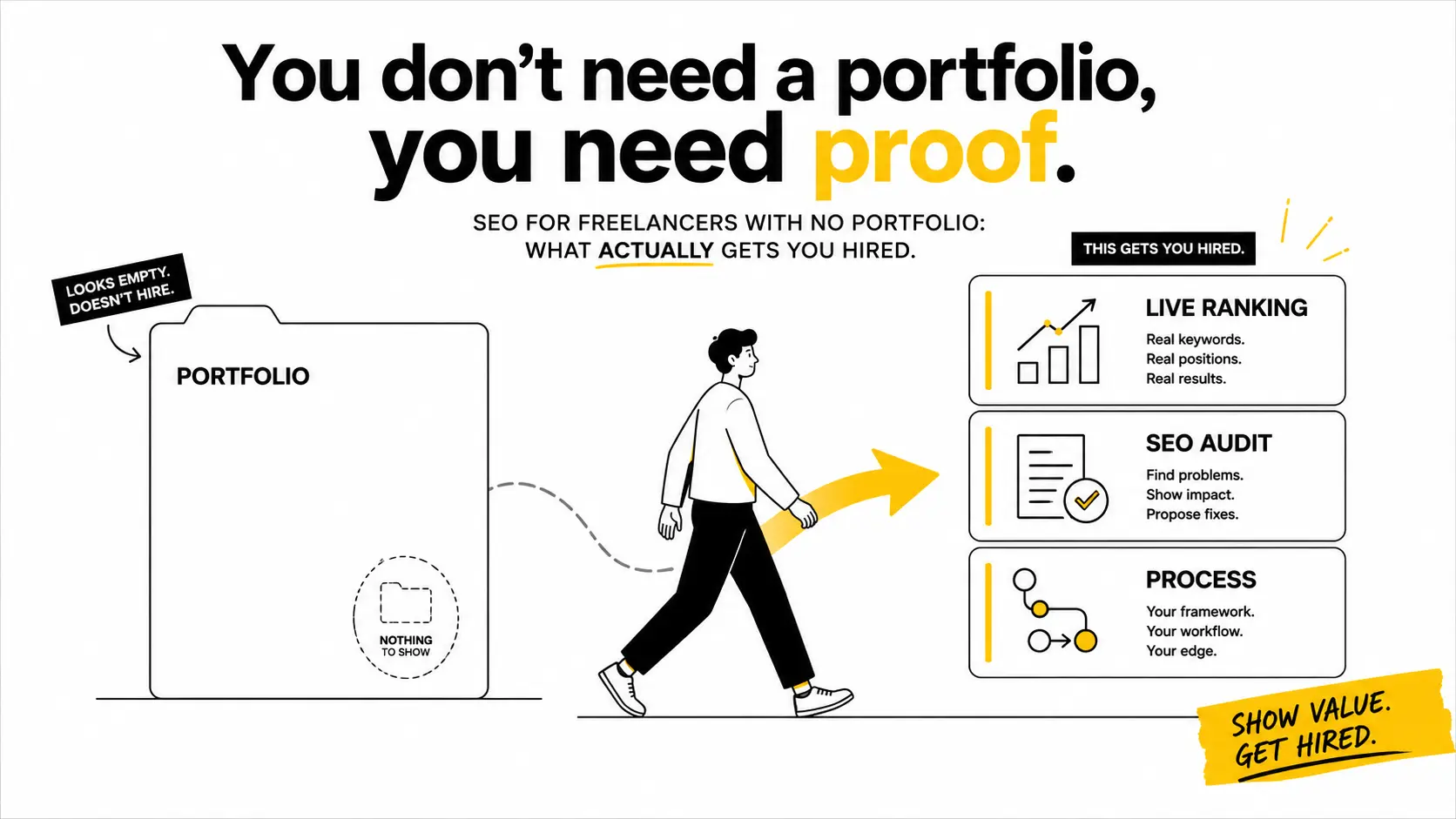
You’ve read the standard advice already. Do free work for friends. Build a mock portfolio. Network on LinkedIn. None of it tells you what to actually put in front of a stranger who has never heard of you and is deciding, in about 90 seconds, whether to trust you with their business’s traffic.
Below is what actually works, why it works, and where each method falls short.
Table of Contents
Why the Portfolio Problem Isn’t the Real Problem
SEO isn’t a portfolio driven service the way design or copywriting is. A designer shows a finished logo and the value is obvious immediately. SEO results take weeks or months to show up, and they depend on things you don’t control: the client’s existing domain authority, how competitive their industry is, whether they’ll actually implement what you tell them.
Serious clients know this, which is part of why they rarely hire based on a portfolio alone. They’re trying to figure out whether you can diagnose their specific problem accurately, in front of them, before they’ve paid you anything. That’s a different skill than showing old screenshots. You can demonstrate it on day one with zero client history.
Portfolios aren’t worthless. They’re just not the actual bottleneck. The bottleneck is proving you can think clearly about a real site, not proving you’ve billed someone before.
Rank Something Real
Skip the mock audits. A fictional site you “optimized” for practice shows you can write recommendations. It proves nothing about whether those recommendations work, and clients who’ve been burned by bad freelancers before tend to sense that.
What actually demonstrates the skill is ranking a real, live, indexable asset:
- Pick a genuinely low competition long-tail keyword: under 100 monthly searches, weak top-10 results (thin content, outdated pages, stray forum threads). You don’t need a paid keyword tool to find these. Google’s “People Also Ask” box and autocomplete will get you most of the way there.
- Publish it somewhere with existing authority: a Medium article, a well-answered Quora response, a YouTube video description, a Reddit post in a relevant subreddit (check the subreddit’s self-promotion rules first, or you’ll get banned before it ranks).
- Optimize it properly. Keyword in the title, in the first hundred words, in one subheading. Write something actually useful, not keyword-stuffed filler.
- Track it weekly in Google Search Console, which is free.
One thing worth being honest about: this proves you understand on-page optimization and keyword targeting. It doesn’t prove you can do technical SEO, things like site speed or crawlability or indexation issues, and it doesn’t prove you understand link building at any real scale. Say that plainly to clients. Overclaiming what one ranked post proves is the kind of exaggeration that costs you trust the moment they catch it.
If you want something more substantial than a single ranked post, build a small site instead. Three pages is enough: a homepage, a service or product page, and one supporting article. Pick a low-competition local niche (a made-up but realistic local business angle works fine), optimize it properly, and document what happens over a few months, indexing time, keyword movement, any traffic that shows up in Search Console. This takes longer than ranking a Medium post, but it gives you something a single article can’t: proof you can plan a site’s structure, not just optimize one page of it. Screenshot the timeline as you go so you have a real record, not a reconstructed one.
Show the Work, Not Just the Result
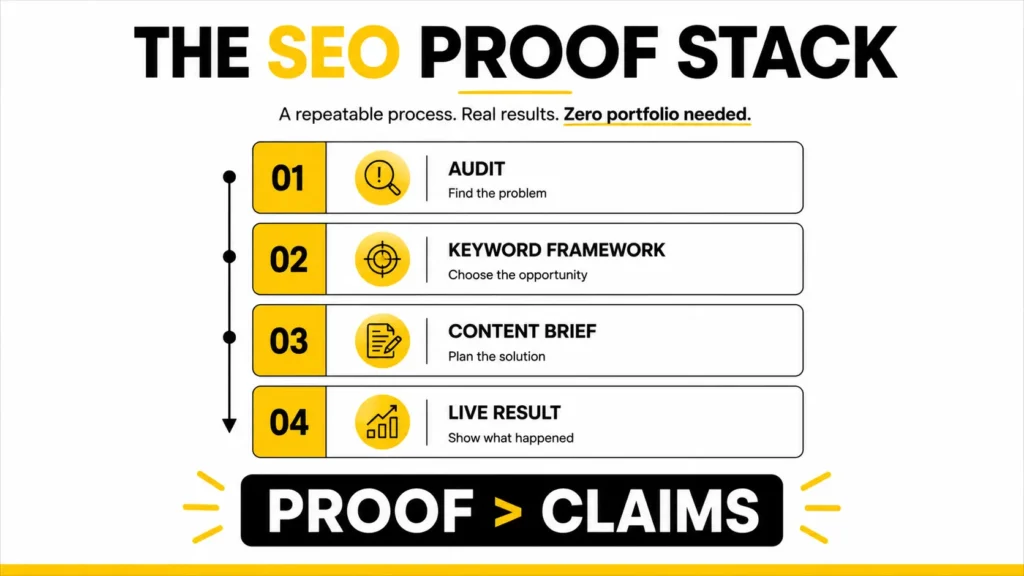
A results-only pitch (“I can get you more traffic”) is easy to be skeptical of when it’s coming from a stranger. A process-based pitch is harder to wave off, because it shows you actually know the mechanics.
Build these before you pitch anyone:
A technical audit checklist. The specific things you check, in order: indexation status, mobile usability, page speed (PageSpeed Insights is free), broken internal links, missing or duplicate title tags, XML sitemap validity, schema markup. Not a vague “I check technical SEO.” The actual list.
A keyword research framework. How you’d approach a new client: where you start with seed terms, how you filter for intent and competition, how you decide what’s a quick win versus a long-term target.
A content brief template. Target keyword, search intent, a word count grounded in what’s actually ranking, heading structure, internal linking targets.
Send these before the client asks for a portfolio. It shifts the conversation from “prove you’ve done this before” to “here’s exactly how I’d approach your site,” which is the question they actually care about.
There’s a second, quieter advantage to having these documents ready: they force you to explain SEO without jargon. Most small business owners don’t know what “crawlability” or “keyword cannibalization” means, and don’t especially want a vocabulary lesson. If your audit checklist reads like “we check whether Google can find and read every page correctly” instead of “we assess crawlability and indexation,” you come across as someone who understands the business impact, not just the technical term. That distinction matters more to a first-time client than most freelancers assume.
Niche Down Instead of Selling Yourself as a Generalist
A client with no reason to trust you yet is unlikely to hand over an open-ended, ongoing SEO retainer. A generalist pitch (“I do SEO”) also puts you in competition with every other beginner offering the same vague thing.
A narrow, well-defined service is easier to sell without a portfolio, because the client can evaluate it on its own terms rather than trusting your judgment across an entire strategy. A few examples of what this looks like in practice:
- Google Business Profile setup and optimization for local service businesses (dentists, salons, contractors)
- Core Web Vitals and page speed fixes for Shopify or WooCommerce stores
- Schema markup implementation for local businesses that have none
- A single technical audit with a prioritized fix list, delivered as a one-time project rather than a retainer
Each of these has a clear scope, a clear deliverable, and a price a small business owner can say yes to without much deliberation. Once you’ve delivered two or three of these, you have something a portfolio never gave you in the first place: an actual track record, in your own niche, that you can point to honestly.
The Video Audit
Cold emails from beginners get ignored because there’s no way to verify anything in them. A short video audit gets around that, because it’s proof rather than a claim.
Target businesses with a visible, specific, fixable issue. Not “your SEO could be better” but “your homepage title tag doesn’t include [service] plus [city], which is likely costing you local visibility.” Keep the video to three or five minutes; anything longer starts to feel like a sales pitch instead of a favor. Screen record yourself pointing at the actual problem using free tools or manual SERP checks, and end with a specific ask, a 15-minute call, rather than “let me know if you’re interested,” which people ignore.
This fails when you send generic audits at volume, use a script that doesn’t reflect the specific business, or target businesses whose owners never check the inbox a cold video would land in. Five well-targeted videos will beat fifty generic ones every time.
Getting In Through Someone Else’s Client Base
Subcontracting for agencies is the least exciting option here, but it’s often the fastest route to real experience. Agencies frequently have overflow work, audits, on-page fixes, reporting, that a senior freelancer doesn’t have time for.
Be clear-eyed about the tradeoff. Subcontract rates are usually lower than what you’d charge directly, and you won’t own the client relationship. What you get instead is real project experience, and if you negotiate it up front, permission to reference anonymized outcomes later (“improved organic traffic for a client in [industry] by X% over four months”).
To find this work, reach out to small agencies directly rather than large ones. Mention a specific gap you noticed in their own site’s SEO as your opener. Be explicit that you’re looking for overflow or subcontract work, not responding to a job listing.
If You’re Pitching From India (or Any Remote Market)
Beginner freelancers based in India, and pitching to clients abroad, run into a few practical questions that generic freelancing guides never address.
Pricing and invoicing. Decide upfront whether you’re quoting in USD or INR. Most US and UK clients expect USD pricing, and quoting in dollars signals you’re used to working internationally rather than newly starting out. If your freelance income crosses the GST registration threshold, register and factor that into your pricing rather than discovering it later. A basic invoice with your PAN, payment terms, and scope of work looks more professional than an ad hoc message with a number in it.
Timezone overlap as a selling point, not a limitation. Framing your location as a downside (“I’m based in India, so there’s a time difference”) undercuts you before you’ve started. Flip it: for US clients, working during their evening or overnight means their site changes get made while they sleep and are ready by their morning. That’s a genuine advantage worth stating directly in a pitch.
Where to actually find this work. Beyond Upwork and Fiverr, LinkedIn outreach using Boolean search strings (“hiring” AND “SEO” AND “remote”) surfaces roles and gigs that never make it to job boards. Niche Slack and Discord communities for marketers, and smaller US-based agencies looking for overseas subcontractors specifically because of the cost and timezone advantage, are both underused channels compared to the generalist platforms everyone else applies through.
Spotting the Gigs That Aren’t Worth Your Time
Not every “no portfolio needed” listing is a real opportunity. Beginners are the most common target for a specific set of low-quality or outright exploitative gigs, and it’s worth knowing what they look like before you spend hours on one.
- Unrealistic pricing for the stated scope. “$20 for 200 backlinks” or “full SEO audit for $10” is not a beginner-friendly entry point, it’s a sign the client (or platform listing) doesn’t understand or doesn’t care about the actual work involved.
- Unpaid “trial work” that’s really just production work. A single free audit to demonstrate skill is reasonable. Being asked to write five articles, build a content calendar, or execute a month of on-page changes “to see if it’s a good fit” is not a trial, it’s unpaid labor with a trial label on it.
- No clear scope or deliverable. If a client can’t describe what “done” looks like, expect scope creep from day one, regardless of how low the initial ask seems.
- Requests for guaranteed rankings or guaranteed traffic numbers. No legitimate SEO work can promise a specific ranking position or traffic figure. A client who insists on this either doesn’t understand SEO or is setting up a dispute over payment later.
None of this means every low-budget or first-time client is a red flag. It means the difference between an honest starting rate and an exploitative one is usually visible before you start, if you’re looking for it.
When a Client Asks to See Your Portfolio
This question trips people up because the honest answer feels like a weakness. It isn’t, if you handle it right.
If you’re genuinely new: “I don’t have a client portfolio yet, but here’s what I can do instead. I’ll run a live audit on your site right now and show you exactly what I’d fix first, so you can judge the work directly instead of taking my word for it.”
If you’ve done subcontract or NDA-bound work: “Most of what I’ve worked on is under NDA, so I can’t share client names, but I can walk you through the process I used and the kind of results it produced, with the numbers anonymized.”
Neither response apologizes for the gap. Both redirect immediately to something verifiable. Clients aren’t actually attached to the word “portfolio.” They’re trying to lower their risk. Give them a cheaper way to evaluate you, a live audit, a small trial task, and the portfolio question tends to stop mattering.
What Doesn’t Work
Worth saying directly, since most guides won’t.
Free work for friends and family builds confidence, not proof. Their sites are low stakes and don’t resemble a real client relationship with real deadlines and real payment.
Mass-applying on Upwork or Fiverr with a generic profile puts you in direct price competition with hundreds of other new profiles. Without a specific niche or a proof asset attached, volume alone rarely converts.
A polished personal website with no live proof signals design taste, not SEO skill, unless it’s actually ranking for something competitive and you can point at that.
Realistic Expectations
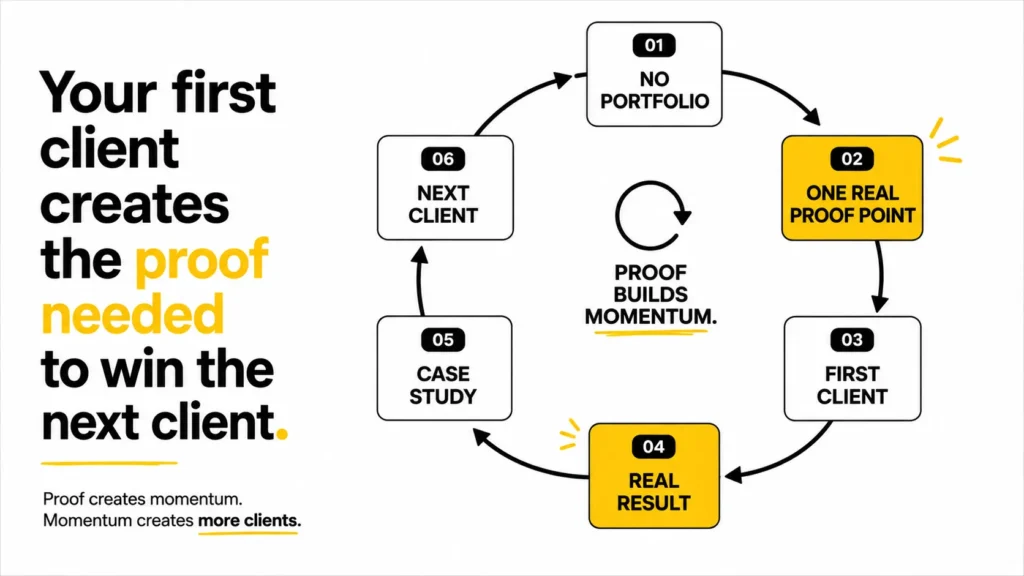
Landing a first paying client through these methods usually takes somewhere in the range of three to six weeks of consistent, targeted effort. It’s not that the tactics are slow. It’s that most beginners give up after one or two attempts that don’t land.
Expect your first project to be underpriced relative to the effort it takes. That’s normal, and temporary. The point of the first client isn’t the income. It’s a real, referenceable result you can point to when you’re pitching the second one.
Quick-Start Checklist
- [ ] Choose one long-tail keyword and publish a genuinely optimized post on Medium, Reddit, or YouTube
- [ ] Build your three process documents: audit checklist, keyword framework, content brief template
- [ ] Pick one narrow, productized service to lead with instead of pitching yourself as a generalist
- [ ] Identify five small businesses with a specific, visible SEO problem, not a vague one
- [ ] Record and send one precise, short video audit, not a generic template
- [ ] Prepare your response to the portfolio question before your first sales call
- [ ] Reach out to two small agencies about overflow or subcontract work
- [ ] Check every gig or listing against the red-flag list before you commit time to it
You don’t need a portfolio to start credibly. You need one real proof point, a clear process, and a willingness to show your thinking instead of just claiming you know what you’re doing.

I’m Leena Kalyana, a Delhi-based freelance digital marketer and graphic designer. I work across SEO, content marketing, social media, and digital design. I’m interested in helping businesses build a stronger online presence through practical SEO strategies, useful content, and creative digital marketing.